

Every agent I know has bought a list of trucking companies and watched it go nowhere. The list told them who existed. It never told them who was renewing, what the carrier was really running, or what problem it needed solved. That gap is why TruckVerifi exists.
The same failure shows up in every role, from brokers seeking capacity to insurance brokers and agents marketing for renewal or new policies to underwriters making the approval determination. The information existed. Nobody had it in one place when they made the decision.
That is the reason for TruckVerifi. It is a sales intelligence workspace built on federal motor carrier data for the people whose paychecks depend on knowing a carrier before they call it: insurance agents and brokers working trucking insurance leads, underwriters pricing a risk, freight brokers building capacity for a lane, and the vendors who sell safety, maintenance, compliance, and technology to fleets. It searches 2.27 million carrier records drawn from the federal census, and people who have done those jobs built it for people doing them now.
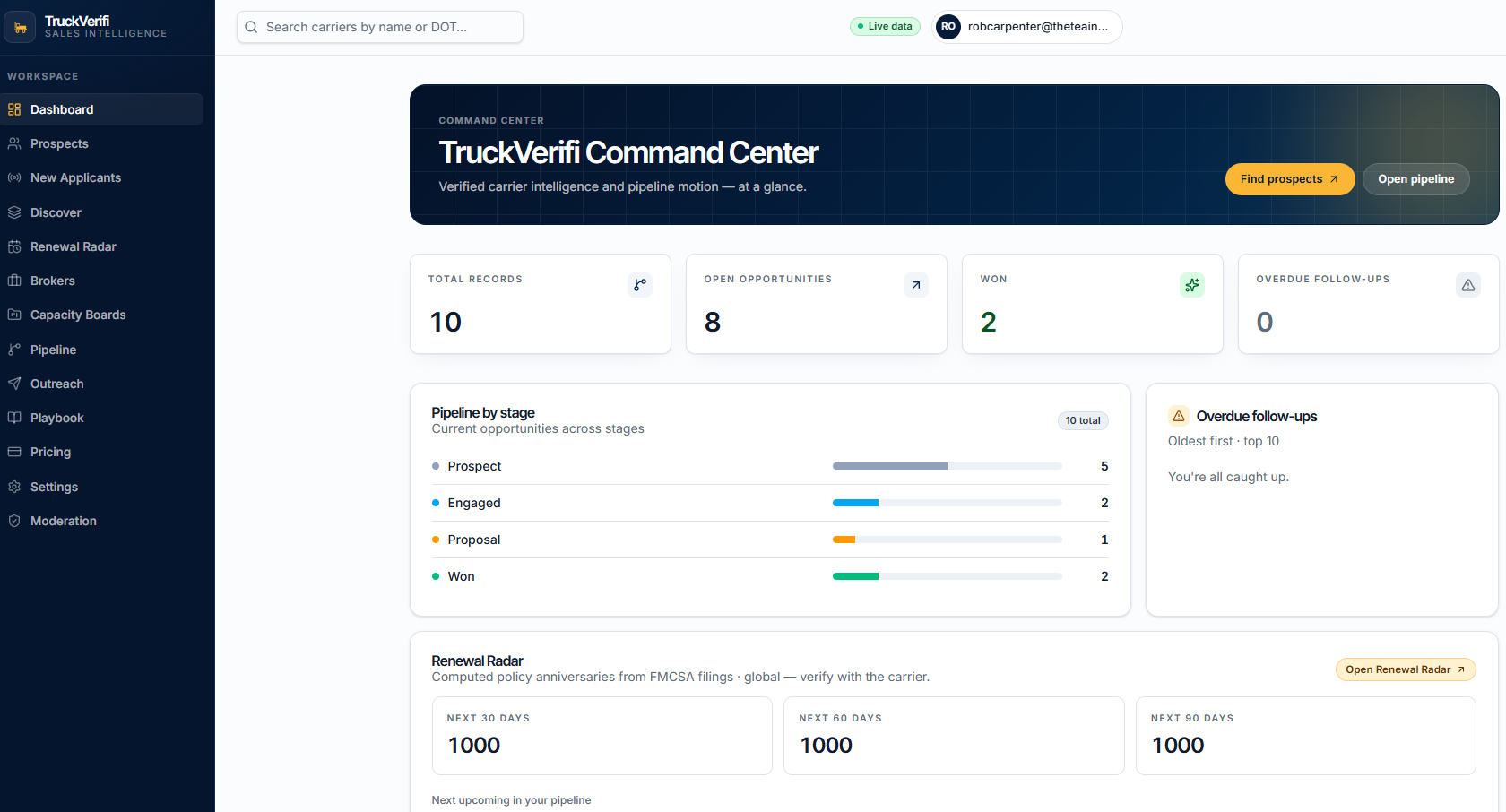
The TruckVerifi Command Center shows your pipeline by stage, overdue follow-ups, and the carriers coming up for renewal in the next 30, 60, and 90 days.
Federal rules guarantee the raw data exists. A for-hire carrier hauling general freight in a truck over 10,001 pounds has to carry at least $750,000 in public liability coverage, and $1 million for most hazardous materials, under 49 CFR 387.9. Every motor carrier has to update its MCS-150 registration every 24 months under 49 CFR 390.19. Insurance filings, roadside inspections, and crashes land in public federal datasets every day. The lists sold to agents don’t connect any of it. They don’t tell you the policy is about to turn over. They don’t tell you the fleet on paper doesn’t match the fleet on the road. They don’t tell you the officer on a brand-new authority ran a company that just got revoked.
Timing is where agents lose, so that is where TruckVerifi starts. Renewal Radar computes policy anniversaries from the effective dates on FMCSA insurance filings and sorts carriers into 30-, 60-, and 90-day windows. Each row carries the current insurer, the filed coverage, whether the carrier is on underwritten or non-underwritten paper, whether it has a prior lapse, and its vetting score. The page says it plainly, and so will I: these are computed anniversaries, not confirmed expiration dates, and you verify with the carrier before you quote. But the agent who calls 60 days out with the right insurer’s name in hand is having a different conversation than the one who calls the day after the policy renewed.
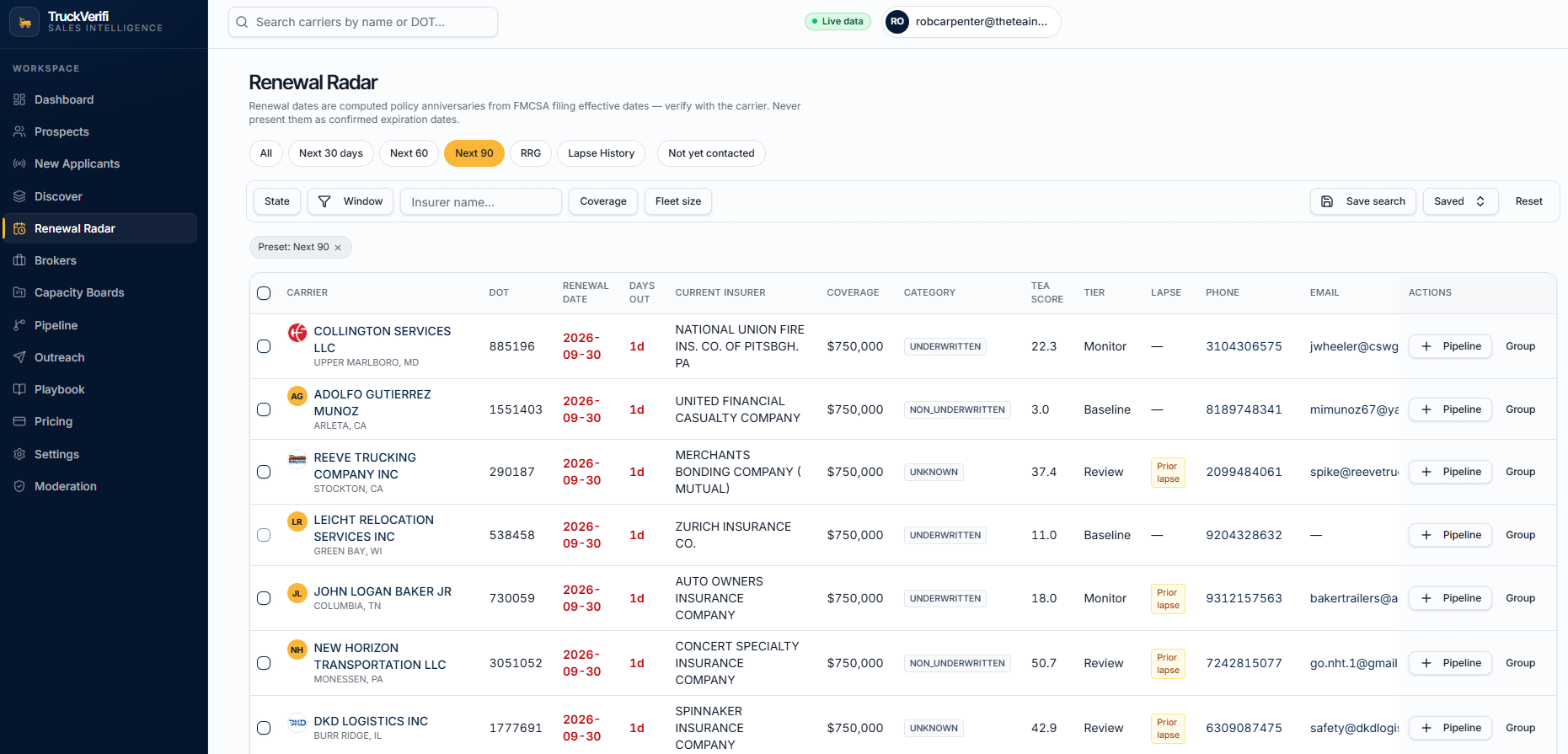
Renewal Radar sorts carriers by computed policy anniversary, with current insurer, filed coverage, prior lapses, and vetting score.
Some people want to work a list. Others want to look at one carrier at a time and decide. Discover is for the second group. It turns the same data into a deck of cards you swipe through. Each card carries the vetting score on a 0 to 100 scale, power units, fleet size, years of authority, crashes per power unit, vehicle and driver out-of-service rates, inspection count, and a line that tells you when the carrier shares officers or VINs with other entities. Flip the Renewal 90d switch and the deck lines up with Renewal Radar, so you are reviewing the carriers whose policies are about to turn over, with their inspection, crash, and fraud history in front of you. Save it, skip it, or drop it into a group. Discover runs the same way for brokers, shippers, and vendors.
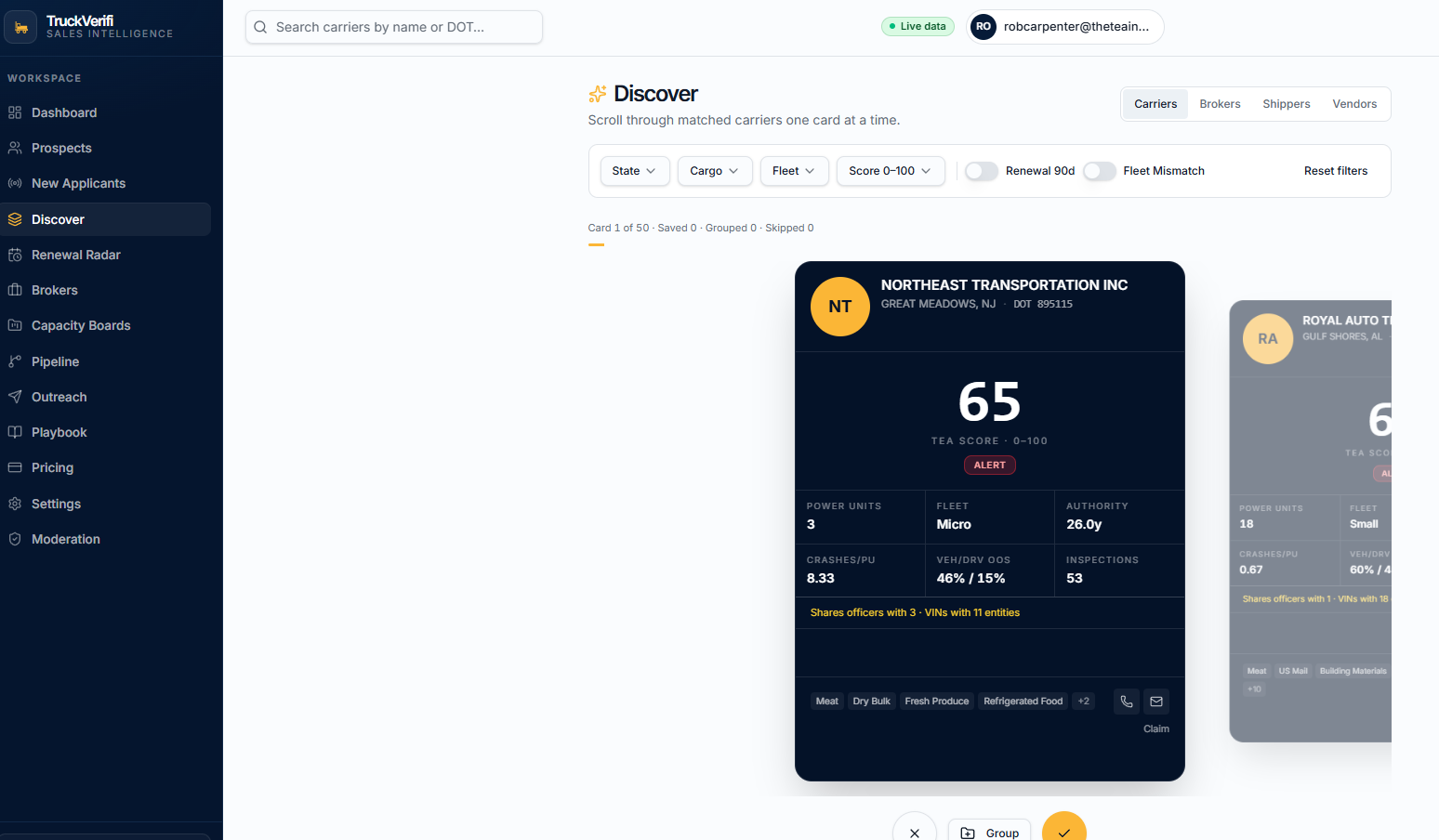
Discover shows one carrier per card: vetting score, fleet, authority age, crashes per power unit, out-of-service rates, and shared officers or VINs.
The column I want most, as a broker and as an expert witness, compares what a carrier claims with what the roadside sees. A carrier declares its power units on the MCS-150. Roadside inspectors record the VIN of every truck they inspect. When those two numbers disagree, somebody is wrong, and it matters who. TruckVerifi counts the distinct power-unit VINs cited in FMCSA inspection records and compares them to the declared power units. A one-truck carrier with 14 distinct power-unit VINs in its inspection history reads 14.0x. The Fleet Mismatch preset flagged 5,880 carriers on the morning I pulled these screens. Ordinary explanations include leased-on equipment, replaced trucks, or an MCS-150 nobody updated, and the tool doesn’t call anybody a fraud. It tells an underwriter that the exposure on the application may not be the exposure on the highway, and it tells a broker to ask one more question before tendering the load.
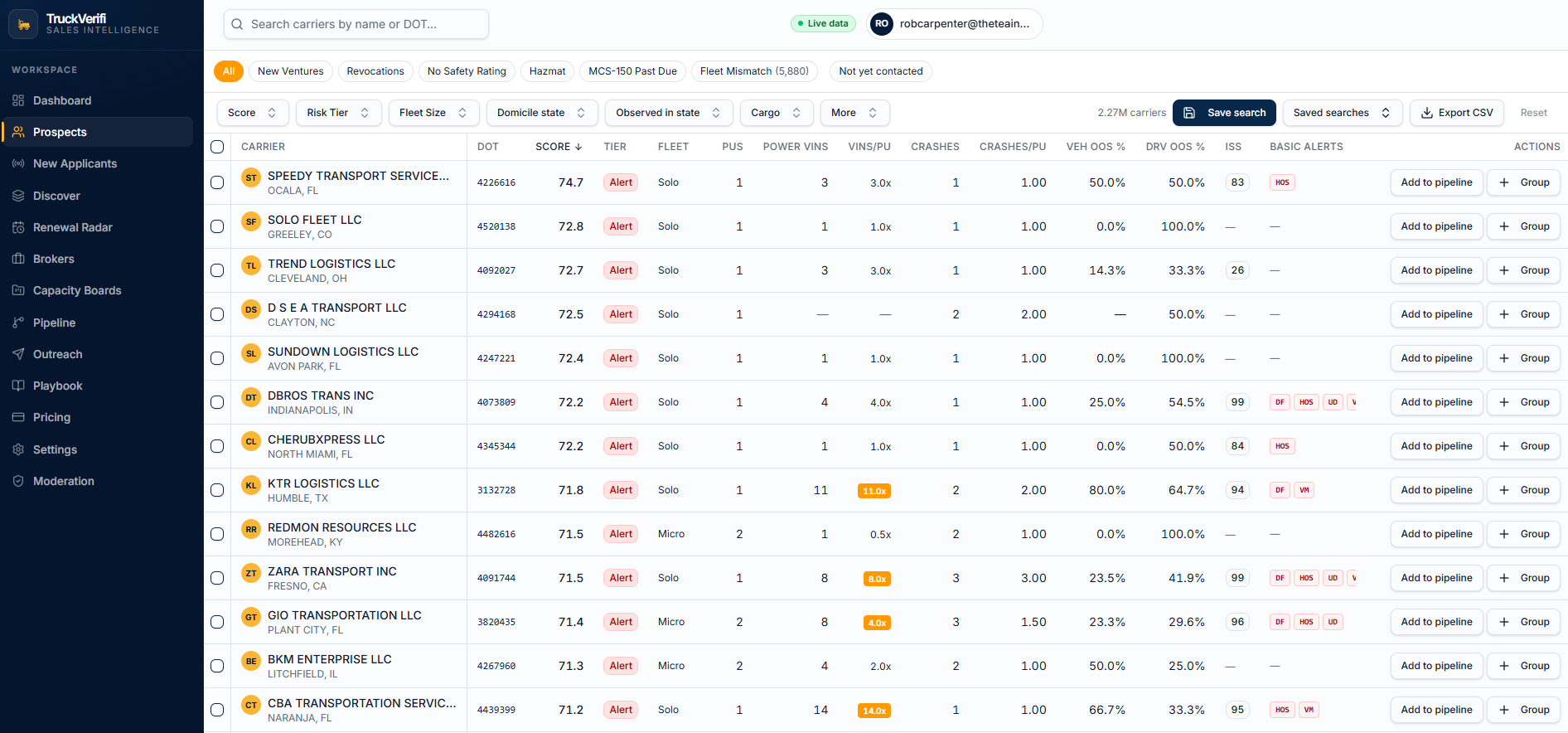
Prospects compares declared power units with distinct VINs seen at roadside, next to crashes, out-of-service rates, ISS and BASIC alerts.
New authority is where fraud is cheapest to start and where agents find their first-year accounts. FMCSA opened Motus, its new registration system, to motor carriers, brokers and freight forwarders in late May 2026. The New Applicants feed in TruckVerifi watches every registration, authority action, insurance filing, cancellation notice, revocation, and census change as FMCSA publishes it, rebuilds every 15 minutes, and scores each event against identity and network signals. On the morning of Sept. 29, it counted 70,959 carriers registered through Motus, 2,220 of them in the prior seven days, and 20,875 applications pending. When an officer on a new filing is tied to a revoked authority, or a possible successor company shows up under the same officer, that signal sits next to the insurance event that triggered the row. An agent sees a new account. An underwriter sees a reason to look twice.
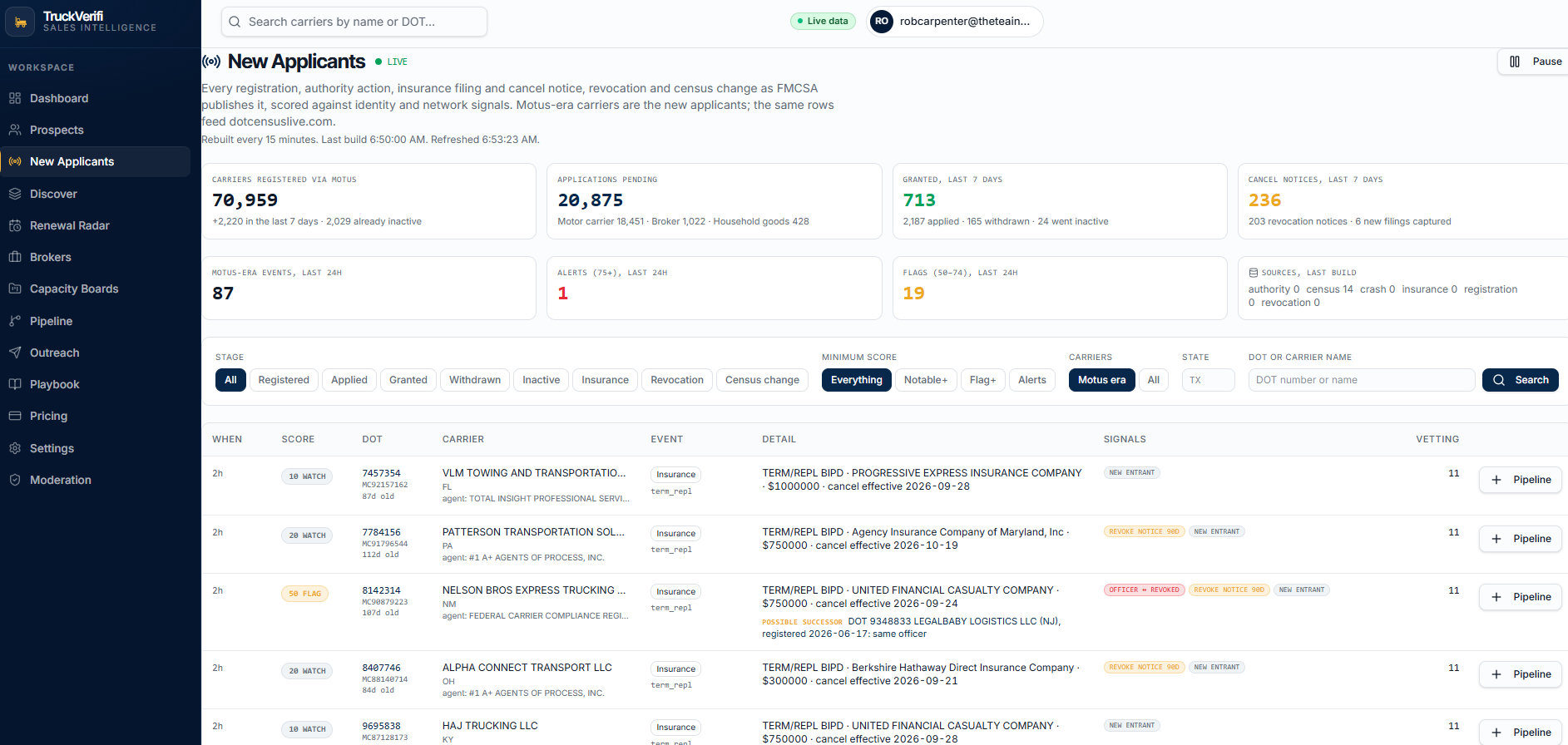
New Applicants follows Motus-era registrations, insurance filings, cancellations, and revocations as FMCSA publishes them, with identity and network signals on each row.
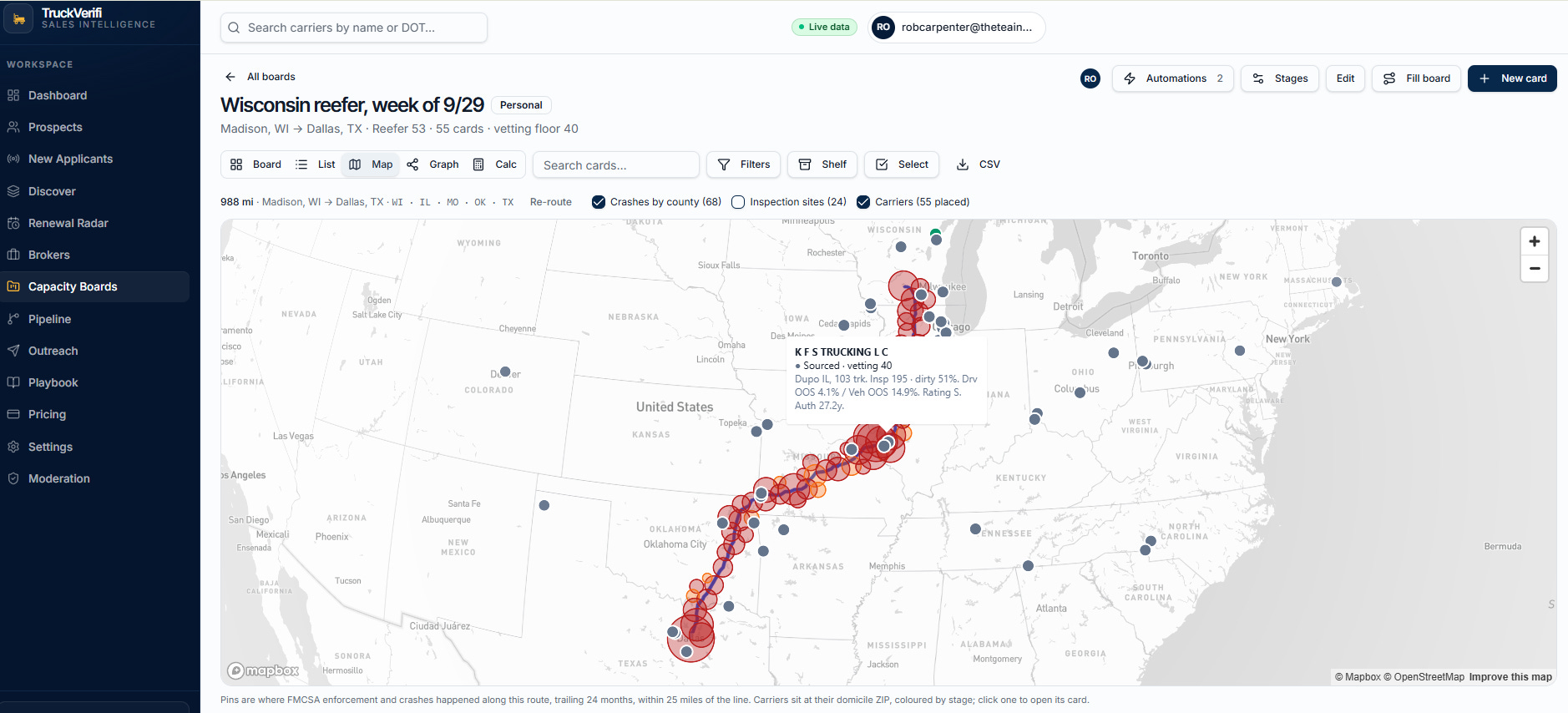
Brokers ask a different question: who runs my lane, in what equipment, and what does their record look like on that road. Capacity Boards answer it. You build a board for a lane and an equipment type. The one in these screens is a reefer run from Madison, Wisconsin, to Dallas, 988 miles through Illinois, Missouri, and Oklahoma, with a vetting floor of 40. Fill Board pulls carriers seen on that corridor and places them on a map at their home ZIP code, colored by stage. Turn on the crash layer and every county within 25 miles of the route shows its trailing 24 months of FMCSA crash and enforcement history. St. Louis alone shows 485 crashes, 11 of them fatal and 267 with injuries, plus 7,457 inspections and 849 out-of-service orders. Click a carrier, and you get its truck count, inspections, driver and vehicle out-of-service rates, safety rating, and authority age without leaving the board. Cards move through stages, take labels and automations, and export to CSV.
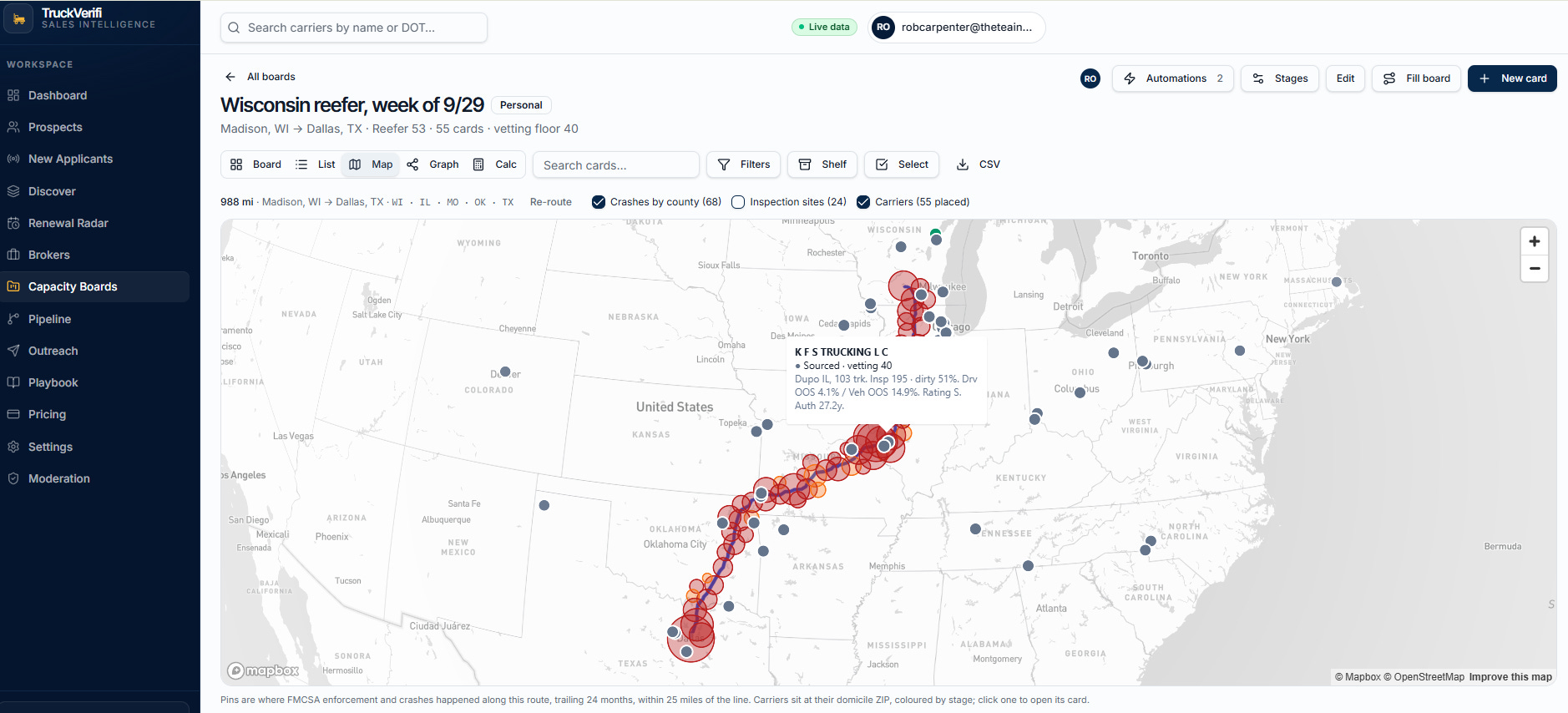
A Capacity Board for a Madison, Wisconsin, to Dallas reefer lane, with carriers placed by domicile and crash history by county along the route.
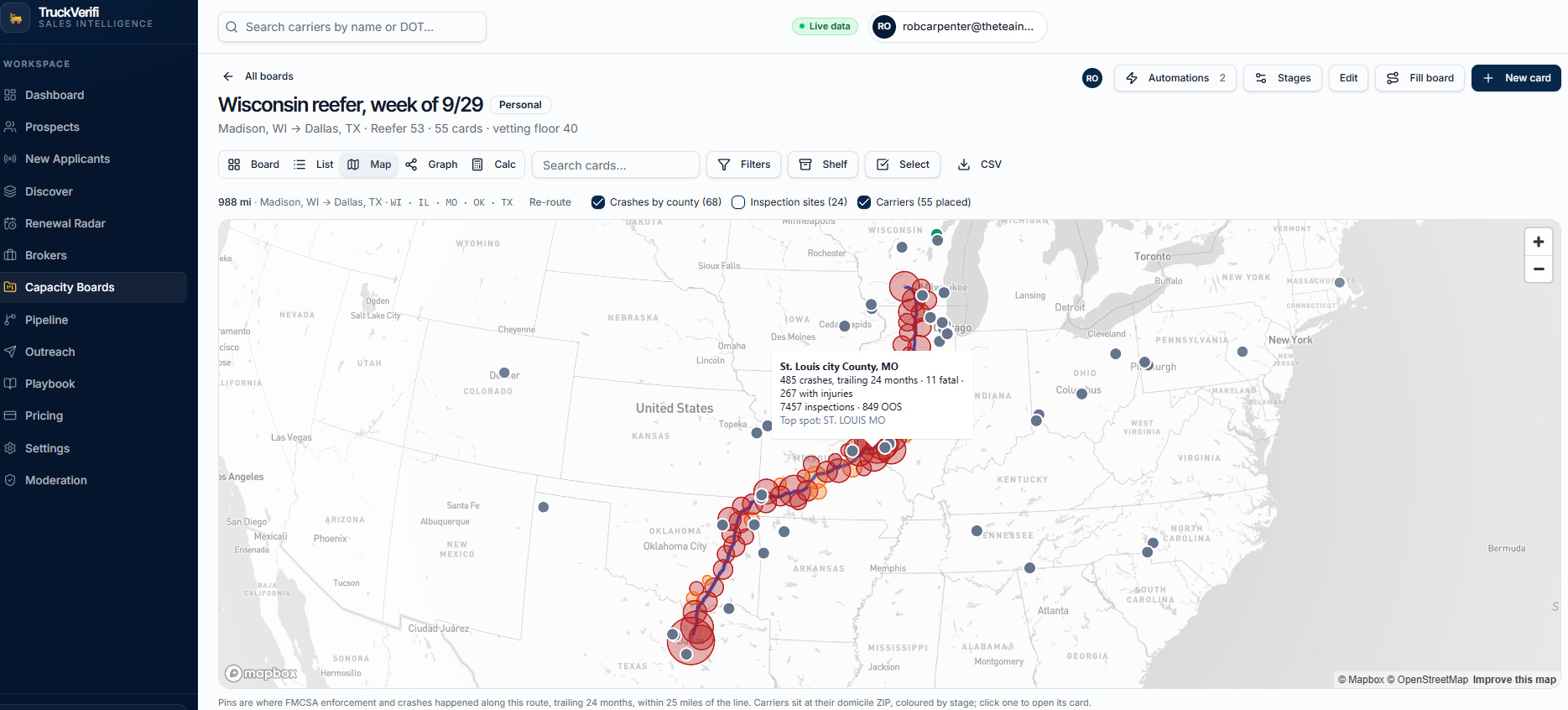
The crash layer on the same board: trailing 24-month crashes, injuries, fatalities, inspections, and out-of-service orders for each county on the route.
Vendors face the same problem as agents, just from the other direction. They sell dash cameras, maintenance programs, drug and alcohol services, training and compliance help to fleets, and the fleets that need them most are already sitting in the federal data. FMCSA sorts roadside violations into seven categories, called BASICs: Unsafe Driving, Crash Indicator, Hours-of-Service Compliance, Vehicle Maintenance, Controlled Substances/Alcohol, Hazardous Materials Compliance, and Driver Fitness. The playbook lets a vendor pick the categories its product fixes, then ranks carriers by how many of those problems they show and by vetting score. Next to that list sits a directory of vendors who address each category. Those referrals are uncompensated. TruckVerifi takes no referral fee, commission, or placement payment from any vendor on the list. It is there because a carrier with a maintenance problem needs a maintenance answer, whoever sells it. In the interest of full disclosure, TruckSafe Academy and TruckSafe Consulting, where I serve as vice president of compliance, appear on that list, as does Motive, a company I produce content with.
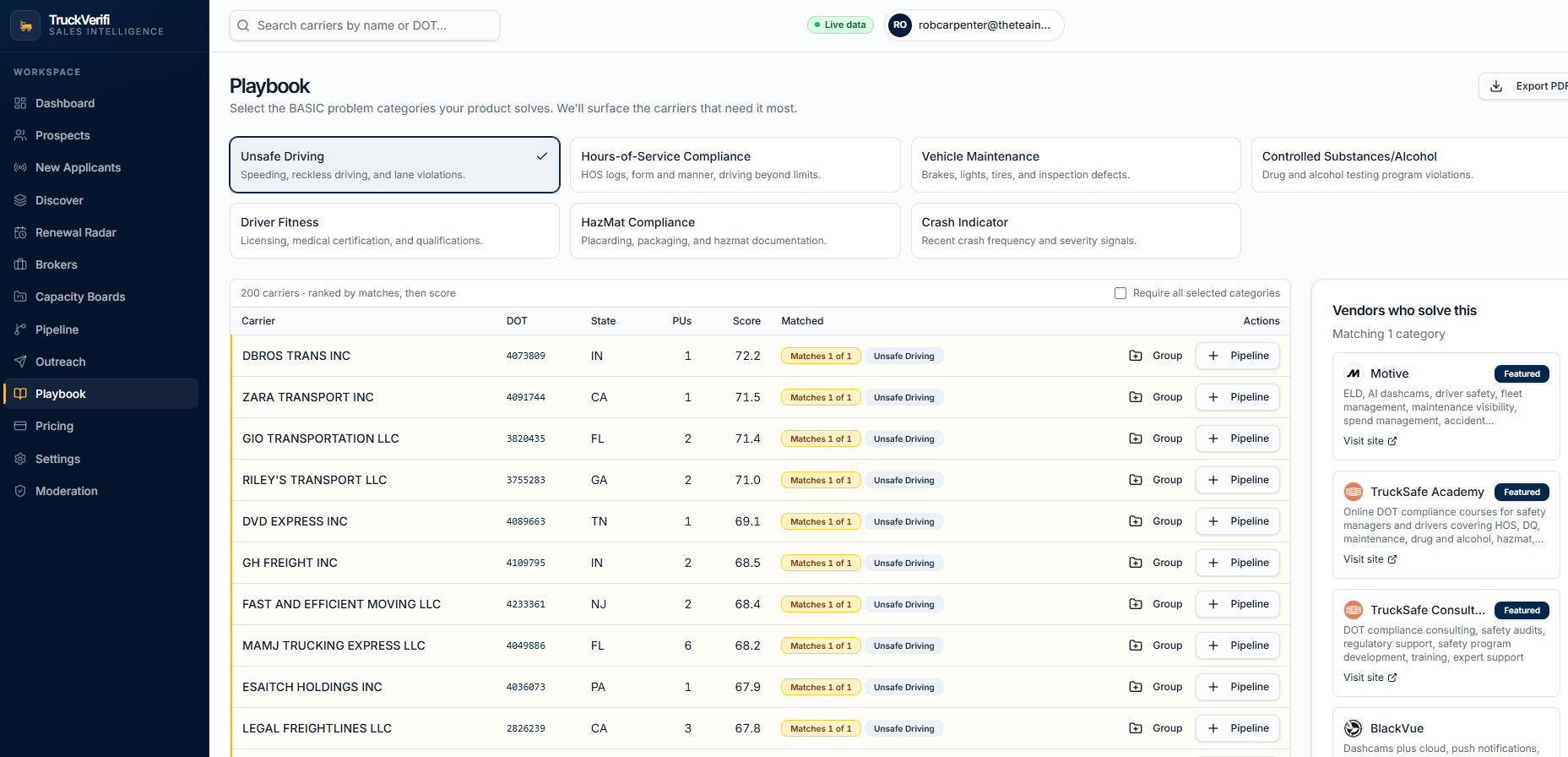
Playbook matches carriers to the BASIC categories a vendor’s product addresses, with uncompensated vendor referrals in the right rail.
When a carrier is worth a call, it goes into the pipeline: prospect, contacted, engaged, proposal, won or lost, with follow-up dates and deal value. Outreach sends email from inside the workspace with unsubscribes honored automatically, and a pitch brief summarizes the carrier’s record for the rep before the phone rings. A separate Brokers view tracks freight brokers by bond status, authority age, and dual-authority signals, for the surety and E&O agents who write them.
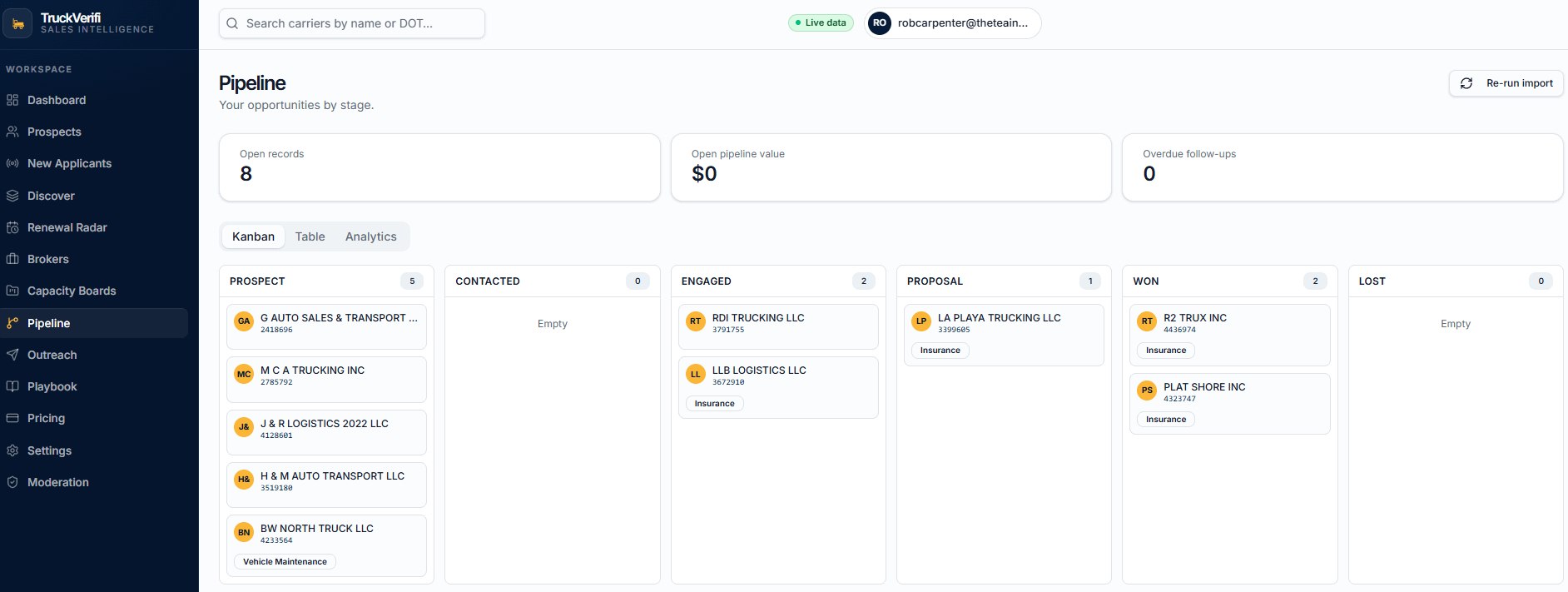
The pipeline moves each opportunity from prospect to won or lost. Account names are blurred.
From the witness chair, the question is always the same: what did you know, and when should you have known it? The American Transportation Research Institute’s December 2025 litigation report found that the median nuclear verdict against trucking, meaning an award above $10 million, reached $36 million in 2022. Verisk CargoNet estimated cargo theft losses at nearly $725 million in 2025, up 60% from 2024. A lot of that damage traces back to decisions made with half the record in view: an agent binding a fleet whose declared trucks didn’t match the road, a broker tendering to a two-week-old authority with a revoked officer behind it, an underwriter renewing without seeing the lapse. TruckVerifi doesn’t make those decisions for anybody. It puts the record in front of the person making them before the phone call, not after the subpoena.
Pricing is simple. Pro is $49 a month. The founding rate is $399 a year for the first 100 seats, locked for as long as you stay subscribed. Agency is $99 a month and adds officer networks, VIN crossover, and chameleon detection. Teams of five or more seats get volume pricing.
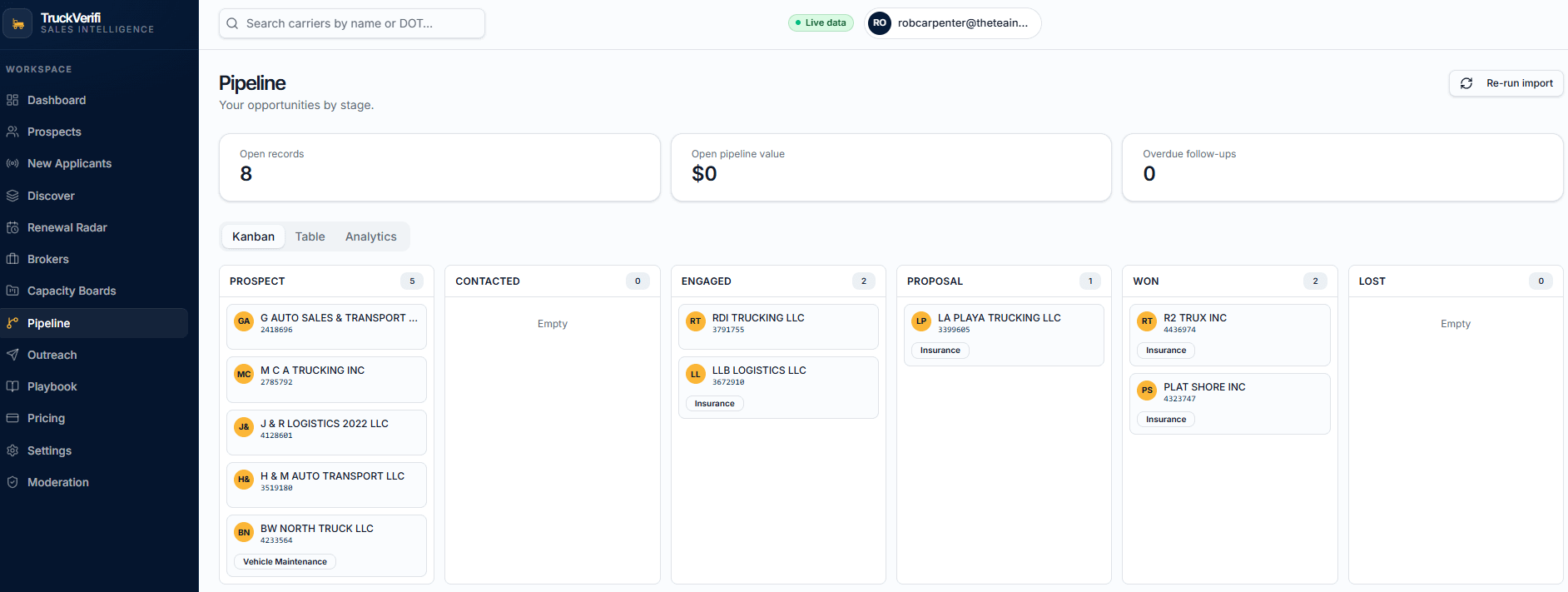
TruckVerifi Pro and Agency plans, including the founding rate for the first 100 seats.
The data was always public. The industry never had the order you see it in: renewal first, record second, fix third, and all three before you pick up the phone. That is what we built.
Rob Carpenter is the founder and chief intelligence officer of Tea Technologies, Inc., which owns TruckVerifi and THE TEA Highway Intelligence Platform. He is vice president of compliance at TruckSafe Consulting and serves as an expert witness in commercial motor vehicle litigation.