

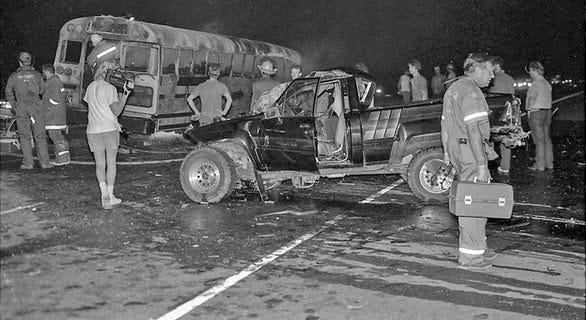
On the night of May 14, 1988, a church youth group from the First Assembly of God in Radcliff, Kentucky, was coming home from a day at Kings Island. Sixty-three kids and four adults on a retired 1976 school bus built on a Ford chassis, rolling south on I-71 through Carroll County. Some of them were asleep. It was about 11 o’clock at night.
Larry Mahoney was driving a 1987 Toyota pickup truck north in the southbound lanes on a curved stretch of that same highway. His blood alcohol concentration was 0.24. That was twice the legal limit in Kentucky in 1988, which was 0.10. It is three times the current national limit of 0.08. He had been arrested for DUI before.
Mahoney took the church bus almost head-on with a fair offset to the right front. The impact was violent but survivable. The NTSB investigation later confirmed that the bus driver, John Pearman, a part-time associate pastor and local court clerk, responded reasonably. He saw the headlights. He tried to steer left to avoid the collision. The NTSB concluded he was limited by the darkness and road curvature but that his response was appropriate.
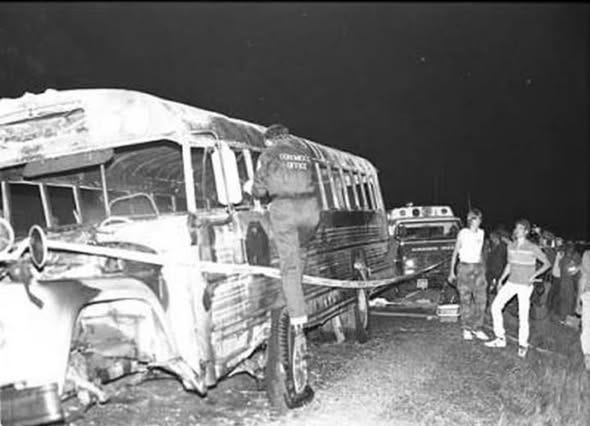
Nobody on that bus died from the impact of the crash.
The collision ruptured the bus’s fuel tank, which was mounted outside the frame rails behind the right front wheel. There was no protective cage. No crush zone. The 60-gallon gasoline tank split open and the fuel ignited immediately. The bus had two exits. The main entrance door at the front was jammed shut by the collision and a single emergency exit at the rear. That was it. Two doors for 67 people.
Survivors described crawling over seat backs and climbing over other passengers, trying to reach the rear exit. The two rear bench seats encroached on the door space, leaving an opening of 12 to 15 inches. A body jam formed at the back door. Passengers who could not reach the rear in time were overcome by smoke and fire. The interior temperature reached 2,000 degrees. The seat coverings were not fire-retardant. They burned.
Twenty-four children and three adults died. All from the fire. All because they could not get out of a bus that met every applicable federal safety standard on the books at the time of its manufacture.
The terrible irony is that if John Pearman had driven straight into Mahoney’s pickup instead of steering left to avoid it, the outcome would almost certainly have been better. A head-on into a Toyota pickup would have been absorbed by the mass of a loaded bus chassis. The offset impact is what ruptured the fuel tank. The evasive maneuver that any reasonable driver would have attempted is what created the geometry that killed 27 people.
The NTSB investigation, published in 1989 as report HAR-89/01, did not simply blame Larry Mahoney. It indicated the bus. The report found that the unprotected fuel tank, the flammable interior materials, and the inadequate emergency exits were design failures that turned a survivable collision into a mass casualty fire. The bus was legal. The bus was also a death trap. Those two facts, coexisting in the same vehicle, are why Carrollton changed the regulatory landscape.
The NTSB made recommendations to three groups: the National Highway Traffic Safety Administration, the 50 states, and church organizations that operated former school buses.
NHTSA was directed to revise three Federal Motor Vehicle Safety Standards. FMVSS 217, governing school bus emergency egress, was revised to require that exit capacity be based on vehicle occupant count rather than arbitrary door placement. FMVSS 301, governing fuel system integrity, was revised to require protective caging around fuel tanks to prevent rupture on impact. School buses built after the revision have fuel tanks encased in steel cages integrated into the frame. FMVSS 302, governing flammability of interior materials, was revised to require fire-retardant seat coverings and flooring. The seat material that burned at 2,000 degrees and killed 27 people inside a bus that survived the crash itself was replaced with materials designed to resist ignition and slow flame spread.
Kentucky moved faster than the federal government. The state now requires all school buses to have 9 emergency exits: front and rear doors, a side door, 4 emergency windows, and 2 roof hatches. That is more emergency exits than any other state or federal standard requires. The bus at Carrollton had two.
Kentucky enacted stricter DUI laws in 1991 and toughened them further in subsequent years, including provisions for looking back into the criminal histories of repeat DUI offenders. Larry Mahoney had a prior DUI arrest. The system that should have kept him off the road failed to do so.
The NTSB recommended that all 50 states propose legislation to phase out pre-1977 school buses, which were built before the April 1977 FMVSS revisions that had already improved exit requirements and structural standards. In 1988, 22.3 percent of all school buses in operation nationally were pre-1977 vehicles. By 1997, that number had dropped to 2.94 percent. The Carrollton bus was a 1977 model year vehicle built to pre-April 1977 standards. A bus manufactured one month later would have had more exits.
The NTSB also identified a critical regulatory gap between school buses in active school service and the same vehicles after they were retired from school use but continued to carry passengers. The Carrollton bus was a retired school bus used as a church activity bus. Had it been built new in March 1977 specifically for non-school use, the applicable federal standards at that time would have required more emergency exits than were required for school buses. The loophole was that a bus built to school bus standards could be retired from school service, transferred to a church or private organization, and continue operating with fewer exits than a non-school bus of the same era would have required. The 27 people who died at Carrollton died in that regulatory gap.
Several families of victims sued Ford Motor Company and Sheller-Globe, the body manufacturer. They argued the bus was defectively designed. The litigation lasted years and resulted in substantial settlements. More importantly, it forced manufacturers to fundamentally rethink how they built school buses.
Karolyn Nunnallee, whose 10-year-old daughter Patricia was the youngest victim, became the national president of Mothers Against Drunk Driving. Janey Fair, another victim’s mother, became MADD’s national vice president. The Carrollton families did not just grieve. They organized. MADD had been working since 1980 to combat drunk driving. The Carrollton crash served as a galvanizing event that accelerated the national push toward the 0.08 BAC standard, which eventually became federal law.
Larry Mahoney was convicted on 27 counts of second-degree manslaughter, 16 counts of second-degree assault, 27 counts of first-degree wanton endangerment, and one count of driving under the influence. He was sentenced to 16 years. He served approximately 10 years before being released in September 1999.
The reforms that came out of Carrollton were real and they saved lives. School buses today are not the bus that burned on I-71. The fuel tanks are caged. The seats are fire-retardant. The exits are multiplied. The structural integrity standards are dramatically higher. School buses are statistically among the safest modes of transportation in the country. NHTSA data shows that of the 343,391 fatal motor vehicle crashes between 2013 and 2022, only 0.28 percent involved school buses. A child is safer on a school bus than in a passenger car, walking, or riding a bicycle.
That does not mean the job is finished.
Between 2013 and 2022, there were 976 fatal school bus crashes in the United States, resulting in 1,082 deaths. That is an average of approximately 108 people killed in school bus crashes every year. In 2024, the most recent year with complete data, 110 people died in school bus-related crashes. In 2023, it was 128. The numbers have been declining gradually over the decade, which is a positive trend attributable to improved safety standards and technology. But 108 people a year, every year, for a decade, is not a solved problem.
The distribution of those deaths is critical and often misunderstood. Of all people killed in school bus-related crashes between 2015 and 2024, approximately 71 percent were occupants of other vehicles, not the school bus. Fifteen percent were pedestrians. Six percent were school bus passengers. Four percent were school bus drivers. Three percent were cyclists. The school bus itself is protecting its occupants at a remarkably high rate. The people dying are overwhelmingly outside the bus, struck by or in collision with the bus, or hit by other vehicles in the crash sequence.
Among school bus occupants killed between 2013 and 2022, 61 were passengers and 50 were bus drivers. That is 111 school bus occupants killed in a decade, out of a system that transports approximately 26 million children to and from school every day on 483,000 buses. The per-trip fatality rate is extraordinarily low. But those 111 people were real. Those 61 passengers were children.
Pedestrian deaths are a persistent and specific problem. NHTSA found that there were 1.5 times more fatalities among pedestrians than among school bus occupants in school-transportation-related crashes between 2014 and 2023. The highest concentration of school-age pedestrian fatalities occurred between 3:00 and 3:59 PM, the afternoon dismissal window. The loading and unloading zone, the moment when children are most exposed to traffic, remains the most dangerous part of the school bus transportation system. The Kansas Department of Education’s national loading and unloading survey for the 2021-2022 school year documented four fatalities caused by school buses and two caused by other vehicles during loading and unloading operations.
Carrollton changed fuel tanks, exits, seat materials, and DUI laws. It did not put seatbelts on school buses. Thirty-eight years later, most states still do not require them.
School buses over 10,000 pounds, which is the vast majority of full-size school buses, rely on a passive restraint system called compartmentalization. The seats are high-backed, closely spaced, heavily padded, and designed to absorb energy in a frontal or rear collision by containing the passenger within the seat compartment. NHTSA has historically taken the position that compartmentalization provides adequate protection for passengers on large school buses and has not mandated lap-shoulder belts at the federal level for vehicles over 10,000 pounds. Federal law requires lap-shoulder belts on small school buses weighing less than 10,000 pounds.
Compartmentalization works well in frontal and rear impacts. It does not work as well in rollovers, side impacts, and ejection scenarios. Test lab footage and real-world crash footage show passengers being thrown from compartmentalized seats during rollover events. In a 2020 crash between a school bus and a service utility truck in Tennessee, the bus driver and a 7-year-old passenger were killed. The NTSB investigation led to a renewed recommendation in 2022 calling for states to require lap-shoulder belts on all school buses.
NTSB Board Member Michael Graham addressed this topic directly at the 2025 NASDPTS conference. “It is hard to believe we are still having a discussion about the safety benefits of seat belts, and their proper usage, on any roadway vehicle, let alone a school bus. The safety data could not be clearer: school buses equipped with lap and shoulder belts, combined with proper usage of the belts, provide maximum protection for all occupants.”
As of 2026, only eight states require seatbelts on large school buses in some form: Arkansas, California, Florida, Iowa, Louisiana, Nevada, New Jersey, New York, and Texas. The requirements vary significantly. Some mandate three-point lap-shoulder belts. Some require only lap belts. Some apply only to buses manufactured after a certain date. Some leave enforcement and usage policy to local school districts. Louisiana’s law lacks the appropriate funding necessary for enforcement.
Texas is the most recent state to act. Senate Bill 546, signed by Governor Abbott in June 2025, requires all school buses in the state to be equipped with three-point lap-shoulder belts by September 1, 2029. The law was a direct response to a fatal 2024 crash in Hays County involving a school bus and a cement truck that killed two people, including a pre-kindergarten student. The NTSB investigation of that crash highlighted the need for passenger restraints.
The cost argument is the primary resistance. NTSB estimates that adding lap-shoulder belts costs between $7,000 and $10,300 per bus. Installing belts requires thicker seats with fewer rows, reducing passenger capacity. For school districts already operating on strained budgets with aging fleets, the cost is not trivial. Several Texas districts have described SB 546 as an unfunded mandate and are planning to retrofit during future replacement cycles rather than retrofitting existing buses immediately.
The counterargument from districts that have implemented belts is instructive. Rutherford County Schools in North Carolina has been phasing in lap-shoulder belts since 2017 at no extra charge from the manufacturer, with over half the fleet now equipped. Drivers reported improved student behavior, better discipline, and higher job satisfaction. Austin ISD has had belts on all buses since 2012. The practical experience from districts that have adopted belts contradicts much of the resistance from districts that have not.
Blue Bird, one of the largest school bus manufacturers in the country, now includes three-point belts as standard equipment. The industry is moving. The question is how fast.
The lesson of Carrollton is not that drunk driving kills. Everyone already knew that. The lesson is that a vehicle can meet every federal safety standard on the books and still be fundamentally unsafe. The 1976 Ford church bus was legal. It had two exits because that was all the law required. Its fuel tank was unprotected because no regulation required a cage. Its seats burned because no standard required fire-retardant materials. Twenty-seven people died in the gap between what the law required and what the physics of a crash demanded.
That gap is what Carrollton should have taught the industry to close permanently. In some areas, it did. Fuel tanks are caged. Exits are multiplied. Interior materials resist fire. Those specific lessons were learned. But the broader principle, that regulatory minimums are not the same thing as safety, and that waiting for a mass casualty event to close the gap between the two is an unconscionable way to make transportation policy, is a principle the industry has not fully internalized.
The seatbelt debate is Carrollton’s unfinished business. The data is clear. The NTSB has been making the same recommendation since the 1990s. The cost is real but it is finite. The risk of a rollover event on a bus full of unrestrained children is not hypothetical. It has happened. Children have been ejected. Children have died. The compartmentalization system that was adequate in 1977 is not adequate in 2026, not because it does not work in the scenarios it was designed for, but because it does not cover all the scenarios that school buses actually encounter on real roads.
In 1988, a bus full of children burned because the law allowed a 60-gallon unprotected gasoline tank and two exits on a vehicle carrying 67 people. It took 27 dead children to change that. In 2026, 483,000 school buses carry 26 million children every day, with no federal requirement for passenger restraints on large buses, and only eight states requiring them in any form. NTSB has been asking for this change for decades. The question is whether we wait for another Carrollton-scale event to force it, or whether we learn from the one we already had.
John Pearman did everything right. He saw the headlights. He reacted. He tried to save his passengers. Twenty-seven of them died anyway because the bus they were in was legal and inadequate at the same time.
The kids riding school buses tomorrow morning deserve better than a regulatory framework that waits for a catastrophe to fix what the data already shows is broken. Carrollton taught us that 38 years ago. We are still learning.