

Around six in the morning on Saturday, June 27, a Greenfield, Indiana officer pulled a tractor-trailer off eastbound I-70 near mile marker 104. Two days earlier, on June 25, roughly 40,000 pounds of tungsten oxide powder had left a facility in Pennsylvania and never reached its destination. Greenfield police stopped the truck, held it on a search warrant, confirmed the cargo, and arrested the driver, 31-year-old Deepak Kumar of Fresno, California, on a Pennsylvania warrant. The charges were theft by unlawful taking of movable property and criminal use of a communication facility. Police valued the powder at $2,857,500. Its destination was Mitsubishi Materials in Japan.
Nobody cut a lock. Nobody pulled a driver out of a cab at a light. According to police, Kumar used fraudulent documents to pick up the load. The paperwork was good enough that a shipper handed over nearly three million dollars of critical mineral and felt fine about it. This is an every single day occurrence in America.
If you want to understand why freight fraud is hollowing out this industry, start there.
Why would anyone steal a trailer of powder?
Tungsten oxide looks like something you’d sweep off a garage floor. It sits at a very specific spot in one of the most contested supply chains on the planet. We had this same issue with coal dust moved from the WV coal country.
Tungsten doesn’t show up in nature as metal. It’s pulled out of ores like wolframite and scheelite, then worked up the chain: ore concentrate, ammonium paratungstate, then the refined oxide, then tungsten metal powder made by reducing that oxide with hydrogen, and finally tungsten carbide. So the powder in that trailer wasn’t a finished good. It was one or two steps away from becoming cutting tools, drill bits, penetrator rods, or carbide inserts. That’s what makes it easy to move once it’s gone. It re-enters the refining stream anonymously, and this batch was export-bound to begin with.
The metal that forms tungsten carbide is close to diamond in hardness, which is why it is used for cutting and grinding in nearly every machine shop and mine on earth. The metal goes into armor-piercing munitions, kinetic penetrators, and tank armor, where its density and melting point make it more or less irreplaceable. It’s in aerospace superalloys, semiconductors, and electric vehicles, which carry a couple of kilograms apiece across gearing and wiring. The U.S. Geological Survey treats tungsten as essential to economic and national security, and it lands on the critical-mineral lists of the United States, the EU, Japan, and most of the industrial world.
Now the geopolitics. China produces somewhere between 75 and 80 percent of the world’s tungsten. The United States hasn’t mined it domestically since 2015, so we import and recycle. In February 2025, China tightened export controls on tungsten. Prices ran up roughly 55 percent afterward to historic highs, on the order of $500 per metric ton unit of tungsten trioxide. That is the macro reason a pallet of dull powder is suddenly a seven-figure target sitting on a loading dock in Pennsylvania. Scarcity plus portability plus fungibility is a thief’s shopping list, and tungsten checks all three boxes right now.
So this wasn’t a crime of opportunity. Somebody knew exactly what was in that trailer, what it was worth this quarter, and where it was going.
The theft that wasn’t a theft until it was
This was strategic theft, or a deceptive or fictitious pickup. Criminals don’t break in. They pose as a legitimate carrier, show paperwork that looks right, and drive off the yard with the load handed to them. The National Insurance Crime Bureau puts it plainly: bad actors use fake documents or stolen carrier identities to fool a shipper into loading the wrong truck.
The numbers are ugly and moving in the wrong direction. All the strategic theft data figures are high and moving higher. When criminals forge identities and impersonate carriers, a padlock on a trailer won’t stop them.
Threat actors phish and spoof their way into broker and carrier accounts, post fake loads on load boards, and double-broker real freight to unwitting drivers by manipulating bills of lading and changing destinations. To make the impersonation stick, the criminals change the legitimate carrier’s contact information with the FMCSA and update its insurance information so the account will accept loads the real carrier never would.
They edit the federal record. They don’t forge around the system of record. They walk in the front door and become you inside it. Beginning to end.
That is what “criminal use of a communication facility” means on Kumar’s warrant. The crime lived in emails, phone calls, load boards, and documents. The truck was real. The driver was real. The paperwork looked real. Every physical thing checked out. What failed was identity and authorization, and no lock, seal, or GPS dot was ever going to catch it.
This is landing at the worst possible moment for anyone still leaning on the government record to save them. With MOTUS in the state it’s in, brokers are already getting told a revoked or uninsured carrier is active. If the source of truth can be edited by the thief and is unreliable even when it isn’t, then “I checked their authority” is the thinnest phrase in freight. The identity layer has to move to somewhere you actually control.
What we built, and why we built it
I built Loadverifi.com for a shipping client in Austin, Texas, because this happened to them 5 times, and they lost nearly $2M in freight. We didn’t build LoadVerifi as a science project. We built it because clients moving the most sensitive, highest-liability freight on the road, firearms, alcohol, and tobacco, were getting loads stolen on a routine basis. My consulting, litigation, and other clients were losing their shirts. When your cargo is ATF-regulated and it walks off on fake paperwork, you don’t have a shrink problem; you have an existential one. So we sat down, used our decades of experience across the board from driver to broker to loss and risk control to expert witness and investigator, and we built a system to end this mess. We wired it into TEA Technologies and its 35 API validation datasets, and built the thing that should have existed years ago. Especially for high-value freight.
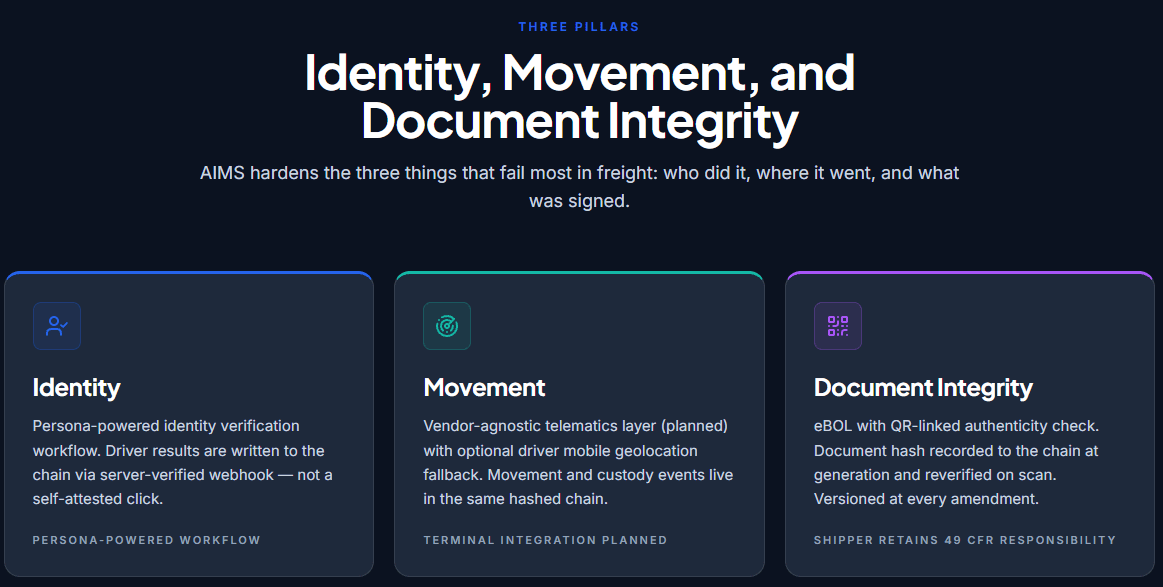
The idea is simple to say and hard to fake. For dollars-per-load shipments, the shipment is built in the Loadverifi system, the shipping documents are generated by the system with an EBOL and QR Code, and every party and object tied to that move is validated and then cryptographically bound to the shipment. Not “verified once at onboarding.” Bound. Here are the layers. Origin to destination.
The carrier entity layer. Before anything moves, the carrier is run against federal records and 35 API datasets to assess risk, Identity crossover, etc., including authority, history, network relationships, whether the VIN has crossed over anywhere else, and whether 12 carriers are using that VIN across 8 plates, as well as the behavioral record. This is not “does the MC number exist.” It’s “is this the real, authorized entity, and does its history hold up?” A cloned MC number dies here.
The transaction document layer. The bill of lading and shipping documents originate in the system and carry a cryptographic hash. A forged or altered document doesn’t match the hash. The paperwork can no longer lie, because the paperwork is no longer just paper.
The driver and driver ID layer. The actual human’s license and identity are validated against government records and facial recognition, and tied to the specific load. The person at the dock has to be the person on the record for that move.
The VIN and vehicle layer. The truck’s VIN is decoded, validated, and bound to the load. The tractor that shows up has to be the tractor that’s supposed to show up.
The movement and ground-presence layer. We track the load regardless of what telematics system is in the vehicle, so the truck moving the freight is confirmed to be the truck on the ground where it’s supposed to be. Layered on top is a proprietary ground-truth risk model built on billions of miles of real-world movement data, known hotspots where cargo goes missing, and the hottest risk spots on the road and en route.
The point isn’t any single layer. It’s the chain. Driver ID to VIN to decoder to driver credential to telematics, every link is hashed to the next. Break one link and the whole chain fails validation. A thief can copy an MC number off a website in ten seconds. What he cannot do is produce a driver, a truck, a document set, and a live movement signal that all cryptographically agree with each other and with the carrier’s real history.
Two more things that matter as much as the validation. First, the transaction data only flows to the parties exclusively and verifiably involved in that specific move. We are not broadcasting your load details onto a board where the next impersonator is shopping. Data minimization is a security control, not a nicety. Second, the system provides real routing guidance, overheight and overweight compliance, plus security-based routing that factors census and demographic risk data along with that ground-truth hotspot layer, so a high-value load isn’t sent straight through the worst place to lose it.
The lock era is over
In 2023, I wrote my first article on this as an idea I thought was worthy of Rich Mason and Critical Infrastructures’ involvement in a blockchain system. Years later, here we are with something very similar. The industry keeps buying bigger locks and better GPS for a threat that no longer cares about either. Kumar’s trailer proves it. Nothing physical failed. The identity and authorization layer failed because, for most of this industry, that layer is a phone call, an email, and a document somebody chose to believe.
You close that gap by validating every party to the transaction and binding them so tightly that the paperwork can’t be forged and the participants can’t be swapped. That’s the whole thesis. That’s LoadVerifi.
The tungsten made it back this time because a cop in Indiana was paying attention. That’s not a security strategy. That’s luck. And luck is the most expensive line item in freight.
See how it works at loadverifi.com.
Clearly, I'm in the wrong business.
What a brilliant idea! Well done Rob 👍👍👍