

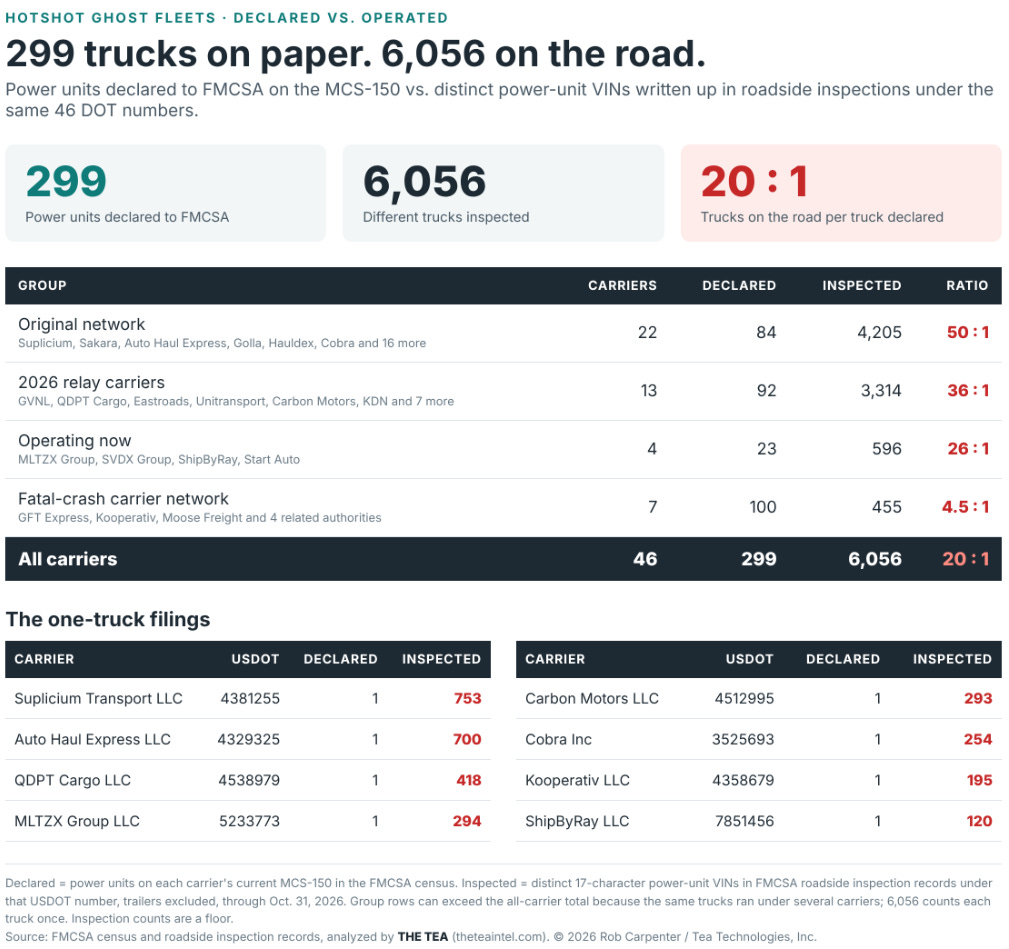
The good news, before we start, is that we know enforcement is all over these groups. After our initial article on these networks, many were getting shut down in real time. Then we started building predictive models based on where they would move equipment next, using trailer-sharing lease models. In one case, Suplicium changed its address the week after we wrote the article. So FMCSA is on it, but not only have we worked with FMCSA on these networks for nearly a year at this point, but we’re also expert witnesses in several cases where their fraudulent operation killed innocent people on the highways. In one of our expert witness litigation cases against one in the group where a father was killed, the driver of the truck had a Russian-issued CDL and was in the country illegally. The company? Based out of an Airbnb address in a Florida high-rise. The authority? Leased from someone no one knows.
We even built interdiction mapping so enforcement knew the routes these trucks were traveling. That’s great if trucks are actually taken out of service, but we discovered that state agency partners would flag the carrier unit in the inspection as “fraud-plate” and let them keep going.
An out-of-service order is supposed to be the end of the line. When the Federal Motor Carrier Safety Administration orders a carrier off the road, the trucks it was running are supposed to stop moving freight under that authority, and the people who ran them are supposed to have to answer for the record they built before they can get back on the highway. That is the promise of enforcement against chameleon carriers: kill the authority, and you kill the operation.

The fleets we mentioned earlier this year reincarnate almost weekly, and one group @Maybedanielle aka www.Projectveritas.com ignited is MLTZX Group LLC, USDOT 5233773, registered Sept. 2, 2026, from an apartment at 1822 Edith St. in Murphysboro, Illinois. Its MCS-150 says one power unit and one driver. Its email runs through Proton, the encrypted mail service. Artisan and Truckers Casualty, a Progressive company, filed a $1 million liability policy effective Sept. 21. Where Danielle’s story bleeds into our early 2026 story, the rest of that network is litigation and investigations with the feds.
Between Sept. 28 and Oct. 31, inspectors stopped MLTZX trucks 339 times in 42 states. They wrote up 295 different vehicle identification numbers on 295 different plates. In 165 of those inspections, inspectors took a driver or vehicle out of service. On Oct. 28 alone, inspectors inspected the one truck on MLTZX’s paperwork 18 times in 11 states: Alabama, Arkansas, Colorado, Georgia, Iowa, Kansas, Louisiana, Mississippi, North Carolina, South Dakota, and Tennessee. MLTZX trucks have been in three crashes in the same five weeks: Oct. 15 in Virginia, with one person injured; Oct. 18 in Springfield, Missouri; and Oct. 21 in Flint, Michigan, with one person injured. As of Nov. 3, FMCSA lists MLTZX as active with no out-of-service order.
She’s right kids, the math ain’t mathin’. MLTZX is not a new problem. It is the same problem, wearing a new number. They’re one of many shell entities used for reincarnation within this largely Eastern European network, especially Armenian and Ukrainian. Ara Sarkisyan was one of the two officers behind the Washington side of the network, and the Sarkisyan family is not new to this relay fraud nor is Armen Poghosyan. Ara Sarkisyan, his brother Arutyun and their mother Asmik were co-defendants in a credit card fraud and identity theft ring. Ara, then 23, got 41 months in November 2009 and owed Chase $263,291 in restitution. Arutyun got 96 months. Two co-schemers fled to Tajikistan. As of 2021, the feds were still collecting restitution from the group as this network grew legs.
Armen Poghosyan ran Horizen LLC (DOT 4400234) in Spokane, which declared 2 trucks and ran 534. The federal provider registry (NPI 1336518067) lists him as CEO of Silverstar Hospice Inc. in Burbank, California. The state has now suspended that company.
Another group we’ve followed is Dmitriy and Inna Chebanenko, who ran car-hauling companies from 2019 to 2021: Amstel, Wild Eagle, Gig Logistics, and Amazing Rides. Drivers without CDLs were recruited from Russia and Ukraine, logs were falsified from a dispatch room in Ukraine, and drivers alleged 140-hour weeks and withheld pay. FMCSA revoked Amstel in September 2020 and Wild Eagle in October 2019.
Inna Chebanenko, the wife, was indicted in February 2018; a federal grand jury in Brooklyn indicted her, along with Andrii Gerasymenko and Georgy Zakalyugin, for conspiracy to commit wire fraud (U.S. v. Chebanenko et al., 1:18-cr-00051, E.D.N.Y.). Tamaz Pasternak was added later. The charge: from 2013 to 2016, they ran car dealerships incorporated in Indiana and operating in Illinois. They got fake Indiana “rebuilt” titles for salvage cars by forging the signatures of nonexistent Indiana police officers. Then they sold the cars on Craigslist to buyers in Brooklyn and elsewhere. She pleaded not guilty and was released on a $200,000 bond. Jury selection finished in November 2019.
Inna’s story isn’t even the craziest part; her federal defense lawyer was Gal Pissetzky of Pissetzky & Berliner. Ian Berliner, the firm’s name partner, was the registered agent on more than 59 Illinois LLCs, including LiveHotshot LLC. He ran the 7234 W North Ave entity mill that registered Pingvin Express. Berliner has since stopped practicing law in Illinois.
So the salvage-title defense and the hotshot LLC formation ran through the same law firm.
In June, I published an investigation into some of these groups as auto-transport carriers that reported 38 trucks to FMCSA while their inspection records showed more than 6,000 vehicles. Suplicium Transport LLC told the government it had one truck and ran 675 VINs. Sakara LLC reported two and ran 682. Auto Haul Express LLC reported one and anchored a shared pool of equipment that moved between nominally unrelated companies within 48 hours of each shutdown. I also wrote that enforcement was finally moving at the speed of the fraud, and it was. What I could not answer then was the question every broker, insurer and plaintiff attorney asked me afterward: when FMCSA kills the authority, where do the trucks go?
So we went back to find out. Tea Technologies took every vehicle identification number ever inspected under 22 by the core carriers in that network, followed each truck forward through the federal inspection record, and recorded the DOT number it wore the last time an inspector saw it. This is that answer.
The 22 core DOTs include Suplicium, Sakara, Auto Haul Express, Golla Group, Hauldex, MTMFO, ASV Xpress, Cobra Inc, MAKGA Inc, Horizen, Pingvin Express, Central Transit Services, MLS Capital, DMLCSL, ONEPOINT, LCZW Cargo, Novaline Auto, Lipchenko and Co, Shapoval and Co, Richroad, Lease AE and Jay Torres. Across them, FMCSA’s roadside inspection records hold 8,072 valid vehicle identification numbers. Of those, 4,205 are power units, the pickups and tractors that pull the trailers.
Those 4,205 power units are not sitting in a yard. Since May 1, 2026, inspectors have re-inspected 1,857 of them. Since July 1, 1,261. Since Sept. 1, 757. In October alone, 381. Since May 1, 664 of them have changed DOT numbers again.
Of the 1,261 trucks inspected since July 1, exactly one was last inspected under the company that originally ran it. The rest were wearing someone else’s number.
Federal inspection volume in the dataset runs lighter from July forward than it did in the spring, so the counts above are a floor. A truck with no recent inspection has not been proven parked. It has only not been stopped.
Owner-operators lease their trucks onto motor carriers every day. A dispatch group can move a whole roster of leased owner-operators from one authority to another, and that is legal. Used pickups change hands constantly, and a truck sold at auction can show up under a new carrier a week later with no wrongdoing anywhere in the chain. A handful of shared VINs between two carriers proves almost nothing.
The problem starts at the margins, and in this network the margins are the whole picture.
Under 49 CFR 390.19, a motor carrier must report its number of power units and drivers, and update that filing every 24 months and whenever the information changes. FMCSA’s own instructions direct carriers to count vehicles they own, term-lease, or trip-lease. A carrier running 295 leased pickups has 295 power units on its MCS-150. Filing one is a false statement on a federal form.
An out-of-service order under 49 CFR 386.72 and 49 CFR 385.13 means what it says: the carrier may not operate. FMCSA’s new-entrant rules at 49 CFR Part 385, Subpart D, require a brand-new carrier to undergo a safety audit within its first 18 months before its authority becomes permanent. The registration form itself, Form MCSA-1, asks every applicant at Question 43 to disclose any affiliation with another FMCSA-registered company in the prior three years through common ownership, management, control, or family, and warns that a false answer is punishable under 18 U.S.C. 1001.
Keep those four rules in mind. Each one is reflected in the records that follow.
So...where’d the trucks go?
FMCSA did its part. When I checked FMCSA’s live registry on October 31, as we move into the trial phase on Franco, every core carrier was either under a federal out-of-service order or listed as inactive. Auto Haul Express went out Nov. 28, 2025. Sakara went out of service Dec. 7. Suplicium went out of service Jan. 9, 2026. MAKGA March 17. Golla April 27. Central Transit Services May 7. PK Logistix May 12. Eastroads June 26. Unitransport June 27. Haulfleet July 4. AVDB Trans July 24. MTMFO Aug. 7. NHX Logistics Aug. 14. KDN Transport Group Aug. 17. The agency is shutting these companies down faster than it did in the spring.
It is not fast enough to stop some of them from driving through the order. Twelve out-of-service carriers kept logging roadside inspections after their orders took effect, for 143 inspections in total. After its Oct. 11, 2025, order, Horizen LLC was inspected 35 times in 23 states. After its order, Sakara was inspected 27 times in 19 states. Golla Group LLC, ordered out of service April 27, 2026, kept getting stopped for four months, with 21 inspections in 16 states through Aug. 27.
The trucks themselves moved on. Of the pickups inspected since July 1, the single largest group was last seen under GVNL Transport LLC, USDOT 4806394, registered June 21, 2026, at 1215 N. Main St., Apt. 8, in Benton, Illinois, declaring 20 power units. GVNL’s first inspection was Aug. 5. By its last, on Oct. 7, inspectors had stopped GVNL trucks 725 times in 48 states and written up 582 different VINs, with an out-of-service violation on 318 of those inspections. GVNL trucks were in nine crashes between Aug. 22 and Oct. 3, in Alabama, Wisconsin, Michigan, Connecticut, Missouri, Indiana, Texas, New Jersey, and Oklahoma. Four people were hurt. GVNL’s insurance was canceled Oct. 6, and its USDOT number is now inactive.
MLTZX’s first inspection was Sept. 28, nine days before GVNL’s last. Sixty-nine of the same VINs ran under both.
Running alongside MLTZX are three more. SVDX Group LLC, USDOT 8891887, registered June 8 at 2402 Marquette Rd., Apt. 9, in Peru, Illinois, declaring 20 power units: 172 inspections, 132 VINs and 41 states since Aug. 24. ShipByRay LLC, USDOT 7851456, registered July 27 at a rural road address in Salesville, Ohio, declaring one power unit: 134 inspections, 120 VINs and 34 states since Sept. 10. Start Auto LLC, USDOT 5639124, registered June 3 in Lynnwood, Washington, declaring one power unit: 65 inspections, 50 VINs and 26 states since Aug. 18, plus a Sept. 28 crash in Bordentown Township, New Jersey. All four were active with no out-of-service order on Nov. 3. All four carry $1 million liability policies from Progressive group companies: Artisan and Truckers for SVDX and MLTZX, Progressive Preferred for ShipByRay, United Financial Casualty for Start Auto.
Not all of the iron stayed in the pickup relay. Cobra Inc., which told FMCSA it had one truck, ran Class 8 Freightliner and Volvo tractors through mid-2025. Those tractors now appear under two established Illinois fleets: 104 at CW Express Shipping Inc of Bolingbrook, which reports 88 power units, and 83 at Korol Trucking Inc of Arlington Heights, which reports 224. Those are real operating companies, and selling or leasing tractors from one carrier to another is ordinary business. The federal record cannot show the paperwork behind the move. Cobra’s operating authority has been revoked. Its USDOT number is still active.
We built the trailer model to track the Kaufman autohaulers for the government. The pickups are only half the rig. Most of them are followed by a car-hauler trailer, and trailers carry their own VINs that inspectors record separately from the truck pulling them. Across the 22 core carriers, inspectors wrote up 4,007 different trailer VINs through June 2026. Kaufman built more of them than anyone else: 1,277 trailers under three Kaufman manufacturer codes, 32% of the network’s trailer iron, with inspectors writing Kaufman in the make field on 1,204 of them. Behind Kaufman come the other wedge and gooseneck builders: Elite Mfg. with 272, Buckeye with 238, Big Tex with 88, then Appalachian, Lamar and Take 3. Cottrell, the stinger builder whose rigs hauled finished vehicles for the big unionized auto haulers, shows up 57 times.
The concentration is the point. Three hub carriers, Auto Haul Express, Suplicium and Sakara, declared four power units between them and put 1,886 different trailers through roadside inspections. Of those, 716 (38%) were Kaufmans. Reitnouer, the Pennsylvania aluminum flatbed builder whose trailers dominate the broader flatbed crossover we have tracked, accounts for five. When we ran the same trailer census this summer across a 300-carrier cohort of crossover networks, Kaufman made up about one in five trailers in this ghost-fleet network and almost none of the trailers in the cross-border van networks or the Super Ego van and reefer fleets. The wedge pool is a signature of this network, not of the industry.
The trailers move like the trucks. Of the Kaufmans, 628 were inspected under two or more of the 22 core carriers, 84 under four or more, and one under seven. The fair concession applies here too. Kaufman is an established builder, and legitimate auto-transport fleets run hundreds of trailers. The brand is not the problem. The problem is a trailer pool this size moving through authorities that each claim one truck.
I’ll let you sleuths figure out who owns the trailer dealers; I’ve already told you their names.
The trailer also settles the licensing question. Under 49 CFR 383.5 and 383.91, a combination rated at 26,001 pounds or more that tows a trailer rated over 10,000 pounds is a Class A vehicle, and its driver needs a Class A commercial driver’s license. A one-ton dually behind a loaded two- or three-car wedge or gooseneck is built to cross that line. That is why operating without a valid CDL was the single most-cited violation across this network when I first reported on it in June, 775 times. The trailer behind the pickup turns a driver with an ordinary license into someone who shouldn’t be behind the wheel.
One of our crash fleets joined the network. THESE FLEETS ARE KILLING PEOPLE.
In June I described a fatal crash I have worked as an expert witness: a hotshot rig hauling two pickups on a car-hauler, stopped in a live interstate lane at night, a driver who held only a Russian commercial license, a load brokered and rebrokered until nobody could say who controlled it, and a man dead. I treated it then as the network’s human cost, a separate group of companies operating the same way.
The records say it is not separate. The carriers in that crash’s operating and authority chain, and the equipment shops and authority vehicles around them, ran 455 power units through federal inspections. Kooperativ LLC, USDOT 4358679, declared one truck and ran 198 power units through 374 inspections between May and September 2025 before going inactive. GFT Express LLC, USDOT 4225562, declared 73 and ran 227 before inspectors revoked its authority. Since Sept. 1, 2026, inspectors have re-inspected 78 of the 455. They were last seen under GVNL Transport, MLTZX Group, ZTR Group, Start Auto, SVDX Group, and Turbohaul LLC of Inman, South Carolina, the same relay that absorbed Suplicium’s and Sakara’s trucks.
That finding matters most to me in this follow-up. The fleet behind a fatal crash I testified about did not wind down after the lawsuit was filed. Its trucks joined the pool, and some were stopped last week under an authority that didn’t exist two months ago. They came to court to fight it and even stated for the record they were borrowing authorities, but it’s still not their fault a man got killed running into the rear of their Russian CDL-licensed trailer that was using flashlights as taillights and a driver who was in the country illegally. That’s the dead man’s fault. That’s literally their argument as we proceed to trial.
None of this is new. On Aug. 8, 2008, a charter bus carrying 55 passengers from Houston to Carthage, Missouri, crashed on U.S. 75 near Sherman, Texas. Seventeen people died. FMCSA declared the operators, Angel Tours and Iguala Busmex, an imminent hazard, and the crash pushed the agency to start screening new applicants for reincarnated companies. In March 2012, the Government Accountability Office reported in GAO-12-364 that FMCSA’s chameleon vetting covered only passenger and household goods carriers, not freight, and that its own 2010 applicant match turned up more than 1,100 new freight carriers with chameleon attributes. Congress put $3.5 million toward an automated detection system. For more than a decade after that, the screening keyed on names, addresses, phone numbers and officers, which are the four things a reincarnating carrier changes first.
What has changed in the past year is the will to act. Administrator Derek Barrs made unmasking chameleon carriers a stated priority in February 2026, paired it with restoring enforcement of the principal place of business rule, and rolled out the agency’s Motus registration system with identity verification at the front door. The enforcement calendar above is what that posture looks like. Nineteen of these authorities have been ordered out of service since Nov. 28, 2025. In June I wrote that the agency was closing the distance between a fraud and the enforcement that catches it. It still is. The network has answered by shortening its own clock.
The companies’ own registrations show the pattern. Since October 2025, the links in this chain are Central Transit Services, Novaline Auto, MTMFO, Golla Group, AVDB Trans, PK Logistix, KDN Transport Group, Eastroads, Carbon Motors, Unitransport, Haulfleet, QDPT Cargo, YMC Transport, ZTR Group, Loadshift, GVNL Transport and MLTZX Group. Every one told FMCSA it had one, two, or 20 trucks. Every one ran hundreds.
The officer names on the filings change every time. The fingerprints do not. Golla Group, Hauldex and ASV Xpress all list phone numbers in the 484-569 block. Horizen, ONEPOINT, Eastroads, PK Logistix and Unitransport list numbers in the same handful of 814 blocks. Pingvin Express, which our July work tied to a Chicago entity mill, lists 730-200-2736. DMLCSL lists 730-201-2432. GVNL Transport, the biggest catcher of the pool this fall, lists 730-202-2196. The addresses moved from rural farm roads outside Spokane in 2025 to single apartments in small downstate Illinois towns in 2026: Benton, Marion, Murphysboro, Peru, Princeton, Charleston and Lyons. The email providers moved from Gmail to Fastmail to Proton.
Form MCSA-1 asks each applicant whether it is affiliated with another FMCSA-registered company. None of those filings are public, so I cannot tell you what each one answered. I can tell you that the officer listed on Central Transit Services, the first link in the 2025 to 2026 chain, is listed as the officer of BXRT Group LLC, USDOT 5231662, registered Sept. 3, 2026, the day after MLTZX, at 404 E. Carter St., Unit 1, in Marion, Illinois, with a Proton email address.
Here is the machine, start to finish. You form an LLC in a small town where an apartment lease is cheap and nobody asks questions. You get a USDOT number and tell FMCSA you have one truck. You buy a $1 million policy priced for one truck. The day before your predecessor’s insurance cancels, you get your first truck inspected. Over the next 60 to 90 days, hundreds of trucks run under your number; and every violation and every crash lands on an authority with no history and no assets. When the out-of-service order comes, it lands on a company you've already moved on from. The trucks are wearing the next number before the order is published. The new-entrant audit that was supposed to catch you in your first 18 months never gets the chance, because you never live 18 months.
The bench for the next round is already built. ZPVR Auto LLC, USDOT 6014649, registered Sept. 3 at an apartment in Vandalia, Illinois, declared one truck, and used a Proton email address. Artisan and Truckers filed a $1 million policy effective Oct. 19, but as of Oct. 31, it had not been inspected. Review the policy numbers on the Artisan and Truckers filings: SVDX, CA878483137, effective Aug. 20; MLTZX, CA880216102, effective Sept. 21; ZPVR, CA881471156, effective Oct. 19. One new link per month. BXRT Group is registered, but no insurance has been filed yet. Two Washington carriers on the same 814 phone blocks as the 2025 links, Constanta LLC in Rockford and Force Movers LLC in Ritzville, are registered with no inspections. So is KWO Cargo LLC of Farmersburg, Indiana, also on an 814 number.
So who pays for this? Well...you do.
The driver behind the wheel of one of these pickups usually has the least information and the most exposure. The out-of-service violations in this chain are dominated by drivers without valid commercial licenses and by brake and tire defects. When he gets put out of service, the company on his door is gone before the citation is processed.
The broker who books the load sees a fresh authority, a clean safety record, and an active $1 million certificate. After Montgomery v. Caribe Transport II, decided unanimously by the Supreme Court on May 14, 2026, that broker can be sued in state court for negligently selecting the carrier, and a carrier whose public inspection record already shows hundreds of trucks under a one-truck registration is the definition of a selection a jury will be asked to examine.
So what about the insurers? Well, there’s a story there too, besides the countless insurance articles we’ve written on that disaster.
In this network, we learned something unique from another fatality litigation case we have. MAKGA Inc had a crash where the trailer was covered by one insurer and registered to one carrier; the truck was insured and registered to a different carrier, and the truck’s cab carried the entire Progressive policy breakdown at the time of the crash. (Progressive Preferred 965589853, Feb. 6, 2025 to Feb. 6, 2026) Scheduled 14 trucks while MAKGA told FMCSA it had two, garaged every unit in Ohio ZIP 45065, while the named insured sat in Elk Grove Village, IL, and listed the RAM that Suplicium was running in the Standifer crash in Kansas City as vehicle 2.
The driver added to that policy two days before the crash, Muratbek Zholdoshbekov, holds a dormant Illinois LLC, Kutunay LLC, that still has no FMCSA authority.
The agent might be a bigger story; we will see. The producing agent on the declarations page is Agidel Insurance Agency LLC, 9435 Waterstone Blvd., Ste. 260, Cincinnati, OH 45249. Ohio Secretary of State lists it as entity 4366733 with Guzel Tanner as statutory agent; BBB lists Tanner as owner, a Mason, OH office, and Ohio Department of Insurance license numbers 1252494 and 1251835. As of today, Progressive’s own agent locator still lists Agidel at the Waterstone address, eight months after MAKGA went out of service.
Agidel’s site says it helps new trucking companies with state permits, IFTA and DOT requirements, and in July its Instagram advertised MC/DOT/BOC-3/UCR setup and a 2025 Top 25 Progressive agency ranking, so the same shop can stand up the company, file the authority and write the policy. The building is the second piece: 45 motor carriers in the FMCSA census list 9435 Waterstone Blvd. as their physical address, nearly all in Ste. 140 with mailbox numbers (140-12, 140-47, 140-129, 140-172, “Mailbox #8”), which reads as a virtual mailbox suite one floor down from the agency, including United Comp, Liberty Global Trans, Uzb Global, Humo Trucks, Guliston Freights and Granduz. Across ZIPs 45249 and 45065, 432 carriers are on file, 258 declaring zero or one power unit. One limit for the record: when I ran those 432 against the hotshot truck pool some months ago, only five of them share VINs with it, six trucks total, so the Cincinnati cluster looks like Agidel’s broader one-truck book and formation business, not the same equipment ring, with MAKGA as the bridge between them.
What we can see is that the live chain is still sitting almost entirely on Progressive paper: Artisan and Truckers wrote MLTZX Group (5233773, CA880216102, eff. Sept. 21), SVDX Group (8891887, CA878483137, eff. Aug. 20) and ZPVR Auto (6014649, CA881471156, eff. Oct. 19, no inspections yet), one new link a month on one-truck applications; Progressive Preferred has ShipByRay (7851456) and earlier wrote the Ohio links Eastroads and Haulfleet; United Financial Casualty has Start Auto (5639124). Progressive should pull data on every policy bound for the DOTs in this network, cross-checked against the Ohio DOI license record, which would show in one step whether this is one agency’s book or a broader underwriting gap, and it is the only way to find the next link before it runs its first inspection. Happy to send the full DOT and policy list in a sheet.
The insurer collected a premium priced for one truck and holds an MCS-90 endorsement that obligates it to pay injured members of the public no matter what the policy says. Every honest carrier on that insurer’s book pays for the gap at renewal. The family in the minivan finds a defendant with no history, no assets, and no one at the address on file.
The fix is still a query, and FMCSA already holds the data to run it. Every inspection record carries the VIN, the plate, the DOT number and the date. Before the agency publishes an out-of-service order, it can pull every VIN inspected under that authority in its final 90 days and flag any new authority where those VINs appear. Before a new registration is granted, it can match the applicant’s phone, email domain and address type against carriers ordered out of service in the prior year, and hold the ones that match for a vetting call. It can treat a new authority that runs 50 VINs in its first month on a one-truck MCS-150 as what the record shows it to be, and audit it in month two instead of month eighteen. None of that requires new legislation. It requires using the inspection data the agency already collects when it makes the decision.
Insurers can do the same thing tomorrow. A one-truck application from a downstate Illinois apartment with a Proton email address, filed 30 days after the last one, is a pattern. Brokers can stop vetting the DOT number and start vetting the VIN.
On Oct. 27, an inspector in Arkansas walked around a 2024 Ford Super Duty on plate PNP2762 and wrote MLTZX Group on the report. In the past 15 months, the federal inspection record shows that same truck under Pingvin Express, Nimbus 2000, Central Transit Services, Speedstar, MTMFO, KDN Transport Group, Eastroads, and GVNL Transport. Nothing on the door told him that.
The out-of-service order was supposed to take the truck off the road. Right now, it only takes the name off the door.