

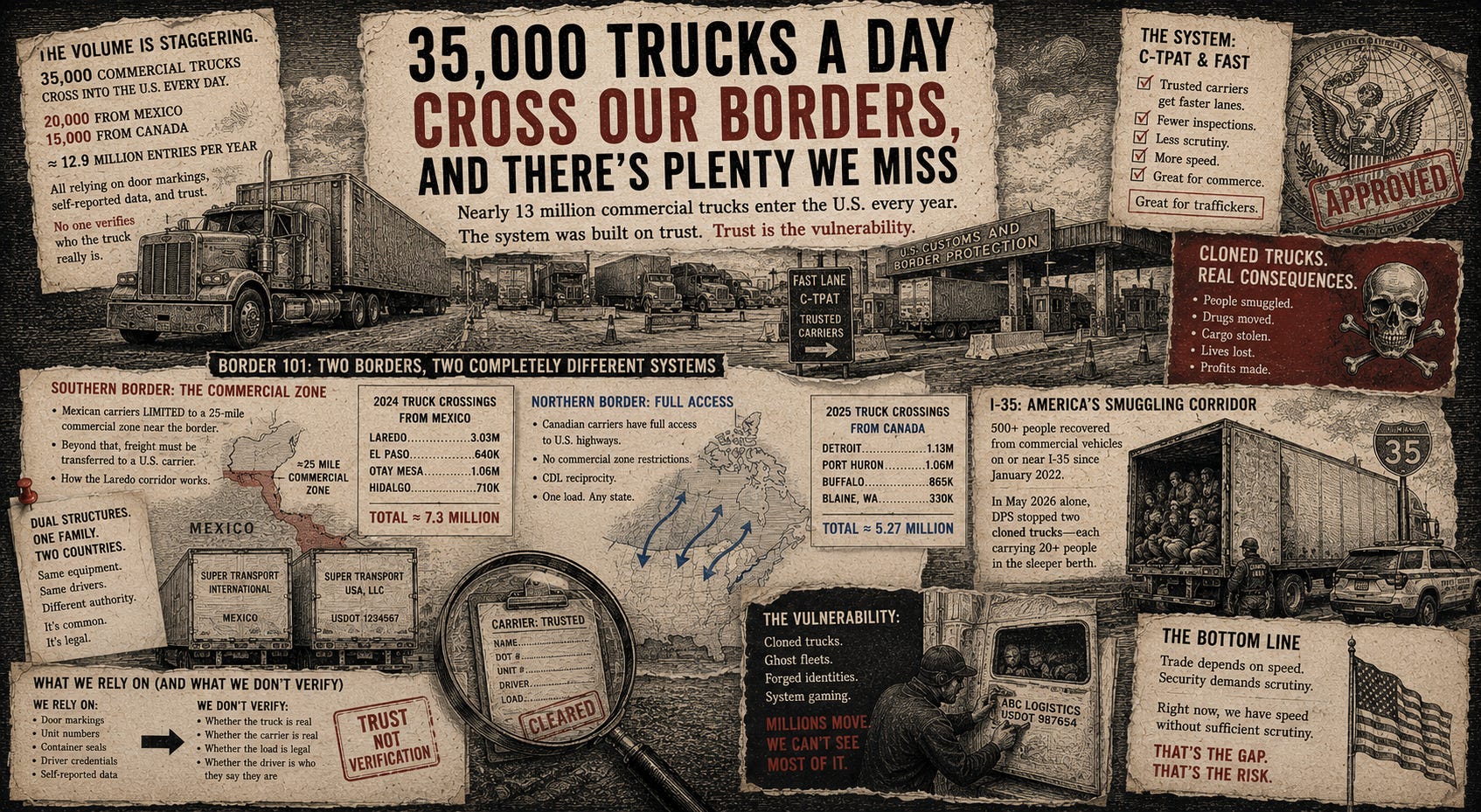
Should we shut down the CTPAT FAST Lane and inspect every truck? I’d argue we should at least at a high level. Roughly 35,000 commercial trucks cross into the United States every day. About 20,000 from Mexico. About 15,000 from Canada. That is approximately 12.9 million truck entries per year according to BTS data, and every single one of them is governed by a regulatory framework that relies on door markings, self-reported data, and trust. Are we catching some, sure, but for every one we catch, how many drive right by undetected?
I’ve spent some time on cloned trucks on I-35, cargo theft rings using forged carrier identities, and ghost fleets that report one truck to the FMCSA while operating hundreds. Every one of those investigations led back to the same root cause: the American freight system has no mechanism to verify that a truck is who its markings say it is. Nowhere is that vulnerability more consequential than at the borders.
Border 101: Two borders, two completely different systems
The first thing most people in this industry get wrong about cross-border trucking is assuming that both sides of the border work the same way. They do not.
The Southern Border and The Commercial Zone
Mexican domiciled carriers cannot haul domestic freight in the United States. Under US cabotage law, they are restricted to a commercial zone near the border, a federally defined area extending roughly 25 miles from the crossing, sometimes more, depending on the municipality. Within that zone, Mexican carriers can perform drayage, picking up and dropping off international freight. To move a load beyond the commercial zone and into the interior of the United States, the freight must be transferred to a US domiciled carrier with US operating authority.
This is how the Laredo corridor works. A Mexican carrier brings a trailer across at the World Trade Bridge. The load is dropped at a yard inside the commercial zone. A US carrier picks it up and runs it to Dallas, Chicago, Detroit, wherever the freight is going. Some operations, like the one we investigated involving Super Transport International, solve this with a dual-company structure: a Mexican parent that handles the Mexico side and a US entity that handles everything outside the zone. Same family, two countries, shared equipment. It is common and legal.
Laredo is the busiest commercial land port in the Western Hemisphere. Approximately 3.03 million trucks crossed at Laredo in 2024, representing 38.8 percent of all US-Mexico truck traffic. El Paso handles about 640,000. Otay Mesa has about 1.06 million. Hidalgo about 710,000. Total southern border truck crossings run around 7.3 million per year.
The Northern Border: Full Access
Canada is different. Under USMCA and the legacy NAFTA framework, Canadian-domiciled carriers have full access to US highways. There is no commercial zone restriction. A Canadian carrier can pick up a load in Surrey, British Columbia, and deliver it to Miami, Florida, without transferring the freight to a US carrier. The CDL reciprocity between the US and Canada means a Canadian commercial driver’s license is recognized in the United States. Canadian drivers operate under Canadian hours-of-service rules while in Canada and switch to US HOS when they cross the border.
Detroit handles about 1.13 million truck crossings per year. Port Huron, which has been absorbing overflow from Detroit due to construction near the I-75/I-96 interchange, processed about 1.06 million in 2025. Buffalo handles about 865,000. Blaine, Washington, about 330,000. Total northern border truck crossings are approximately 5.27 million per year.
Both borders participate in the FAST program, the border-crossing component of C-TPAT. FAST-enrolled carriers get dedicated lanes, reduced inspections, and expedited processing. The premise is the same on both borders: CBP trusts you enough to look less closely at your trucks. It’s the TSA Pre-check of cross-border trucking.
What’s happening on the Southern Border
The I-35 corridor between Laredo and San Antonio has become the most documented truck-based human smuggling route in the country. Last night, another 38 were discovered in a trailer that ended up on fire. Since January 2022, DPS has recovered more than 500 people from commercial motor vehicles on or near I-35 in Webb and La Salle counties. In May 2026 alone, DPS stopped two professional and supposedly cloned commercial trucks on the same stretch of highway eight days apart, each carrying 20 or more people in the sleeper berth.
DPS stated that at least one of those trucks was a professional clone, a newer-model Volvo with manufacturer markings identical to those of a legitimate C-TPAT-certified fleet, down to the unit number and font. The second truck, a Peterbilt, stopped eight days later, was also described by DPS as cloned. These were not magnets or tape. These were organized operations that invested real money in professional markings and wraps to create trucks that could pass visual inspection at any checkpoint, scale, or dock. I say supposed because these announcements were near immediate and an FMCSA source stated on condition of anonymity, “often carriers appearing to be legitimate will haul dope or smuggle, traffic people until they’re caught and then…”That’s not our truck. Never seen that driver before. They’re off the hook.” While we have no reason to suspect these aren’t cloned, there is room for skepticism about cross-border cloning, given the considerable expense, research, and knowledge that go into these vehicles. Unit numbers are real, VINs are real, the truck is nearly new, and data elements are real. The entities and people cloning these trucks are going above and beyond in many cases, even cloning FedEx and UPS trucks. One commenter on LinkedIn said, “We shouldn’t judge the entire border zone or an individual carrier for this behavior.” The border zone provides its own element of criticism; all we’re doing is republishing accurate FMCSA and border data. The objectivity in this is simple regurgitation of government data that people just don’t have readily available. We’re journalists.
The cloners did not pick a random carrier. They picked one whose C-TPAT status means reduced border inspections. The trust was the target.
On the violation side, the data from our cross-border risk model at Tea Technologies shows systemic patterns across the Mexican carrier population. English language proficiency violations, which became an out-of-service criterion under CVSA in June 2025, are widespread at border zone inspections. CDL violations are a recurring finding. The STI network alone had five CDL violations across connected entities in under two years, including three on the Mexican parent.
The Mexican parent entity in the STI investigation, Super Transporte Internacional SA de CV, currently has Driver Fitness and Maintenance issues. It has 12 crashes and 159 violations across 35 reported trucks.
What is happening on the Northern Border
The northern border does not have the same human smuggling crisis. What it has is drug trafficking through commercial vehicles and a systemic fraud problem that is unique to Canadian trucking.
In November 2025, CBSA arrested a truck driver named Satnam Singh at a British Columbia border crossing after a detector dog team found 314 kilograms of methamphetamine concealed in a commercial truck and trailer returning to Canada from the United States. In a separate case, two Ontario truck drivers were charged after CBSA seized $43.7 million worth of cocaine at the border.
These are not isolated incidents. Commercial trucks crossing at Detroit, Port Huron, Buffalo, and Blaine carry the same access and the same trust assumptions as their southern counterparts. A C-TPAT-enrolled carrier crossing at the Ambassador Bridge gets the same reduced scrutiny as one crossing at the World Trade Bridge in Laredo. If a carrier’s identity can be cloned on the southern border to smuggle people, it can be cloned on the northern border to smuggle drugs.
Canada also has its own cross-border trucking fraud problem that has no direct equivalent in the United States. The Driver Inc. scheme, which parliamentary hearings in 2025 exposed in detail, involves carriers misclassifying employee drivers as independent contractors to avoid payroll taxes, workers’ compensation, and insurance obligations. The scheme creates a layer of identity ambiguity in the driver pool: a driver operating as “Driver Inc.” may not appear in the carrier’s employment records, may not be covered by the carrier’s insurance, and may not be subject to the carrier’s safety protocols. Parliamentary hearings revealed deep rifts within the industry over the practice, with major carriers and enforcement agencies calling it a safety and tax-fraud issue.
British Columbia just passed Bill M217, requiring forward-facing dash cams on every heavy commercial vehicle over 26,000 pounds operating on B.C. highways. The rule applies to any in-scope truck on a B.C. road, regardless of where it is registered, meaning US carriers running the Alaska Highway are covered. The bill passed unanimously. That kind of political unanimity on a camera mandate tells you something about the direction of cross-border enforcement.
The C-TPAT problem
C-TPAT was designed to secure the supply chain against terrorism. The program works by giving trusted trade partners expedited border processing in exchange for implementing enhanced security protocols. The concept is sound. The implementation has a gap that has hundreds of people and hundreds of kilos floating right through it.
C-TPAT’s published Highway Carrier Security Criteria require tracking and monitoring of conveyances, but the standard can be satisfied with a paper activity log. It does not require cameras, geofencing, or real-time tracking technology. It requires a seven-point conveyance integrity inspection before each crossing, but there is no mechanism to verify that the truck presenting at the crossing is actually the carrier it claims to be.
When a carrier earns C-TPAT certification, every truck with that carrier’s markings inherits the trust. CBP does not scan the VIN against the carrier’s registered fleet. CBP does not match the unit number against a real-time fleet database. CBP reviews the markings, checks FAST enrollment, and waves the truck through. If someone puts the right markings on a different truck, the clone inherits the trust too.
While we document cloned C-TPAT trucks being used to smuggle 40 people in eight days, CBP is expanding the program. The C-TPAT Pilot Program Act of 2023, signed into law as Public Law 118-98 in October 2024, authorizes CBP to extend C-TPAT eligibility to non-asset-based freight brokers. TIA held a meeting with CBP leadership to implement a pilot with 10 broker participants. The program is getting bigger at the exact moment its foundational assumption, that trust equals security, is being exploited.
What the data shows
We built a cross-border risk model at Tea Technologies that profiles every foreign-domiciled carrier operating on US highways. The numbers tell two very different stories depending on which border you are looking at.
Southern Border: 5,901 Mexican Carriers
Our platform tracks 5,901 Mexican-domiciled carriers with active FMCSA registrations. Those carriers have generated 141,270 inspections, producing 410,097 violations and 50,680 out-of-service orders. The aggregate OOS rate is 24.5 percent, meaning roughly one in four inspections results in a truck or driver being placed out of service.
The behavioral violation data breaks down the specific failure modes. English language proficiency violations total 13,005 across 1,765 carriers. No valid CDL violations, the strongest single predictor of crash involvement, totaled 1,404 across 871 carriers, with 1,289 placed out of service. Vehicle maintenance OOS violations total 17,352 across 1,990 carriers. Unsafe driving violations total 836 across 397 carriers. Hours of service and ELD violations total 569 across 203 carriers.
Three carriers in the Mexican population have both unauthorized passenger violations and no valid CDL violations, a combination our system flags as a potential trafficking signal warranting immediate investigation. Seven carriers match at least one global watchlist, including those from OFAC, the FBI, and trade control screening lists.
The cabotage detection data reveals where these carriers are actually operating. Texas accounts for 7,555 inspections with a 30.5 percent OOS rate, but 6,120 inspections were recorded in US interior states, outside any border or commercial zone, with a 34.8 percent OOS rate. Interior inspections are a cabotage indicator. A Mexican domiciled carrier inspected in Tennessee, Arkansas, or Alabama is operating well beyond the commercial zone.
Northern Border: 16,568 Canadian Carriers
The Canadian carrier population is nearly three times larger at 16,568 carriers, reflecting the full highway access Canadian carriers receive under USMCA. Those carriers have generated 103,207 inspections, producing 76,688 violations and 14,288 OOS orders. The aggregate OOS rate is 10.7 percent, less than half the Mexican carrier rate.
The behavioral violation comparison shows that English language proficiency violations total 59 across 55 Canadian carriers, compared to 13,005 across 1,765 Mexican carriers. CDL violations total 165 compared to 1,404. Drug and alcohol violations total 25 compared to 5. But hours-of-service violations are significantly higher for Canadian carriers, at 3,451 across 1,495 carriers, reflecting the longer haul distances they operate into the US interior. Unsafe driving violations total 3,519 across 1,366 carriers, also higher than the Mexican population in raw numbers due to greater interior exposure.
Zero Canadian carriers have unauthorized passenger violations. 127 Canadian carriers match at least one global watchlist, higher than the Mexican population in raw numbers but representing a much smaller share of the total.
The comparison
Mexican carriers generate 2.9 violations per inspection. Canadian carriers generate 0.74. Mexican carriers have a 24.5 percent OOS rate. Canadian carriers have 10.7 percent. 64.2 percent of Mexican carriers are CRITICAL or HIGH risk. 21.6 percent of Canadian carriers are. The southern border is not the same problem as the northern border. The scale of the violation burden, the driver qualification gaps, and the risk profile are fundamentally different.
Yet the C-TPAT program applies the same trust framework to both. A C-TPAT-enrolled carrier crossing at Laredo with a 30.5 percent OOS rate environment gets the same reduced scrutiny as one crossing at Detroit, where the OOS rate environment is half that. The program does not differentiate based on population-level risk. It differentiates based on individual enrollment. That means a carrier that earns C-TPAT certification in a high-risk corridor inherits the same trust benefits as one operating in a lower-risk environment. The trust is not calibrated to the threat.
On June 4, 2026, a semi-truck carrying 39 people fled the Border Patrol checkpoint near Falfurrias in Brooks County on US-281. DPS troopers pursued, deployed spike strips, and the vehicle caught fire. All 39 people exited safely. That makes two active smuggling corridors in South Texas: I-35 through Webb and La Salle counties and US-281 through Brooks County. The combined total of people recovered from commercial motor vehicles in the South Texas corridor since January 2022 now exceeds 600.
The identity thread
Every border security measure, C-TPAT, FAST lanes, reduced inspections, expedited processing, is built on the assumption that the carrier presenting at the crossing is who it says it is. That assumption is not verified at the point of contact.
On the southern border, we now have documented cases of professionally cloned trucks exploiting that assumption to smuggle people. On the northern border, we have documented cases of commercial vehicles being used to smuggle hundreds of kilograms of methamphetamine and millions of dollars in cocaine. In the cargo theft space, we have the Manhattan DA indicting eight Uzbek nationals for impersonating legitimate carriers to steal $4.5 million in goods. In the insurance space, we have ghost-fleet networks reporting one truck while operating hundreds of trucks under multiple identities.
All of it runs through the same gap. A truck with the right markings is assumed to be legitimate. A carrier with the right number on its MCS-150 is assumed to be operating the fleet size it reports. A driver with the right paperwork is assumed to be qualified. None of it is verified in real time. FMCSA is working on that.
The technology to close this gap exists. Biometric identity verification, VIN matching against real-time fleet databases, and telematics-based chain of custody from load tender to delivery. We are building it at Tea Technologies through LoadVerifi. The tools are not the bottleneck.
The bottleneck is the regulatory framework designed in an era when the only way to identify a truck was to read what was written on its door. That era is over. The criminals know it. The system has not caught up.
Thirty-five thousand trucks a day. Two borders. Twelve point nine million crossings a year. The primary identifier at the point of entry is still painted on a door, or sometimes taped on.