

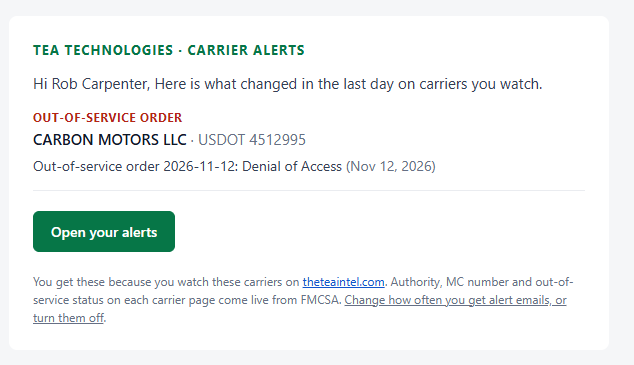
The alert from Tea Technologies hit my inbox this morning. You can actually monitor DOT census changes and applications in real time here with no sign-in or account. Carbon Motors LLC, USDOT 4512995, out-of-service order dated Nov. 12, 2026. Reason: Denial of Access. Federal live data now shows the carrier is not allowed to operate.
I have been writing about the hotshot network fleets for over a year, and I have taken a steady stream of messages from people who think it is all noise. FMCSA doesn’t care. Nothing happens. The bad actors run forever and the honest carriers eat the cost in rates and insurance premiums. I understand the frustration. I’ve carried it myself. But I deal in records, not feelings, and the record on this network says something different. The agency is taking it apart one company at a time, and over the last two weeks it picked up speed.
Carbon Motors is a good place to show you how, because it is about as clean an example of a paper fleet as you'll find, and because I flagged it to the agency myself in July.
One truck on paper
Carbon Motors was added to FMCSA’s registry Jan. 5, 2026. Its MCS-150, filed Jan. 16, lists a physical address at 400 8th St. S. in Naples, Florida, a mailing address on SW 38th Terrace in Miami, a Gmail address, one power unit, one driver and zero miles. Its common carrier authority, MC 1786974, was granted Jan. 26. Cargo: motor vehicles. That is a car hauler, and in this network that means a one-ton Ram or Ford pulling a gooseneck or a Kaufman-style wedge trailer.
The MCS-150 is a self-declaration. Nobody at FMCSA drives to Naples to count trucks. The roadside inspection file is a different animal. Every time a state trooper or a commercial vehicle officer stops a truck, the report goes into the federal file with the carrier’s USDOT number, the VIN and the plate. You can lie on a form. It is a lot harder to lie at a scale house in 46 states.
Carbon Motors’ first roadside inspection came May 11. Its last came Oct. 1. In between, inspectors logged 562 inspections under its number in 46 states. That works out to 26 in May, 36 in June, 120 in July and 238 in August, then 19 in September and one in October. The inspection reports carry 386 different VINs, roughly 290 of them powered units. One truck declared. Hundreds of trucks on the road.
A small carrier can lease to owner-operators, and a leased truck runs under the motor carrier’s number. If Carbon had filed an honest MCS-150 counting those trucks and drivers, a big inspection count would mean a growing company, nothing more. But a company that leases 290 trucks has to qualify 290 drivers, keep their files, run them through a drug and alcohol program and log their hours. The roadside record shows what happened instead.
What inspectors found
FMCSA’s national averages run 22.26% for vehicle out-of-service and 6.67% for driver out-of-service. Carbon Motors’ vehicle out-of-service rate is 46.7%, about double the national number. Its driver out-of-service rate is 43.3%, about six and a half times the national number. In plain terms, inspectors pulled the driver off the road in 241 of Carbon’s inspections and parked the truck or trailer in 205.
The violation codes tell you why. At least 93 inspections cited a driver operating a commercial motor vehicle without the required commercial driver’s license, 49 CFR 383.23(a)(2). That is the core problem with this whole model. A one-ton pickup pulling a loaded three-car trailer is well over 26,000 pounds combined, and the driver needs a Class A CDL. Inspectors also cited 47 drivers for operating without a medical certificate under 391.41(a) and 46 for having no record of duty status at all under 395.8(a)(1). On the equipment side, 61 inspections ended with a trailer out of service for breakaway braking under 393.43(d), the system meant to stop a trailer that comes loose from the truck.
The crash file shows five crashes in seven weeks: July 2 on Interstate 88 in Lisle Township, Illinois; Aug. 8 on Interstate 80 in Cedar County, Iowa; Aug. 12 on Interstate 80 in Hammond, Indiana; Aug. 14 on U.S. 191 at milepost 121 near Moab, Utah; and Aug. 21 on U.S. 69 near Kiowa, Oklahoma. All five were tow-aways. The Moab crash killed one person and injured another, according to the federal crash record. KUTV reported that morning that one person died in a multi-vehicle crash on Highway 191 near Moab and the highway closed in both directions for hours. The crash record does not assign fault, and neither do I. But a carrier that declared one truck and zero miles had a fatal crash on its number in August.
The policy on file was $1 million in liability coverage from GEICO Marine Insurance Co. That is the limit most brokers ask to see on a certificate, and it was written for the one truck on the application.
We told them in July
On July 24, I sent FMCSA a hotshot data breakdown on the network I had been mapping since spring. Carbon Motors was in it. My exact words to the agency: “CARBON MOTORS LLC, DOT 4512995, Naples FL, one declared truck, 31 powered units in 24 states, inspected July 17; not the same network but the same game.” Ironically, we were working the ELDT, ELD fraud data with the agency, which led to the school raids and the ELD shutdowns of 1200+ ELD providers at the same time. We built all this data into our systems, and for the ELD case made famous visually by my buddy Zach Meiborg and his driver, we’ve been working the data for years in litigation and for a year with FMCSA.
I was right. It was the same game. The equipment record since then shows it was also much closer to the same network than I thought. TEA’s VIN analysis of the federal inspection file shows Carbon Motors sharing equipment with 253 other carriers across 860 VIN links. The heaviest overlaps run straight into the companies I have been writing about all year: 45 shared VINs with Golla Group LLC of Davenport, Washington; 45 with Eastroads LLC of East Sparta, Ohio; 45 with GVNL Transport LLC of Benton, Illinois; 35 with Twin Powers Logistics LLC of Miami; 32 with Sakara LLC of Otis Orchards, Washington; 31 with Hauldex LLC of Fargo, North Dakota; 30 with Unitransport LLC of Edwall, Washington; 28 with MLTZX Group LLC of Murphysboro, Illinois.
Follow one truck and you can see the whole thing. A 2025 Ford F-450, VIN ending 46532, shows up in the federal inspection file under ASV Xpress LLC in Mississippi in August 2025. By Halloween, it is running under Central Transit Services LLC in Ohio on a temporary tag. In February, it is in Arizona under OnePoint LLC wearing Florida plate 79FPEK. In June, it is in Texas under Haulfleet LLC, same plate. On July 28, it is back in Arizona under Carbon Motors. Five companies in less than a year. ASV Xpress, Central Transit, OnePoint and Haulfleet are all under federal out-of-service orders. As of Thursday, Carbon Motors is too. Every door that truck has gone through has now been shut by the federal government.
The scoreboard
Doubters of the agency should follow what it’s doing because it’s more than has ever been done before, and twice as fast.
I traced the carriers’ TEA ties to Carbon Motors through shared equipment and ran each one against FMCSA’s out-of-service order file. I matched 248 of the 253. Of those 248 carriers, 116 have drawn at least one federal out-of-service order. Since Jan. 1, 2026, 71 of them, counting Carbon Motors, have been ordered off the road on 79 separate orders. Thirty-eight of those carriers were hit with denial-of-access orders. Thirty-six had their new entrant registrations revoked for refusing a safety audit or ignoring the agency.
A shared VIN is not proof of anything on its own. Used pickups get sold, repossessed and leased every day, and some of the 253 carriers on that list share a single truck with Carbon and are almost certainly legitimate. One of them is Daimler Truck North America. So narrow it down. Look only at the 22 carriers that share 10 or more VINs with Carbon Motors, the ones where a sale or a lease can’t explain the overlap. Seventeen of those 22 are under federal out-of-service orders today: Eastroads, Golla Group, Twin Powers Logistics, Twins Power Logistics, Sakara, Hauldex, Unitransport, Suplicium Transport, ASV Xpress, PK Logistix, Auto Haul Express, AVDB Trans, Horizen, INTT, Haulfleet, Petron Logistics and Rangers Logistics. Of the other five, three show inactive USDOT numbers. Two, MLTZX Group and ShipByRay LLC, are active with no orders.
Seventeen of 22. That is not an agency asleep at the switch.
Look at the calendar. Across this equipment network, FMCSA put seven carriers out of service in October 2025, 12 in November, 10 in December, seven in January, nine in February, eight in March, eight in April, 10 in May, 11 in June, eight in July and six in August. That is a steady drumbeat, month after month, for more than a year. It slowed in September and October.
Between Nov. 5 and Nov. 13, FMCSA issued eight out-of-service orders to carriers in Carbon Motors’ equipment network, and every one of them was a denial-of-access order. Loadshift LLC on Nov. 5. Bullrun Transport LLC and NHX Logistics LLC on Nov. 6. The Time Trans Inc. on Nov. 9. YMC Transport LLC on Nov. 10. The Clearing Path 101 LLC and Carbon Motors on Nov. 12. SVDX Group LLC on Nov. 13. NHX and The Clearing Path were already sidelined by earlier new entrant revocations. The new orders stack federal enforcement on top.
SVDX is a one-truck registration that inspectors stopped 190 times starting in August, and I’ve kept it on my watch list as a link in this chain since the fall. Two days ago, the agency shut it down.
What “denial of access” means
Most people outside compliance have never heard of a denial-of-access order, so here is what it is. Federal law, 49 U.S.C. 521(b)(2)(E), requires a motor carrier to let FMCSA inspect and copy its records and get at its equipment, land and buildings. 49 CFR 390.29 gives a carrier 48 hours, not counting weekends and holidays, to make its required records available at its principal place of business when an investigator asks. A carrier that refuses or can’t produce them can be ordered out of service. It applies to interstate carriers, which is everyone in this network.
In practice, it works like this. An investigator opens a case, contacts the carrier at the address and phone number on its registration, and requests driver qualification files, drug and alcohol testing records, hours-of-service records, and maintenance files. A real trucking company with 290 trucks has a safety department and a filing cabinet. A paper carrier has a Gmail account. When nobody can produce a driver file for a driver without a CDL, the order follows.
That is exactly the tool FMCSA Administrator Derek Barrs said he would use. In February, standing beside Transportation Secretary Sean Duffy, Barrs announced the agency was restoring principal place of business enforcement. “We’ve got to unmask chameleon carriers,” he said. The agency’s handout said carriers would have to keep a physical location where records can be inspected within 48 hours. At the same event, Barrs put it more bluntly: “We’re going to put you out of service, and we’re going to do it as quickly as we can within the rules we have and the tools in our toolbox.” Eight denial-of-access orders in nine days in one equipment network is what that looks like in the data.
Why it doesn’t feel like it’s working
An out-of-service order lands on a USDOT number. In this network, the trucks are already gone by the time it lands. Carbon Motors’ last inspection was Oct. 1. Its USDOT number went inactive Oct. 11. The order came Nov. 12. By then, 120 of the VINs that ran under Carbon had already been inspected again under somebody else’s number. Thirty-one were last seen under GVNL Transport, which is now inactive. Twenty-seven were last seen under MLTZX Group, most recently on Nov. 8. Thirteen turned up under ShipByRay, most recently on Nov. 7. Five went to Solera Logistics LLC of Tampa, which still had one on the road on Nov. 11. MLTZX, ShipByRay, and Solera are active with no out-of-service order.
That is the gap between enforcement and the road. An investigation takes weeks because it has to. The agency has to open a case, make contact, give the carrier its 48 hours and document the refusal, or the order won’t hold up. The network knows that, and it builds the next company before it finishes the last one. The same week FMCSA shut down Carbon, the trucks it ran were working under two other numbers.
Each one is permanent on the record. Every one kills an MC number, a USDOT number and a $1 million policy the network spent money and time setting up. Every one is a piece of evidence for the next case, because FMCSA’s reincarnated carrier rule at 49 CFR 386.73 lets the agency look at shared equipment, management, financial records and insurance to tie a new company to an old one and put the new one out of service too. Every one also puts a broker on notice. A broker who keeps tendering loads to a carrier under a federal order is on the hook for that choice.
The network has to move fast to stay ahead. Carbon Motors ran less than five months from its first inspection to its last. YMC ran about three. SVDX ran about three. When the doors close that fast, the network has to burn through registrations, addresses, phone numbers and insurance policies faster, and every new filing is another fingerprint.
Who pays
The honest small carrier pays first. Every load a paper fleet hauls at a cut rate is a load a legitimate owner-operator didn’t get, and the underwriter who wrote a one-truck policy that ended up covering 290 trucks prices that loss into everyone’s renewal. Those losses don’t stay with the network. They land on the honest carriers in the same risk pool.
The driver pays. A man behind the wheel of a hotshot rig without the CDL the load requires, with no medical card and no logbook, is the one who gets pulled over and put out of service on the shoulder. He often has no idea whose authority he is running under that week.
The broker pays. A one-truck carrier with fresh authority, a clean safety rating because it has never been rated, and an active $1 million certificate looks fine on most vetting screens. One free public carrier lookup site still showed Carbon Motors with a trust score of 87, “Excellent,” after the federal order. Since the Supreme Court’s unanimous May 14 decision in Montgomery v. Caribe Transport II, a broker that picks a carrier like this can be sued over that choice. The defense will not be that the website said: “Excellent.”
The family on the shoulder pays the most. A carrier with one declared truck, a Gmail address and a $1 million policy is the defendant they get after a fatal crash. There is no safety department to depose and no fleet to collect against.
What has to happen next
The agency has shown it will act. The next step is to act before the trucks move, not after.
FMCSA already has the data to do that. A carrier that declares one truck and logs 120 inspections in a month is telling the agency something on its own paperwork. An automatic trigger tied to inspections per declared power unit would open the investigation at week four instead of month four. The reincarnation rule already allows the agency to follow the equipment. Using VIN overlap to pull a successor into the same order, the way the 2012 rule contemplated, would close the door the trucks are walking through. None of that needs a new law. It needs the agency to use the rules it already has against the fingerprint, not the name.
Brokers can start tomorrow. Stop vetting only the USDOT number and start vetting the truck. If the VIN on the rate confirmation ran under three dead carriers this year, you have your answer before the load leaves the dock. TEA flagged Carbon Motors as rejected long before the order came. Carbon’s broker decision score was 31 out of 100, and the network panel showed 41 carriers sharing three or more power units with it.
To the people who tell me FMCSA isn’t doing anything: the investigators are doing their jobs, and they are doing them in a way that holds up. I have sent them network maps, VIN lists and address clusters all year. They have taken the data, built cases and shut down carriers. Seventeen of the 22 companies that shared the most trucks with Carbon Motors are off the road. Seventy-one carriers in this equipment network have been ordered out of service since New Year’s Day. That is real work, done the hard way, by people most of you will never meet.
Carbon Motors told the government it had one truck. The government took that truck’s number off the road. Now it has to get to the next number before the trucks do.
Focusing solely on the roadside inspections, I’m curious how many of these 140 drivers that did not have a valid CDL or valid Fed med card were allowed to drive away from the stop? I’ll bet most or all of them did.
How frustrating. So many people should be doing prison time….