

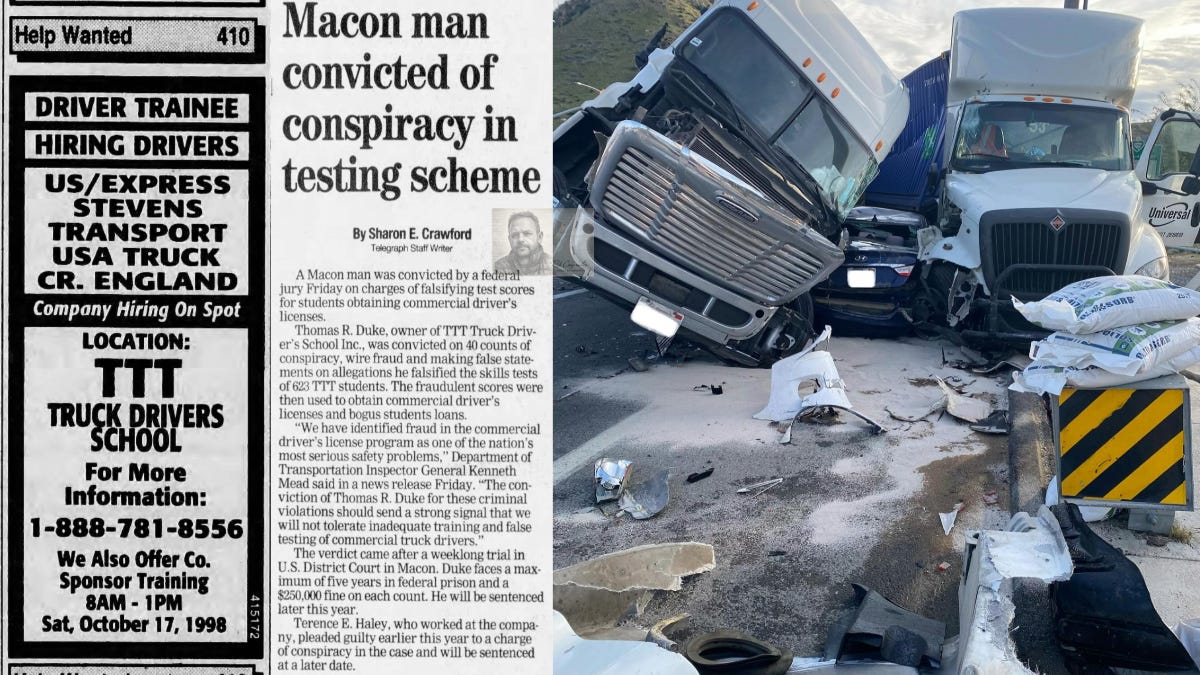
A 24-year review of DOT Inspector General cases reveals a licensing system that can be bought for $2,000, a justice system that treats it like a parking ticket, and a government that has no idea where the people convicted of enabling it are working now.
Between 2001 and 2025, federal investigators documented at least 69 major CDL fraud cases across 20 states, resulting in a conservative estimate of more than 6,000 fraudulent commercial licenses issued to drivers who couldn’t pass a legitimate test, couldn’t read English road signs, and in some cases never got behind the wheel during their “examination.” At least 13 people are dead as a direct result. The fraud factory is still running.
George Ryan died peacefully at his Kankakee, Illinois, home on May 2, 2025, at age 91. The former Illinois governor had spent his final years as something of a folk hero to death penalty opponents. He’d served just over five years in federal prison for corruption charges, walked out in 2013, and lived another 12 years as a free man.
The Reverend Scott Willis and his wife, Janet, still grieve the six children they lost in 1994 when a truck driver with a fraudulently obtained CDL dropped debris that caused their van to explode on a Milwaukee interstate. That driver got his license through the system Ryan oversaw as Illinois Secretary of State.
That gap, between apology and consequence, between conviction and accountability, is the defining feature of America’s commercial driver licensing fraud problem. After analyzing 24 years of DOT Office of Inspector General investigations, the pattern is consistent and maddening. Schemes run for years. People die. Convictions happen. Sentences are light. And then the convicted disappear back into society with no database tracking them, no system flagging them if they return to transportation, no way of knowing if the examiner who sold 248 fake licenses in Ohio is now administering tests in Florida under a different name.
Illinois Secretary of State Alexi Giannoulias received more than $300,000 in campaign donations from individuals and organizations associated with the trucking and logistics industries between 2021 and 2025, according to state campaign finance records reviewed by Just the News. During that same period, his office was issuing commercial driver’s licenses at a pace and in a manner that a federal audit last week found resulted in nearly one in five non-domiciled CDLs failing to comply with federal requirements. Illinois now faces losing $128 million in federal highway funding if it does not revoke the noncompliant licenses and bring its program into compliance within 30 days.
That audit is not an isolated data point. It sits on top of a separate federal charge against Illinois trucking company owner Mykola Datkun, accused of running a hidden earpiece operation at his Island Lake testing facility from 2019 to 2022, charging applicants $500 each to have answers relayed to them in real time during written CDL exams. It sits on top of FMCSA, issuing more than 550 notices of proposed removal to commercial driver training providers last week following a five-day nationwide enforcement sweep that found unqualified instructors, improper training vehicles, and systemic failure to meet federal and state requirements.
The numbers clarify a problem that has been documented for years but is now becoming impossible to ignore. FMCSA identified 17 fatal crashes in 2025 caused by non-domiciled CDL holders whose fitness could not be verified. North Carolina and New York audits found that more than half of the reviewed non-domiciled CDLs were issued illegally. Texas came in near 50 percent. Illinois, at 20 percent, is presenting the number as a defense.
The broader reality that these audits are surfacing is straightforward. Federal broker authority costs $300 in filing fees. CDL mills are moving applicants through programs for $800 to $1,200. For less than what most Americans spend on a used car, a person with no verifiable qualifications, no demonstrated English proficiency, and no legitimate training record can operate an 80,000-pound commercial vehicle or broker freight on American highways. The system was not designed to work this way. It has drifted here over years of insufficient oversight, inadequate enforcement, and, in some states, the active participation of the officials responsible for preventing it.
The fraud factory is still running. There are just so many people operating it today.
THE SCALE
Between 2001 and 2025, federal investigators documented systematic corruption across 20 states, resulting in a conservative estimate of more than 6,000 fraudulent commercial driver’s licenses issued to unqualified operators. That number is conservative; it counts only cases that resulted in convictions. The actual figure is higher when accounting for undiscovered schemes and cases that never reached prosecution.
The documented death toll is at least 13 people killed and hundreds injured. The single worst incident involved Adem Salihovic, who in 1998 triggered a 74-vehicle pileup in California that killed two and injured 51. Salihovic had obtained his CDL through a scheme run by Watkins Motor Lines supervisor Frank Catanzarite, who admitted to accepting $10,000 in bribes from unqualified drivers. Catanzarite served 17 months in prison. He’s been free for over 20 years. Where is he? The system doesn’t know. The system doesn’t track that.
THE THREE BIGGEST CASES
Operation Safe Road is where most people’s story starts, and for good reason. Between 2001 and 2003, federal investigators dismantled an Illinois-based scheme that stretched into Florida and produced more than 1,000 fraudulent CDLs with 41 total convictions. Illinois driving schools recruited Eastern European and Russian immigrants who couldn’t pass a legitimate test. Middlemen charged $800 to $2,000 to transport these applicants to Florida, where corrupt testers at 3S Trucking Inc. would pass them without actual testing. Many applicants never got behind the wheel.
It went higher than that. Back in Illinois, Secretary of State employees were selling fake CDLs for $500 to $1,500 and using the proceeds to buy raffle tickets for Governor George Ryan’s political campaign. Ryan’s chief of staff, Scott Fawell, had tied employee pay raises to ticket sales, so employees found it easier to issue fraudulent CDLs and use that money to buy the tickets themselves. At least $170,000 in illegal CDL money flowed directly into Ryan’s campaign coffers. Ryan and Fawell each served 6.5 years. The other 38 individuals convicted in Operation Safe Road? Most served probation or short sentences and vanished back into the workforce. No database tracks where they went.
In Florida, Larex Incorporated ran a Russian-language trucking school between 2014 and 2016 that charged students $1,800 to $5,000 for guaranteed CDLs. The operation used covert cameras, wireless earpieces to feed answers during written tests, fake residency documents, and a cooperative third-party tester who passed everyone regardless of ability. The Florida Highway Patrol discovered the scheme when investigators noticed hundreds of applicants using the same address, Larex’s business location. Florida sent warning letters to more than 2,000 CDL holders requiring retesting within 60 days. There is no follow-up data on how many actually retested, how many simply stopped using the CDL, or how many continued driving without anyone the wiser. Owner Ellariy Medvednik served 12 months and one day. Released in early 2017. Current whereabouts: unknown.
In Georgia, TTT Truck Driver’s School owner Thomas Duke and third-party examiner Terence Haley falsified skills tests for 623 students over six years ending in 2004. Georgia required all affected drivers to retest. Of those who showed up, only 142 passed, a 77 percent failure rate. That means 481 people who had been operating commercial vehicles on American highways had never legitimately demonstrated they could do it safely. Duke served 51 months. Haley got five years’ probation. Current whereabouts of Haley: We believe he is driving for a national carrier. Nothing prevents that. Nothing would flag it.
HOW IT WORKS
Two decades of OIG investigations reveal four consistent fraud methods. Ghost testing accounts for 47 percent of documented cases, applicants paid for passing scores without taking tests, examiners pre-signed score sheets ,or submitted electronic records for people who never showed up. Database manipulation accounts for 23 percent, primarily in California, where DMV employees with system access discovered they could alter records and make hundreds of thousands of dollars by changing database fields. Shawana Denise Harris, a California DMV employee, made approximately $277,500 in bribes before being sentenced to five years in prison in November 2022. Abbreviated testing accounts for 18 percent; legitimate CDL skills testing takes nearly an hour, including a pre-trip inspection, basic controls, and a road test. Ohio examiner Neal Conaway was running group tests in about 10 minutes. Technology-enabled cheating accounts for the remaining 12 percent, including hidden cameras, wireless earpieces, pencils with encoded answers, and Bluetooth headsets that feed test responses from off-site operators.
The pricing reveals a functioning market. Individual examiner bribes ran from $70 to $400. Mid-range full-service operations that included transport to testing sites, fake documents, and guaranteed passage charged $800 to $2,000. Premium packages with fake residency documents, cheating equipment, and coordinated multi-jurisdictional testing ran $2,500 to $5,000.
Approximately 40-45% of documented cases involved foreign nationals or immigration fraud. This is not about immigrant communities in general; it reflects how fraud operations specifically target populations who faced legitimate barriers to licensing, primarily the English proficiency requirement. Non-English speakers who couldn’t pass legitimate tests were the ideal customers for fraud networks that charged premium prices to bypass those requirements. The schemes consistently involved higher fraud fees, organized networks targeting specific ethnic and language communities, technology to circumvent language testing, and interstate fraud to exploit reciprocity between state licensing systems.
WHAT HAPPENS WHEN YOU GET CAUGHT
Not much, by any reasonable measure. Examiner and facilitator sentences ranged from probation to 51 months, with a median of 12 to 18 months. DMV employees typically receive 24 to 36 months. Driving school owners averaged 18 to 24 months. Individual drivers who purchased fraudulent licenses were rarely prosecuted; most faced only license revocation.
The people enabling mass casualties in commercial trucking served, on average, less time in prison than someone convicted of possession with intent to distribute. The economic calculation for someone considering selling CDLs is straightforward. A DMV clerk making $35,000 annually could match that salary in bribes in a few months. The risk of prosecution was low, the sentences upon capture were light, and there was no system to track them afterward.
THE CASES THAT ARE HAPPENING RIGHT NOW
This is not a historical problem. In Massachusetts, former State Police Sergeant Gary Cederquist ran the CDL Unit from February 2019 to January 2023 and arranged passing scores for dozens of applicants who failed or never took the test. The conspirators used the code word “golden” to identify applicants receiving special treatment. Text messages recovered by investigators showed Cederquist describing applicants as “horrible,” “brain dead,” and “should have failed about 10 times already” while giving them passing scores anyway. What did he receive in exchange? A new driveway worth more than $10,000, a snowblower, a granite mailbox post, and thousands of dollars in bottled water, coffee, and candy, Twizzlers and Swedish Fish specifically. Cederquist faces up to 20 years in prison. His co-conspirators received sentences ranging from one month to one year. All will be free within the next year or two.
In Louisiana, a federal grand jury in August 2025 indicted six people, two state DMV employees, three third-party testers, and a restaurant owner, for operating a bribery scheme from at least August 2020 through February 2024. Four years. Operating inside the state agency responsible for issuing the licenses. When those defendants are convicted, they will serve abbreviated sentences and return to society with no system flagging them if they attempt to return to transportation work.
In Connecticut, a Peruvian citizen identified as Flor Consuelo Del Carmen Caballero Bernabe was charged in August 2025 with operating under a stolen American identity since 2000. She maintained a Connecticut CDL under that identity for 25 years, made false statements on FMCSA medical examination forms to keep it current, and drove commercially for FMCSA-regulated entities throughout. The case was only discovered when the actual identity owner applied for Social Security Disability benefits in 2022, and the SSA informed them that someone in Connecticut had been earning income using their Social Security number.
THE FIX THAT EXISTS AND HASN’T BEEN BUILT
The FMCSA Drug and Alcohol Clearinghouse launched in 2020 and demonstrated that a national tracking system for commercial driver violations is operationally feasible. Employers query it more than a million times annually. It works. It prevents drivers with substance violations from state-hopping to avoid consequences.
There is no equivalent system for CDL fraud convictions.
A third-party examiner convicted of fraud in Ohio can apply to become a certified examiner in Florida. A DMV employee convicted of altering records in California can seek employment in a motor vehicle agency in Texas. A driving school operator convicted of bribery in Massachusetts can open a new school in Georgia. There is no national database to flag them, no mandatory reporting requirement, no cross-state coordination protocol, and no employment verification system to surface a transportation fraud conviction before someone is granted authority to certify commercial drivers again.
The FMCSA has the model. The technology exists. What has been missing is the political will to build the fraud-clearinghouse equivalent of what already exists for drug and alcohol violations. Until that system exists, every conviction in this article represents someone who served their time, walked out, and disappeared into a country with no system watching where they went next.
Out of more than 100 convicted individuals examined for this analysis, definitive current locations could be confirmed for only a handful, those currently incarcerated or recently sentenced. Everyone else is unknown.
The fraud factory is still running. The question isn’t whether it will produce the next mass casualty event. It’s how many it will produce before the system that enables it is actually changed.
A note on sourcing: This article is a condensed version of a more comprehensive investigation published across the “30 Days of Why” series on The Tea Substack. The full CDL fraud case repository covering all 69 documented cases, immigration cross-reference data, and extended systemic analysis that doesn’t fit publication constraints is available here.
Absolutely crazy !