

Two years ago, I wrote a piece called “Resurgence of Authenticity” for my “Rob Report” newsletter on LinkedIn about how the era of the curated facade was dying, and people were starving for what’s real. I used Oliver Anthony as the example, a guy who sat on his porch, looked like he’d been working all day because he had, and sang about what he actually knew. No stylist. No strategist. No consultant whispering in his ear about how to “connect with rural America.” He just was. And tens of millions of people felt it immediately.
That piece was about culture. This one is about politics. Same disease, higher stakes, bigger body count.
Let’s talk about what’s actually happening.
The Costume Change
There’s a pattern playing out in American politics right now that’s so transparent it’s almost insulting. Politicians who’ve spent their entire careers in curated, consultant-driven bubbles are suddenly showing up cosplaying as everyday Americans, expecting us not to notice.
Kamala Harris is cooking collard greens on camera. Let’s be honest, that woman has a personal chef, and every clip of her in a kitchen looks like someone handed her a spatula for the first time five minutes before they hit record. Obama sipping Guinness at an Irish pub like he’s been a regular since the ‘90s. Pete Buttigieg, the former Secretary of Transportation who was arguably the most openly progressive cultural figure in the Biden administration, is suddenly sporting a beard, wearing flannels, and holding firearms as if he’s been hunting whitetails in Indiana his whole life. This is the same man who, not long ago, was photographed using a supplemental nursing device to feed his infant. And there’s nothing wrong with that, unless six months later you’re trying to sell yourself as Paul Bunyan. Then you’ve got a credibility problem.
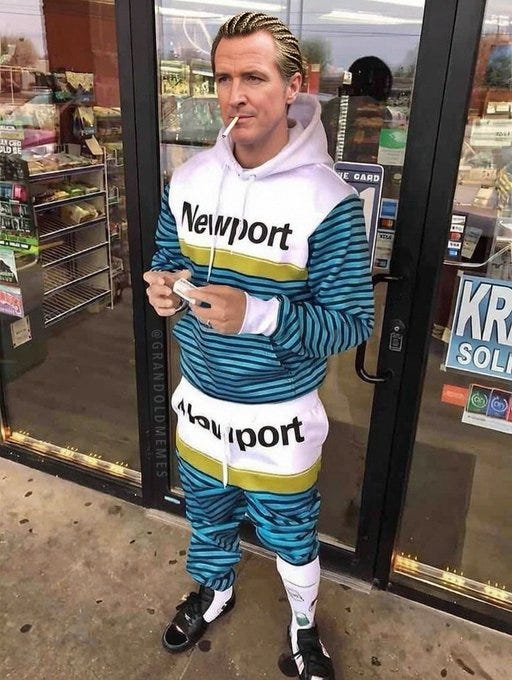
Now Gavin Newsom apparently steps in it this week by essentially telling a room full of Black voters he’s just like them. Who does that? Who walks into a room and says the quiet part loud, thinking the people you’re pandering to are too unsophisticated to notice?
The answer: people who’ve never actually been around the people they’re pretending to understand.
Why It Fails
There’s a concept in psychology called the uncanny valley. It was originally used to describe humanoid robots that look almost real but not quite, and how that “almost” makes people more uncomfortable than something that’s obviously fake. The same thing happens with political authenticity.
When a politician puts on a flannel and picks up a shotgun, your brain doesn’t just see the image; it cross-references everything it already knows about that person. Every prior appearance. Every speech. Every policy position. And when the new image doesn’t match the catalog, it doesn’t build familiarity. It triggers suspicion. You’re not closing the gap with voters, you’re widening it. You’re telling them you think they’re stupid enough to fall for a costume change.
Harvard research actually backs this up. Voters penalize perceived pandering more harshly than they penalize genuine disagreement. People would rather you tell them you don’t hunt, you’ve never held a gun, and you think differently about the Second Amendment than pretend to be something you’re not. At least disagreement is honest. Fakeness is an insult.
Kamala Harris lost an election in large part because of this. She tried to be everything to everyone and ended up being nothing to anyone. Every appearance felt like a different character. Different accent, different energy, different persona depending on the room. The inconsistency wasn’t just noticeable; it was disqualifying. Because if you can’t be consistent about who you are, how can anyone trust you to be consistent about what you’ll do?
Why Trump Works
Here’s what drives people crazy about Donald Trump, and I say this as an observation, not an endorsement: the man has never pretended to be something he isn’t.
He’s never worn a flannel. Never held a hunting rifle for a photo op. Never showed up at a factory pretending to work a shift. He eats McDonald’s and well-done steak with ketchup, not because some consultant told him it would play well with middle America, but because that’s apparently what the man actually eats. He wears a suit and a red tie to everything, including disaster sites and rallies in rural Alabama.
And yet, working-class America feels a connection with him that polished, consultant-built politicians have spent billions trying to manufacture and failed.
Why?
Because the brain doesn’t need you to be like someone to trust them. It needs you to be consistent. Psychologists call it congruence when the signal matches across time, context, and environment. Trump in 2015 is Trump in 2020 is Trump in 2025. You can disagree with every word the man says, but you can’t say you don’t know who he is. That consistency registers as honesty in the brain’s heuristic processing, even when the actual content is debatable.
The consumer politicians, the ones who’ve never employed a working-class person, never managed a crew, never sat across from someone at a truck stop at 2 AM, they don’t understand this. They think familiarity is something you can manufacture in a photo shoot. But familiarity is earned, not borrowed. And borrowed familiarity has a shelf life of about one news cycle before people start smelling the fraud.
The Detection System
Here’s what these politicians and their consultants consistently underestimate: human beings are fraud detectors. We evolved in small tribal groups where detecting deception was a survival skill. Those instincts didn’t go away just because we moved to cities and started consuming politics through screens. Your subconscious is processing hundreds of micro-signals: the way someone holds a firearm, whether their hands look like they’ve done manual labor, how naturally they interact with a plate of food, and assembling a verdict before your conscious mind even engages.
I do this professionally in a different arena. I investigate chameleon carriers in trucking, companies that change their name, their officers, their DOT numbers to evade accountability after killing people on the highway. Same entity, new mask. The detection methodology is the same: look for the patterns that don’t change when someone swaps out the surface-level identity. It’s the same instinct, different domain. Americans are better at this than politicians think.
The reason some people get temporarily bamboozled is a well-documented phenomenon called the commitment and consistency bias. Once you’ve publicly supported someone, your brain works overtime to rationalize the signals that don’t match. You’ll defend the beard and the flannel because admitting it’s performative means admitting you were fooled. And that admission is psychologically expensive. So people hold on until they can’t anymore. And then they feel betrayed, which is worse than if the politician had just been honest from the start.
Authenticity Can’t Be Manufactured
Two years ago, I wrote that above all else, be authentic, and second, be humble. I stand by that. Someone once threatened me with exposure, “I’ll tell everyone about you.” Bro, I’m an open book. People already know exactly who and what I am. That’s not bravery. That’s just math. You can’t be leveraged when there’s no mask to remove. You can’t be unmasked when you never hid.
That’s the advantage authentic people carry, in business, in content, in life, and especially in politics. Oliver Anthony didn’t strategize his way to virality. He was just himself, and the market was so starved for genuine that it responded with a force no marketing budget could replicate.
The politicians who will win going forward are the ones who figure out what people like Anthony and, yes, Trump already understand instinctively: you don’t connect with people by becoming them. You connect by being unapologetically, consistently, relentlessly yourself, and by trusting that honesty is enough.
Authenticity is a commodity now. And most of these people are bankrupt.