

Every credit decision is a bet on one simple proposition: the company that signs the paper today will still be the company that owes you tomorrow. Trucking was supposed to make that bet easier than most industries do. Every for-hire motor carrier gets a USDOT number and operating authority from the Federal Motor Carrier Safety Administration. It files an MCS-150 telling the government who runs it, how many trucks it operates, and how many drivers it employs. It files a BOC-3 naming an agent in every state who will accept lawsuits. It keeps a registered agent with its state of incorporation. Its insurer files proof of coverage with FMCSA and has to give notice before that coverage ends. Its lenders file UCC financing statements so the next lender can see who is already in line.
Stack those records together, and you should know who you are dealing with. A credit analyst, an underwriter, a factor’s onboarding team, a lessor’s collateral desk, and a broker’s carrier vetting team all build their files from some combination of them.
The issue is, each of those records is filed by the company being judged, and almost every one can be changed cheaply, quietly, and fast. The networks I investigate know that better than the people extending them credit.
Why I went looking
I spent 25 years on every side of this business: CDL-A driver, owner, freight broker, fleet executive, compliance director, crash reconstructionist. I have filled out both sides of a trucking credit application. I asked for terms as a carrier and extended them as a broker. I ran fleets for a private equity owner, and I have done insurance risk control, finance risk control, and loss control. We advise some of the nation's PE firms, insurers, and finance teams. When I did work for Cortec Group under Groome Management, there's a reason the CFO came to me and not anyone else. Real financial risk comes from real frontline ground-level intelligence. The best minds in finance realize that.
Today I testify in truck crash litigation, and in case after case the same parties end up at the bottom of the pile: the family, the drivers who did not get paid, and whoever lent money against the trucks. Every one of those jobs taught me the same thing. Risk in trucking is almost never just operational. A bad maintenance call becomes a claim. The claim becomes a lawsuit. The lawsuit becomes a default, and the default lands on somebody’s credit desk.
On Monday, I speak to credit and collections professionals at the TRMG Fall Conference in Clearwater Beach, Florida. Preparing for that room forced me to ask a question I had been circling for a year. We talk about chameleon carriers as a safety problem, and they are. What nobody prices is that they are a credit problem first, and credit failures keep unsafe trucks rolling. Many of the risk tools sold to this industry were built by people who have never been close to a truck, based on what somebody told them should be in it. Most vetting confirms a carrier has a DOT number, insurance, authority, and a phone number. We built ours to look behind the name: hazmat spill history, SBA loans, UCC liens, SCAC codes, and the network of people and trucks behind the company. Disclosure: I founded Tea Technologies, which operates TeaTech’s platforms are used for the analysis in this piece, sells carrier risk intelligence, and provides the platform to FMCSA under an evaluation agreement.
The market you are lending into
Start with the numbers that frame every renewal and every credit line in transportation right now.
Commercial auto insurance lost money on an underwriting basis for 14 straight years through 2024, according to AM Best, which put the 2024 loss at $4.9 billion. The 2025 line improved and still ran underwater, at a 114.7 combined ratio and roughly $1.9 billion in losses. The American Transportation Research Institute’s 2026 cost update puts insurance at 10.6 cents per truck mile, up 23.9% since 2021. That cost hits your customers’ margins before it ever hits your aging report.
Verdicts are the reason. ATRI found the average trucking verdict above $1 million rose from $2.3 million in 2010 to $22.3 million in 2018, a 967% increase. Marathon Strategies’ 2026 edition of its corporate verdicts report found trucking and automotive nuclear verdicts of $10 million or more totaled $3.4 billion in 2025, up from $1.4 billion in 2024, on fewer cases. Across all industries, the firm counted about 200 nuclear verdicts totaling $25.6 billion, up 40.7%.
Then the floor moved under brokers and shippers. On May 14, 2026, the Supreme Court ruled 9-0 in Montgomery v. Caribe Transport II, No. 24-1238, that federal law does not preempt state negligent-selection claims against freight brokers. A jury can now review the carrier-selection decision. In July, a Dallas County jury returned a $604 million advisory verdict against C.H. Robinson as broker of record in Lipe v. Lupus Superior, a fatal crash case; the company has said it will appeal.
The insurance market answered immediately. A SONAR analysis published Sept. 9 reported primary broker liability renewals up roughly 40% to 60%, excess layers up 50% to triple digits, two underwriters out of the broker auto liability market since May, and a remaining pool of about 10 carriers, citing TD Cowen. Scopelitis partner Greg Feary told Transport Topics that one broker client’s premiums tripled a week after the ruling. Cottingham and Butler’s Chris Vogel described a broker whose renewal cut its limit from $10 million to $5 million, doubled the deductible, and turned the limit into an aggregate.
Follow that chain to its end, and you arrive at a credit desk. Exposure turns into defense costs and settlements. Those need capital. The capital needs insurance that just got more expensive and thinner. The broker or carrier that cannot fund all of that comes to a lender, a factor, or a supplier for terms. The supply chain has never carried more financial risk than it does right now, and the parties carrying it are underwriting from the thinnest files in the industry.
The weak end of the market is already breaking. FreightWaves counted more than 20 trucking-related Chapter 7 and Chapter 11 filings in a single 30-day window this spring, including the liquidation of Standard Forwarding Freight, a 92-year-old carrier with 14 terminals. Trucking payroll employment hit its lowest level since September 2020, according to Bureau of Labor Statistics data FTR analyzed.
None of that means trucking credit is collapsing. The Equipment Leasing and Finance Association’s CapEx Finance Index for July 2026 reported delinquencies at 1.8% and an average loss rate of 0.46%, the lowest in nine months, on record monthly new business volume of $14.3 billion. Most carriers pay their bills. Most fleets that run several DOT numbers do it for ordinary reasons: a separate entity for equipment, one for real estate, a brokerage kept apart from the fleet. Ryder and Republic run multiple numbers in the open, and in our data their entities share every identifier, from officers to trucks, because they have nothing to hide. Most liens are lawful. Most lenders sue small businesses every day, and a closed docket often means the bill got paid.
The losses do not spread evenly. They pool where the paper and the operation have been deliberately separated.
What the rules actually say
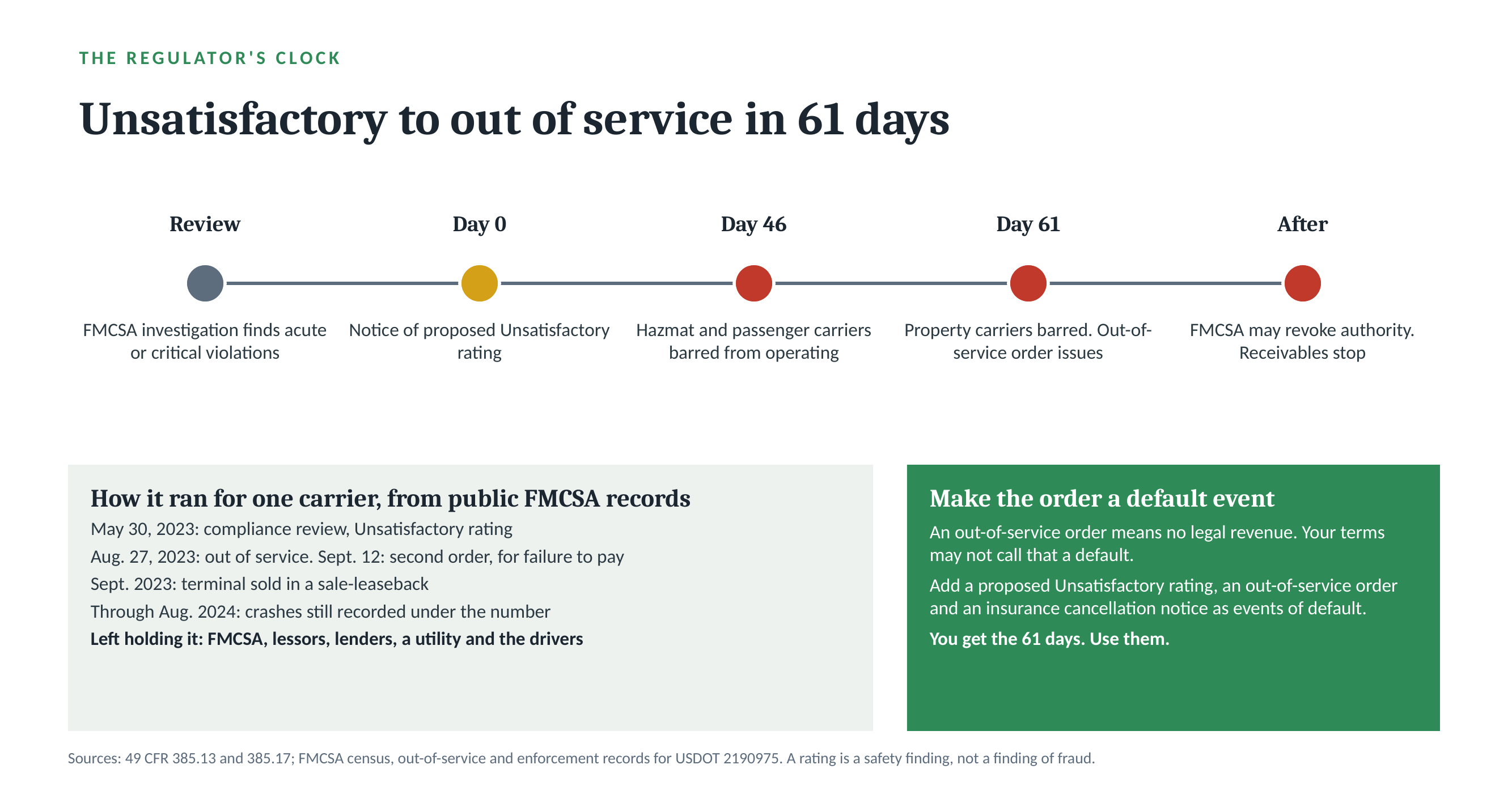
Credit teams should know five federal rules by number, because each one is a clock or a ceiling that decides who gets paid.
The first is the safety rating clock. Under 49 CFR 385.13, a property carrier that receives a notice of a proposed Unsatisfactory rating is prohibited from operating beginning on the 61st day after that notice; hazmat and passenger carriers stop on day 46. When the rating becomes final, FMCSA issues an out-of-service order, and it may revoke the carrier’s authority. An out-of-service order means no legal revenue. Most credit agreements do not treat it as a default.
The second is the insurance clock. Under the federal MCS-90 endorsement, either the insurer or the carrier can cancel by giving 35 days’ written notice to the other and 30 days’ notice to FMCSA. When coverage ends, FMCSA moves to revoke authority. The same endorsement says something most creditors have never read: when the insurer pays a claim it would not otherwise have owed under the policy, “the insured agrees to reimburse the company.” A rescinded policy does not just leave your customer uninsured. It can also create a new creditor.
The third is the ceiling. The federal minimum liability for general freight, in 49 CFR 387.9, is $750,000. It was set in 1980 and has not moved. A serious crash outruns it before the first deposition, and the plaintiff’s lawyer goes looking up the chain for whoever has more.
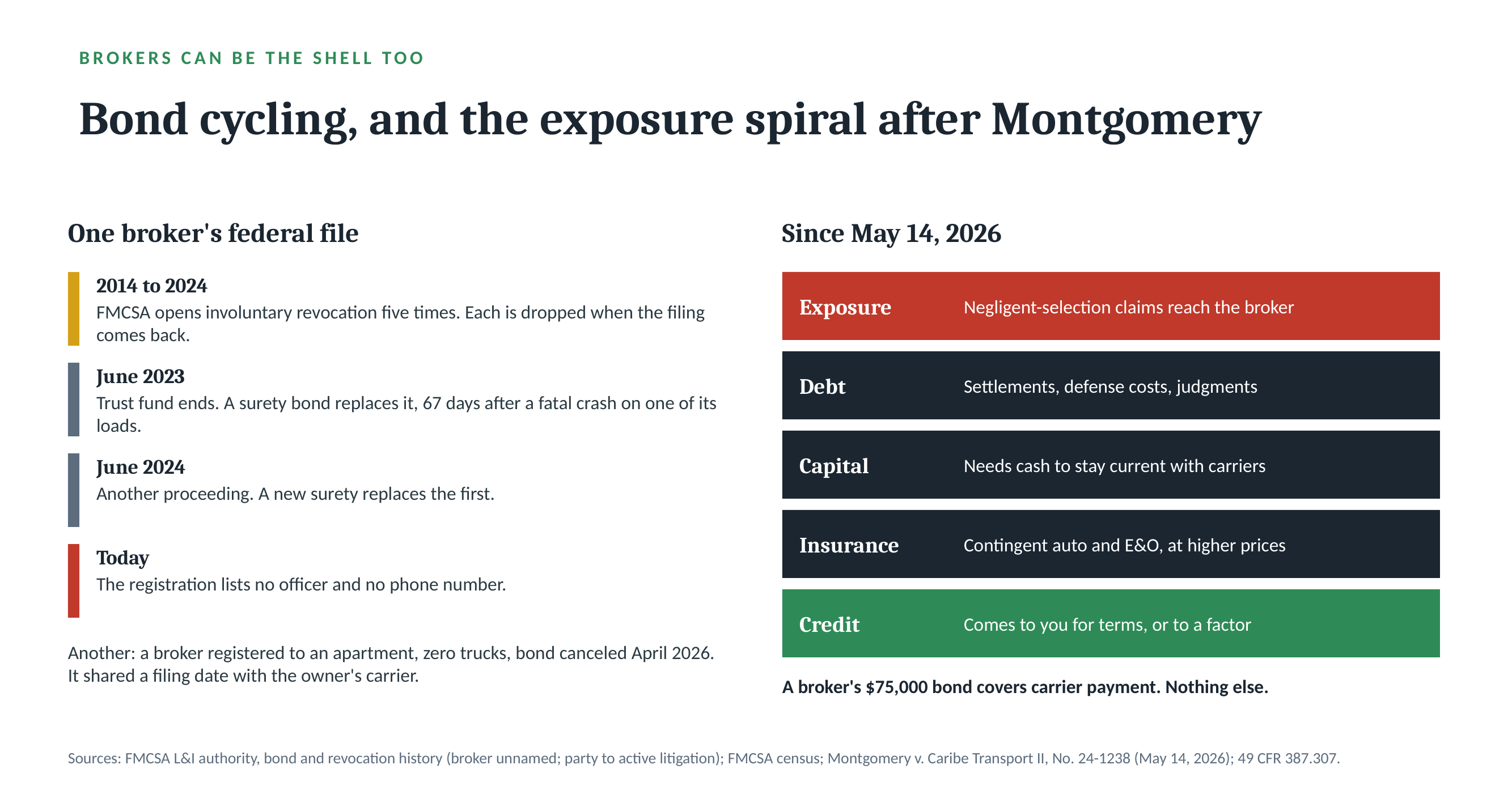
The fourth is the broker bond. Under 49 CFR 387.307, a broker carries a $75,000 surety bond or trust. It exists to pay carriers. It does not pay a crash claim or your invoice. Since Jan. 16, 2026, FMCSA can suspend a broker whose bond falls below that floor and isn't replenished within seven business days.
The fifth is the one this piece is about. Under 49 CFR 386.73, adopted in 2012, FMCSA may order a carrier or broker out of service if it operated under a new identity or as an affiliated entity to avoid an order, a penalty, or association with a poor compliance record, and the agency may merge the new company’s record with its previous incarnation. The factors the rule lists- common officers, addresses, phone numbers, equipment, drivers, and customers- are the same factors a creditor needs to prove successor or alter ego liability. The government wrote your collection checklist 14 years ago.
Case one: the paper died, the trucks kept working
On March 14, 2025, Auxilior Capital Partners Inc., a Plymouth Meeting, Pennsylvania, equipment finance company, filed a verified complaint in the Northern District of Illinois (Case No. 1:25-cv-02702) against RTL Leasing LLC, RTLX Ltd., and Reserve Truck Lines Ltd. Co. and Jacob Kuenzl. The complaint is the best credit case study I have seen in this industry because the lender laid out its own mistakes in sequence.
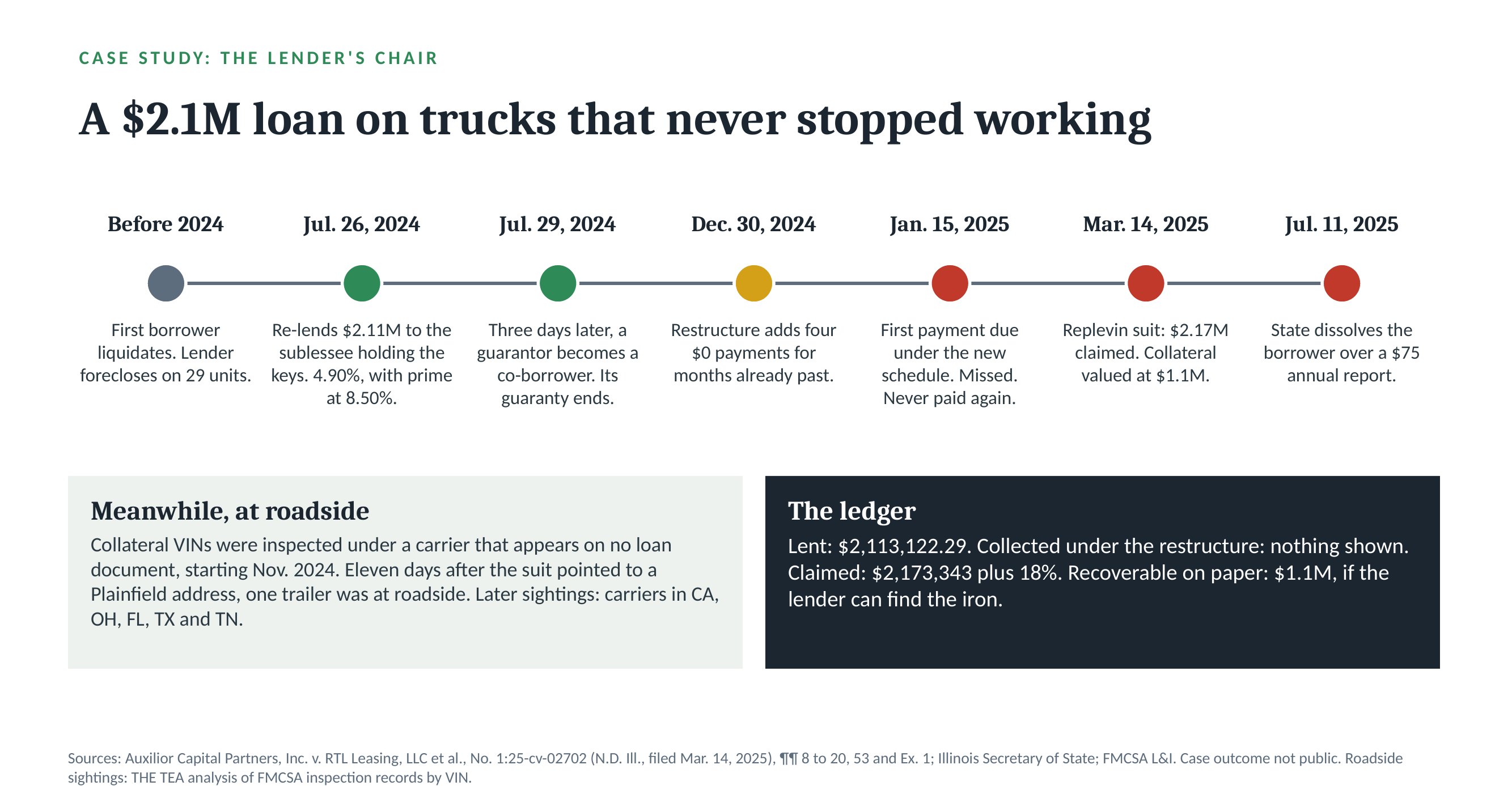
Auxilior had financed equipment for a Joliet carrier called Merging Express LLC. According to the complaint, Merging Express told Auxilior it had subleased the equipment to RTL Leasing, then ceased operations and liquidated. Auxilior foreclosed. As the sublessee, RTL Leasing had possession of the trucks. Instead of sending recovery agents into a yard, Auxilior “agreed to finance RTL Leasing’s purchase of the equipment previously owned by Merging Express.”
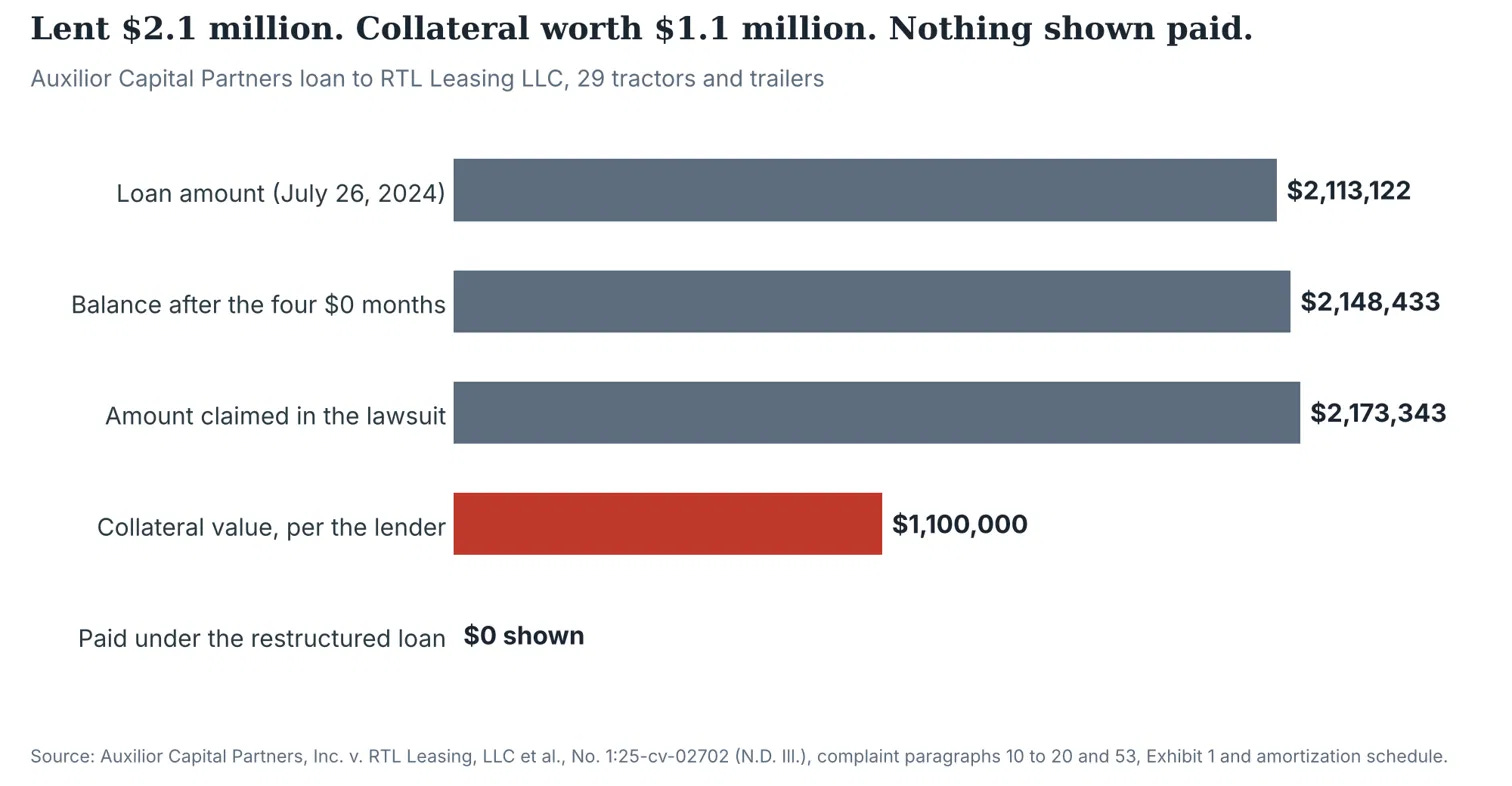
On July 26, 2024, Auxilior and RTL signed Loan and Security Agreement No. XXX2906 for $2,113,122.29, payable in 48 monthly installments of $48,607.71. The collateral was 29 units: 11 Freightliner and Volvo sleeper tractors from model years 2018 to 2020, and 18 dry van and reefer trailers from 2017 to 2022. The loan exhibit carries a 4.90% rate. The Wall Street Journal prime rate that day was 8.50%. RTL Leasing, an Illinois LLC formed in January 2021 at 13717 U.S. Route 30 in Plainfield, has never held a USDOT number or operating authority. It could not legally haul a load, which means it had no freight revenue of its own to pay the note.
Reserve Truck Lines, an Iowa company at 222 3rd Ave. SE in Cedar Rapids, USDOT 3175112, signed a corporate guaranty. Kuenzl signed a personal guaranty. RTLX also signed a corporate guaranty, and three days after closing, on July 29, 2024, a first amendment made RTLX a co-borrower and terminated that guaranty. Paragraph 16 of the complaint concedes that RTL never got new titles issued, so every certificate still named Merging Express, a company that had already liquidated, as the owner.
On Dec. 30, 2024, the last business day of the year, the parties signed a second amendment “as an accommodation to RTL Leasing.” It accepted $0.00 payments for September 15 through December 15, 2024, months that had already passed, then one payment of $12,883.44, five of $8,772.77, six of $15,000, 12 of $30,000, 36 of $45,000, and a final balloon of $400,632.70. On paper, a loan four payments behind became current with one signature. The amortization schedule attached to the complaint shows interest capitalizing during the zero-dollar months, pushing the balance from $2,113,122.29 to $2,148,433.28, with the first scheduled dollar of principal reduction on payment 11.
RTL and RTLX missed the first payment due under the new schedule on Jan. 15, 2025, and every payment after it. Auxilio’s complaint claims $2,173,343 plus 18% contract interest. In paragraph 53, it puts the fair market value of all 29 units at $1.1 million. The lender asked a federal judge for a writ of replevin authorizing the U.S. Marshal “to use all necessary force, including the force necessary to break locks,” and stated that it “has been unable to secure the Equipment by peaceful means.”
The complaint said the equipment was believed to be at 13717 S. Route 30, Suite 111, in Plainfield, “or wherever it may be found.” Federal roadside inspection records show where some of it was found. Collateral VINs were inspected under a carrier that appears nowhere in the loan agreement, the guaranties, the UCC filing, or the lawsuit, starting in late 2024. Eleven days after the suit was filed, one of the 2022 Utility reefers was at roadside. Over the following months, units surfaced under carriers in California, Ohio, Florida, Texas, and Tennessee. On July 11, 2025, the Illinois Secretary of State involuntarily dissolved RTL Leasing for failing to file an annual report. FMCSA’s live record today shows Reserve Truck Lines with an active USDOT number and its for-hire authority revoked. The outcome of Auxilior’s case is not public.
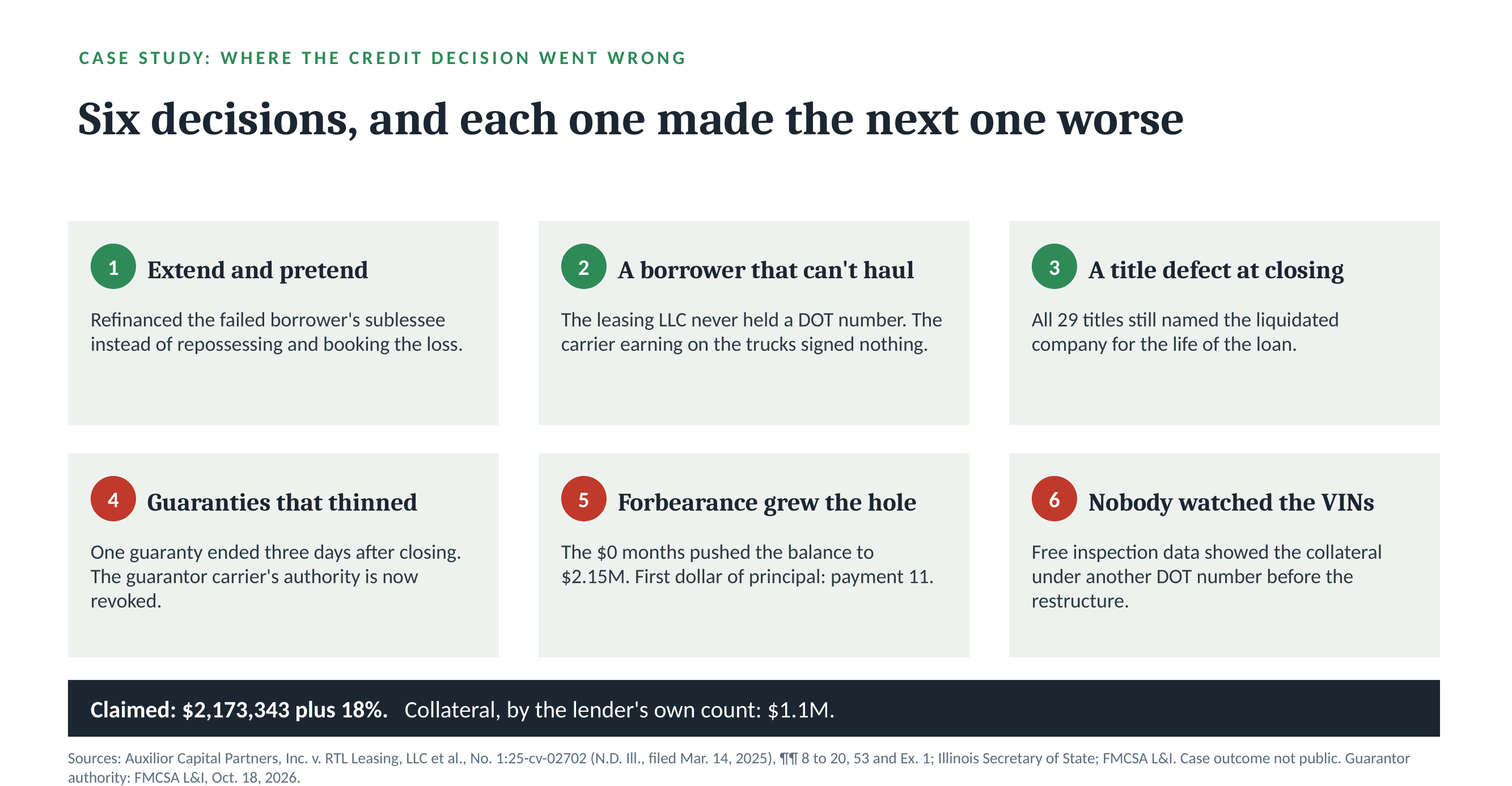
The lender refinanced a failed borrower’s sublessee instead of taking the loss. It lent to an entity that could not legally earn money with the collateral, while the company that did earn money with it signed nothing. It accepted a title defect at closing. It watched one guaranty disappear three days in. It restructured into a larger balance on depreciating iron. It did not watch the VINs, which were sitting in free federal inspection data before the restructure was signed. None of those decisions were illegal. Each one made the next one worse.
Case two: the veneer and the ledger
The second case is the one I would hand to any lender who has ever been dazzled across a desk.
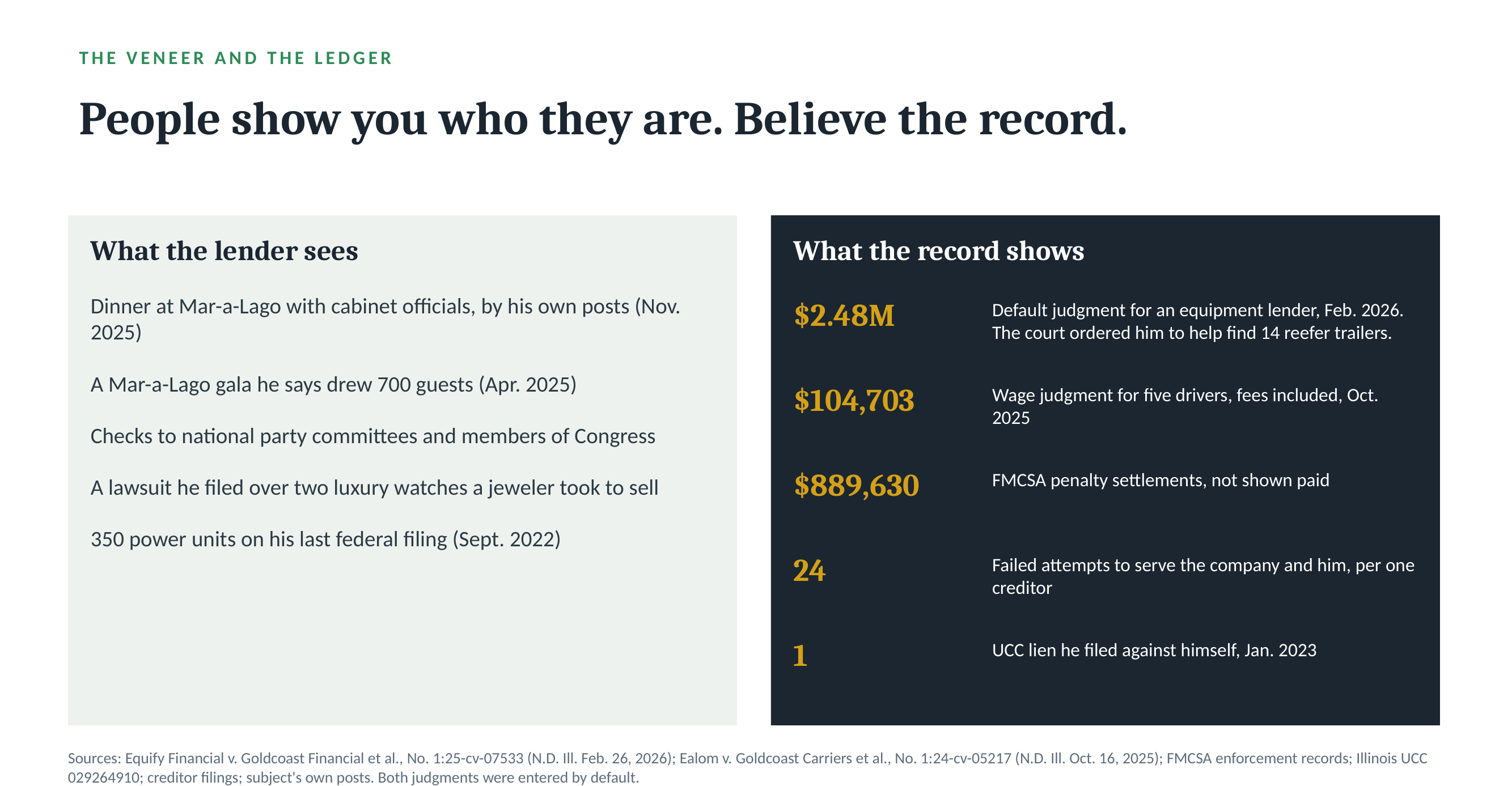
Dragos Sprinceana founded DMG Consulting & Development Inc., which did business as Goldcoast Logistics Group, USDOT 2190975, in the Chicago suburbs. Its last MCS-150 before the trouble, filed Sept. 29, 2022, reported 350 power units and 334 drivers at 2130 Point Blvd. in Elgin, Illinois. I am a retained expert in litigation involving DMG. Everything below comes from federal and state records, court dockets, and his own public statements.
Start with what a lender would see. In his own social media posts, Sprinceana described celebrating the 2024 election result at Mar-a-Lago, meeting future National Security Adviser Michael Waltz there in January 2025 to discuss Romania, hosting an April 2025 gala at the club that he told the Romanian newspaper Gândul drew about 700 guests, and, in a Nov. 20, 2025, post, dining at Mar-a-Lago with then-Homeland Security Secretary Kristi Noem and Secret Service Director Sean Curran. Federal Election Commission records show campaign contributions from him and his wife to the Republican National Committee, members of Congress, and a leadership PAC. In 2024, he sued a celebrity jeweler in Miami-Dade County over two watches he said the jeweler took to sell for him and never paid for. Wealth, access, and a 350-truck fleet. That is the veneer.
Now the ledger. FMCSA’s enforcement records show case IL-2021-0097-US1688, closed May 17, 2022, with a $791,640 settlement for violations of 49 CFR 383.37(a), knowingly allowing drivers to operate without a valid CDL, and 49 CFR 395.3, the driving-time limit. A compliance review dated May 30, 2023, produced an Unsatisfactory rating. FMCSA placed DMG out of service on Aug. 27, 2023, and issued a second out-of-service order on Sept. 12, 2023, for failure to pay. A second enforcement case, IL-2023-0120-US1713, closed Oct. 19, 2023, for $97,990. That is $889,630 in settlements, and the public record does not show it was collected. The Elgin terminal was sold in a sale-leaseback weeks after the first order. Successor numbers in the same orbit, Goldcoast Carriers Inc., USDOT 3014047, and Freight Transportation Group Inc., USDOT 3008326, went out of service on Aug. 15, 2025, and April 20, 2026.
On Jan. 25, 2023, Illinois UCC file 029264910 recorded a financing statement listing Dragos Sprinceana as the debtor at a Boca Raton address and Dragos Sprinceana as the secured party at a commercial registered agent suite in Glendale, California. He filed a lien against himself. A perfected lien puts a claim on assets ahead of later judgment creditors. For a credit audience, that filing alone should end the conversation.
The creditors came anyway. On Oct. 16, 2025, U.S. District Judge Robert W. Gettleman entered default judgment in Ealom v. Goldcoast Carriers Inc., DMG Consulting & Development Inc. and Dragos Sprinceana, case 1:24-cv-05217, finding the defendants liable under the Fair Labor Standards Act and the Illinois Wage Payment and Collection Act. The court noted that no defendant, “nor anyone purporting to represent Defendants,” appeared at the hearing. Five drivers received $56,574.52 in judgments, the largest $22,377.60 to Anthony Ealom, and their lawyers were awarded $48,129.09 in fees and costs. Those men hauled the freight. They are judgment creditors now.
On Feb. 26, 2026, Chief Judge Virginia M. Kendall entered default judgment for Equify Financial LLC against Goldcoast Financial LLC, DMG and Sprinceana, jointly and severally, case 1:25-cv-07533, for $2,478,219.84. The order awarded Equify immediate possession of 14 CIMC Cool Globe 53-foot reefer trailers with Thermo King Precedent S-600 units, listed by VIN, and contained a sentence I have never seen in an equipment order before: “DRAGOS SPRINCEANA shall assist EQUIFY FINANCIAL, LLC in locating and recovering the Outstanding Equipment.” A federal judge had to order the debtor to help the lender find its own collateral.
Finding him is its own line item. In one creditor’s case, Bank Capital Service documented 13 failed attempts to serve DMG and 11 failed attempts to serve Sprinceana personally. In an equipment lease case in New Mexico, Inland Lease and Rental v. DMG, 1:24-cv-00608, the court filings describe registered addresses that turned out to be virtual offices and executive suites before the court approved alternative service. Federal dockets list 13 cases with DMG or a Goldcoast entity as a party, from equipment lessors to a utility to Centennial Bank’s admiralty action against a vessel. Both judgments above were entered by default. He has not been charged with a crime.
Follow the financing, and you see why this is a credit story and not just a safety story. Illinois and Arizona UCC indexes show trust vehicles registered at 9300 Metcalf Ave. in Overland Park, Kansas, the headquarters of Shamrock Trading Corp., parent of RTS Financial, filing against Sprinceana and a long list of Goldcoast entities starting in 2017. In February 2024, six months after the first out-of-service order, a Chicago-area factor took assignment of a lien position across the network, and in February 2025 Goldcoast Carriers filed a new financing statement with the same factor. A financing statement is not a default, and a factor doing its job is lawful. It does show capital still attached to the trucks 18 months after the government told them to stop rolling.
People tell you who they are. In trucking, they also file it. The veneer is what a borrower wants you to see. The ledger is what the courts and the government recorded. Believe the ledger.
Wall Street already learned this lesson in 2025
If the trucking cases feel small, look at what the same pattern did at scale. First Brands Group, an Ohio auto parts maker reporting about $5 billion in annual sales, filed for bankruptcy on Sept. 28, 2025, with $12 million in cash and more than $9 billion in liabilities. On Jan. 29, 2026, federal prosecutors in Manhattan unsealed an indictment charging its founder and his brother with wire and bank fraud, alleging fake, inflated, and double-pledged invoices submitted to factoring partners and inventory pledged to multiple lenders. “In some instances, invoices were generated for transactions that had never occurred,” the U.S. Attorney’s Office said. The defendants are presumed innocent. In the Tricolor Auto Group collapse that same fall, a Chapter 7 trustee alleged collateral was double pledged and loans were sold more than once.
Private credit spent the next year relearning one rule: verify the collateral independently, because the borrower’s own reporting is the thing being falsified. Trucking runs on factoring. Its collateral moves at 65 miles an hour and changes plates when it crosses state lines. If the most sophisticated lenders in the country can be fooled by documents produced by the borrower, a credit analyst approving a 30-day line for a two-year-old carrier from an MCS-150 and a certificate of insurance has no margin at all.
Size is not safety, and fraud is not the only way to lose
It would be convenient if this were only about bad actors. It is not. Some of the biggest losses trucking credit has taken came from large, long-lived companies that simply could not make money in a volatile market.
Yellow Corp., the less-than-truckload carrier that operated for nearly 100 years, shut down in late July 2023 and filed for Chapter 11 protection in Delaware in early August with about 30,000 employees. It carried about $1.5 billion in debt as of March 2023, including $729.2 million owed to the federal government, most of it from a $700 million pandemic-era Treasury loan made in 2020. As of that March, Yellow had repaid $230 million of the loan’s principal. The lender of last resort was the U.S. taxpayer, and the taxpayer was in line with everyone else.
Celadon Group, an Indianapolis truckload carrier with about 3,300 tractors and 10,000 trailers, filed on Dec. 9, 2019, and shut down, eliminating about 4,000 jobs, many of them drivers stranded on the road. Its collapse followed an accounting scandal built around buying and selling trucks at inflated values through its Quality Cos. affiliate to make its finances look stronger than they were. Celadon agreed to pay $42.2 million in a 2019 resolution with the Justice Department, and Quality's former president pleaded guilty. Federal charges against two former Celadon executives were dismissed with prejudice in 2022. The mechanism a credit analyst should remember is the one that matters at any size: related-party equipment sales at prices nobody independently verified.
Those two cases bracket the problem. A carrier with real assets, real freight and a century of history can still default when rates fall, and costs climb. A carrier inflating its equipment values with an affiliate can look healthier than it is right up to the day it closes. And a chameleon can look exactly like either one on paper. The credit cycle hits honest operators too, and the bad actors hide inside that noise. That is why underwriting has to be built on what the operation actually does, not how big it is or how long it's been around.
Outside capital cuts both ways too. I ran fleets under a private equity owner across 28 states and more than 50 terminals, and the discipline was real: systems, audits, compliance programs, and diligence designed to protect an investment the owners intended to grow and sell. A private equity sponsor has every reason to want the operation underneath the paper to be exactly what the paper says. Venture money plays a different game. Convoy, the Seattle digital freight broker backed by Jeff Bezos, Bill Gates, Alphabet’s CapitalG, and T. Rowe Price, raised more than $1 billion, reached a $3.8 billion valuation in 2022, and shut down on Oct. 19, 2023. Its founder blamed “a massive freight recession and a contraction in the capital markets.” Carriers that had hauled its loads were left sorting out who would pay them. Growth funded ahead of profit can vanish as fast as a chameleon, and the carriers, shippers and lenders on the other side of the ledger find out at the same moment the employees do.
The same goes for the insurers behind your customers. Risk retention groups are owned by the members they insure, which means their capital is only as strong as the fleets inside them. When Nevada placed Spirit Commercial Auto RRG into permanent receivership on Feb. 27, 2019, it carried $199 million in unpaid losses; a forensic audit by FTI Consulting found at least $30 million missing, and its surplus was restated from $13.4 million to $703,000. The same operator had run Federal Motor Carriers RRG, which went insolvent in 2011. An insurer can fail as quietly as a carrier, and when it does, every customer it covered becomes uninsured for every open claim at once.
Judge the customer by the insurer it keeps
There is a question almost nobody on a credit desk asks: who insures this customer, and who else do they insure?
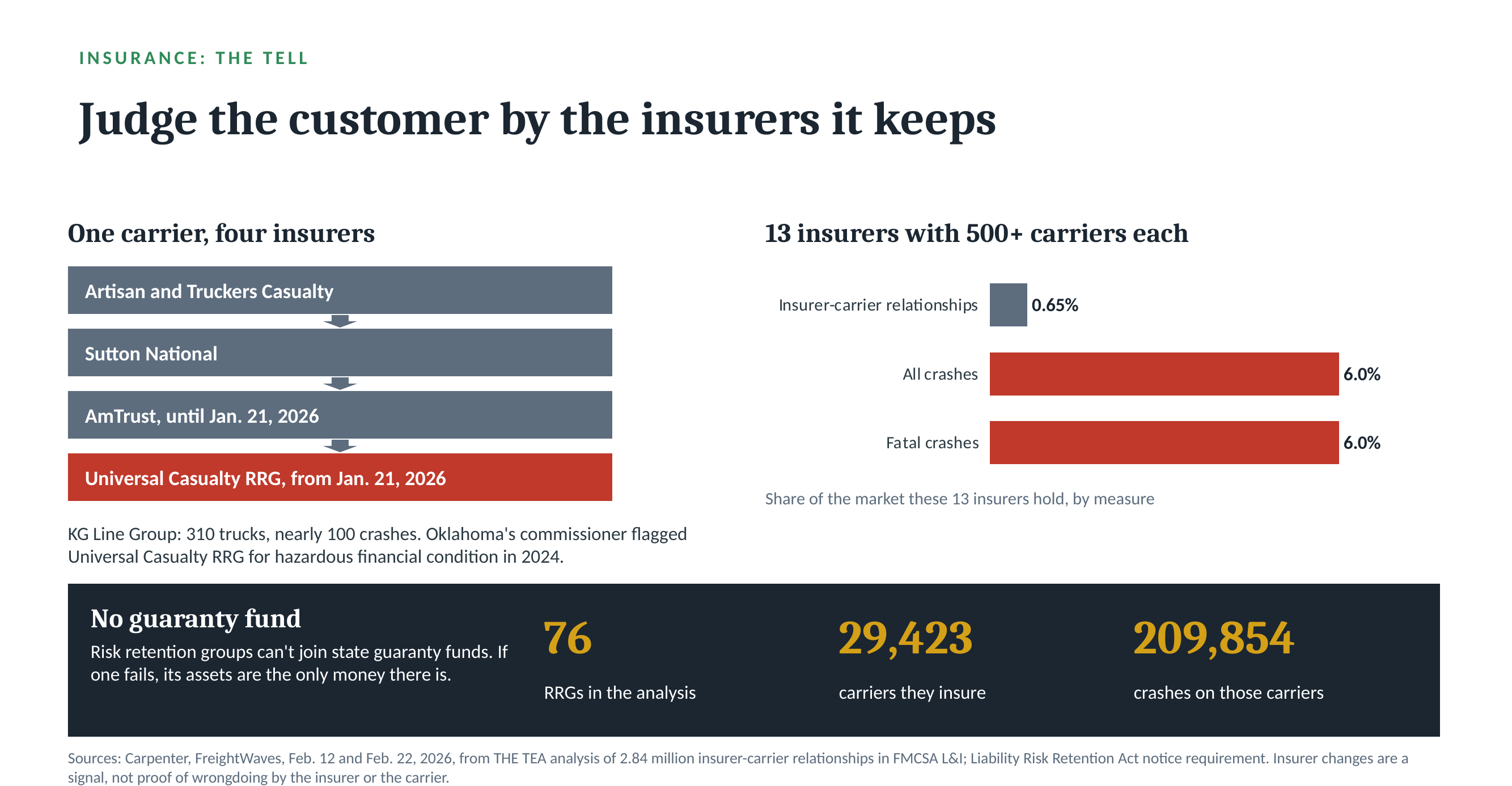
Insurance history is the earliest underwriting signal you can borrow for free, because somebody upstream already read the file. In February, I published an analysis of 2.84 million insurer-to-carrier relationships across 1,310 insurers in FMCSA’s licensing and insurance data. Thirteen insurers with 500 or more carriers each held 0.65% of the relationships and accounted for 6% of all crashes and 6% of fatal crashes. The top 10 insurers wrote more than half of all new carriers’ first policies.
One 310-truck carrier in that work, KG Line Group, moved from Artisan and Truckers Casualty to Sutton National to AmTrust, then to Universal Casualty Risk Retention Group on Jan. 21, 2026. Oklahoma’s insurance commissioner flagged Universal Casualty for hazardous financial condition in 2024. When a customer walks down the insurer ladder like that, the market has already told you something.
Risk retention groups deserve their own line in every credit file. Under federal law, they cannot participate in state guaranty funds, and their policies must say so. Seventy-six RRGs in our analysis insure about 29,423 motor carriers linked to 209,854 crashes. When one fails, your customer's claim has no insurance behind it. Vermont’s regulator said Global Hawk Risk Retention Group was “so deeply insolvent that the vehicles are effectively uninsured” when it was liquidated in 2020 with about $23.8 million in liabilities against $3.4 million in assets, covering roughly 1,008 trucks. James Richardson, seriously injured in Chicago, could not collect on a $1 million settlement after Spirit went into receivership.
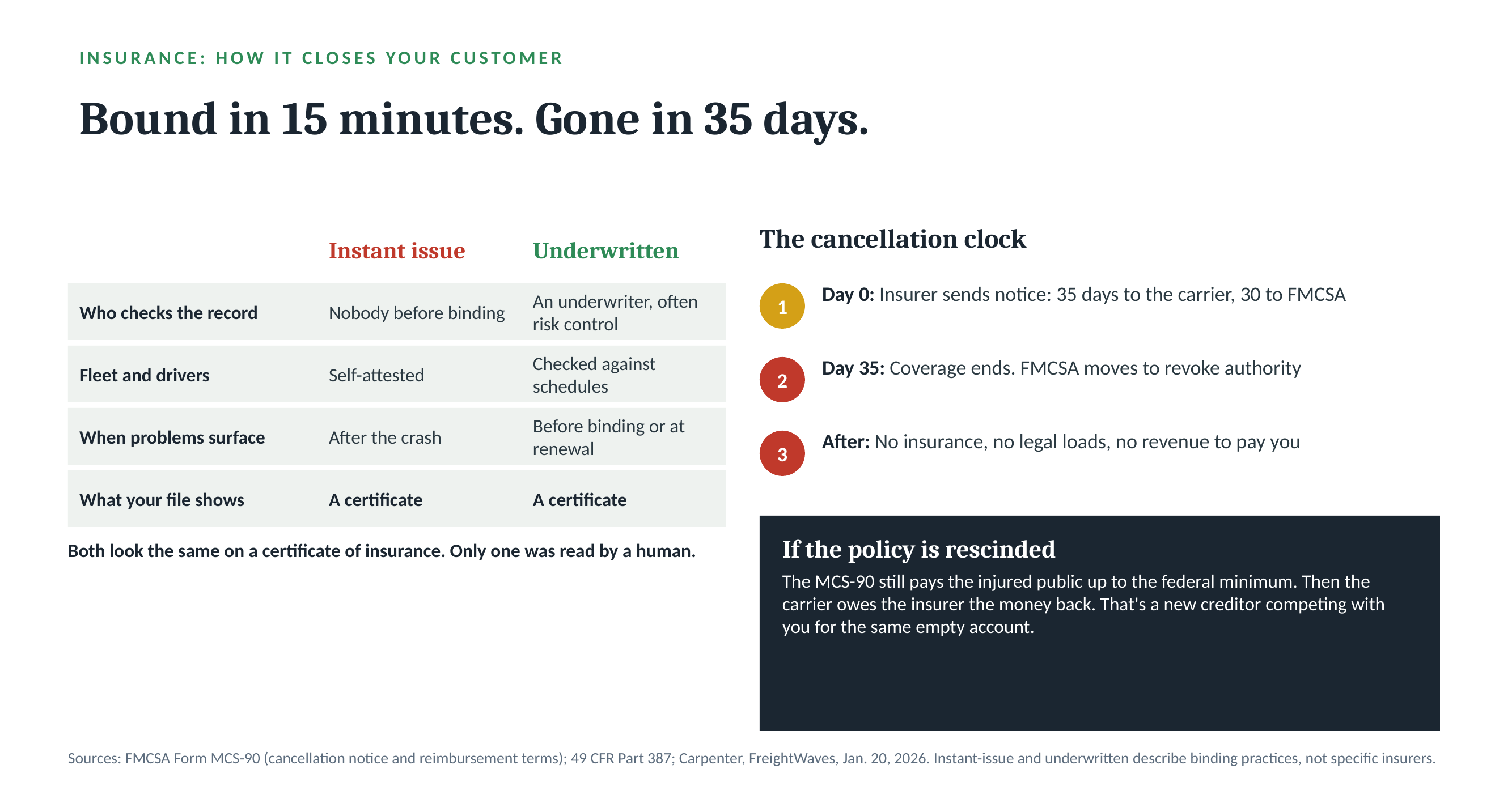
How the policy was bound matters as much as who wrote it. Instant-issue programs let a carrier attest to its own drivers and trucks and buy coverage with a credit card in minutes, with nobody reading the file until there is a claim. Underwritten programs put a human on the record before binding and again at renewal. On a certificate of insurance, the two look identical. When the instant-issue insurer finally reads the file after a crash, it reaches for misrepresentation clauses. A rescission leaves the carrier uninsured for its own losses, and under the MCS-90 it can leave the carrier owing the insurer for whatever it paid the public. That is one more creditor at the table, chasing the same empty account you are.
Brokers can be the shell too
Credit teams tend to treat brokers as the safer counterparty: no trucks, no drivers, a bond on file. After Montgomery, that assumption is expensive.
Look at a broker’s FMCSA licensing and insurance history the way you would look at a borrower’s payment history. One broker in active litigation, which I am not naming for that reason, shows FMCSA opening involuntary revocation proceedings against its authority five times between 2014 and 2024, each discontinued when the required filing came back. Sixty-seven days after a fatal crash on one of its loads, its trust fund filing ended, and a surety bond replaced it; a year later, a new surety replaced the first. Its federal registration today lists no company officer and no telephone number. Changing sureties can be ordinary. Five revocation proceedings and an empty registration are not.
The Gold Coast network ran a broker too. Cargo 247 Inc., USDOT 4304928, registered as a broker with zero trucks and zero drivers at a residential apartment in Pompano Beach, Florida. It filed its MCS-150 on the same day as a carrier in the same orbit, and its Merchants Bonding Co. bond was canceled April 10, 2026. Trans Recovery Solutions posted a public collection notice for unpaid freight charges owed by DMG’s brokerage, and Baxter Bailey & Associates lists it in its debtor database. The carriers who hauled those loads and never got paid are creditors too. They just do not have a docket.
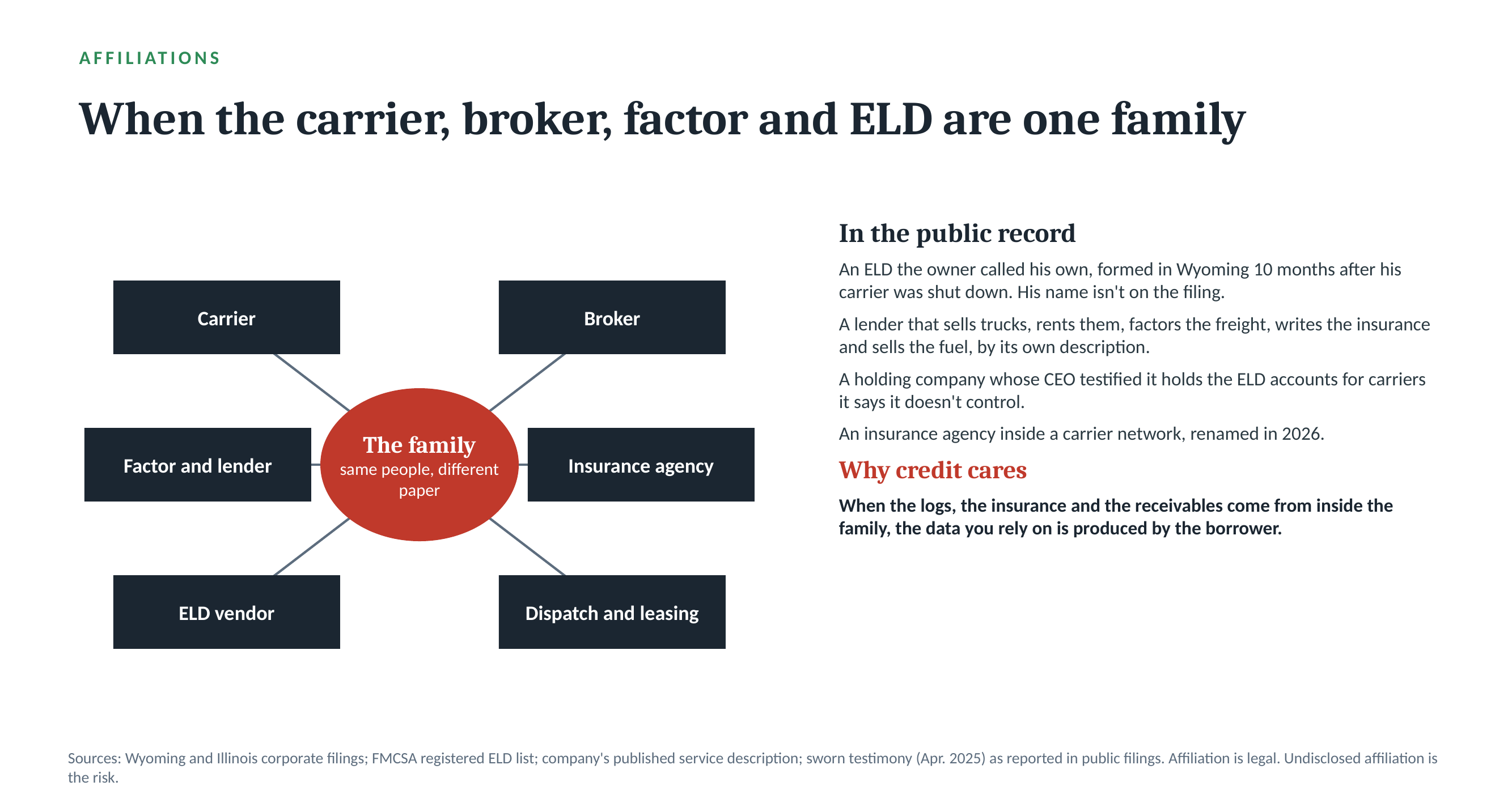
Now add the affiliation layer. The networks I investigate do not stop at the carrier and the broker. They wrap the factor, the lessor, the dispatch floor, the insurance agency, and sometimes the ELD vendor around one family. An ELD that the Gold Coast owner publicly described as his own was formed in Wyoming in July 2024, 10 months after his carrier was put out of service, at a commercial registered agent address, with his name nowhere on the filing; it appears on FMCSA’s registered ELD list. A Chicago-area lender describes itself as selling trucks, renting them, factoring the freight, providing insurance, and selling fuel- everything a new carrier needs from one address. In the Super Ego network, Floyd Inc.’s chief executive testified in April 2025 that he runs both Floyd and Super Ego Holding and that Super Ego holds no operating authority; six carriers, including Stevens Trucking, Western Flyer and Freymiller, filed a federal RICO complaint in the Eastern District of Texas on Sept. 23, 2026, alleging more than 70 carrier entities and 1,500 equipment transfers. Those allegations have not been answered or decided.
Here is the credit point. When the hours-of-service logs, the insurance placement, and the receivables all come from inside the family, every document you rely on was produced by the borrower. That is the First Brands lesson in a truck cab.
How we got here
Congress set the $750,000 minimum in the Motor Carrier Act of 1980 and never indexed it. The Interstate Commerce Commission, which once policed who could hold authority, was abolished at the end of 1995, and registration moved to a volume-based system. In 2012, the Government Accountability Office reported in GAO-12-364 that new applicants with chameleon attributes had a severe crash rate of 18%, three times the 6% rate of other new entrants. FMCSA adopted the reincarnation rule the same year. For more than a decade, a carrier could register online with very little verification; when FMCSA replaced that system with Motus in May 2026, the Department of Transportation said that under the old process “all they needed was an email, name, and physical address,” and that several thousand registration numbers were tied to fraudulent carriers. Every carrier in your customer file before this spring came through that door.
Meanwhile, capital got easier. Factoring made cash available on day one. Instant-issue insurance made coverage available in minutes. Used equipment flowed out of the 2021 boom into the hands of anyone with a down payment. Authority itself became a product; in July I documented an online marketplace that listed 108 operating authorities as sold for a combined asking price of about $1.54 million. By 2025, you could assemble a trucking company out of other people’s capital in a week.
How the shell is built on your money
Walk through it the way the operators do. You form a leasing LLC that never applies for a DOT number. It borrows against the trucks, so the lender sees a leasing company and a title. You run the trucks under a separate carrier with its own DOT number, insurance, and factor, so the broker and insurer see a carrier. You put a relative, a working driver, or a registered agent service on the paperwork, so the process server finds nobody. You buy insurance that binds without questions, and when an underwriter finally declines you, you move one rung down the ladder. You sell your receivables the day they are created, so your trade creditors are unsecured behind a factor that filed first. If you are careful, you file a lien against yourself before the lawsuits arrive.
When the safety rating comes, you have 61 days. You stop paying the equipment note, because nothing is owed that you can be made to pay quickly. The carrier number goes out of service. The trucks move to a new number with a new name on the door, often the same day, and the plates follow the paperwork to a new state. The debt, the fines, the judgments, and the crash history stay with the dead number. The equipment, the drivers, the customers, and the people in control walk across. In this model, a dissolved entity is not a failed business. It is an exit.
That is why the same indicators that predict nonpayment predict crashes. A carrier that will not keep its own drivers’ wages current will not keep its brakes current. Credit extended to that operation does not just risk a write-off. It keeps the trucks on the road.
Who is holding it
Run the ledger across one of these networks and every party absorbs something except the equipment. The lender holds a judgment against an entity with no assets and collateral it cannot locate. The factor holds receivables that were sold twice, or that belong to a company that no longer exists. The insurer pays the public under an endorsement it cannot cancel retroactively and chases reimbursement from a shell. After Montgomery, the broker holds negligent-selection exposure for picking the carrier. The shipper holds the same exposure one step up, and its own insurer is reading the ruling too. The lessor holds a lease with a company whose name came off the door months ago. In an asset-backed securities structure, the loss does not stop at the originator; it runs to the noteholders. Taxpayers hold uncollected federal penalties. Drivers hold wage judgments. Somewhere, a family holds a policy-limits tender for $750,000.
Everybody underwrote a different slice of the same company from a different file. Nobody saw the whole thing. That is not a flaw in the arrangement. That is what the arrangement is for.
What would close it
The system built to make trucking companies identifiable has become the system bad actors use to make themselves unidentifiable to the people who pay for them. Most of the fix sits with the parties extending capital, and most of it costs nothing.
Underwrite the operation, not the entity. Pull roadside inspections for every VIN on an equipment schedule, and compare the trucks a customer declares on its MCS-150 to the trucks inspectors actually see. Ask who holds title, who holds authority, and who earns the revenue, and if the answers are three different companies, find out why before you fund. Get titles reissued before closing, not after.
Run UCC searches on the company and every officer, and read the filings to see who is already first, for self-liens, and for trust vehicles that tell you who is factoring the freight. Pull federal and state dockets on the company, its officers, and any prior company those officers ran. Read the insurance history in FMCSA’s licensing and insurance system: how many insurers in three years, whether any were risk retention groups, and whether any cancellation notices are pending. Check whether a predecessor ever carried an Unsatisfactory rating or an out-of-service order.
Write the federal clocks into your paper. A notice of a proposed Unsatisfactory rating, an out-of-service order, and an insurance cancellation notice should be events of default because each is public, each starts a countdown, and each ends the customer’s legal revenue. Monitor identity the way you monitor payment behavior: officer changes, address changes, new DOT numbers sharing officers or VINs, and a fleet that jumps with no financing trail. And when a customer flips anyway, use 49 CFR 386.73 as your evidence map for successor and alter ego claims, follow the VINs to the new number, and find the factor and the lessor, because they know where the receivables went.
Regulators have their own short list, and none of it requires new legislation. FMCSA can require every MCS-150 to identify every person who owns or controls a carrier or broker and every DOT number each has controlled in the past decade, under penalty of perjury, and check that list against its own out-of-service, Unsatisfactory, and unpaid-penalty records before granting or keeping authority. It can refuse to keep active a registration that names no officer. It can use the reincarnation rule it already has. States can reject a registered agent filing that names a person their own vital records list as dead.
The judgment creditor
Anthony Ealom drove for Goldcoast. On Oct. 16, 2025, a federal judge in Chicago awarded him $22,377.60 in unpaid and underpaid wages and liquidated damages, after the company and its owner stopped showing up to court. He is now a judgment creditor of a 350-truck fleet, standing in the same line as an equipment lender holding $2.48 million, a factor, a utility, and the United States government.
The DOT number was supposed to tell you who you were lending to. For a chameleon, it only tells you who they used to be.