

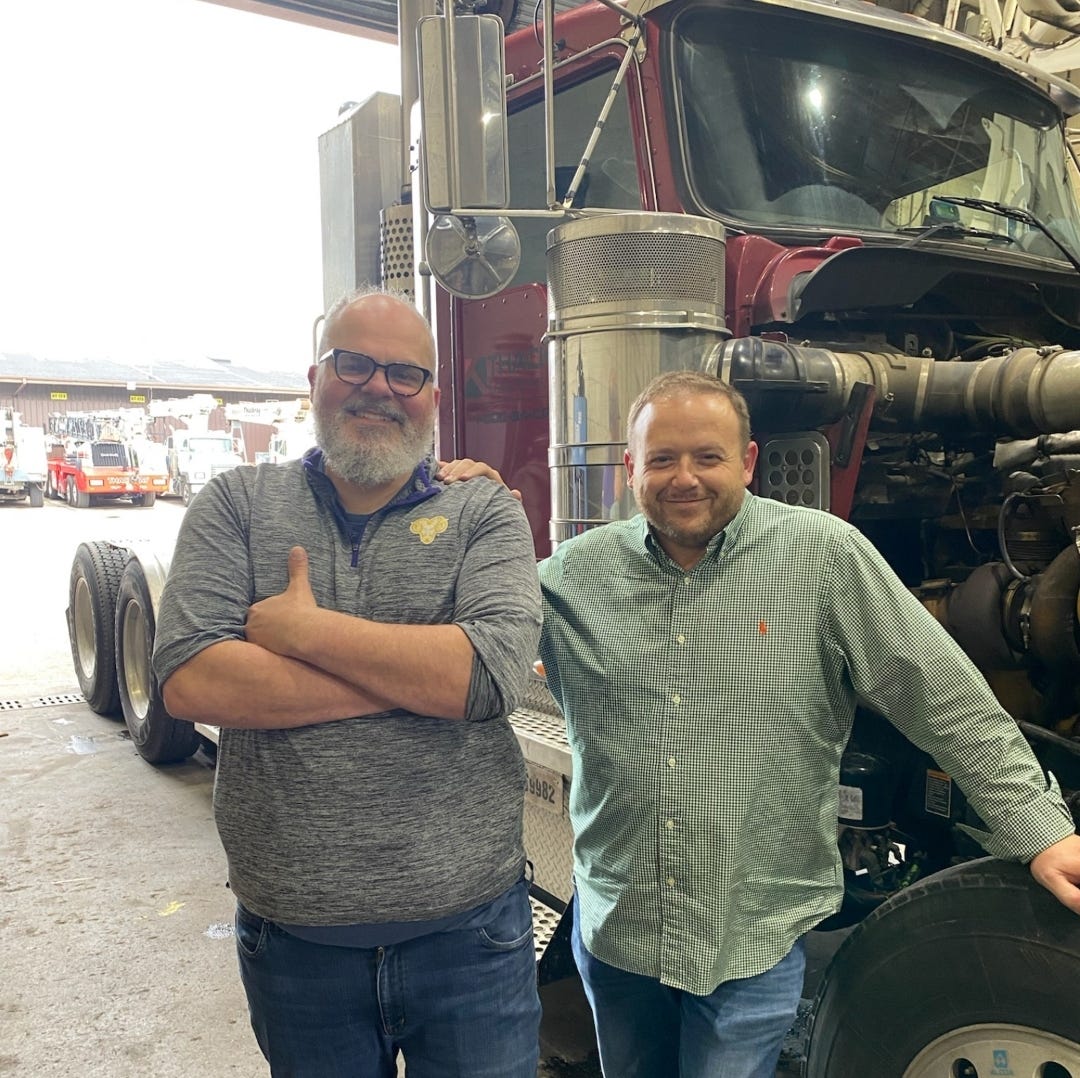
I’m pro-US trucking. I drove it, brokered it, owned it, oversaw it, fixed it, ran fleets in it, and sit in meetings where decisions about it get made. My father’s side of this is farming, my mom’s side was Gissel Packing, and my own side of it is a CDL. I’m not distant from this industry.
I didn’t say I’m pro whoever is willing to pay me. I didn’t say I’m pro any publication or media outlet, including the ones I write for. I didn’t say I’m pro all industry vendors, or pro every association, or pro the narrative. Those are five separate positions, and I hold none of them; the reason I’m writing this is the industry has spent a long time treating them as though they’re the same position. My outdoor cat persona allows me to be me, not for everyone else at the expense of me. I’ll go back to driving full time or working fields before I’d allow someone to compromise my principles, but that's not everybody in this industry. The industry is bought and paid for in so many ways.
We don’t take everyone’s money, and we don’t take everyone as a client. That sounds like a marketing line, and it isn’t; it’s a cost. Turning down revenue is the only proof of independence that can’t be faked, because everything else is something you say about yourself. Anybody can publish a values page. Not everybody can point at the invoice they didn’t send. That’s why they call me an “outdoor cat.” I eat what I hunt and kill and work for; I don’t eat what someone gives me. I’m not fed or housetrained or domesticated. I say no when I want to because I feed myself. If you stand for nothing, you'll fall for everything.
Capture doesn’t require anybody to be corrupt
The version of this story where somebody hands over an envelope is mostly wrong. Almost nobody in this industry is taking a bribe. What’s actually happening is slower and more respectable, and it works on people who think of themselves as honest, which is exactly why it works. Capture that required villains would be easy to find and easy to fix.
A vendor sponsors a program, and now there’s a relationship. A publication sells a booth, and now the person you’d have to report on is the person funding the conference that keeps the lights on. An executive joins an advisory board, and now he has access he’d rather not lose. A media property takes an equity stake, or its parent does, and now the story runs into a conflict nobody can speak on out loud. An association’s largest members fund the association, and the association advocates for positions its largest members hold, which is not a scandal; it’s the job description.
At no point in that sequence does anyone instruct anyone else what not to write. That’s the part people miss when they go looking for a smoking gun. The instruction is unnecessary because the incentive already did the work, and a reporter who has to decide between a story and a relationship usually chooses the relationship without ever consciously deciding. I’ve watched this happen to people I like and respect. I’ve felt the pull myself, which is why I recognize it, which is also why when I walk away from people, cliques, groups, or organizations, associations or publications or even clients, there’s a reason.
Silence is the product
You can buy coverage in this industry, and everybody knows it, and honestly, the paid coverage is the least of the problem because it’s labeled. Sometimes the sponsors sponsor you because they need your writers and reporters to not talk poorly about them, and when you’ve sanctioned that in the past, they know what they bought, and they know what to expect in the future. The bigger purchase is the absence of coverage, and that one is cheaper, quieter, and leaves nothing behind. There’s no correction to issue on a story that never ran. There’s no disclosure requirement on an investigation somebody killed in a meeting nobody minuted.
Count the critical coverage in trucking media over the last five years and then sort it by who the subject was. Small carriers get covered aggressively, and they should, because that’s where a great deal of the fraud lives, and I’ve written more of that coverage than most people. Now count the adversarial coverage of vendors, associations, technology providers, and service companies with marketing budgets. Count negative coverage of those who don’t sponsor the media outlet vs coverage against sponsored vendors by the same outlet. The rate of critical coverage in this industry runs roughly inverse to the advertising spend, and that isn’t a conspiracy; it’s a business model operating exactly as designed.
There are products sold into American trucking with documented failure histories, including failures that show up in crash records and in litigation, and the coverage of those products tracks the marketing budget rather than the failure record. Some of those vendors sponsor policy work, industry voices, and safety programs. A vendor funding the safety conversation while its own product sits in the discovery file of a wrongful death case is a conflict, whether or not anybody involved intends it as one. The conflict doesn’t require the vendor to do anything improper. It only requires everyone downstream of the check to notice where the check came from, which people do automatically and without being asked. I’ve had articles completely scraped for discussing vendors in “the clique,” and I’ve had directives to add these bad vendors when I’ve refused to mention them. Someone more focused on the check might accommodate me? I removed the entire article. I refuse to mention and advocate people’s purchase of trash vendors. There is no check you will ever write me to make me do that.
The vendors who make the fraud possible
The fraud networks I’ve been mapping for the last year don’t run on trucks. They run on services. Somebody has to factor the invoices, and some factors have shown remarkably little curiosity about who’s on the other end of a receivable. Somebody has to file the authority paperwork and serve as process agent, and there are BOC-3 shops with thousands of carriers registered to a single mailbox. Somebody has to write the insurance, and I’ve documented what happens when that somebody is a risk retention group with a photocopier and a story. Somebody has to vet the carrier, and there are vetting services that sell a green checkmark rather than an answer.
Every one of those vendors has legitimate customers, and most of their business is legitimate. That’s what makes the problem hard, and it’s why I keep saying the industry can’t solve it by pointing at the trucks. A chameleon network needs a factor, an agent, an insurer, a broker willing not to look, and a compliance product willing to say the carrier is fine. Remove any one of those and the model gets harder to run. Nobody wants to be the one who says that at a conference where those companies bought tables.
The fair version of the other side
Trade journalism is funded by the industry it covers. That’s true of every trade press in every sector, and it’s not optional, because there’s no consumer subscription base large enough to fund reporting on freight brokerage. Associations exist to advocate for their members, which means taking positions their members pay them to take is not corruption; it’s the literal function of a membership organization. Vendors sponsor safety programming because safety programming costs money and somebody has to pay for it. Sponsorship is not a scandal, and I’ve been on sponsored panels.
The line isn’t whether money changed hands. The line is whether the money bought the position, and whether anybody told you it did. Disclosure is the whole ballgame. Every article I publish carries a block at the bottom naming what I sell and to whom, because my consulting practice creates an interest in the arguments I make and the reader is entitled to weigh that. It costs me nothing to write that block, and it costs the reader nothing to read it. The number of industry voices who do the same thing is small enough to be worth noticing.
Pro industry means hostile to the people wrecking it
Being pro trucking and being protective of everyone in trucking are opposite positions, and the industry keeps conflating them.
The carrier who does it right pays for the carrier who doesn’t. He pays in the premium pool, because the losses generated by the worst books get spread across everybody buying commercial auto. He pays in the rate, because a fraudulent operator with no compliance cost underbids him on freight he should have won. He pays in the regulatory response, because enforcement written in the aftermath of a mass-casualty event is indiscriminate by design and lands hardest on the people who were already compliant. He pays in the reputation, in the jury pool, in the recruiting pipeline and at the dinner table when somebody asks what he does for a living.
Protecting bad actors is not industry advocacy. It’s a transfer of cost from the operators who created the problem to the operators who didn’t. Every quiet position, every unpublished story, and every paid-for policy stance is part of that transfer, and the people receiving the transfer are a small fraction of the people paying for it. An industry that shields its worst operators isn’t defending itself; it’s taxing its best ones to subsidize its worst.
I wrote a piece this week arguing that trucking finances risk from the wrong end: a control purchased early costs dollars, and the same risk purchased late costs a verdict. This is that same argument applied to speech. Saying the uncomfortable thing early is cheap. It costs a sponsorship, a relationship, an invitation, a client. Saying nothing costs nothing until four people die in Jay County, Indiana, and then the bill arrives for everybody at once, written by people who don’t know this industry and aren’t in a mood to be careful with it.
I’d rather pay on the front end. That’s the whole position, and it’s why the list at the top of this article is written as a list of things I’m not. The measure of anybody in this business isn’t what they claim to support. It’s what they turned down. Pay attention to who sponsors what, who sponsors who, and what messages those sponsorships push, and watch the correlation and the silence that checks purchase.
Good article, but I want to know why owners of fleets that employ illegals, the incompetent, or the fragrantly non-complaint, are never arrested and prosecuted?