

The broker tier's shield: FAAAA preemption. For twenty years, "you can't sue me at all, federal law preempts the claim." Montgomery took that one in May.
The lessor's shield was the Graves Amendment: "I just own the truck, I can't be vicariously liable for what the renter does." That one was never as broad as the industry believed, and the savings clause always preserved direct negligence claims; courts since Stratton won't extend it to lessors affiliated with the carrier renting from them.
The carrier's shield was the two-party reading of the leasing regs: "statutory employment stops at the entity that actually leased the truck, so if I'm two contracts removed from the driver, I'm clean." That's the one the Fifth Circuit just took in Meyer Penske; no one’s talking about it, but that's tied to one of my expert witness cases.
One shield per tier, all resting on the same underlying bet that layers of paper between you and the driver mean the driver isn't yours, and all three failed the summer of 2026.
I’d argue Meyer Penske is more dangerous than Lipe CHR. Why? C.H. Robinson lost to a control-in-fact doctrine; the Lipe jury looked at the actual relationship, found CHR directed the manner of the driver’s work, and made him a borrowed employee. That can be attacked on appeal as unsupported by the evidence, which is what the appeal will do, and it’s the same fight CHR won in Montgomery’s own case when the Seventh Circuit found result-control only. Prove you didn’t control the details and the doctrine never attaches.
Penske lost to something different. Statutory employment under 376.22 doesn’t ask whether Penske controlled Lehal, ever met him, or knew his name. Once Penske, a carrier, engaged Liberty Lane, a carrier holding the truck under lease, the regulation assigned Penske control and responsibility as a matter of law “regardless of whether Penske and Liberty Lane complied with the formal regulatory requirements,” in the panel’s words. There’s no control record to attack because no control showing is required. Arm’s length isn’t a defense; arm’s length is irrelevant. The arrangement itself is the trigger, and the regulation defines “lease” to include any arrangement.
Penske lost the shield, not the case. Meyer reversed summary judgment so nobody has awarded a dollar; plaintiffs still have to prove the crash elements on remand, and whether Penske was even acting as a motor carrier on this load is still open. CHR has a $604 million verdict against it; Penske has a trial ahead of it. Same destination if plaintiffs win, the driver’s negligence becomes the upstream entity’s negligence, but Lipe got there through a jury, Meyer got there through a regulation. Lipe is what happens when the control is thick enough; Meyer says on the carrier side of the chain, you don’t even need the file.
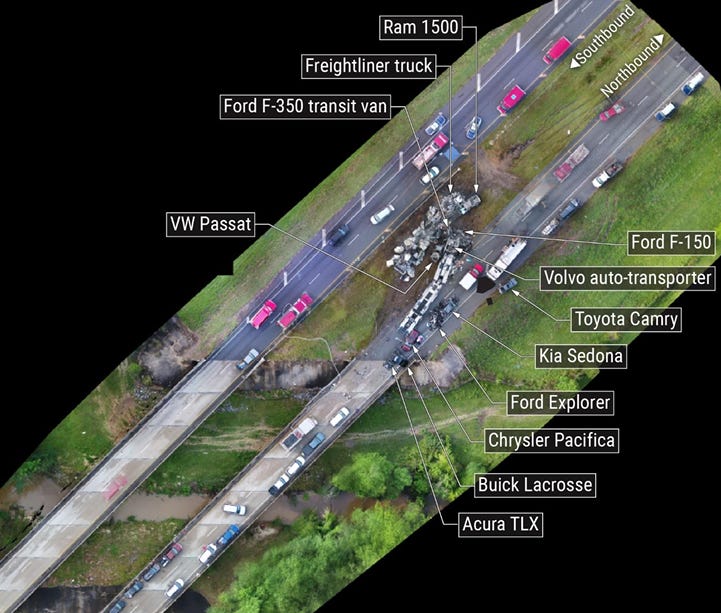
Satnam Singh Lehal was on his way to Laredo to pick up a load of Adient cargo when his tractor-trailer jackknifed, crossed the centerline, and hit Lyndon Dean Meyer’s vehicle head-on. Meyer died on impact. Adient had hired Penske Logistics to move its freight. Penske didn’t hire Lehal and didn’t own the truck he was driving. Penske’s affiliate broker, Penske Transportation Management, gave the job to a carrier called Liberty Lane. Liberty Lane’s affiliate broker gave it to a third carrier, OK Trans, which supplied the truck and put Lehal in the seat. The federal district court in the Southern District of Texas looked at that chain and threw the case out. Penske had no agreement with OK Trans and no agreement with Lehal, so Penske couldn’t be his employer, and the negligent-hiring claim against the Penske broker was preempted by federal law. On Aug. 4, 2026, the Fifth Circuit reversed both holdings. Meyer v. Penske Transportation Management, No. 25-40012.
On July 23, a Dallas County jury returned a $604 million verdict in Lipe v. Lupus Superior and found that the driver of a brokered load was C.H. Robinson’s borrowed employee, which moves the driver’s 45 percent share of that verdict onto the broker’s balance sheet on top of the broker’s own 23 percent. On July 29, C.H. Robinson’s CEO told investors the company will appeal the moment a final judgment is entered. Six days after that, a federal appeals court one state over published an opinion holding that responsibility for a driver travels up a freight chain through two intermediary tiers, on nothing more than an arrangement. The appeal C.H. Robinson promised will be briefed in a legal environment that shifted while the promise was still being made.
This is the third piece I’ve written on this shift, and the shields are falling in order. After the verdict, I wrote that the employer finding is where the C.H. Robinson appeal will live, because the jury’s several-share allocation put roughly $139 million on the broker and the route to the full $604 million runs through the finding that treated the broker as the driver’s employer. Earlier in the summer, I wrote that the companies that own the trucks never had the shield the brokers just lost: the Graves Amendment, 49 U.S.C. 30106, blocks vicarious liability for equipment lessors, and its own savings clause preserves every direct negligence claim, while courts since Stratton v. Wallace have refused to extend it to lessors affiliated with the carriers they lease to. Montgomery stripped the broker tier in May. The lessor tier was never covered the way its owners believed. Meyer just reached the carrier tier, and it did it with a doctrine that has been sitting for fifty years.
When a carrier hauls freight in a truck it doesn’t own, federal law makes that carrier responsible for the truck and the driver as if they were its own. The regulation is 49 CFR 376.11 and 376.12, the enabling statute is 49 U.S.C. 14102(a), and the industry term is statutory employer. The rules exist because of what trucking looked like in the trip-leasing era, when a certificated carrier could rent a rig and a driver for one haul, put its placard on the door, and then point at the lessor when the wreck happened. The Supreme Court described the problem in Transamerican Freight Lines v. Brada Miller in 1975. Abuses and evasions of certificated authority, and difficulty fixing the lessee’s responsibility. The regulatory answer was to make the responsibility non-negotiable. A carrier using leased equipment takes exclusive possession, control, and use of it, and complete responsibility for its operation, whether the paperwork says so or not. The Fifth Circuit has enforced that rule since Simmons v. King in 1973, and it has never required the lease to be written. Jackson v. O’Shields said an oral lease is enough. The Ninth Circuit said the same thing in Zamalloa v. Hart, which matters if your freight moves through the West Coast, because that’s the circuit those state courts look to on federal questions.
For fifty years, the industry read that doctrine as a two-party problem. One carrier, one lease, one owner-operator. The district court in Meyer read it exactly that way. Penske had an agreement with Liberty Lane. Liberty Lane had an agreement with OK Trans. Nobody had an agreement with the driver except OK Trans, so the statutory employment stopped at Liberty Lane and the tiers above it were clean. The Fifth Circuit said no. Penske, a carrier, employed Liberty Lane, a carrier that held the truck under lease from OK Trans, and that arrangement falls under 49 C.F.R. 376.22, the augmenting-equipment rule for carrier-to-carrier deals. Under 376.22, Penske was required to take control and responsibility for operating the equipment. Its assumption of that control made Penske the driver’s statutory employer, in the court’s words, regardless of whether Penske and Liberty Lane complied with the formal regulatory requirements. The footnotes go further than the holding. The contract you never signed doesn’t protect you, because the regulation writes it for you: the definition of a lease at 49 C.F.R. 376.2(e) includes any arrangement granting the use of equipment for compensation, and the panel cited a Northern District of Illinois decision from April, Dewey v. K. Split Logistics, for the proposition that any arrangement is sufficient.
Meyer reversed a summary judgment; it didn’t enter one. What the opinion doesn’t decide is important too. The plaintiffs, Meyer’s child and parents, still have to prove the rest of their case on remand, and the panel assumed without deciding that Penske was acting as a motor carrier on this shipment, which the parties will litigate. The opinion binds federal courts in Texas, Louisiana, and Mississippi and persuades everywhere else. A borrowed-employee finding under Texas common law and statutory employment under Part 376 are also different animals, and conflating them is how bad briefs get written. Borrowed employee is a control-in-fact doctrine: a jury looks at who directed the details of the driver’s work and decides he was functionally the defendant’s employee. Statutory employment needs no control-in-fact showing at all. Once the arrangement exists, the regulation assigns the responsibility, and the carrier’s actual conduct toward the driver is beside the point. Two doctrines, two different proofs, one result: the driver’s share of the verdict lands on the deepest pocket in the chain.
The borrowed-employee side has its own lineage, and anyone calling the Lipe verdict invented law hasn’t read it. A worker loaned to another business becomes that business’s servant when the business controls the manner of his work; the Supreme Court was applying that rule in Standard Oil v. Anderson in 1909, before the interstate trucking industry existed. Its freight application has an appellate signature fifteen years old: in Sperl v. C.H. Robinson, an Illinois appellate court affirmed a $23.8 million verdict holding the broker vicariously liable for a driver, and the control evidence that carried it was a system of fines governing the driver’s conduct across the whole load, schedules a driver couldn’t meet without violating the hours rules. The doctrine cuts both ways on the facts, and the cleanest proof is Montgomery’s own case: the Seventh Circuit examined the relationship between C.H. Robinson and Caribe under the same control test, found the broker held the right to the result but not the manner of the work, and rejected the vicarious claim. Same defendant, same doctrine, opposite outcomes, a decade apart, because the control records were different. The law is old. The fight is always about the file.
The second half of Meyer runs through the case that started all of this. Shawn Montgomery was stopped on the shoulder of Interstate 70 in Illinois with a mechanical problem on Dec. 7, 2017, when a truck from Caribe Transport II rear-ended him. He lost his leg. Caribe held a conditional safety rating that sat on a public federal website next to the deficiencies that produced it, and C.H. Robinson had brokered the load. For years, the broker defense to cases like his was the Federal Aviation Administration Authorization Act, which preempts state laws related to a broker’s services. In May 2026, the Supreme Court held in Montgomery v. Caribe Transport II that the FAAAA’s safety exception at 49 U.S.C. 14501(c)(2)(A) preserves negligent-hiring claims against brokers, because requiring a broker to use ordinary care in picking the truck is a safety regulation with respect to motor vehicles. The Meyer district court had dismissed the negligent-hiring claim against Penske Transportation Management on preemption grounds before Montgomery came down. The Fifth Circuit reversed that too, in two paragraphs, because there was nothing left to argue. The broker tried to save its judgment with an alternative argument that it owed the family no duty under Texas law, and the panel declined to reach it because the district court never had. The duty fight will happen on remand, in front of a judge, instead of never happening at all. That’s what Montgomery bought.
The word doing all the work across these three pieces is the same word: lease. On one side of the industry, the lease is a shield. An equipment lessor cites the Graves Amendment and argues that owning the truck and renting it out creates no vicarious liability for what the renter does with it, and within its terms that’s right, so long as the lessor is genuinely in the leasing business, isn’t independently negligent, and isn’t the carrier’s own affiliate wearing a second corporate hat. On the other side, the lease is the trap. A carrier that takes equipment under any lease, oral or written or merely an arrangement the regulation deems a lease, assumes complete responsibility for it and statutory employment of its driver. The industry has spent two decades building structures where the truck is owned by one entity, leased through a second, dispatched by a third, and driven for a fourth, on the theory that each layer of paper is a layer of protection. Meyer, Lipe, and the Graves savings clause say the layers run in the other direction. The lessor’s shield fails exactly where the structures are cutest, at the affiliated captive. The carrier’s exposure attaches exactly where the paperwork is thinnest, at the arrangement nobody wrote down. The broker’s shield is gone entirely.
May 2026: the Supreme Court removes the preemption shield and lets juries hear broker-selection cases. July 2026: the first major jury to hear one finds the broker liable for negligent hiring and, through the borrowed-employee finding, hangs the driver’s share on the broker too, for a combined 68 percent of $604 million. August 2026: a federal circuit court holds that the employer question climbs the chain as a matter of federal regulation, through tiers that never touched the truck, on arrangements that never made it to paper. Each decision stands on its own docket. Together they answer the question every intermediary has been asking since the verdict: was Lipe a Texas jury doing something exotic, or is this where the law is going? The Fifth Circuit is not a plaintiff-friendly outlier, and Meyer was unanimous.
The operational lesson is the several-share number is not your exposure, the employer finding is your exposure, and the employer finding is built out of things your own systems generate. Every rate confirmation that commands a driver to check in with a pickup number, stay on a tracking app for the duration of transit, submit photos through your platform, or maintain hours of service sufficient to make your delivery window is a document about who directed the details of the work. Every substituted-service clause that keeps you liable to the shipper for the performance of any carrier down the chain is a document about who assumed responsibility. Sperl was won on a fine schedule. I’ve reviewed vetting files in litigation from every seat at this table, and the pattern repeats: companies that can produce a thick file about the control they exercised over the load and a thin file about the diligence they exercised in selecting the carrier. That ratio is now exactly backward. Control evidence builds the employer finding. Selection evidence is the defense to the claim Montgomery revived. The ninety seconds it takes to pull a carrier’s federal record, and the documented decision that follows, is worth more in front of a jury than every geofence ping your tracking platform ever logged.
The freight chain was built to pass loads down. Montgomery, Lipe, and Meyer say it passes responsibility up, and the tiers that collect a margin in the middle are the tiers the doctrine was written to reach. A carrier that subs out its overflow, a broker that tenders to a carrier of record without asking who actually owns the truck, a lessor whose corporate family includes the carrier renting its equipment, and a shipper whose dedicated freight moves under somebody else’s placard are all standing somewhere on that chain. The courts spent the summer of 2026 confirming that the chain conducts.
I want the money, but don't want to see how it's made, Drug dealers on wheels
I followed your chain of custody, is it fixed every where now