

How a federal bribery case became a living network that still operates in public view
One of the best features we rolled out at The Tea Intel is an OpenCorporates integration and the addition of all ELDT providers. This story illustrates how our platform handles all investigative positions from one platform.
The federal investigation into trucks and CA DMV employees ended with guilty pleas, prison sentences, and a Justice Department press release declaring that fraudulent CDL licenses had been purged from California’s roads. The problem is that the ecosystem that generated those licenses, the training schools, the carrier identities, and the network infrastructure never fully went away. It reorganized.
What follows is a full accounting of the federal case, the people it named, and what their entities look like in the FMCSA database as of March 2026, years after the last sentence was handed down.
Part I: The crime
The scheme, as described by the U.S. Attorney’s Office for the Eastern District of California, was built around a single systemic vulnerability: the California DMV database could be accessed and altered by insiders, and those insiders were for sale.
Between September 2014 and June 2017, a network of driving school operators, employees, and paid DMV workers conspired to issue commercial driver’s licenses to applicants who had never passed the required written and skills tests, and in some cases had never taken them. What should have been a safety checkpoint became a product. The CDL, the foundational credential that authorizes someone to operate an 80,000-pound commercial vehicle on public roads, was sold.
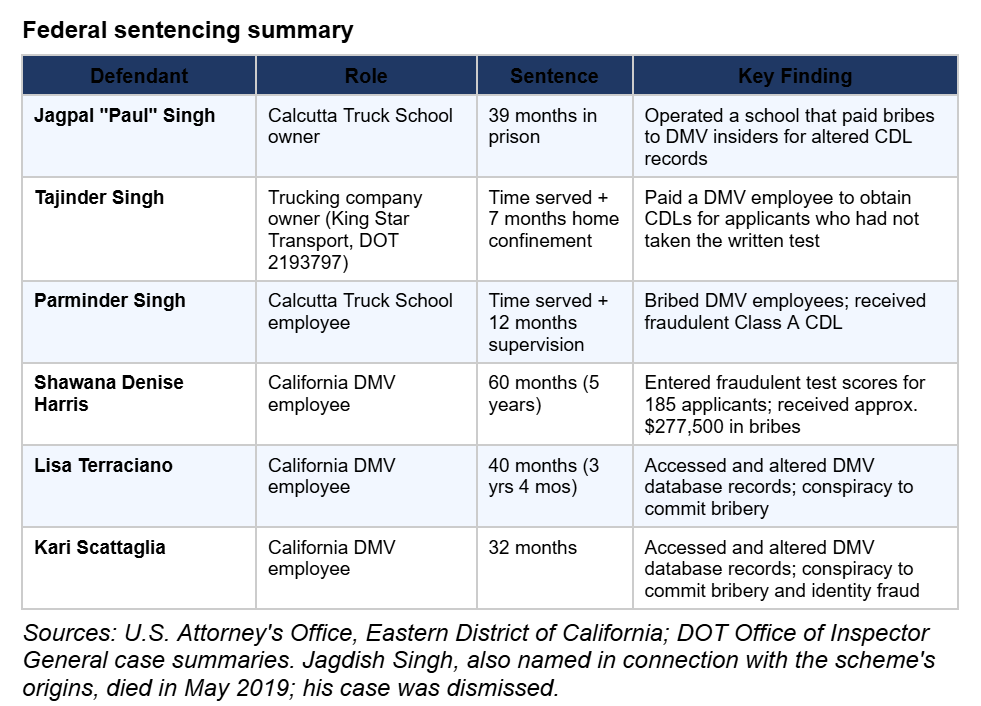
The Department of Transportation’s Office of Inspector General summarized the case. DMV employee Lisa Terraciano was linked to at least 148 fraudulent CDLs. DMV employee Kari Scattaglia was linked to at least 68. A third DMV employee, Shawana Denise Harris, entered fraudulent test scores for 185 applicants and received approximately $277,500 in bribes over the course of the scheme. That is not one rogue employee.
The school-side operator at the center of federal prosecution was Jagpal Singh, owner of Calcutta Truck School in North Hollywood. In December 2019, the U.S. Attorney’s Office announced that Singh was sentenced to more than 3 years in federal prison for bribing DMV employees to issue commercial driver’s licenses to unqualified drivers. Prosecutors said he paid to have DMV records altered so applicants appeared to have passed tests when they had not.
Two of Singh’s co-defendants pleaded guilty in August 2021. Parminder Singh, a Calcutta Truck School employee, pleaded guilty to conspiracy to commit bribery, identity fraud, and unauthorized computer access. Tajinder Singh, described in the DOT OIG case summary as the owner of a trucking company, pleaded guilty to fraud involving identification documents. Tajinder Singh paid a DMV employee to obtain commercial driver’s licenses for applicants who had not taken the written CDL test, according to the DOT OIG.
The DMV employees fared worse in sentencing. Harris was sentenced to five years in federal prison. Terraciano was sentenced to three years and four months. Scattaglia was sentenced to two years and eight months. The federal record is clear on what happened. What it does not tell you is what came next.
Part II: The infrastructure that did not go away
When federal investigators close a case, they measure success by the number of convictions. They do not typically map what the ecosystem looks like 24 months after the last supervised release ends. That job falls to the industry, and to the FMCSA data that anyone with a browser can access.
What the public record shows is continuity. The same phone numbers. The same addresses. The same family of entity names. In one documented case, a convicted federal defendant listed as the primary officer of a new carrier registration after the ink on his sentence was dry.
The anchor address: 15838 Leadwell St., Van Nuys, CA 91406
A single residential address in Van Nuys sits at the center of this network’s physical footprint. At 15838 Leadwell St., a four-bedroom house built in 2005 on a quiet residential street, multiple business registrations, carrier identities, and financial filings converge.
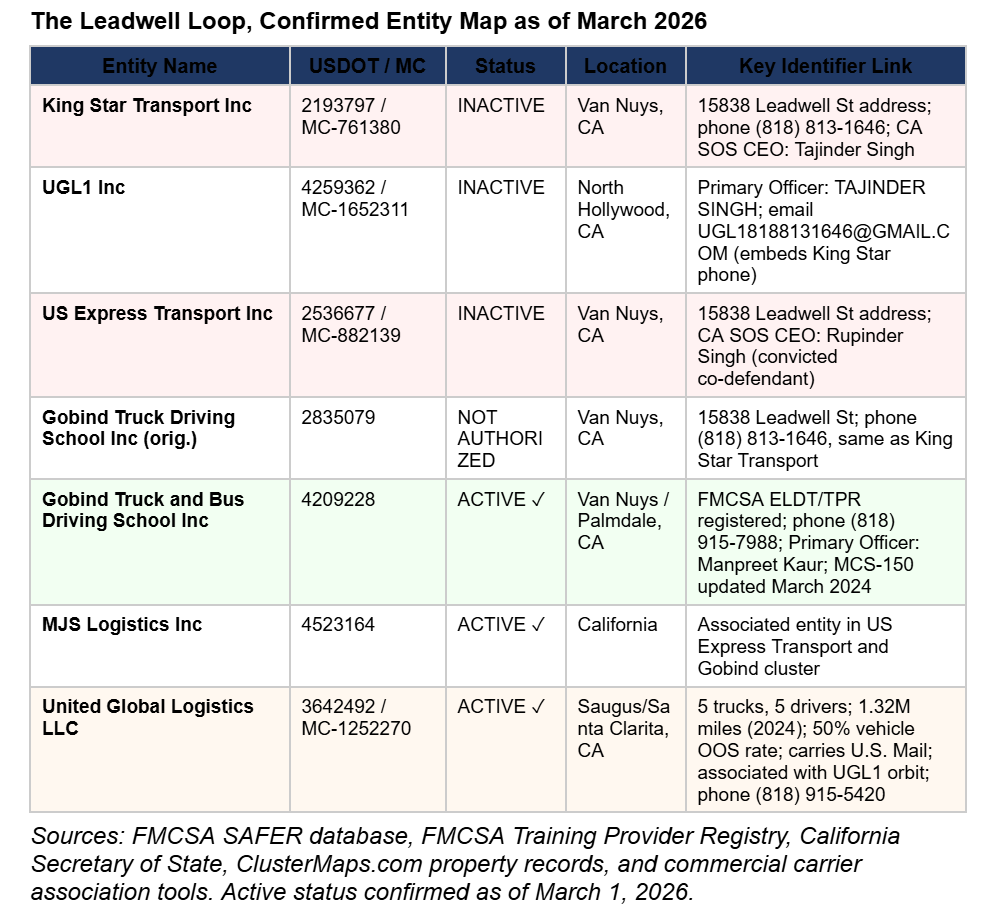
The FMCSA carrier profile for King Star Transport Inc (USDOT 2193797, MC-761380) lists 15838 Leadwell St. as its physical address. That carrier, now inactive, was the trucking company owned by Tajinder Singh, the same Tajinder Singh identified as a co-defendant in the federal CDL bribery case, who pleaded guilty in August 2021.
The original Gobind Truck Driving School Inc. (USDOT 2835079) also used 15838 Leadwell St. as its FMCSA-registered address and listed phone number (818) 813-1646. That entity is no longer authorized to operate in interstate commerce.
California Secretary of State records and UCC filings examined for this report show the same Leadwell address linked to multiple additional entities and individuals: King Star Transport Inc., US Express Transport Inc., Kulwant Enterprises Inc., and personal names including Jagdish Singh (the deceased father of Tajinder, listed as property owner), Kulwinder Kaur, Rupinder Singh, and Singh Satnam.
The property owner of record is Singh Jagdish. A solar permit was pulled on the property in June 2022, more than two years after Jagdish Singh’s death in May 2019 and more than a year after Tajinder Singh’s guilty plea. The property remains in use.
The phone number: (818) 813-1646
In network analysis, a shared phone number is one of the strongest identity linkages available. Phone numbers are harder to accidentally share than addresses, and they require deliberate registration. The sequence of events around the number (818) 813-1646 is worth documenting.
That number appears in SAFER as the registered contact for Gobind Truck Driving School Inc. (USDOT 2835079), the original school entity at the center of this story. It also appears in commercial carrier directories as the listed number for King Star Transport Inc. (USDOT 2193797), the carrier owned by Tajinder Singh.
Then, a new carrier entity, UGL1 Inc. (USDOT 4259362, MC-1652311), appears in the FMCSA records. It is registered in North Hollywood, California. It is inactive. Its listed phone number is (661) 417-7881, a Bakersfield-area number. Its registered email address is UGL18188131646@GMAIL.COM.
That email address embeds the digits 8188131646, the exact digits of (818) 813-1646, King Star Transport’s phone number. That is a deliberate encoding of a legacy identifier into the official contact record of a new entity. And the primary officer listed for UGL1 Inc. in FMCSA records is Tajinder Singh.
Tajinder Singh
Tajinder Singh pleaded guilty on August 19, 2021, to fraud involving identification documents in connection with the CDL bribery scheme. He received a sentence of time served plus seven months of home confinement and 12 months of supervised release. His supervised release ended, by most calculations, in late 2023.
At some point after his involvement in the bribery scheme and potentially after his supervised release concluded, Tajinder Singh appears in FMCSA records as the primary officer of UGL1 Inc. (USDOT 4259362). That carrier is registered, designated MC-1652311, and is currently inactive.
There is no federal law that categorically bars a person convicted in a CDL fraud scheme from later forming or operating a trucking company. That is one of the systemic gaps this case exposes. FMCSA has no automatic cross-check mechanism that flags when a new DOT registrant was previously convicted of transportation-related fraud. The registration process is largely self-certifying. So Tajinder Singh can appear in the federal carrier database, and without a human investigator running a specific name-match against prior fraud cases, that registration may never trigger review.
This report does not allege that UGL1 Inc. is currently operating or that any new crime has been committed. It documents that the federal registration exists, that the primary officer’s name matches that of a convicted co-defendant in the CDL bribery case, and that the email address registered to that entity encodes a phone number associated with the defendant’s prior carrier identity.
Part III: The ELDT-registered school that keeps reincarnating
The ‘Gobind’ brand name is the clearest example in this case of what might be called the corporate costume change: same name, new shell, new paperwork footprint, continued operation.
California Secretary of State records show three distinct iterations of Gobind-named entities filed in different years, each with different statuses and registered agents. The first, Gobind Truck Driving School Inc. (entity #3850596), filed in December 2015, is currently suspended by the Franchise Tax Board. The second, Gobind Truck Driving School Inc. (entity #4640762), filed in September 2020, while Tajinder Singh was under federal indictment, has been terminated. The third, Gobind Truck and Bus Driving School Inc. (entity #4690241), filed in January 2021, just months before Tajinder Singh’s guilty plea, is currently active.
That third entity, Gobind Truck and Bus Driving School Inc., holds FMCSA carrier registration USDOT 4209228, registered March 13, 2024, with a last MCS-150 update of the same date. It is currently active and classified as intrastate only. Its listed primary officer in FMCSA records is Manpreet Kaur. Its registered phone is (818) 915-7988. Its registered email is GOBINDDRIVINGSCHOOL@GMAIL.COM.
This entity is registered in the FMCSA Training Provider Registry as an Entry-Level Driver Training (ELDT) provider.
ELDT training became mandatory by the FMCSA beginning on February 7, 2022. The rule requires that entry-level CDL applicants complete a standardized training program with a provider listed in the federal Training Provider Registry before taking certain CDL skills tests. Being listed in the TPR means a provider can submit training completion records to FMCSA, and those records flow into the CDL issuance pipeline through the same state DMV infrastructure that was compromised in this case.
The FMCSA Training Provider Registry lists an active in-person training location for this entity at 1056 W. Ave. N., Palmdale, CA 93551, with the phone number (818) 915-7988. That is the same number listed in the carrier’s FMCSA profile. The provider is listed as offering Class A theory and behind-the-wheel training, Class B theory, passenger theory, and hazmat theory.
A separate Gobind-branded school location in Castaic, California, also appears in the Training Provider Registry, and at least one additional location in Bakersfield, California, has been documented in commercial review listings. The Castaic location sits in the same Santa Clarita Valley corridor as several other entities that appear in this network’s associated-entity orbit.
The TPR is built on provider self-registration and self-certification. Providers apply for registry listing without undergoing background checks on principals’ criminal histories. There is no mechanism in the current TPR framework to flag when a training provider shares a name, phone number, or address with entities previously connected to CDL fraud investigations. FMCSA has not publicly indicated whether any review of Gobind’s TPR registration occurred in connection with the underlying federal case.
The documented fact is the cross-system identity match: the same brand name, the same phone number, and the same operational footprint connecting an active ELDT provider to a cluster of entities whose principals were convicted in a federal CDL bribery scheme. This report does not allege that the current training is fraudulent, that any specific trainee is unqualified, or that Manpreet Kaur has done anything improper. What the record establishes is that the Gobind brand survived the prosecution, reorganized under a new entity, obtained ELDT registration, and is today feeding training records into the same state and federal licensing systems that were exploited before.
Part IV: The full entity map, what FMCSA data shows
Carrier linkage tools used for this investigation, cross-referencing phone numbers, physical addresses, email addresses, and equipment VINs across FMCSA records, reveal a broader network than a single snapshot of any one entity would suggest. The following table documents the entities identified, their current FMCSA status, and the specific identifiers that link them to the broader cluster.
The United Global Logistics thread
The entity association tools used in this investigation identified a carrier, United Global Logistics LLC (USDOT 3642492), connected to the UGL1 Inc. orbit via entity association signals. That carrier’s name mirrors the interpretation of ‘UGL’ in UGL1 Inc.’s entity name. The connection warrants documentation because of what the FMCSA SAFER data shows about United Global Logistics’ current safety performance.
United Global Logistics LLC is based at 27213 Banuelo Ave., Saugus, CA 91350, in the Santa Clarita Valley, the same geographic corridor as the Gobind Castaic training location. Its registered phone is (818) 915-5420. It reports 5 power units and 5 drivers. Its most recent MCS-150, filed February 12, 2025, reports 1,324,964 miles driven in calendar year 2024. It carries U.S. Mail and holds an active USDOT number.
In October 2025, United Global Logistics underwent a compliance review. FMCSA assigned it a rating of Satisfactory. However, the SAFER roadside inspection data for the 24-month period ending March 1, 2026, tells a more complicated story. Of 28 vehicle inspections conducted, 14 resulted in vehicles being placed out of service, a vehicle OOS rate of 50 percent. The national average vehicle OOS rate for the same period was 22.26 percent. United Global Logistics’ vehicle OOS rate is more than double the national average.
The carrier also recorded three crashes in the same 24-month period: zero fatal, one injury, and two tow-away incidents. It carries authority only as a property carrier, and its current operating authority status is ‘Not Authorized’, meaning it holds an active DOT number but is not currently authorized for-hire property authority under MC-1252270.
A carrier running U.S. Mail, reporting 1.3 million miles annually, with a vehicle OOS rate more than double the national average, and operating in the same geographic corridor and entity-association orbit as a cluster tied to a federal CDL fraud prosecution, is a carrier that merits enforcement attention on its own merits, regardless of any other connection documented in this report.
Part V: The governance loop that keeps looping
None of what this report documents is hidden. Every data point comes from a public federal database, a state filing, a commercial carrier directory, or a property record. The FMCSA SAFER system is publicly accessible. The Training Provider Registry is publicly accessible. The California Secretary of State’s business entity portal is publicly accessible. What is not accessible, and what apparently no agency is performing in a systematic way, is the cross-system analysis that would connect these dots before a reporter does.
The specific governance failures here are worth naming directly.
The first is the absence of a post-prosecution audit requirement. When a federal case involving CDL fraud concludes, there is no standing requirement that FMCSA, the affected state DMV, or any other regulatory body conduct a structured review of carrier and training provider registrations associated with convicted individuals. The DOJ files its press releases. FMCSA does not receive a mandatory referral. The CDL pipeline, which was the target of the underlying fraud, does not get a forensic review of what passed through it during the scheme’s active years.
The second is the ELDT registration gap. The Training Provider Registry has no background check on principals. It has no cross-reference requirement against prior fraud cases. A provider whose brand name, phone number, and geographic footprint directly overlap with a prosecuted scheme can self-register in the federal ELDT system and begin submitting training certifications to the same state licensing infrastructure that was previously compromised. That is not a hypothetical vulnerability. This story documents the realization of vulnerability.
The third is the carrier registration gap. New DOT numbers can be obtained without triggering a review of prior convictions. A convicted CDL fraud defendant can appear in FMCSA records as a primary officer of a new carrier entity, and without a human cross-referencing the name against federal case records, that registration may never be reviewed. The Drug and Alcohol Clearinghouse, launched in 2020, tracks substance violations across the industry. There is no equivalent system for fraud convictions.
The fourth is the equipment-level linkage gap. The carrier association tools used in this investigation flagged at least one equipment VIN connection linking entities in this cluster, meaning that physical assets, not just names and phone numbers, were shared across different carrier identities. Equipment moves. When an operator changes MC numbers, the trucks do not automatically trigger a compliance review. Investigators at FMCSA have access to inspection records that contain VIN data. Cross-referencing VINs against carrier identity churn is a straightforward analytical task. It is not routinely performed.
The fifth and most systemic gap is the lack of transparency after prosecution. The public can read a press release and learn that Tajinder Singh was sentenced to time served plus seven months of home confinement. The public cannot read any official document explaining what happened to the 185-plus fraudulent CDLs that federal prosecutors documented, whether they were reviewed and revoked, what carriers employed the holders of those licenses, or whether any crashes occurred involving those drivers. The public also cannot read any official document explaining what regulatory changes were made to the CDL issuance and training pipeline in California after this case concluded, because, to the best of this reporter’s knowledge, no comprehensive after-action report has been publicly released.
Part VI: Accountability
Accountability in this context is not another press conference. It is not a legislative hearing where officials describe the problem and promise better enforcement. Accountability, in 2026, looks like a specific set of measurable actions.
First, FMCSA should review all Training Provider Registry registrations in California in which the registrant’s name, phone number, email, or address overlaps with any entity connected to the CDL fraud prosecutions documented in this report. That review should be documented, and the results made public. If the review finds no basis for concern, that finding should be published. If it finds a basis for concern, the public has a right to know what action was taken.
Second, FMCSA should review the carrier registration for UGL1 Inc. (USDOT 4259362), in which Tajinder Singh is listed as the primary officer, and the basis for that registration, given Singh’s 2021 federal conviction. The FMCSA has the authority to review a carrier’s fitness. It should exercise that authority here.
Third, United Global Logistics LLC (USDOT 3642492) should receive immediate enforcement attention given its 50 percent vehicle-out-of-service rate, regardless of any other concerns identified in this report. A carrier running U.S. Mail at 1.3 million miles annually with a vehicle OOS rate more than double the national average is a public safety problem on its own terms.
Fourth, the California DMV should be able to publicly account for what happened to the CDLs issued through the bribery scheme. Were the holders notified? Were any licenses revoked? Were any carriers employing those drivers subject to review? If that review was conducted and those answers are documented, the DMV should make them public. If that review was not conducted, that is the answer.
Fifth, Congress and FMCSA should close the ELDT registration gap. The requirement for entry-level training was a meaningful safety improvement. But self-certification into the Training Provider Registry, without background checks on principals and without cross-referencing against fraud case records, means that the very pipeline ELDT was designed to protect can still be seeded by the same networks that operated before it existed.
The Leadwell Loop is not a metaphor. It is a physical address, a phone number, a family of entity names, and a set of federal carrier registrations that, taken together, document how a prosecuted CDL fraud ecosystem reorganized and continued operating in public view after the case was closed.
The federal government proved the vulnerability in court. Prosecutors named the defendants, documented the scheme, extracted guilty pleas, and imposed sentences. That part of the story is finished. What the public record shows in the FMCSA SAFER database, the Training Provider Registry, and California Secretary of State filings is that the ecosystem the scheme created has not been fully dismantled. It has adapted. It operates under new entity names, sometimes with the same phone numbers and addresses, sometimes with new ones. It carries U.S. Mail. It trains entry-level CDL applicants. And it shows up, right now, if you know where to look.
That is not an accusation against everyone in the orbit. It is a demand for an answer from the regulators who are paid to audit this infrastructure and have not, at least publicly, done so.
The burden is not on the public to ignore these patterns. The burden is on the agencies that hold the data to demonstrate that their systems are built to detect them. Until that demonstration is made, the loop will keep looping.
Methodology and Source Note
This report relies on: (1) Federal case summaries and press releases from the U.S. Attorney’s Office for the Eastern District of California and the DOT Office of Inspector General; (2) FMCSA SAFER carrier profile records, including identity, contact, and inspection data; (3) FMCSA Training Provider Registry listings; (4) California Secretary of State entity filings; (5) Property and UCC records from public aggregators; (6) Commercial carrier association tools that cross-reference phone numbers, addresses, and equipment VINs across FMCSA data. All identifier linkages described in this report are documented record matches, not interpretive inferences. All entity statuses are as of March 1–2, 2026. No entity or individual was found guilty of new crimes by this report. Questions of current criminal conduct are for law enforcement, not journalism.
Rob Carpenter is VP of Compliance at TruckSafe Consulting, founder of theteaintel.com, and a contributor to FreightWaves. He has 25+ years of experience in commercial transportation, holds a CDL, CDS and CDM/E certifications, and serves as an expert witness in highway accident litigation.