

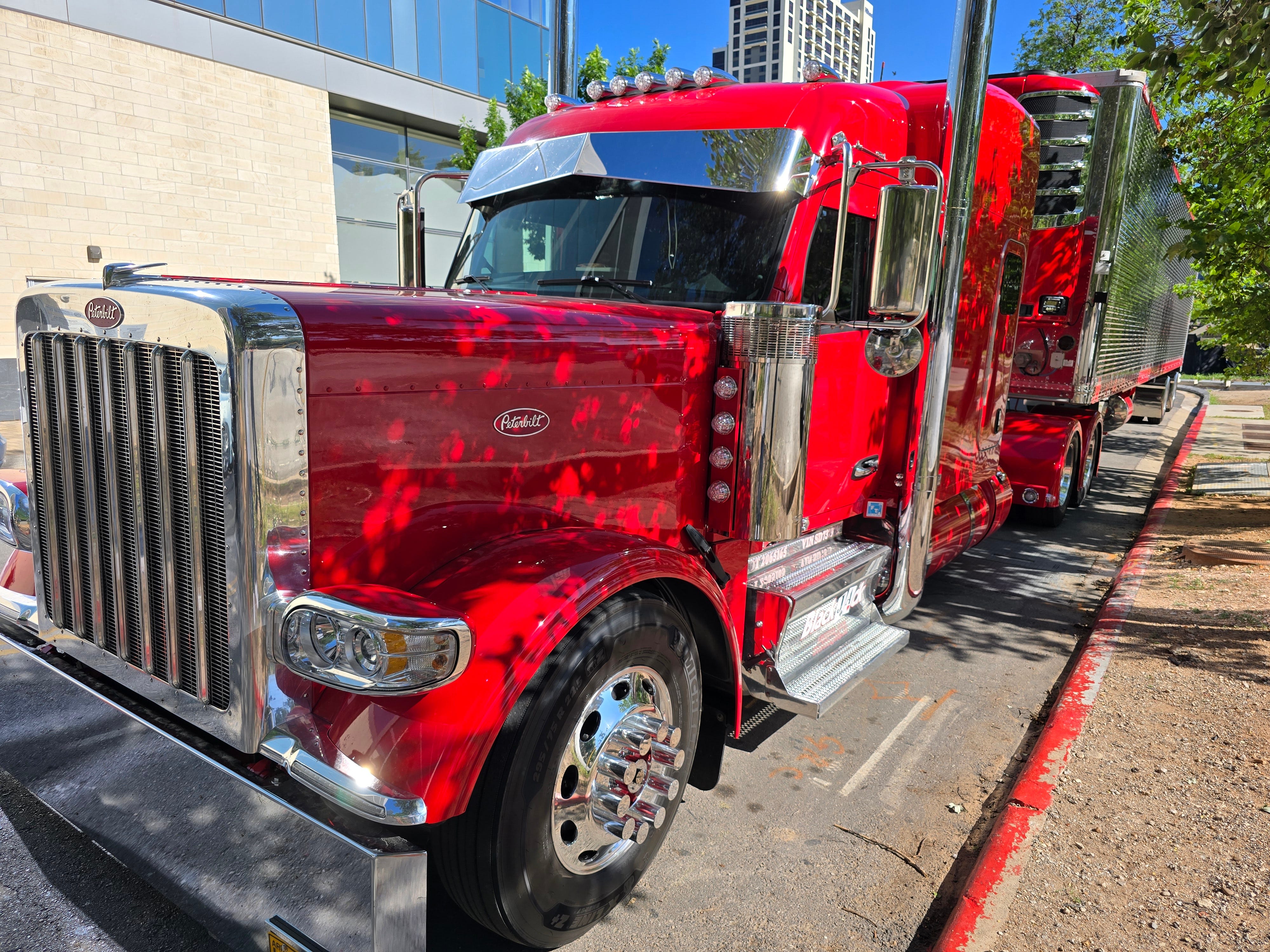
Ingrid Brown and Black Jack’s truck is the poster child here because one of the best indicators of carrier fitness is their drivers and how well the carrier takes care of their equipment. Ingrid drives the truck, and no matter how much she drives, she and “Lucy” here are always professional and always look and act the part. Professionalism is a huge first indicator.
Part I. How We Got Here
1. The bargain of 1994 and the shield it built
Trucking was deregulated economically in 1980. The Motor Carrier Act of that year dismantled the Interstate Commerce Commission’s authority over interstate rates and entry, and the number of carriers holding federal authority went from around eighteen thousand to well over forty thousand within a decade. What the 1980 Act didn’t touch was intrastate regulation. States kept their own commissions, their own tariff filings, their own entry restrictions, and by the early 1990s something like forty states still regulated intrastate trucking rates and routes. A parcel company running a truck from Sacramento to Fresno was operating under a rate structure a state agency had approved. The same truck crossing into Nevada wasn’t.
That patchwork is what Congress went after in 1994, and it went after it in a strange vehicle. The preemption language rode into law on the Federal Aviation Administration Authorization Act, which is why a statute that governs freight brokers has the word aviation in its name and why half the industry has never bothered to learn what the acronym stands for. The operative language, now codified at 49 U.S.C. 14501(c)(1), says a state may not enact or enforce a law, regulation, or other provision having the force of law “related to a price, route, or service of any motor carrier, or any motor private carrier, broker, or freight forwarder with respect to the transportation of property.”
Three things about that sentence have driven thirty years of litigation.
The phrase “related to” was deliberately borrowed from the Airline Deregulation Act of 1978, which had itself borrowed it from ERISA. By 1994 the Supreme Court had already read that phrase broadly in the airline context in Morales v. Trans World Airlines, 504 U.S. 374 (1992), holding that state consumer protection enforcement against airline fare advertising was preempted because it had a connection with or reference to fares. Congress used the same words in the trucking statute knowing what the Court had done with them. The breadth was the point.
The word “broker” is right there in the list. That wasn’t an accident either. Congress was preempting state economic regulation of the whole freight arranging chain, not just the carriers. The drafters, though, were thinking about tariff filing requirements and entry permits, not about a jury in Illinois deciding whether a company should have pulled a safety rating before tendering a load.
The statute also contains its own limit. Section 14501(c)(2)(A) says the preemption provision “shall not restrict the safety regulatory authority of a State with respect to motor vehicles.” States lost the ability to set rates. They kept the ability to regulate safety. Everything that followed turned on how far that second sentence reaches.
The tort shield was built out of the gap. Somebody gets hurt. The family sues the carrier, which is insured for a million dollars and has four trucks, and then sues the broker, which is insured for considerably more and has a balance sheet. The claim against the broker is negligent hiring: you selected this carrier, you had access to its record, and its record said this was coming. The broker answers that selecting a carrier is a broker service, that a state negligence claim about carrier selection is therefore a law related to a broker service, and that 14501(c)(1) preempts it. The plaintiff answers that the safety exception saves the claim. The court decides that question on the pleadings, before discovery, before anybody’s file gets produced and before anybody sits for a deposition.
Courts split, and they split on a narrow point. Everyone agreed common law duties count as state law for preemption purposes. Everyone agreed a negligence claim about carrier selection is at least arguably related to a broker’s services. The fight was over the four words “with respect to motor vehicles” in the safety exception. Brokers argued the phrase limits the exception to state authority aimed at motor vehicles themselves, and a broker doesn’t own, drive, maintain, or put a driver in a truck. Plaintiffs argued that choosing which truck goes on the road is about as motor-vehicle-concerning as a decision gets.
The Ninth Circuit went with the plaintiffs in Miller v. C.H. Robinson Worldwide in 2020. The Eleventh Circuit went the other way in Aspen American Insurance v. Landstar. The Seventh Circuit went with the brokers in Ye v. GlobalTranz Enterprises, 74 F.4th 453 (2023), reasoning that the exception requires a direct link between the state law and motor vehicles, and that a claim against a broker is a step removed. For the next three years, whether a grieving family got to depose a broker depended on which side of a circuit line the crash happened on. The Supreme Court declined to take the question several times before it took Montgomery.
What matters about this history for anyone selecting carriers today isn’t the doctrine. It’s that the shield was never a judgment about whether carrier selection matters. It was a judgment about a preposition. The entire industry built its selection practices around a procedural defense that had nothing to do with safety, and many companies convinced themselves the defense was a verdict on the merits. It wasn’t, and when it went away there was nothing underneath it.
2. What Montgomery actually says
Caribe Transport II held a conditional safety rating when C.H. Robinson tendered it a load of plastic pots. Conditional isn’t a secret, and it isn’t hard to find. It sits on a public federal website next to the record that produced it, and in Montgomery’s telling that record included deficiencies in driver qualification, hours of service, vehicle maintenance, and crash rates. The driver, Yosniel Varela-Mojena, had been cited for careless driving before that day. On December 7, 2017, Shawn Montgomery was stopped on the shoulder of Interstate 70 in Illinois with a mechanical problem when Varela-Mojena’s tractor-trailer left the road and rear-ended him. Montgomery lost his leg.
He sued the driver, the carrier, and the broker. The claim against C.H. Robinson was negligent hiring: that a company arranging freight knew or should have known that putting this carrier under this load was reasonably likely to hurt somebody. The district court in the Southern District of Illinois never reached that question. Applying Ye, it held that the FAAAA expressly preempted the claim and entered judgment on the pleadings for the broker in January 2024. The Seventh Circuit affirmed at 124 F.4th 1053 (2025). That was the ordinary outcome. For most of a decade, in a large part of the country, a broker facing a negligent hiring claim filed a motion, cited preemption, and went home before anyone took a deposition.
The Supreme Court granted certiorari at 606 U.S. 1066 (2025) and decided the case on May 14, 2026. The vote was nine to zero. Justice Barrett wrote the opinion and it runs eight pages. The reasoning fits in a sentence: requiring a broker to use ordinary care when selecting a carrier concerns motor vehicles, most obviously the trucks that will haul the goods, so the claim falls inside the safety exception and survives preemption.
The Court took the counterarguments seriously and rejected all of them. C.H. Robinson argued, with the United States joining in part, that reading the exception this way would let it swallow the preemption provision whole, since nearly any claim can be framed as a safety claim. It argued the reading creates surplusage, and it argued the reading produces an anomaly, because a separate subsection of the same statute, 14501(b)(1), preempts state regulation of intrastate broker services with no safety exception at all, meaning brokers would end up more completely protected on intrastate freight than on interstate. The Court granted that the anomaly is real and said it could not explain why Congress would have done that. It concluded it would be odder still to hold that the negligent hiring of an unsafe carrier whose truck injured someone isn’t an exercise of a state’s authority to regulate safety.
That’s the holding. Now read the parts the industry coverage skipped, because they are where the next three years of litigation live.
The Court decided nothing about purely intrastate loads. The intrastate provision at 14501(b)(1) has no safety exception, and the Court expressly declined to say whether a negligent hiring claim on an intrastate move is preempted. For a brokerage running regional freight inside a single state, that’s a live defense that has to be pleaded and preserved rather than assumed away. Every summary saying the ruling “applies in all fifty states” describes the interstate holding and quietly drops this. It’s one of the few doors left open, and it will get tested.
The Court decided nothing about vicarious liability. Negligent hiring says you chose badly. Vicarious liability says the carrier was functioning as your agent, so its conduct is your conduct, which reaches past the selection decision into how the freight actually moved. It was never preempted, it wasn’t before the Court, and Montgomery left it exactly where it was. For a broker exercising real control over routing, scheduling, equipment, or dispatch, the agency theory is frequently the larger exposure, and it’s the one that scales with how modern digital freight matching actually works.
The concurrence is being quoted with the front half removed. Justice Kavanaugh concurred, joined by Justice Alito, and the concurrence says the case was closer than the majority opinion made it appear before agreeing with the result. The line the trade press ran with is the policy point: if brokers can be held liable for disregarding poor safety records, they have a strong incentive to do business only with safe and reliable motor carriers. That sentence will appear in plaintiff briefs for a generation. The sentence in front of it belongs to the defense, and dropping it’s how you get surprised in a hearing.
3. What Montgomery didn’t do, and why that’s the harder problem
There’s no threshold in the opinion. No required data source, no minimum score, no form, no filing, no audit standard, and no safe harbor. The Court answered a jurisdictional question and left the substance to state common law negligence. That means the standard is ordinary care, and ordinary care is whatever a jury decides a reasonable company in your position would have done.
That isn’t a loophole, and it shouldn’t be read as one. A bright-line federal rule is something you can satisfy and then stop thinking about. Ordinary care judged after the fact has no ceiling. It gets defined at trial, by a lawyer holding the same free public records you could have pulled in ninety seconds, standing next to a family. The absence of a rule is worse for defendants than a strict rule would have been, because a strict rule is a floor you can prove you cleared and a hindsight standard is a moving target you argue about in front of people who have already seen the photographs.
The doctrinal hook in most states is older than the FAAAA. The Restatement (Second) of Torts section 411 says an employer of an independent contractor is liable for physical harm caused by the contractor’s failure to exercise reasonable care, if the employer failed to exercise reasonable care in selecting a contractor who is competent and careful. Most states have adopted some version of it. That’s the body of law that fills the space Montgomery opened, and it’s state by state. What counts as reasonable inquiry in Texas is not identical to what counts in Washington. Anyone telling you there’s now a national carrier vetting standard is selling something.
Three claims get confused constantly, and they are different animals.
Negligent selection, also called negligent hiring, is the direct claim that you chose a carrier you knew or should have known was unsafe. Your conduct is the wrong. Your file is the evidence. This is what Montgomery unlocked.
Negligent entrustment reaches the decision to put freight in the hands of a specific driver or a specific piece of equipment. It’s narrower and harder to prove against a broker, because a broker usually doesn’t know which driver or which tractor is coming. Usually. If your system captured the driver’s name and the unit number at dispatch, and that driver was in your data with a prior event, the argument gets much easier for the other side.
Vicarious liability doesn’t care whether you chose well. It asks whether the carrier was your agent, which turns on control: who set the route, who dictated the schedule, who specified the equipment, who could tell the driver what to do and expect to be obeyed. This is the theory that punishes companies for building sophisticated operational tooling, because every feature that gives you visibility and control over how the freight moves is a fact in the plaintiff’s column. It was never preempted. It has always been available. It is going to be the growth area.
You can be found not liable on all three and still spend two years and seven figures getting there, which is the part that actually changes behavior. The value of the preemption shield was never that it produced good outcomes at trial. It was that it ended cases before discovery. Discovery is the expense, discovery is where your emails live, and discovery is now the default.
4. Who this actually hits
The trade coverage framed Montgomery as a broker problem. That framing is wrong in a way that leaves the most exposed parties feeling safest.
Brokers and 3PLs are the obvious defendants, and they at least know it. The property broker holding FMCSA authority under 49 U.S.C. 13904 is the named defendant in the case and the party every article addressed.
Shippers who tender direct are selecting carriers as surely as any broker, and the duty of ordinary care in selecting a contractor doesn’t attach to a license number. It attaches to the act of choosing. A manufacturer with a private fleet and an overflow program that tenders directly to carriers is doing selection with, in my experience, less process than a mid-size brokerage. I have reviewed direct-tender programs at companies with revenue in the billions where the entire vetting record was a signed carrier packet and a certificate of insurance in a shared drive folder.
Shippers who hire brokers face a second-order version of the same claim: negligent selection of the broker. The question is whether you knew or should have known your broker didn’t vet carriers. If you ran a bid, awarded on price, and never asked how the routing guide gets filled, you have a problem that a broker indemnity clause doesn’t solve.
Freight forwarders are in the statute by name and take custody, which gives them both exposures at once.
Asset carriers brokering their own overflow are the most underappreciated group in this entire conversation. A carrier with a hundred trucks and a brokerage authority that covers surge volume is a motor carrier for half its revenue and a broker for the other half, and the brokered half now carries the same selection exposure as any 3PL. Most of them have a compliance department built entirely around the carrier side. Their brokerage side is three people and a load board.
Digital freight platforms have a specific problem. The product advantage is automation: instant tender, algorithmic matching, no human in the loop. Automation means the selection decision is a set of rules somebody wrote, which will be produced in discovery and read line by line. The question in the deposition isn’t what the dispatcher was thinking. It’s what the code did, why the threshold was set at that number, and who approved it. That’s a harder question than the human one, because a rule applies to every load and a human error applies to one.
Insurers, agents, and MGUs aren’t defendants, but they are repricing. Contingent auto liability and broker errors and omissions were written in a world where preemption killed most of these claims early. That assumption is gone, and the pricing is following. If you broker freight, your renewal is where you will feel Montgomery before you ever feel it in a courtroom.
5. The money, and why the plaintiff bar was ready for this
Trucking litigation isn’t general liability litigation. The physics decide the damages before anybody hires a lawyer. When a tractor-trailer at eighty thousand pounds meets a passenger car, the people who die are overwhelmingly in the smaller vehicle, and the survivors are catastrophically injured rather than moderately injured. These are wrongful death and lifetime-care cases, and the verdict distribution reflects it.
The nuclear verdict data everyone quotes comes from the U.S. Chamber Institute for Legal Reform, which logged roughly 1,300 verdicts over ten million dollars between 2013 and 2022, with a median award near twenty-one million and a mean near eighty-nine million. That spread between median and mean is the whole story. The distribution has a tail, the tail is where the trucking cases live, and 2023 alone produced more than twenty trucking verdicts over a hundred million dollars.
The theory that moves those numbers isn’t the crash. Crash facts establish liability and damages. The theory that moves the number past the policy limits and into the balance sheet is the argument that somebody made a choice, in advance, with information available to them, and chose revenue. Improper hiring and onboarding allegations correlate with some of the largest increases in total award of any negligence theory, because they convert an accident into a decision. A jury can forgive an accident. A jury has a much harder time forgiving a decision, especially when the decision is documented in an email that says the load had to go out.
The plaintiff bar has spent a decade building the infrastructure for this. There are firms, conferences, expert networks, and litigation funding aimed specifically at commercial motor vehicle cases, and the discovery playbook is standardized. They know what to ask for, what a carrier profile looks like on the day of the crash versus the day of the deposition, and that most defendants can’t produce a contemporaneous selection file. Before Montgomery, all of that work stopped at the courthouse door in a large part of the country. The infrastructure was built and waiting.
What the industry keeps saying to itself is that its exposure went up on May 14. That’s not what happened. The exposure was constant. Brokers and shippers were always capable of putting a dangerous carrier under a load, and the data to see it coming has been free and public the entire time. What changed on May 14 is that the question now gets asked out loud, in front of twelve people who have never heard of the FAAAA and won’t care that the carrier was technically allowed to operate.
Part II. What a Motor Carrier Actually Is
6. Three questions, one check
The industry collapses three separate questions into one lookup, and the collapse is the single most common failure I see when I am brought into a file after the fact.
A compliant carrier holds active operating authority, has the required financial responsibility filings on record, and is legally permitted to haul. That’s a status. You can confirm it in ninety seconds, and it tells you close to nothing about whether the carrier will hurt somebody. Authority and insurance are the price of admission. They are not evidence of anything except that a fee was paid and a form was filed.
A safe carrier is one whose record and conduct say it’s unlikely to hurt somebody. That’s a pattern, not a status. It lives in crash history, out-of-service rates, inspection results, violation severity and trend, driver behavior, and maintenance discipline. Part of it lives in public records. The most predictive part doesn’t, because it lives inside the carrier’s operation and only surfaces if the carrier shows it to you.
A defensible carrier is one you can prove you were reasonable to choose. That’s a record of your own diligence, and it’s the only one of the three that’s entirely within your control. It’s the file showing what you checked, when you checked it, what the data said that day, and why you proceeded.
These come apart in every direction. Caribe Transport II was compliant on the day of the tender. It held active authority, and it had insurance on file. It also held a conditional safety rating with alleged deficiencies across driver qualification, hours of service, maintenance, and crash rate, which is the entire compliant-but-not-safe case in a single carrier. Run it the other direction, and you get the carrier that’s genuinely well run, with a thin inspection record because it operates in a state that inspects lightly, and a broker who never looked. That carrier was safe. The selection was still indefensible, because in discovery the question isn’t only whether the carrier was dangerous. It’s whether you did anything at all to find out.
“They had active authority and insurance on file” is a true sentence. In front of a jury, it’s close to worthless, because it answers the compliance question while the plaintiff is asking the safety question, and everyone in the room can hear you answering the wrong one.
7. Anatomy of a carrier, and how each layer lies
A motor carrier is six layers stacked on top of each other. Each layer has its own public record, its own failure mode, and its own specific way an operator can make it look better than it’s. Most vetting tools read one layer, usually the first, and report the result as if it described the whole company.
The authority
A USDOT number is a census identifier. It means an entity registered with FMCSA and answered questions about itself. It isn’t a license, it doesn’t expire, and it doesn’t mean anybody checked anything. An MC number is an operating authority for interstate for-hire transportation, and it can be active, pending, revoked, or reinstated.
The failure modes here are staleness and misreading. Authority gets revoked, most commonly for failure to maintain the required financial responsibility filing, and the revocation doesn’t announce itself to anyone who onboarded the carrier eight months ago. There’s a window between the notice of revocation and the effective date where a carrier is still technically operating and is functionally uninsurable. Reinstatement after revocation resets nothing in most vetting tools, so a carrier that lost and regained authority twice in a year shows up as active with no history displayed.
The subtler failure is confusing the identifiers. A carrier can hold a DOT number with no active MC authority and still look legitimate in a screenshot, because the DOT number resolves and returns a company. If your process confirms “the DOT number is valid,” your process confirms nothing.
The entity behind the authority
Behind the authority is a corporation or an LLC, registered in some state, with a registered agent and an incorporation date. Behind that’s a BOC-3 process agent designation, which is the filing that tells the world who can accept legal service on the carrier’s behalf in each state.
This layer lies beneath the surface: it’s newer than it looks and one of many. A corporation formed two months ago holding authority that appears seasoned is a reincarnation tell, and it’s one of the highest-signal, lowest-cost checks available, because corporate formation dates are public in every state and almost nobody pulls them. Process agent designations cluster: a handful of agents serve enormous numbers of carriers legitimately, but rapid agent changes and unusual clustering track with problem networks in a way that’s visible if you look at the aggregate rather than the single filing.
The entity also lies by address. A commercial mail receiving agency or a registered agent suite that houses hundreds of authorities isn’t itself proof of anything. It’s a reason to look at what else is at that address and whether the other tenants have a pattern.
The people
Officers are reported to FMCSA and are recorded in state corporate filings, and people move. The principal who ran a carrier into revocation last year is running a new one this year, and the new one has no history because it’s new. That’s the whole mechanism of authority reincarnation, and it’s a people problem wearing a paperwork costume.
This layer lies by omission. Officer fields are self-reported and thinly validated. The person who actually controls the company is frequently not the person listed, and the listed officer is sometimes a relative, an employee, or a name that appears on a dozen filings. UCC financing statements are useful here for the same reason they are useful in any fraud workup: they name principals and related entities as debtors and co-debtors, and they are filed by lenders who did their own diligence and had money at stake.
The iron
Power units are reported on the MCS-150 and are captured, imperfectly, in the roadside inspection record by VIN and plate. A carrier’s fleet is some mix of owned tractors, leased tractors, and owner-operator equipment under lease, and the mix matters, because a carrier whose entire fleet is leased from its drivers has different control over maintenance than one that owns and shops its own trucks.
The iron lies through the paper attached to it. The same plate appearing on materially different VINs, or the same VIN appearing in two states on the same day at a distance no truck could cover, isn’t a data error often enough to ignore. Equipment also migrates between authorities: a fleet of VINs that were inspected under one DOT number last year and a different DOT number this year, with no sale recorded, is the physical evidence of a reincarnation that the paperwork was designed to hide. Trucks are harder to fake than filings, which is why the equipment record is the highest-value place to look when the corporate record is clean.
The drivers
Drivers are employees, 1099 contractors, or leased through a driver staffing company, and the distinction determines who holds the qualification file and who runs the drug and alcohol program. A carrier that leases drivers can have a perfectly compliant driver qualification process that it doesn’t perform, and can be genuinely unsure how many people drove for it last quarter.
This layer barely exists in public data, which is why the worst risk hides there. Roadside inspections capture the driver on that day. Nothing public tells you turnover rate, and turnover is one of the strongest signals in the entire business. A carrier running a hundred and forty percent annual turnover is putting a stranger in a truck every few months and has no accumulated knowledge about any of them.
The money
Somebody insures the carrier, somebody factors its invoices, and somebody gets paid. Each of those relationships is a signal, and each is a place a carrier can be something other than what it appears.
Financial responsibility filings tell you a policy was filed. They don’t tell you the insurer’s financial strength, whether the policy schedules specific autos and drivers rather than covering any auto, whether the limit is adequate for the freight, or whether the coverage has lapsed and been reinstated four times in eighteen months. A carrier placed with a thinly capitalized risk retention group at a minimum limit, hauling high-value freight through a plaintiff-friendly venue, is functionally uninsured against the loss that’s actually possible, and every one of those facts is checkable in advance.
Payment is the fraud tell. When the entity that wants to be paid isn’t the entity that was vetted, something is wrong, and it’s either a factoring assignment nobody documented or it’s somebody else’s load. That check costs nothing and catches a category of loss that vetting the carrier’s safety record will never touch.
8. Where the federal data comes from, and what it can’t tell you
Understanding the limits of the public data is itself part of reasonable care, and it’s the part that separates people who use these systems from people who quote them.
Almost everything you can see about a carrier comes out of the Motor Carrier Management Information System. MCMIS is fed by three things: registration filings the carrier submits about itself, roadside inspections performed by state enforcement, and crash reports submitted by states. Each of those inputs has a bias, and the biases compound.
Roadside inspections are a sample, not a census. A carrier gets inspected when it drives past an open scale, gets selected at a weigh station, or gets stopped. Inspection volume is driven by state enforcement capacity, which is driven by Motor Carrier Safety Assistance Program funding and state priorities, and the variance between states is large. A carrier running lanes through states that inspect aggressively will accumulate a thicker record than an identical carrier running lanes through states that don’t. Two carriers with identical safety practices can look meaningfully different, and the difference is geography.
Absence of data isn’t the same as absence of risk. This is the single most misread thing on a carrier profile. A carrier with three inspections and no violations doesn’t have a clean record. It has almost no record. The screening system reads no violations and returns nothing adverse, and a person under load pressure reads nothing adverse as good. A one-truck authority six months old with two inspections is the least-known carrier on your board, and the least-known carrier isn’t the safest one. Thin data is a risk condition, and it should be scored as one.
SMS percentiles were never a crash predictor, and FMCSA says so. The Safety Measurement System sorts inspection and crash data into behavioral categories and ranks each carrier against a peer group by percentile. FMCSA attaches a disclaimer to the public display saying the data shouldn’t be used to draw conclusions about a carrier’s overall safety. A 2014 Government Accountability Office review found that most of the violations feeding the system didn’t have a demonstrated statistical relationship to crash risk, and that the peer grouping produced unreliable results for the large majority of carriers because they had too few inspections to support a percentile at all. The Driver Fitness category has been shown to run inverse to crash risk in some analyses, which means a worse score predicted fewer crashes. A metric that runs backward isn’t a safety metric.
None of that makes the underlying data useless. It makes the percentile useless. The inspection record itself, read as outcomes rather than as a rank, is one of the better signals available. What you want out of it is out-of-service results rather than paperwork findings, severity rather than count, rate against exposure rather than raw totals, and trend over a rolling window rather than a snapshot. That’s a different reading of the same data, and it’s the reading a competent expert will perform on your file whether you did or not.
Crash counts arrive without fault. The crash indicator counts reportable crashes regardless of preventability. FMCSA’s Crash Preventability Determination Program allows review of certain crash types, but coverage is partial, and the process is slow, so a carrier that was rear-ended at a red light carries that crash in its record the same way it carries one it caused. Reading raw crash counts without adjusting for what the carrier actually did is how you disqualify good carriers and how a plaintiff’s expert makes you look arbitrary on cross.
The MCS-150 is self-reported and frequently garbage. Power units, driver counts, and annual mileage come from the carrier, on a biennial update schedule that many carriers treat as optional. The mileage figure in particular is unreliable in both directions, and both directions are informative. A carrier reporting nine thousand miles a year across three trucks is either dormant or lying, and a carrier reporting three hundred thousand miles per truck is inflating to dilute its own crash rate. That second one is worth understanding, because crash rate normalized by self-reported mileage is a metric the carrier controls the denominator of.
Safety ratings are rare and old. A rating comes out of a compliance review, and most carriers have never had one. The absence of a rating isn’t adverse and should never be scored as adverse, because it describes agency resource allocation rather than carrier behavior. What’s adverse is a rating that exists and is bad. What’s misleading is a satisfactory rating from a compliance review conducted eleven years ago under a different owner, which is a document about a company that no longer exists.
The systems aren’t one system. SAFER returns a snapshot. The SMS site returns the behavioral data. Licensing and Insurance returns the filings of record. QCMobile returns live authority and out-of-service status through an interface that’s current at the time of the call. They don’t all update on the same cycle, and the gap between a cached snapshot and the live record is where false positives and false negatives both live. Any system that gates a decision on authority status or out-of-service order and reads that status from a stored table rather than a live call will eventually reject a good carrier and pass a bad one, and it will do both in the same week.
The honest summary of the public data is that it’s enough to disqualify and not enough to qualify. It will reliably tell you that a carrier is a bad idea. It won’t tell you a carrier is a good one. Everything that separates a good carrier from an unremarkable one lives inside the operation, and Part III is about how to see it.
TOMORROW….Parts III through VII follow: what good looks like from inside the yard, what the losers look like, the vetting protocol, defensibility and the deposition, and where the market goes from here.
Montgomery holding, vote, authorship, date, docket number, procedural history, the Kavanaugh concurrence joined by Alito, the open intrastate question under 14501(b)(1), the untouched vicarious liability question, the facts of the December 7, 2017 crash, and the Ye citation at 74 F.4th 453.
Miller v. C.H. Robinson (9th Cir. 2020) and the Eleventh Circuit Aspen American / Landstar decision. The Morales citation at 504 U.S. 374 (1992) and the Restatement (Second) of Torts section 411
Chamber Institute for Legal Reform nuclear verdict counts and averages, the 2023 count of trucking verdicts over one hundred million dollars, the 2023 workplace fatality share attributed to transportation incidents, the 1980 to 1990 carrier population figures, and the count of states regulating intrastate trucking before 1994.