

Regulators, policymakers, Will Cain, 60 Minutes, CBS, NBC, hundreds of podcasts, Sirius hosts, insurance underwriters, the NTSB, the FBI, Treasury, multiple FMCSA administrators, special investigators, and litigators come to us for chameleon and general carrier and broker plaintiff and defense work... It’s what we do. I started researching at 4. Yes. 4. When my mother left, I didn’t know who she was or where she came from. When I wasn’t sitting at the window watching the street, looking for her return that never came, I was at the York County library or working on the farm and property. As technology developed, I knew where the records were, what records existed, and where they were being developed, literally to piece together my mother, her family, her family’s Gissel Packing, and other businesses. It rounded the wagon from my ICC truck data to stocks to the Supreme Court case of NLRB v. Gissel Packing.
As DNA and technology continued to develop, so did our constant resourcing of materials. I went on to file for my legal emancipation from my grandparents at 15, and to our knowledge, I’m the only successful one to do that in VA. Those decades of historical York County, VA, paper record deep dives, the AOL floppy internet access, and tech development led me to find families all over the world, to reunite with tech, no tech, DNA, and no DNA. We knew where the source data was and where it was constantly evolving, and that got us here to where we are today.
That bled into trucking... decades ago with the ICC, the FHWA, and then the FMCSA, insurance policy, and litigation. I started as a driver, then became a broker, then a manager, then an owner, then a large-fleet executive, and now we’re here: litigation, risk, and insurance. We’re the best at it because we’ve spent our entire lives developing data that solves the general unknown, often blank-white puzzle.
Chameleons aren't new; going back to 2008 and the Sherman bus crash, we’ve been here before. Many times. From Sherman to the Congressional Archi and the subsequent Ursa push to solve it, to where we are today, the buck never really stops; it just keeps getting passed, with ebbs and flows of outrage when bodies drop. So what is it? We tried to break it down in our 60 Minutes piece, and in other work we do with just about everybody, but this is the 101 for dummies: from their development to their quick rise, sudden fall, and reincarnation. It all boils down to identity, disclosure, and accountability.
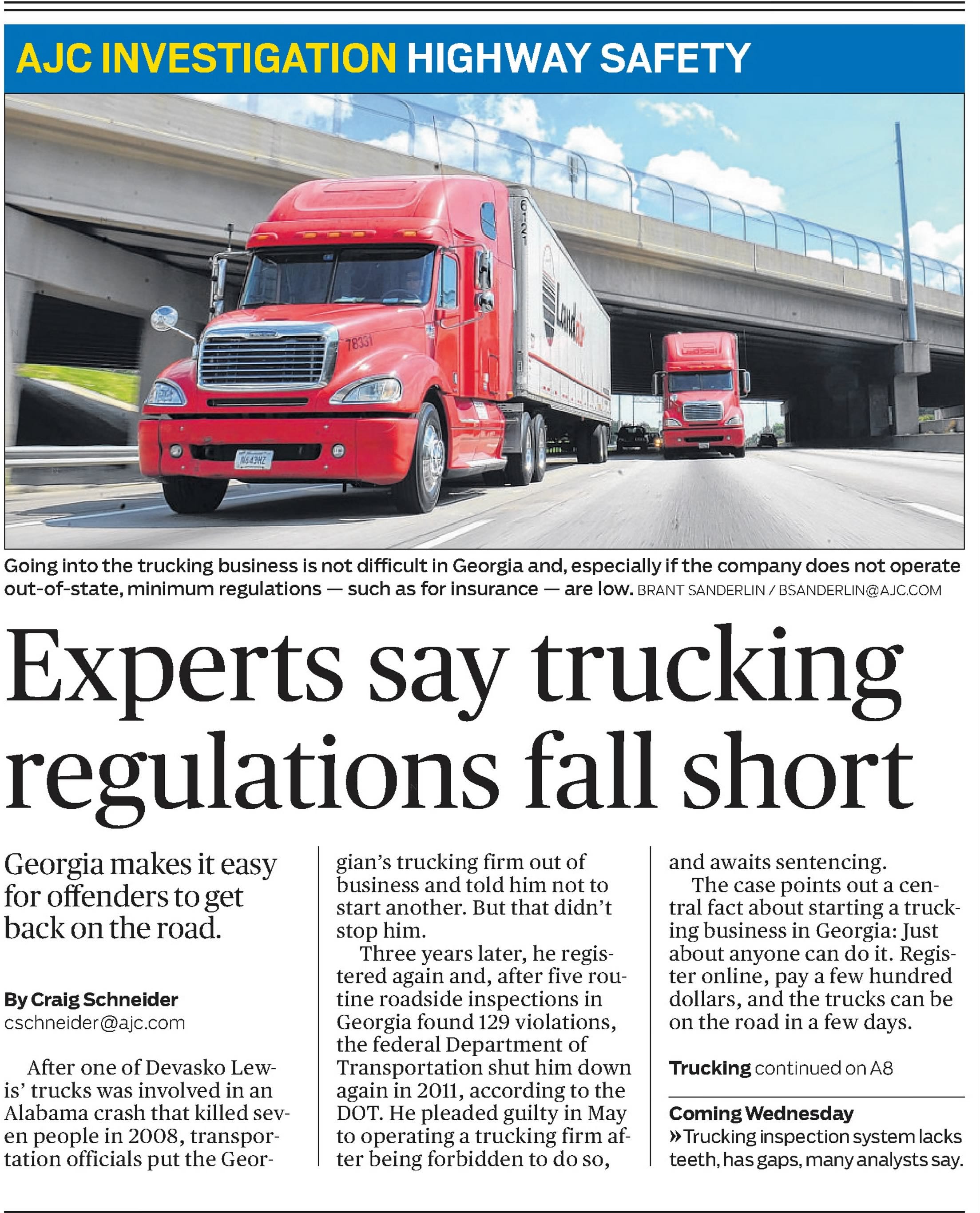
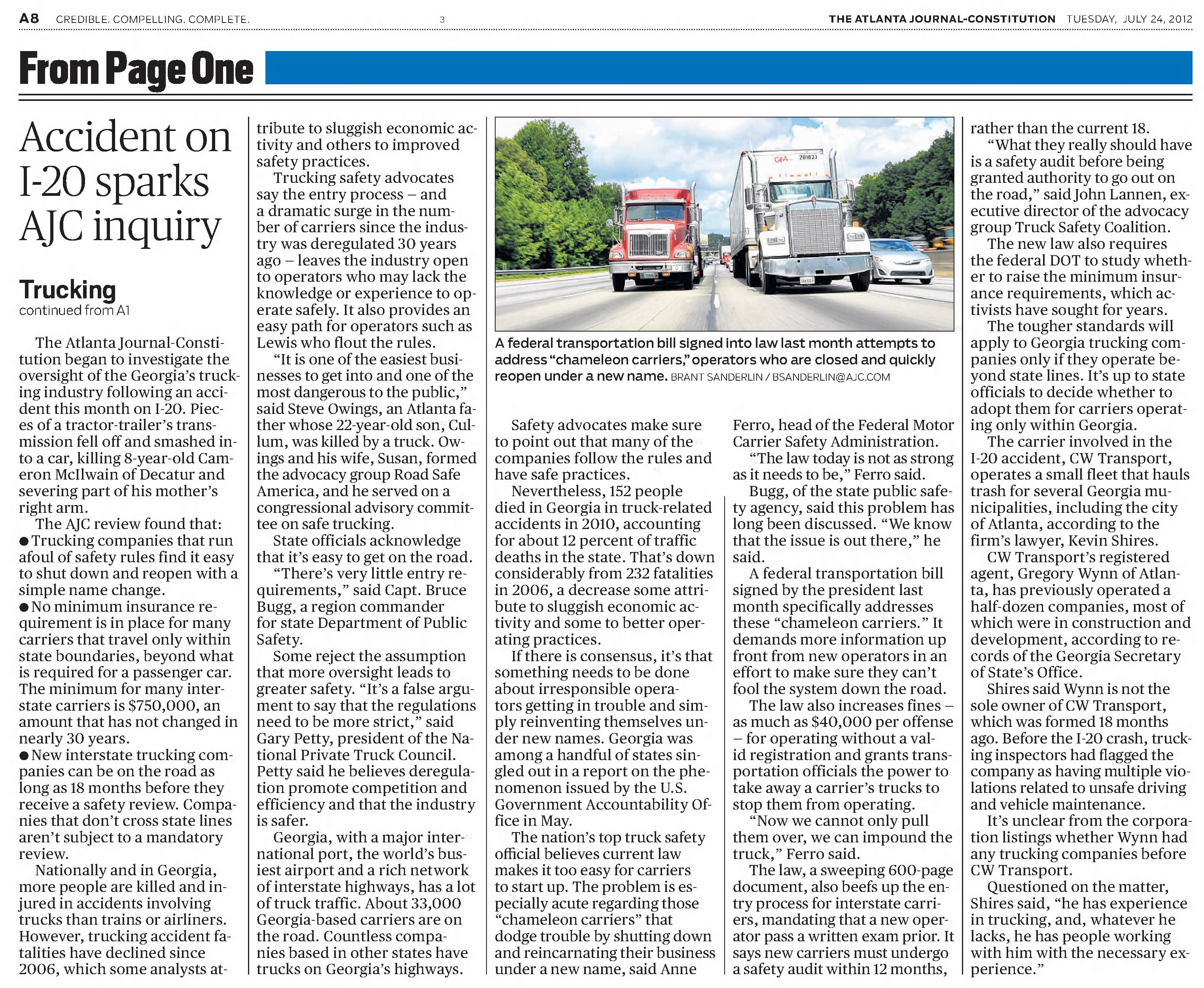
A federal rule lets you identify the person responsible for a truck. Every interstate carrier files an MCS-150 that names its company officers. Every for-hire carrier designates a process agent in every state it runs, on a form called the BOC-3, so a lawsuit can be delivered anywhere the truck goes. Every corporation keeps a registered agent with its secretary of state for the same reason. Federal law also requires an applicant for operating authority to disclose “any relationship involving common ownership, common management, common control, or common familial relationship” with any other carrier, broker, or freight forwarder in the three years before it applies.


Put together, that is the promise. A DOT number is a name, an address, and a person, and the crash file, the enforcement case, and the unpaid penalty follow that number to the people behind it.
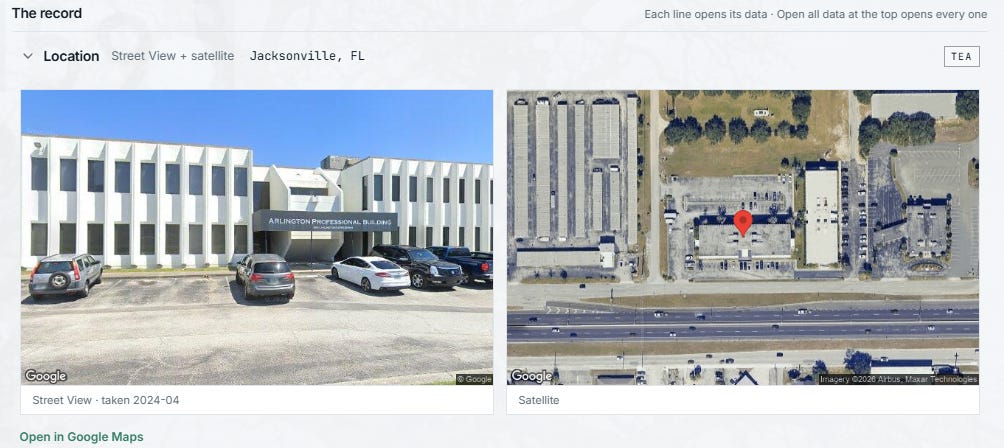
A chameleon carrier is the business built to break that promise. Same trucks, same drivers, same dispatch floor, new paper. The industry calls it authority reincarnation, and the regulators’ own word for the target is “a new identity.”
Why I went back
On Feb. 8 I published a piece on how these networks build their empires, after a truck in the Sam Express orbit crossed the centerline on State Road 67 in Jay County, Indiana, and killed Henry Eicher, 50, his sons Menno, 25, and Paul, 19, and their friend Simon Girod, 23. That piece walked the growth formula. Since then I’ve spent eight months in the records behind it, and in a federal courtroom’s worth of complaints filed by drivers, insurers, and carriers caught in the same machinery. The pattern beneath it all isn’t the trucks. It’s the identity.
You can’t judge a trucking entity the same way Nick Shirley judges a day care. If there are no kids, there's clearly no day care. If there are no trucks, that doesn’t always mean what you think it means; M&A fleets have some of the same chameleon indicators as chameleon fleets, as do Driveaway fleets and leasing fleets like Ryder and Penske. What decides is where you fall on what I call the chameleon spectrum, and that takes work.
The topline
The government has known the size of this since 2012. The Government Accountability Office matched new applicants against carriers with history, using company names, addresses, and phone numbers, and found carriers with chameleon attributes rising from 759 in 2005 to 1,136 in 2010, 5,640 over six years. About 94% were freight carriers. The key finding: “18 percent of the applicants with chameleon attributes were involved in severe crashes compared with 6 percent of new applicants without chameleon attributes.” Three times the severe-crash rate. At the time, FMCSA’s vetting program screened only passenger and household goods carriers, about 2% of new applicants in 2010. The agency expanded vetting to all new applicants in February 2016.
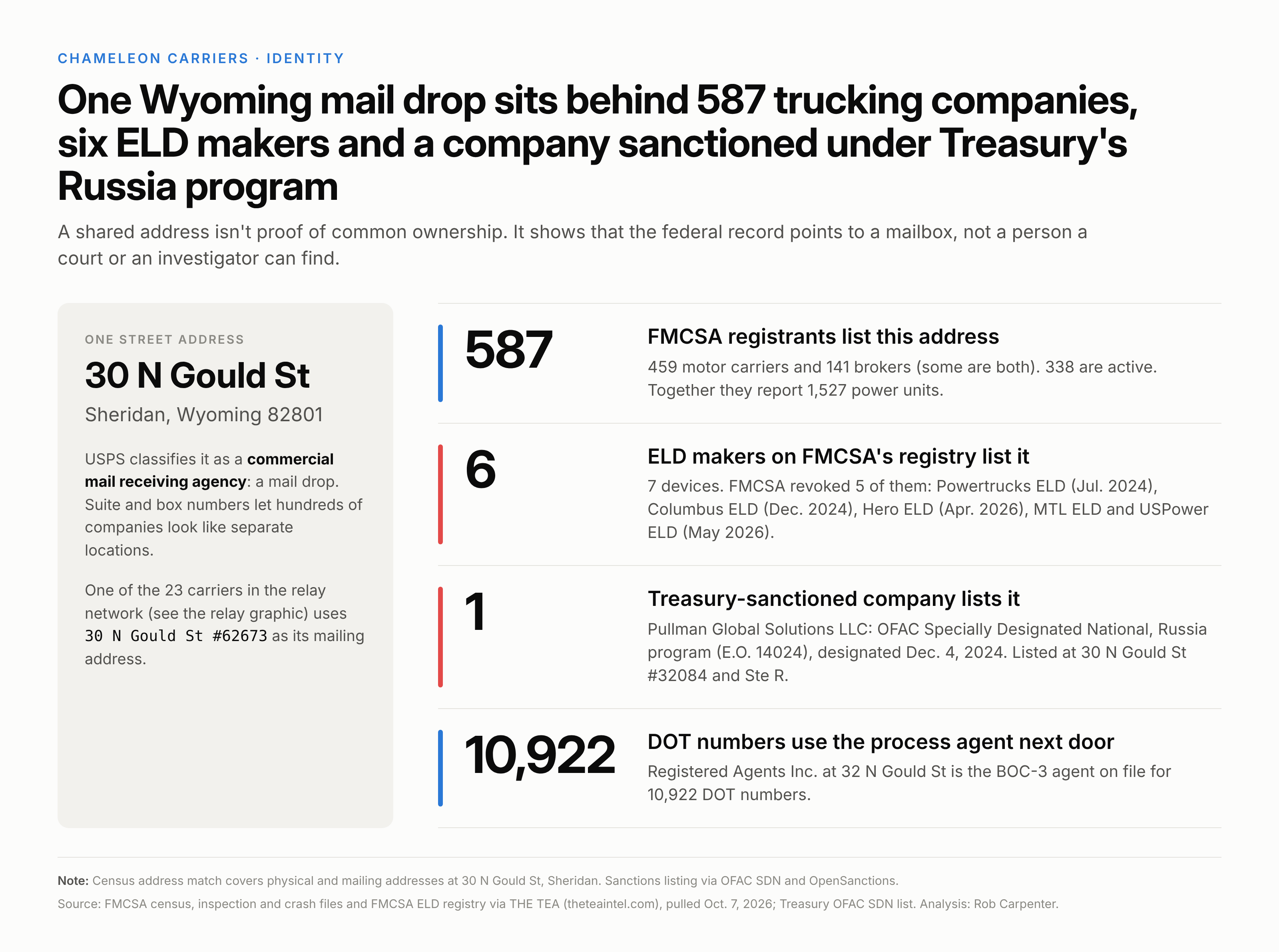
Ten years later, the agency says the problem got bigger. When Transportation Secretary Sean Duffy launched FMCSA’s new registration system, Motus, on May 19, 2026, the department said “several thousand suspicious registration numbers” were “tied to fraudulent carriers,” and described the old system this way: “All they needed was an email, name, and physical address.” A year earlier, when FMCSA started checking applicants’ identities against government IDs, the agency’s registration director, Ken Riddle, said, “Fraud is rampant.” In February, Duffy said, “You can’t have 200 DOT numbers going to a P.O. box.”
This is an M&A, private-equity-backed fleet, versus a Chameleon-indicated fleet ownership model. The M&A/PE-backed holding company model discloses and manages the fleet as a true, identifiable business that can be held accountable, while the Chameleon-indicated fleet and owner declare they know nothing about each other and often claim they're totally unaffiliated.
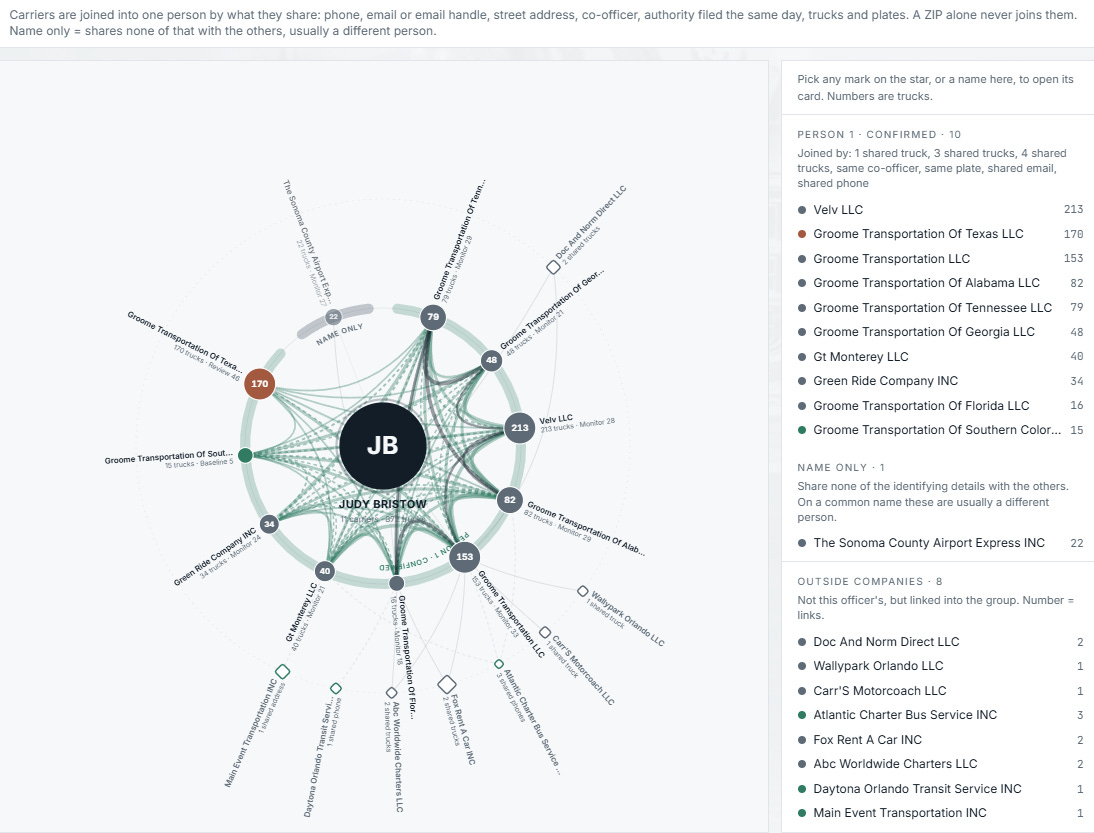
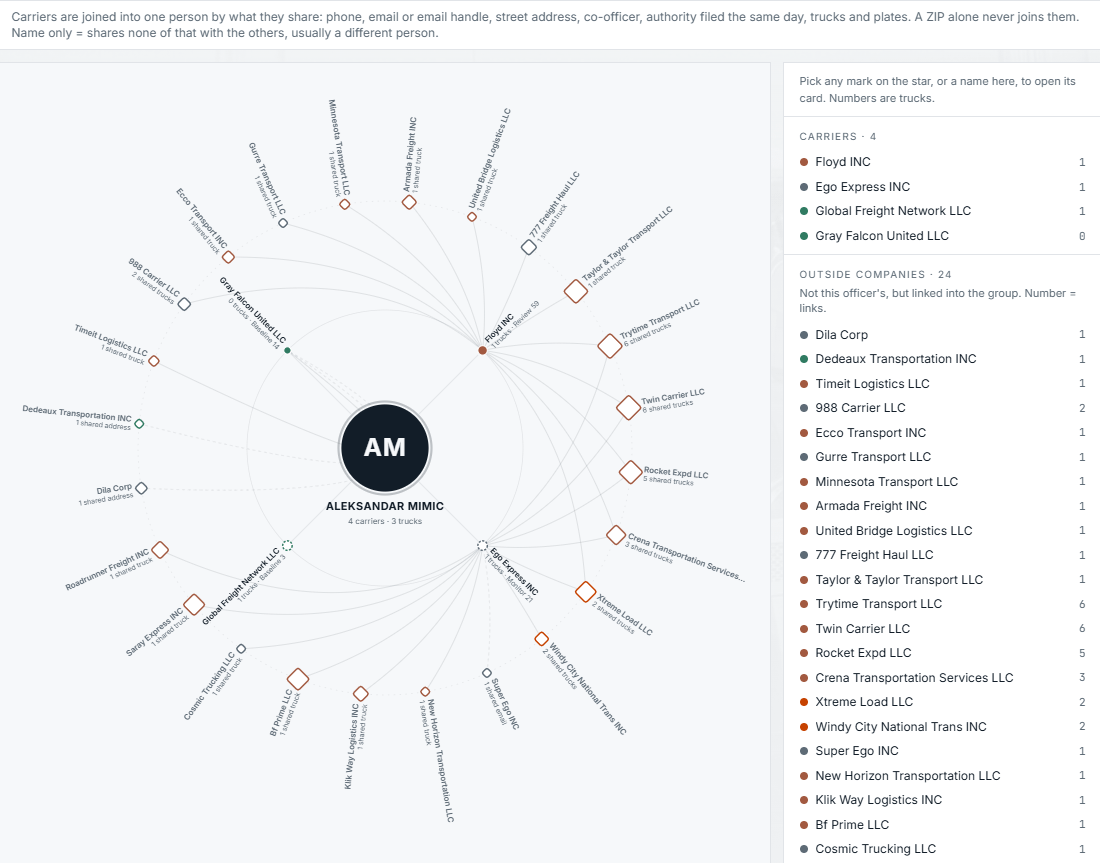
Most of what follows can be innocent on its own. Families run several companies. A brokerage and a fleet under common ownership is an ordinary structure. Carriers share office buildings, buy each other’s used trucks, lease from the same lessor and use the same factoring company. Immigrant communities have built trucking companies the way every other community has, through mentors, relatives, and people from the same town who already knew how to file the paperwork. None of that is fraud, and nothing in this piece says it is.
The problem starts when you line up the records, and the identity doesn’t hold still.
What the rules say
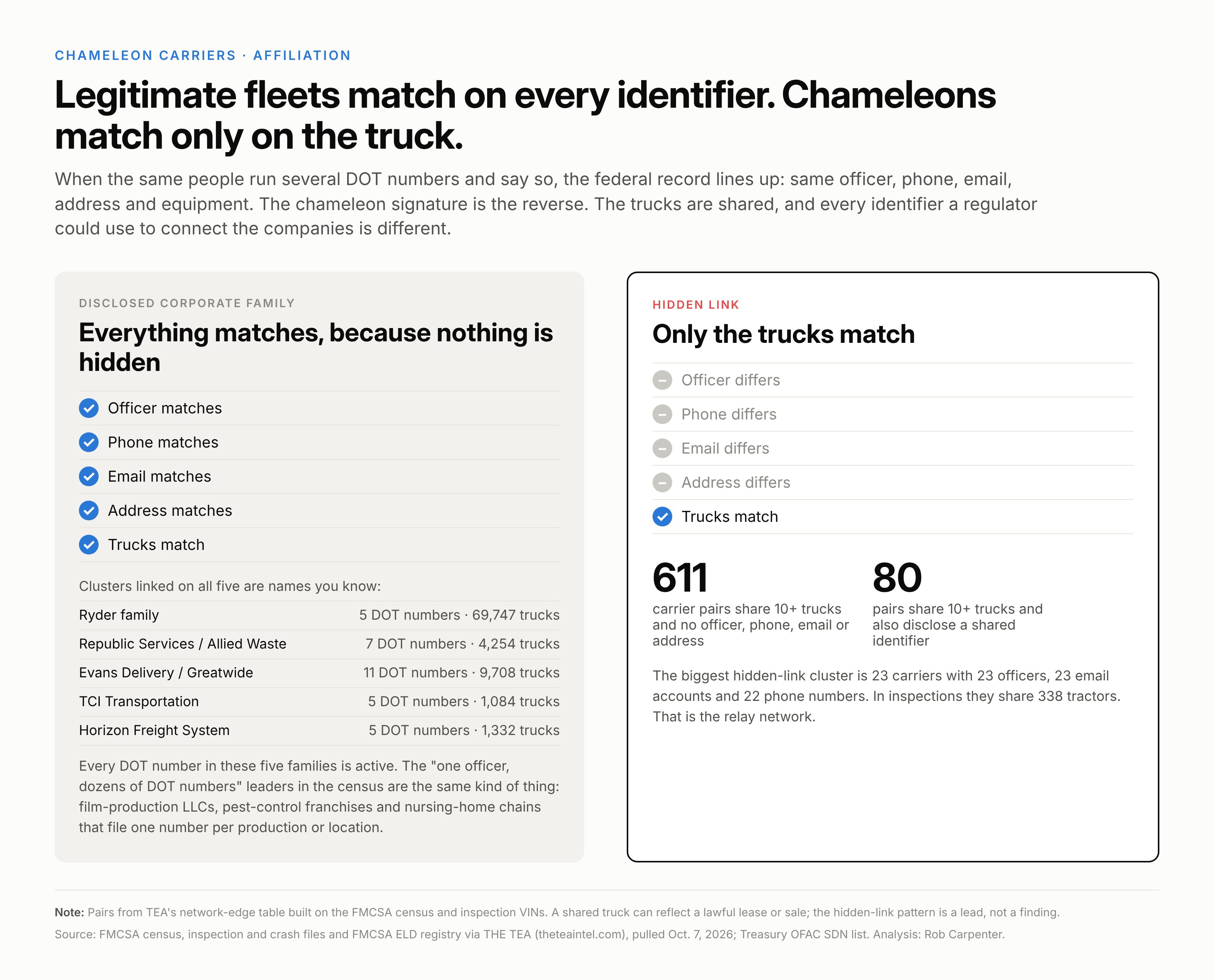
Federal law is more specific than most people in this industry realize. Under 49 U.S.C. 13902(a)(1)(C), an applicant for authority must disclose its relationships of common ownership, management, control, or family with other carriers, brokers, and forwarders over the prior three years. Under 13905(d)(2), FMCSA may revoke a registration for failing to disclose a material fact or a relationship with a carrier the agency finds “unwilling or unable to comply.” Since 2012, 49 U.S.C. 31135(b)(1) has said that two or more carriers or persons “shall not use common ownership, common management, common control, or common familial relationship to enable any or all such motor carriers, employers, or persons to avoid compliance, or mask or otherwise conceal non-compliance, or a history of non-compliance,” and the statute lets the agency go after an officer individually.
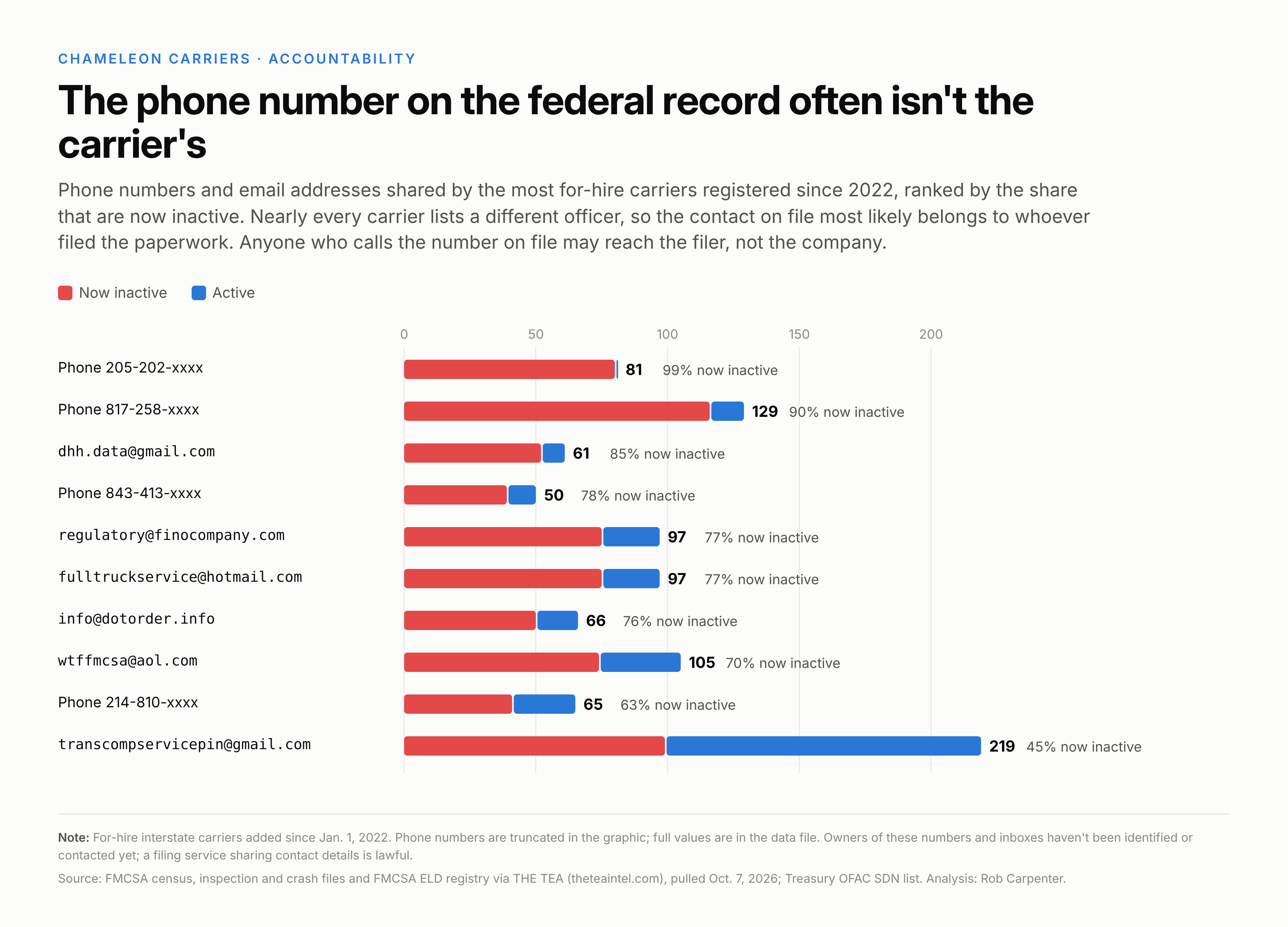
The enforcement tool is 49 CFR 386.73, adopted in 2012. It lets FMCSA order a carrier, broker, or forwarder out of service if it “operated or attempted to operate” under “a new identity or as an affiliated entity” to avoid an order, a penalty, an enforcement action, or being “linked with a negative compliance history.” The test is “substantial continuity between the entities such that one is merely a continuation of the other,” and the listed factors read like an investigator’s checklist: “commonality of officers and management personnel,” “identity of physical or mailing addresses, telephone, fax numbers, or email addresses,” “identity of motor vehicle equipment,” and continuity of insurance, drivers, and customers.
The form that was supposed to collect the affiliation answer up front is the MCSA-1. Its Section K asks applicants to “disclose certain information concerning affiliations with other entities registered with FMCSA.” The rule that created that registration system was published in October 2015, and FMCSA suspended it for existing carriers effective Jan. 14, 2017. The public record doesn’t show whether new applicants have been held to the affiliation question since then. The MCS-150, which most carriers still file every two years, asks for officers. It doesn’t ask for affiliates, prior names, or prior DOT numbers.
That is the agency’s own architecture. The law requires the disclosure. The registration rule built around the form has been suspended for existing carriers since 2017. The records that follow show what fills that space.
Indicator one: who is the officer
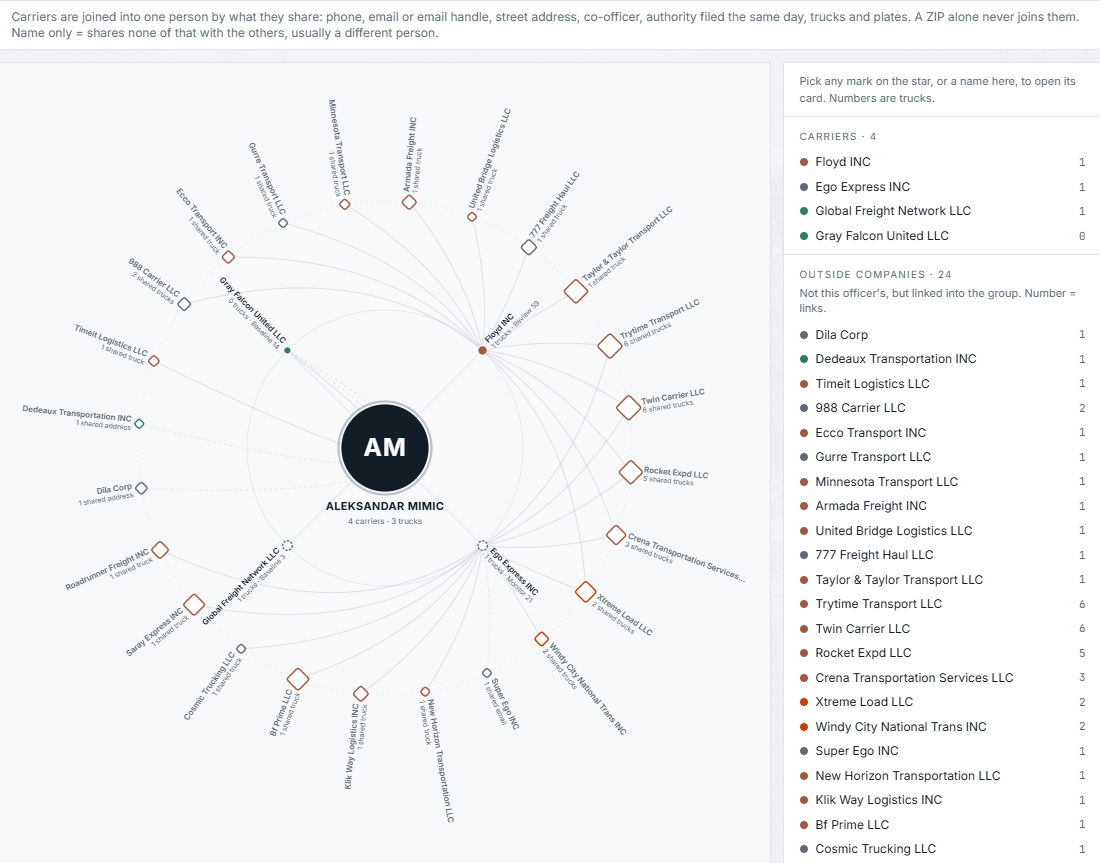
The first question on any carrier is the simplest one: who runs it. The records keep answering with people who can’t be found, can’t be the operator, or aren’t there at all.
A dead man is the starkest version. On March 21, 2025, someone filed an Illinois form naming Chheanrem Chhean as registered agent for DMG Consulting & Development Inc., the company that did business as Goldcoast Logistics Group, with a signature line reading “CHHEANREM CHHEAN, PRESIDENT.” Chhean, a truck driver everyone called Rocky, died on Interstate 81 in Virginia on Oct. 8, 2019. The company’s December 2025 annual report still listed him.
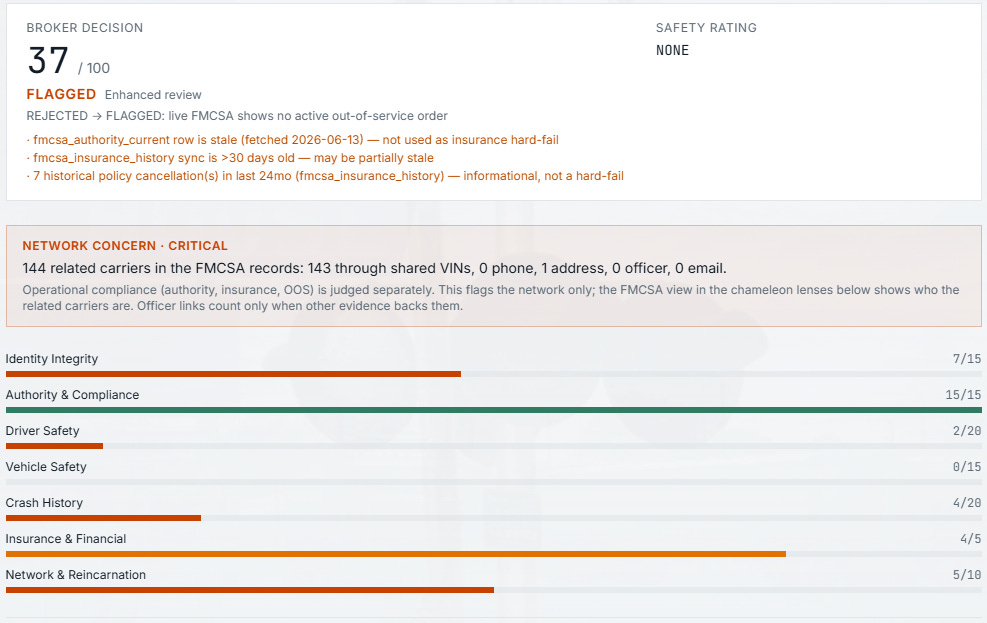
A working driver is next. Marian Visan is the sole officer of record for Goldcoast Carriers Inc., USDOT 3014047, which reported 325 power units and 330 drivers on its last MCS-150. In August 2024, according to court papers in a New Mexico equipment lease case, DuPage County deputies trying to serve him at home were told by his roommate that he was an over-the-road truck driver who wouldn’t be back for two weeks.
Nobody at all is the third. FMCSA’s census record for ArcherHub, USDOT 2345286, the Denver broker named in the Beaumont wrongful-death case I’ve covered this year, lists no company officer, no phone number, and no MCS-150 date. The broker authority has been granted, revoked, reinstated, and pulled back from five revocation proceedings. The record doesn’t name a person.
Then there is the person with two names. The founder behind that brokerage files Colorado and North Carolina paperwork as Nick Darmanchev or Nikolay Darmanchev, while his venture-backed software company’s California filings list him as Nick Darman. Every Unsatisfactory rating and out-of-service order in his file sits under the longer name. That’s legal. It’s also why a search under one name never finds the other.
The officer field is where 386.73 starts. “Commonality of officers and management personnel” is the first factor in the rule. A registration that names a dead man, a long-haul driver, or no one has already defeated it.
Indicator two: what the company says about itself
The second family of indicators is disclosure: what a carrier tells the government about its size, its equipment and its relationships, and whether that matches what shows up at the scale house.
Floyd Inc. is the textbook case in a public court file. In a federal suit filed May 23, 2023, MS Amlin, a Lloyd’s syndicate, said Floyd’s June 24, 2022, insurance proposal declared 12 tractors, its Dec. 16, 2022, MCS-150 reported 112 power units, and the policy covered at least 81 tractors. The insurer sought to rescind the policy. The case settled and closed Aug. 2, 2024. In a deposition taken April 7, 2025, and filed publicly in another case, Floyd’s chief executive, Aleksandar Mimic, testified that he runs both Floyd and Super Ego Holding, and that Super Ego holds no operating authority of its own.
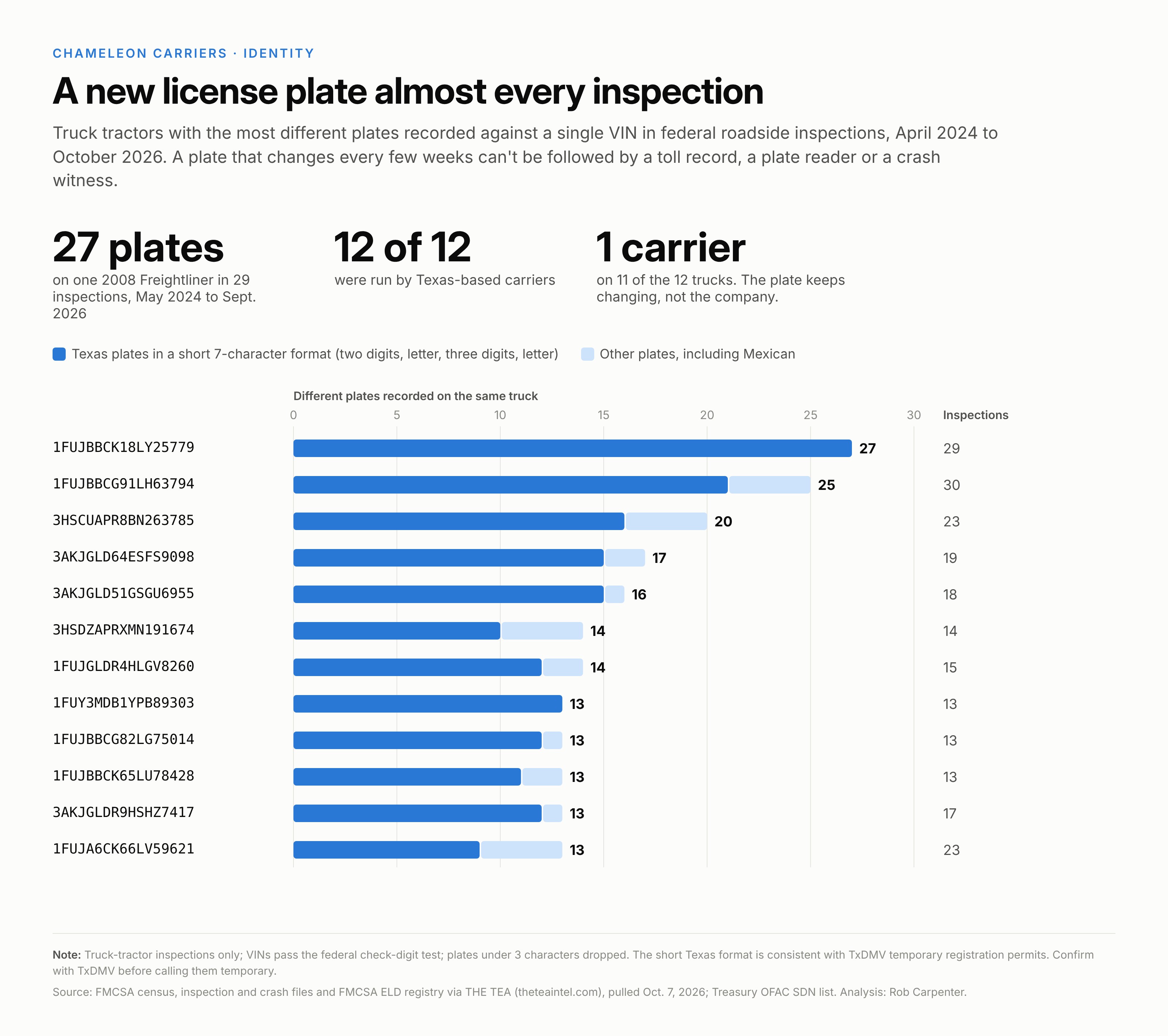
Mileage tells the same story from the other direction. Leader Freight Systems Inc., USDOT 3283188, an Indianapolis carrier whose officer of record is Danilo Tosic, filed an MCS-150 on Feb. 9, 2026, reporting 13,596,399 miles for 2023. The same filing reports five power units. Five trucks don’t run 13.6 million miles in a year. The fleet that ran them went somewhere.
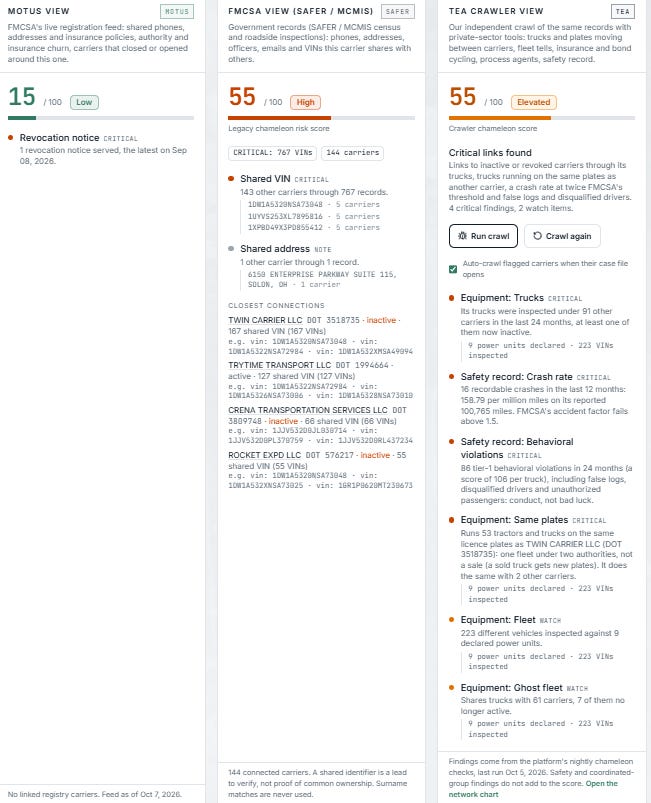
Names drift too. FMCSA’s census lists Davenport, Iowa, carrier Denver Cargo Inc., USDOT 3585416, as doing business as LEADER FREIGHT SYSTEM. Iowa records show Denver Cargo adopted that name on Nov. 12, 2024. About 17 weeks later, FMCSA revoked Leader Freight Systems’ operating authority, effective March 10, 2025. It was reinstated April 8. No sale document, lease assignment or UCC filing I have connects the two companies, and I’m not asserting one. The record shows one company’s name moving onto another company’s federal file while the first company’s federal file fell to five trucks.
Under the law, the carrier must provide the declaration. The carrier files the MCS-150 under its own signature, and the affiliation disclosure is an obligation, not a courtesy. A broker or insurer who reads the declaration and never checks it against inspection records is reading the one part of the file the carrier wrote.
Indicator three: whether anyone can find them
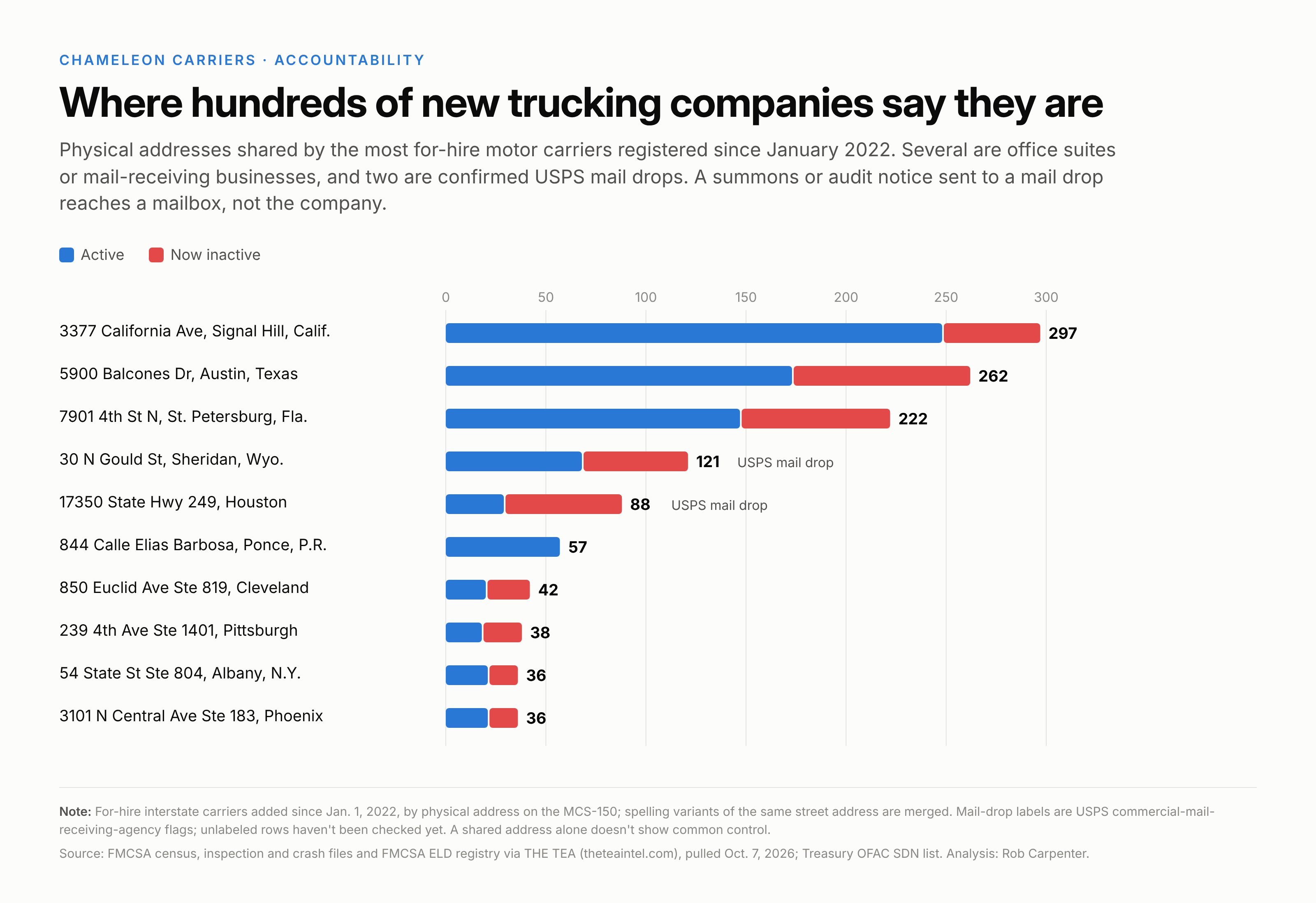
The third family is accountability, where identity failures turn into money and time taken from people with claims.
When National Specialty Insurance Co. filed an interpleader over Hope Trans LLC in federal court in Dallas in October 2025, the insurer needed to serve the company’s alleged former owners. A process server went to their Orlando home four times between Dec. 1 and Dec. 12, 2025, three mornings and one evening, with their names on the call box and a vehicle in the driveway. Nobody answered. On Jan. 23, 2026, a magistrate judge authorized taping the papers to the door. In a cargo-theft RICO case in Miami in 2022, Scotlynn USA Division’s process server returned four summonses unexecuted.
The federal side breaks the same way. FMCSA’s process-agent policy, MC-RS-2019-0002, gives a carrier with an invalid BOC-3 a show-cause order and 30 days to fix it before the agency can suspend its authority. Revocation proceedings for lapsed filings are routine, and most get discontinued when the filing comes back. Denver Cargo’s licensing file shows seven involuntary revocation proceedings since December 2021, every one discontinued. Leader Freight’s shows seven more, all discontinued, plus the March 2025 revocation and a reinstatement four weeks later.
Each one shows the paper was out of order. None of them finds who controls the trucks.
The money breaks last. A penalty FMCSA settles binds the number that settled it. DMG settled two federal enforcement cases for $889,630, by FMCSA’s records, and its number went out of service. Whether the penalties were collected is the subject of a FOIA request I filed. The out-of-service order doesn’t follow the people who controlled DMG to the next number. The statute that would let FMCSA go after an officer individually has been on the books since 2012.
Indicator four: how fast it grew
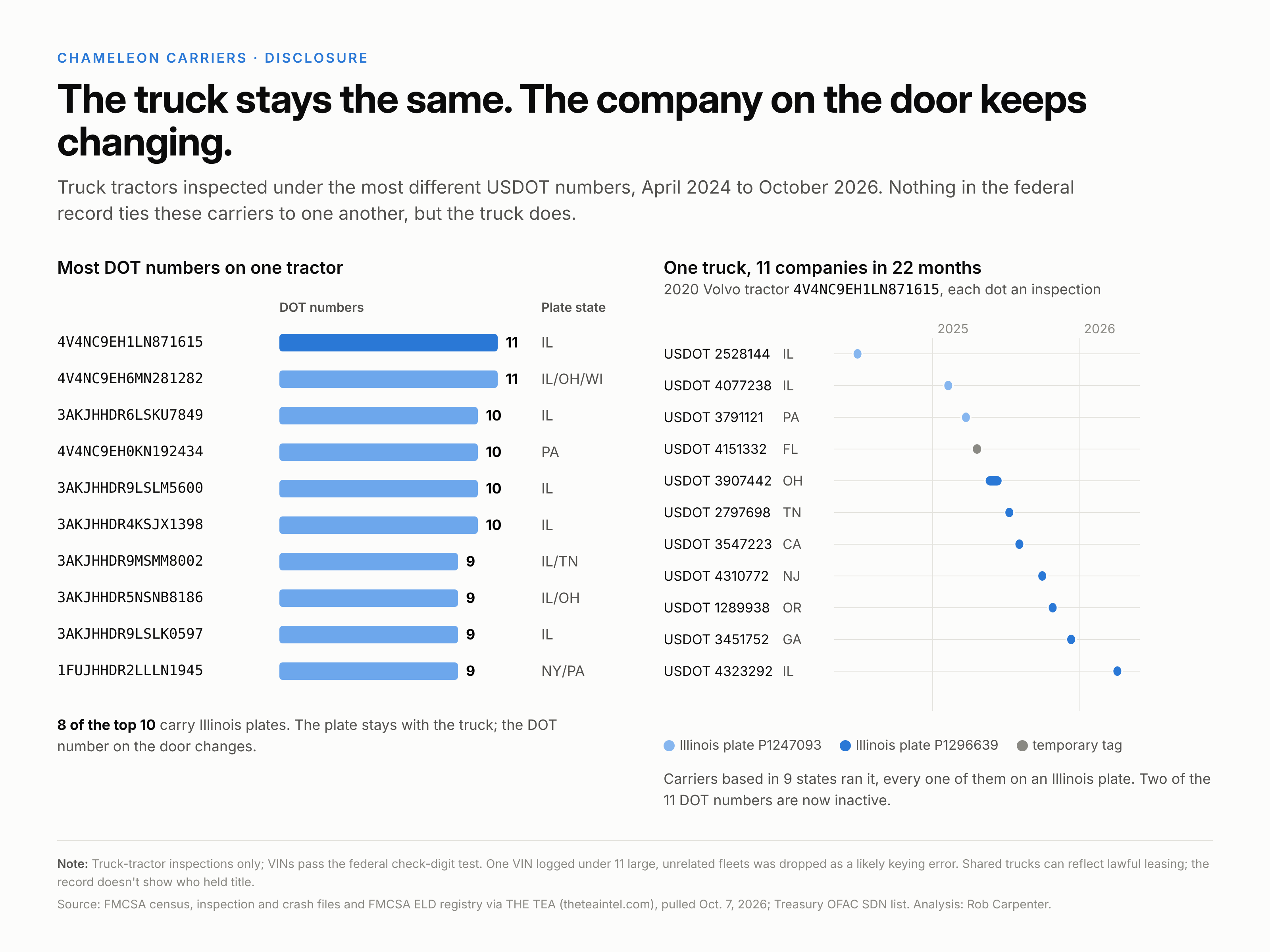
The fourth family is growth, and it’s the one brokers notice first and understand last.
FMCSA’s own audit schedule gives a new carrier a year of running before anyone from the government shows up. Federal law requires a safety audit within 12 months of a new entrant beginning operations, and the agency monitors new entrants for 18 months. In fiscal 2023, FMCSA reported 60,138 new-entrant safety audits, 50.6% completed on time. A carrier that goes from a handful of trucks to hundreds inside that window is running on paper nobody has checked.
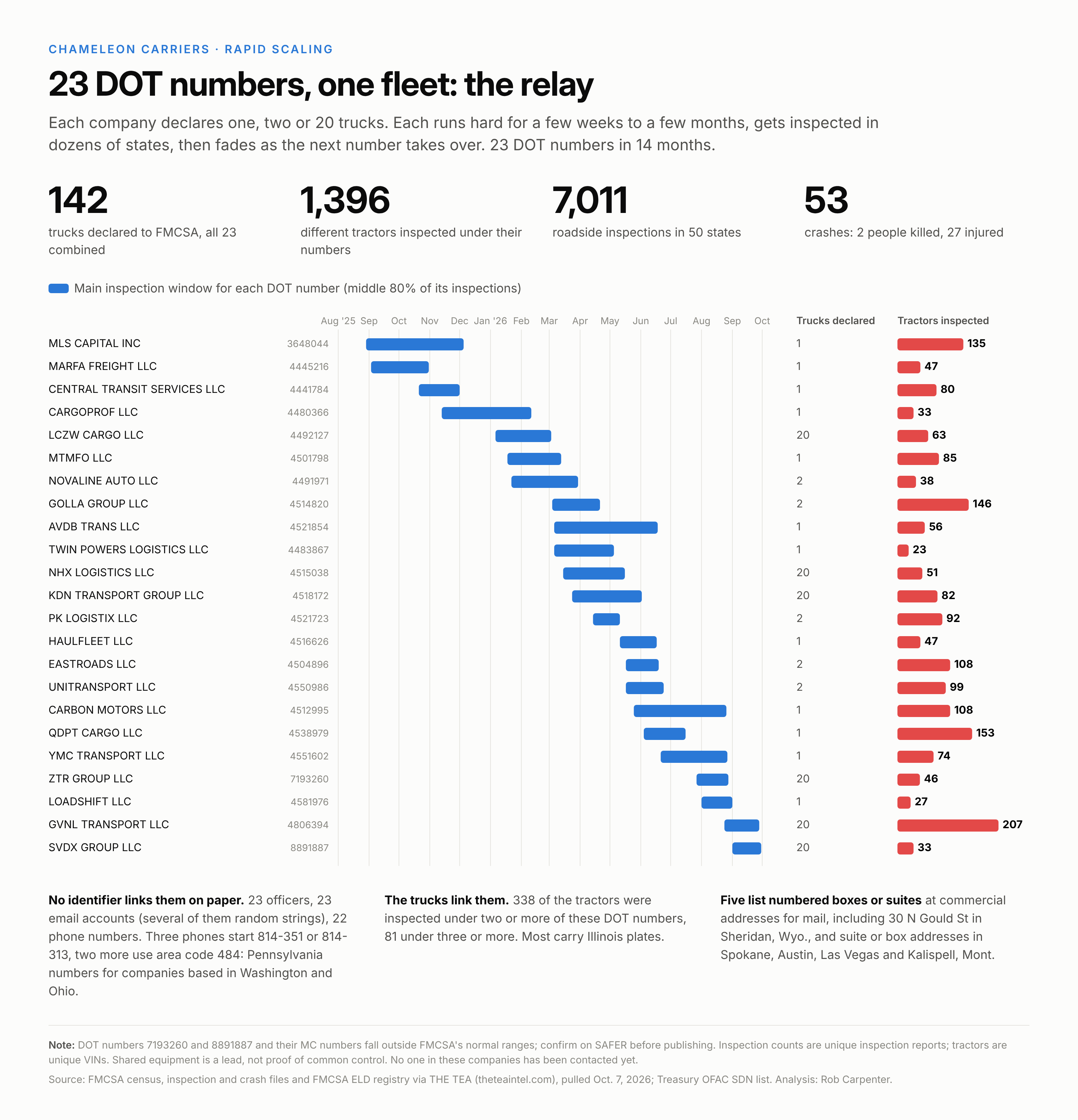
The Indiana network did exactly that. When FMCSA shut down carriers tied to the Jay County crash in February and March 2026, trade press reported KG Line Group at 310 power units, Tutash Express at 156 and AJ Partners at 111. Floyd went from 12 declared tractors to 112 power units in six months. Suplicium Transport, which I reported on in June, had operating authority 14 weeks old when its truck crashed, declared one truck, and showed 675 VINs in federal inspection records.
Nobody builds a 300-truck fleet in a year out of savings. The capital, the trucks, the insurance, the dispatch floor, and the drivers come from somewhere, and in the networks I’ve documented, they come from people who did it before.
It isn’t one company. It’s a method.
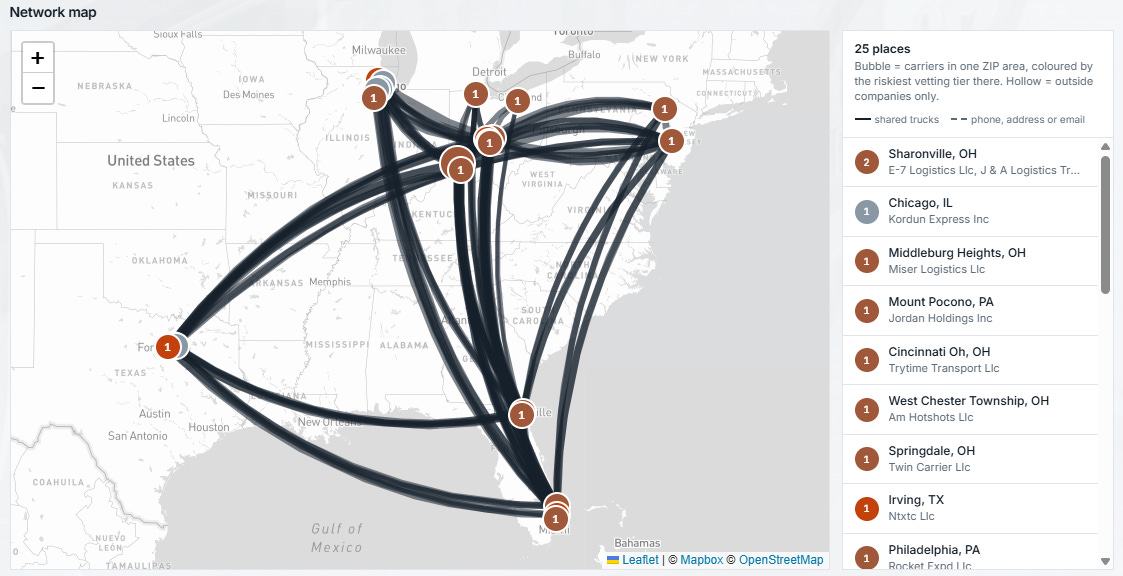
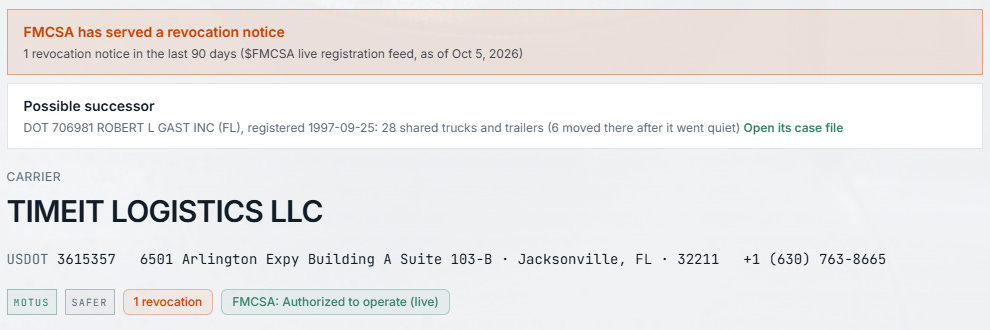
Time it here has been based with different officers in OH, then to IL, then to OH, then a supposed sale in April where the officer went blank in FMCSA, then the officer reappeared back on the filing with FMCSA but ended up in Florida with a new email and fewer trucks. Timeit’s sister entities kept the same migratory official, address, phone, and email patterns.
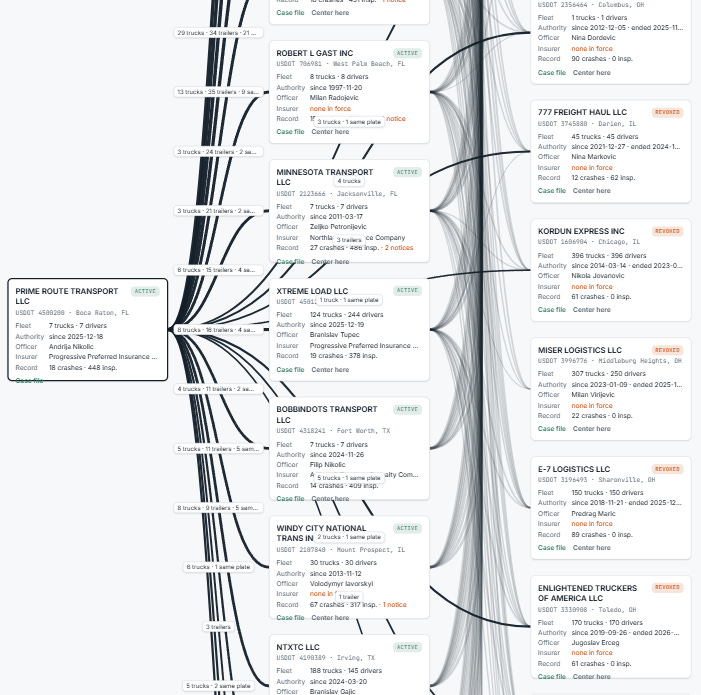
Civil courts have started saying so. On Sept. 23, 2026, six carriers, including Stevens Trucking, Western Flyer Express, and Freymiller, sued C.H. Robinson and Total Quality Logistics under the federal racketeering statute in the Eastern District of Texas (Case No. 2:26-cv-00869). The complaint alleges that Super Ego Holding “holds no motor carrier authority of its own” and operates through more than 70 carrier entities, with more than 1,500 equipment transfers between affiliated DOT numbers. It quotes a dispatcher’s text to a driver: “Super Ego Holding is a mother company, we have several daughter companies… those are all our companies.” The defendants haven’t answered, and those are allegations.
The driver class action against Super Ego, Atkinson v. Super Ego Holding, filed in Chicago federal court on Aug. 5, 2022, alleges the affiliated carriers operated as “alter egos,” with drivers assigned loads for entities other than the one they’d signed a lease with, and that the companies “fraudulently altered load confirmation documents.” More than 800 drivers have joined it. In February 2023, North River Insurance Co. sued Super Ego Holding and United Ego LLC in DuPage County to void four policies, alleging insurance fraud. None of those claims have been decided against anyone.
Disclosure: I’ve been retained by plaintiffs in cases against Super Ego entities. Everything here about Super Ego comes from public filings, not discovery in any of those cases.
The ecosystem behind the growth
The question I get most from brokers is how a first-time owner gets to 300 trucks. The answer in Chicago’s Balkan trucking community, which I’ve called the EuroChicago model, is that he doesn’t do it alone. He does it with a mentor who has already built the factoring company, insurance program, truck rental fleet, fuel card, and office suites.
Compass Holding, founded by Radovan “Roy” Dobrasinovic, provides that infrastructure for much of that community. Its companies include a factoring business, a truck rental and leasing company that reports 1,800 power units to FMCSA, a payment and fuel card company, a risk retention group, and a carrier, Compass Logistics LLC, at 115 55th St. in Clarendon Hills, Illinois. FMCSA’s census shows four more carriers registered in that building since November 2023, each with a different officer, in suites 401 through 410: LVA Expedite, NNK Express, VS Express and Major Line.
Filip Milivojevic’s path runs through it. His 2020 federal campaign contribution records list his employer as Compass Payment Services, where he worked as a national account manager. On March 10, 2021, he incorporated Denver Cargo in Davenport, Iowa, and FMCSA added it to the registry that day; it received operating authority on April 16, 2021. On LinkedIn, he wrote, “I started my carrier with my mentor, Roy,” tagging Dobrasinovic. Denver Cargo reports 45 power units today, and FMCSA’s crash file shows 36 crashes under its number, with two people killed.
The relationships are in the state registries. Illinois Articles of Organization filed June 25, 2025, for Joint Venture FH, LLC list two managers: Roy Dobrasinovic, at Compass’s Clarendon Hills address, and Filip Milivojevic. Illinois Articles filed Dec. 14, 2021, for Panda Truck Sales LLC list three managers: Maybach Capital, Filip Milivojevic and Nenad Balac. Maybach International Group, USDOT 2487790, reports 296 power units, and FMCSA’s crash file shows 193 crashes under its number. In 2025 and 2026 filings, Panda’s managers were cut to Maybach Capital alone. In February 2025, Denver Cargo gave $50,000 to the Serbian American PAC, FEC committee C00895003, one of five $50,000 founding contributions.
Equipment moves through the same circle. FMCSA inspection records show a tractor with VIN ending 469514 inspected under Denver Cargo and under two carriers named as defendants alongside Super Ego in the Atkinson case, Twin Carrier and Trytime. A shared VIN can be a sale, and one truck proves nothing about control.
None of this shows anyone did anything illegal. Mentorship is how this industry has always grown. What the records show is the infrastructure a new carrier needs to scale, available in one building, from people who have done it before, to people who learn it from them. That’s the part the federal registration system never sees. The MCS-150 asks for one carrier’s officers. It doesn’t ask who financed the trucks, who insures the fleet, who taught the owner how to file, or which suite down the hall opened its authority last month.
How it works, start to finish
Strip out the names, and the method is short. You learn the paperwork from someone who already filed it. You form a company and get a DOT number the same week. You lease the trucks, factor the invoices, and buy the insurance from the same circle. You put a relative, a driver, or a registered agent service in the officer slot, or leave it empty. You grow as fast as brokers will tender loads, because no auditor is coming for a year. When the crashes and the violations pile up on the number, you let the filings lapse, and the next number, under a new company name, picks up the trucks. If someone sues, they start by trying to find you. If the government fines you, it fines the number.
Every step is a filing, and every filing is public. No one in government is assigned to read them all.
The inversion
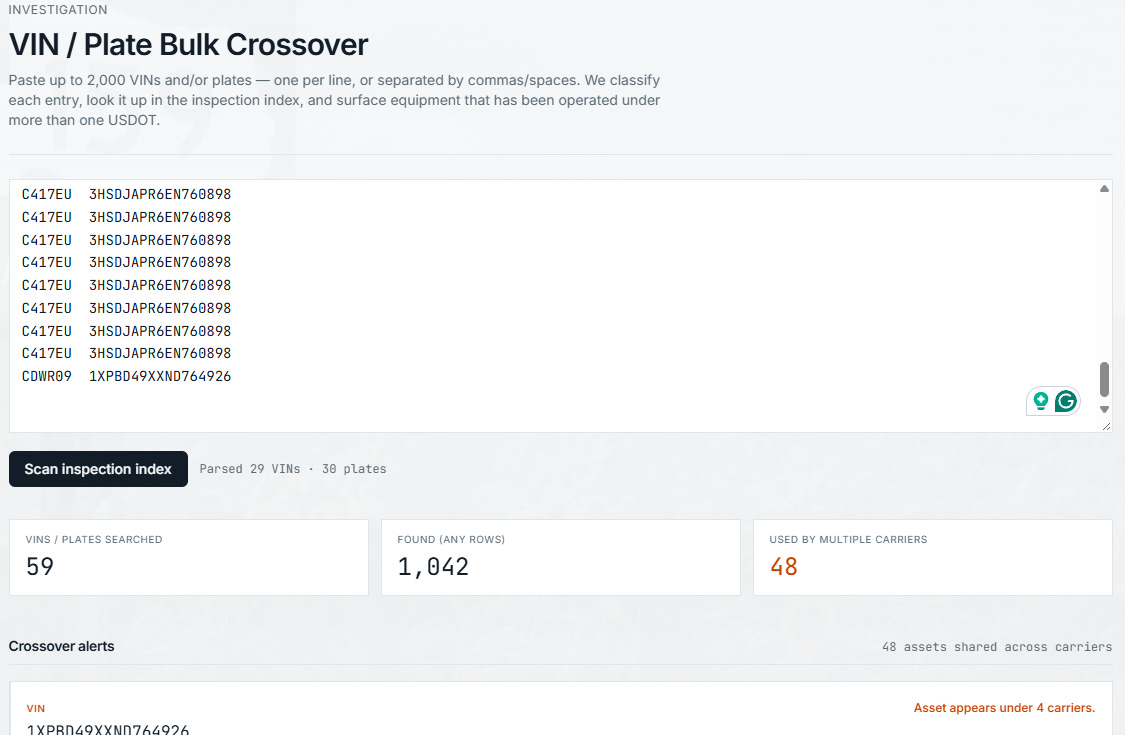
The DOT number was supposed to make a trucking company findable. In a chameleon network, it does the opposite: it gives the government something to fine, revoke, and put out of service, while leaving the people behind it free to start again under a new one. The disclosure law says the applicant has to tell the agency who else it’s connected to. The registration rule that carried the question has been suspended for existing carriers since 2017. The rule that lets FMCSA consolidate records and shut down a “new identity” has been on the books since 2012, and this year’s biggest chameleon shutdowns came after a crash put a network on the evening news.
What would close it
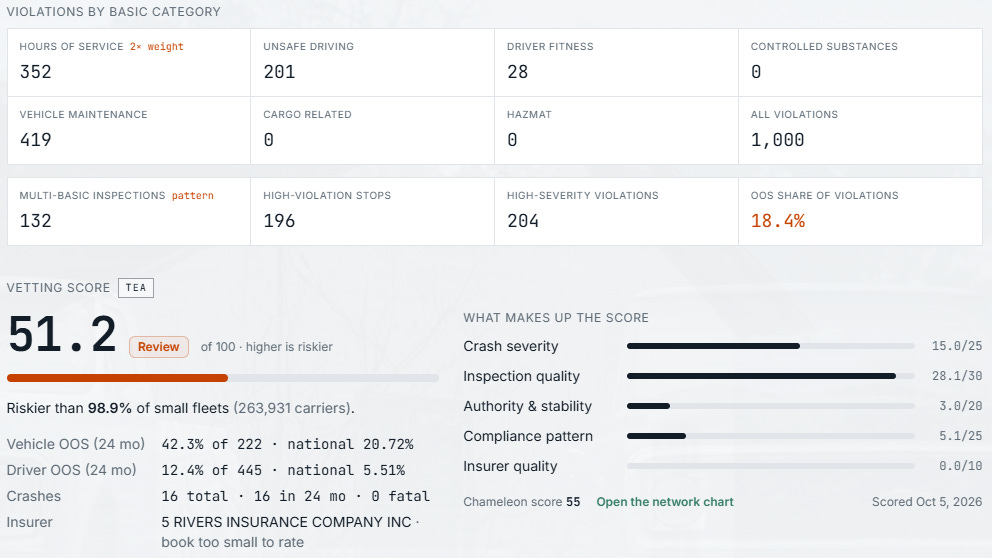
None of this needs a new law. FMCSA can put the affiliation question back on every application and every MCS-150 update: every name each officer has used, every DOT number they’ve controlled in 10 years, every company that finances or insures the fleet, under penalty of perjury. Motus already checks an applicant’s identity against a government ID and a facial scan; it can verify every listed officer the same way and refuse a registration that names no one. It can run declared power units and mileage against inspection records and flag the gaps automatically, the kind of red-flag screen Congress is now debating. It can use 386.73 before the crash instead of after it, and it can use the officer provisions of 31135 to make an unpaid penalty follow the person. States can refuse a registered agent whose death is in their own records.
Brokers and shippers can do the cheapest part themselves. Before a load is tendered, pull the carrier’s officers, prior names, address history, and declared fleet; compare them to its inspections; and write down that you did. After the Supreme Court’s 9-0 ruling in Montgomery v. Caribe Transport II in May, a jury can ask whether you did.
The four in the van
Henry Eicher was 50. Menno was 25, Paul was 19, and Simon Girod was 23. They were riding in a van on a Tuesday afternoon in Jay County, Indiana, when a truck from a network of carriers that shared officers, terminals, trucks, and a logo crossed the centerline. The carriers had different DOT numbers. The federal file had a different name for each one.
The DOT number was supposed to tell you who you were dealing with. For a chameleon, it only tells you who they used to be.
All the data available for this post is at www.teatechnologies.com, which I built and maintain and which the FMCSA uses, along with other federal and state agencies, insurers, and litigators. This site is a universal login for all our sites, including our www.motusverifi.com vetting and investigative tools. There's a 7-day trial for $1. (The $1 is to verify you. We’re constantly attacked by the people and groups we investigate.)