

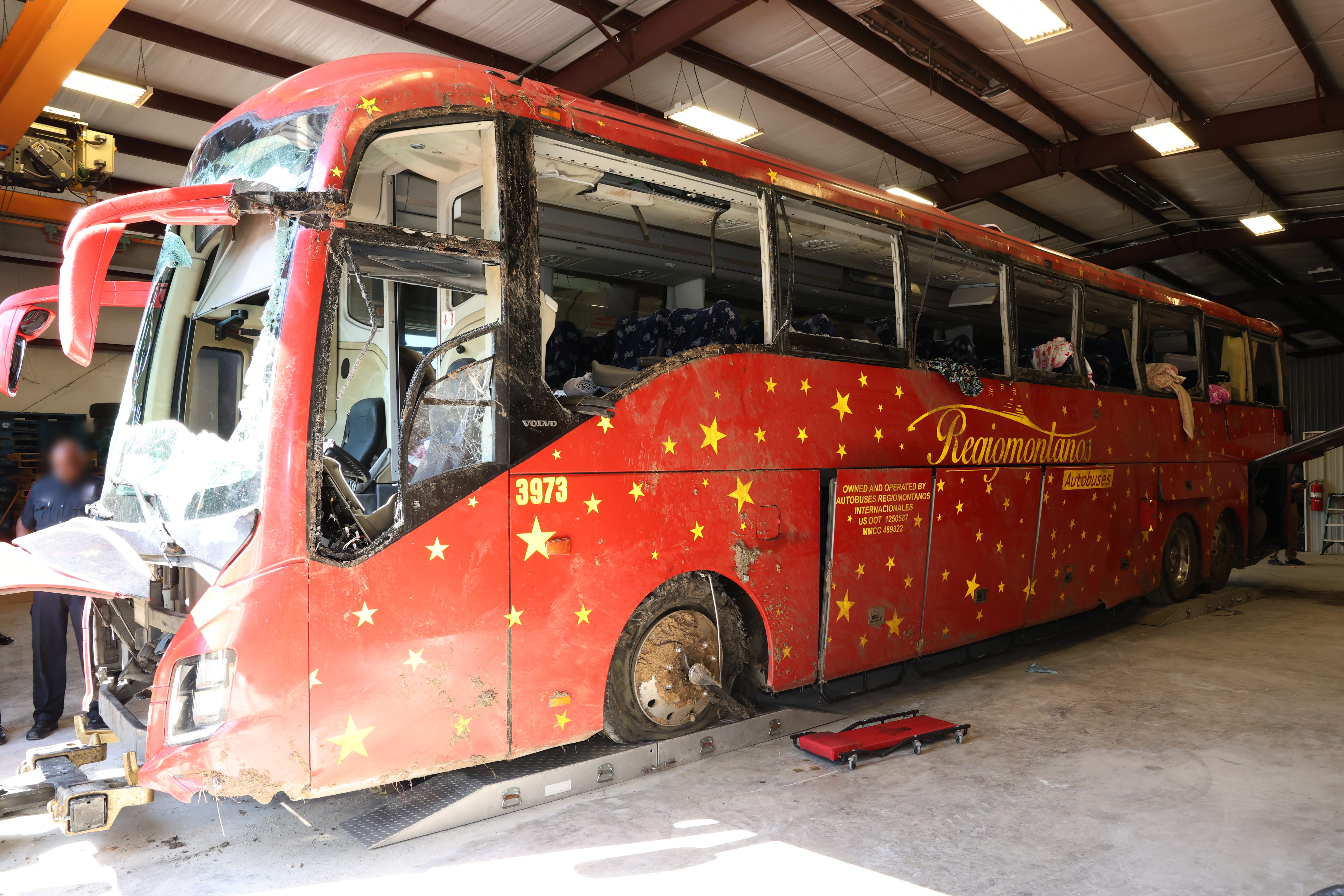
At 12:33 in the morning on August 31, 2024, a 2018 Volvo motorcoach was running west on Interstate 20 near Vicksburg, Mississippi, carrying 41 passengers and two drivers from Atlanta back toward Dallas. The left front steer tire came apart. The driver, a 54-year-old man from Monterrey, told federal investigators he heard the explosion, felt the wheel jerk hard to the left, and grabbed it with both hands to hold the bus straight. He braked light because he was afraid that braking hard would roll it. It rolled anyway.
Seven people died. Among them a six-year-old boy and his sixteen-year-old sister. Thirty-four more were hurt. Most of the dead were thrown from the bus, because the bus had lap-only belts and no policy that anyone wear them.
That is the crash. The National Transportation Safety Board is still working on it as HWY24MH016, and the Federal Motor Carrier Safety Administration is a party to the investigation. This story is about what the crash uncovered when investigators started pulling on the paperwork, because the paperwork does not hold together, and the way it comes apart tells you something about how a certain kind of cross-border bus operation actually works.
A permit for a bus that wasn’t there
The coach that crashed was unit 809, a 2018 Volvo with VIN ending in 3973. When an NTSB investigator looked at the Texas temporary permit the operation had placed on that bus, the permit was written for a different vehicle. A 2023 Volvo. Different VIN. Different year.
That bus did not have a valid permit at the time of the crash. The explanation the operators gave is the part worth sitting with. They told the investigator the accident bus had been dropped from the Texas DMV database, so to keep it on the road, they used a permit issued to another of their buses and applied it to the crashed coach. Twice a week, that bus went from Mexico up to Pennsylvania and back, on a permit that belonged to a vehicle that wasn’t it.
A permit tied to the wrong VIN is the same trick as a plate tied to the wrong truck. The identity on the document and the steel on the road no longer match. Once they stop matching, enforcement, a crash investigator, or an insurer trying to trace an accident is chasing a number that leads somewhere else. On the Vicksburg coach, that was not a theory. The operators described doing it on the vehicle that killed seven people.
The company that became a different company
After the crash, the carrier that operated the bus, Transportes Regiomontanos of Laredo, USDOT 1250587, lost its insurance in November 2024. New coverage came back sky-high. So the owner, Jose Campa, kept one coach insured under Regiomontanos and leased the other eight to a company called Lily’s Bus Lines.
The buses did not change routes. They did not change drivers. Same mechanic, same dispatch out of Monterrey, same Samsara equipment on board. What changed was the DOT number on the side and the insurance policy behind it.
The safety director for both operations, Baltazar Hernandez, put it to the NTSB that it’s the company, he said, that is one and the same. From that point forward, if one of those buses gets pulled over or wrecks, the inspection and the crash will count against Lily’s safety record. No Regiomontanos. Even though, in his words, the company is still operating as Regiomontanos.
That is the whole game. A carrier with a fatal crash and lost insurance does not shut down. It moves its equipment onto a clean number and keeps running the same routes with the same people. In the industry, we call it a chameleon carrier or a reincarnation, and FMCSA has spent a decade trying to catch it. Here it was described to the agency’s own investigator, at the kitchen-table level, as a reasonable business decision.
Lily’s is not a stranger. Lily’s is owned by Liliana Campa, the wife of Hugo Campa, the brother of Jose Campa, who owns Regiomontanos. The successor carrier is the owner’s sister-in-law. Lily’s carries two DOT numbers, both registered to the same Houston address, and the authority on one of them had already been revoked by the government three months before the Vicksburg crash.
One house, a dozen carriers
Pull the thread on the family, and it does not stop.
Jose Campa still owns a house at 5621 Harrisburg Avenue in Houston. He told the NTSB that the house is the registered address for a stack of carriers run by his relatives. His brother Hugo’s company. His brother Jesus’s two companies. His brother Jorge’s company, Transportes Latinos, runs the Dallas area. A company that his son opened after the two of them parted ways. A company in his wife Perla’s name that, she told the investigator, never operated a single day, and whose DOT number got deactivated right around the time the government came asking.
The operation traces back to nine passenger vans in Norcross, Georgia, in 2009, registered by Jose Campa’s sister. Somewhere along the way, a niece opened a duplicate DOT number under the same company name. When the investigator laid out the pattern, he reminded Campa that the form he signs to register each of these carriers, the MCS-150, includes a perjury clause.
It is all sitting in the government’s own databases, one entity at a time, which is why it works. You have to already be looking at the whole family at once to see it, and the systems are not built to look at families. They are built to look at carriers.
Every piece of this could have been known before the crash. The shared address. The revoked authority. The buses that show up under one company’s number this month and another’s next month. The plates that move from a bus to a freight truck and back. It sat scattered across thirty different lookups, waiting for somebody to put it in one place.
What the labor is
Alongside the scheduled runs from Monterrey to the Midwest, the operation’s bread and butter is moving H-2 temporary visa workers. A full busload picked up in Monterrey, hauled to Florida to work the fields, then run back empty. The safety director described it as the core business of Lily’s and of another carrier in the family, Isamex Plus, for which he also runs safety. Pick them up at the border, drop them at the work site, come back for the next load.
This is legal work when it is done right. It is also the exact activity a 2019 Department of Justice settlement flagged at a related Houston bus company, El Expreso, for pushing aside qualified American drivers in favor of foreign visa labor. It is why this network keeps collecting the same violation over and over: the border-zone English-proficiency stop, drivers who cannot converse with the officer who pulled them over. The company’s file shows it recommends its drivers take English classes and that it does not even give them so much as a card to help them talk to a cop.
The seven people who died on that bus were foreign nationals. So were the people who kept dying in the crashes this network of companies has stacked up over twenty years. The passengers are the product, and the product is cheap, and the machinery that moves it is built to be hard to trace when it fails.
The tire, and the training that wasn’t
Back to the tire. The driver had never had a steer tire blow before. He told the NTSB he had never been trained on what to do when one does. The carrier could not produce a training record. When investigators asked for the training the driver was required to complete, the company returned a one-page checklist and nothing more.
A steer tire failure at highway speed is survivable. Drivers are trained to keep it straight, avoid hard braking, and let the bus slow down. That is close to what this driver did on instinct. The company had no belt policy, and the bus had only lap belts, and nobody had told anyone to wear them. When it rolled, the unbelted passengers went to the low side. That is where the deaths came from.
You can call that a tire failure. NTSB probably will, in part, but a tire is a maintenance item, and maintenance is a paperwork trail, and this operation’s paperwork does not survive contact with a single honest question. The bus that killed seven people was running on another bus’s permit, for a carrier that would dissolve into its owner’s sister-in-law’s company within ninety days, out of a family that has been recycling authority since there were vans in a Georgia parking lot.
The tire is what let go. It is not what was wrong.
Fascinating.