

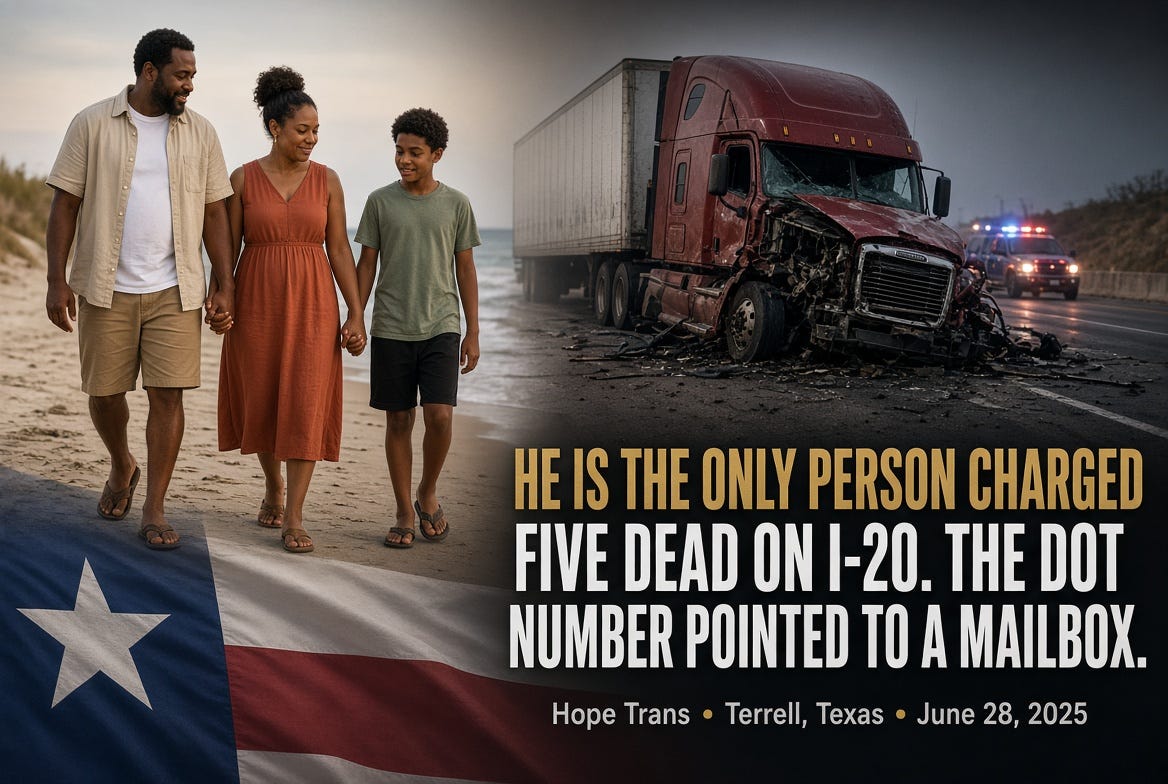
On June 25, 2026, in a Kaufman County courtroom, Nicole Gregory’s mother told the man who killed her daughter that he should have rested, because that was the law. Alexis Osmani Gonzalez-Companioni, now 28, of Kissimmee, Florida, pleaded guilty that day to five counts of manslaughter and four counts of aggravated assault with a deadly weapon. Judge Casey Blair sentenced him to 20 years in the Texas Department of Criminal Justice, with the counts running concurrently, and ordered deportation to Cuba when he walks out.
He is the only person charged in the deaths. That’s where this story starts.
The McKellar family of Fort Worth was riding in a Ford F-150 on westbound I-20 near Hiram Road on the afternoon of June 28, 2025. Traffic had been stopped for more than an hour behind an earlier wreck caused by an unlicensed driver in a Ford F-250 towing an unregistered trailer. A loaded 2020 Freightliner Cascadia operated by Hope Trans LLC came up behind them in clear weather on dry pavement and never braked. Zabar McKellar, 52, his wife Krishaun, 45, their son Kason, 15, and Zabar’s father, Billy, 79, died in the pickup. Nicole Gregory, 49, of Dallas, died in a Jeep Compass. The McKellars’ 20-year-old daughter was the only one in the truck who lived. The Freightliner pushed into two other tractor-trailers, jackknifed across the lanes, and hit three more cars.
Gonzalez-Companioni told investigators he fell asleep. The NTSB pulled his logs from his ELD provider. Based on those logs, he had been on duty for about 47.81 hours. Terrell's federal crash record lists his Florida Class A license as invalid.
What a DOT number is supposed to guarantee
Every carrier on an interstate highway has made the federal government three promises on paper. It has a principal place of business where its safety records live, under 49 CFR 390.5. It has people on its MCS-150 who answer for its operations. And its drivers log their hours on a device that records them accurately, under 49 CFR Part 395. The DOT number is the government’s receipt for those promises. When a truck kills somebody, that receipt is supposed to tell investigators, courts, and families where to go.
I first wrote about Hope Trans in September 2025, when the story was a chameleon carrier and a 60-day window. A year on, the records have filled in. Each of those three promises failed, and the only person the system has held to account for the deaths is the man in the seat.
The office that wasn’t there
Hope Trans, USDOT 3556385, MC 1192879, had been in operation since 2021. The federal crash file lists 15 crashes under its DOT number from July 2024 through September 2025. Its last MCS-150 before the crash declared 5 owned trucks, 188 leased trucks, 5 owned trailers, and 195 drivers. It listed a shared workspace in Tacoma, Washington, as its home. After the crash, FMCSA records moved it to Apartment 357 at 5956 Bent Pine Drive in Orlando and swapped the principal from Aishat Magomedova to Todd August. Florida records show the registered agent changed to August days after the crash.
Bent Pine Drive is an apartment complex. FMCSA’s census lists 45 motor carriers at Bent Pine Drive addresses in Orlando, 28 of them active.
FMCSA’s Washington division checked the Tacoma address. According to the NTSB’s report on the carrier, it was a virtual office service with no legal or functional relationship to Hope Trans that federal rules require of a principal place of business.
The NTSB then contacted the people listed on the paperwork. The principal contact on the MCS-150, identified in the report only as “SM,” said they had sold the company. SM referred investigators to someone identified as “SG,” who denied any role in running Hope Trans but said they owned another fleet. SG told the NTSB that Jetruck Logistics in Tashkent, Uzbekistan, managed Hope’s daily operations.
Jetruck is a registered resident of Uzbekistan’s state-backed IT Park, which advertises itself as an outsourcing company that runs dispatching, tracking, monitoring, and accounting for U.S. trucking clients from Tashkent, on morning and night shifts so a U.S. fleet is watched around the clock. In August 2023, IT Park officials met Jetruck’s head in Orlando, along with a delegation of 17 people from U.S. logistics companies, to discuss moving more back-office jobs to Uzbekistan. In March 2024, the Uzbek government toured Jetruck’s office as a showcase for its offshore outsourcing program.
Offshore dispatch isn’t illegal. Plenty of U.S. carriers run back-office work overseas, and a dispatcher in Tashkent can follow the hours rules as well as one in Tulsa. The problem is who answers for it. Federal safety law puts the duty on the motor carrier named on the DOT number. When that carrier is a mailbox, its listed principal says she sold it, and the person she points to says a company 7,000 miles away ran it; nobody inside U.S. jurisdiction admits to having been in charge on June 28.
The logbook that came off the approved list
The ELD in Gonzalez-Companioni’s truck was made by Ontime Logs Inc. It was on FMCSA’s list of registered devices the day of the crash. At the time, registration was self-certification: the provider told FMCSA its device met the Part 395 specifications, and FMCSA listed it.
On Nov. 20, 2025, FMCSA revoked the Ontime Logs PT, model OTL100, for failing to meet the minimum requirements in Appendix A to Subpart B of Part 395. Ontime Logs had already registered a second device, the Ontime Logs iosix, model OTL101. FMCSA revoked that one on July 9, 2026. The model numbers are one digit apart, and the revocations came eight months apart.
The NTSB didn’t need the device to be honest to find the story. Even the logs it produced showed a driver on duty for nearly two days. The CSA profile the NTSB pulled on June 30, 2025, two days after the crash, had Hope Trans above the intervention threshold in three categories: Hours-of-Service Compliance at the 79th percentile, Vehicle Maintenance at the 91st, and Driver Fitness at the 88th. Those alerts were public before the McKellars got on I-20.
Former drivers said the company pushed them to falsify logbooks, backdate paperwork, and drive past legal hours, and that dispatchers used the word “coffee” as code for more drive time. One said he ran a mail load from Atlanta to Phoenix, about 1,900 miles, in 34 hours on three hours of sleep, weeks before Terrell.
Mail, solo, 700 miles out
The Terrell load was U.S. mail, subcontracted through Covenant Transport Solutions, a unit of Covenant Logistics, on a run that started in Atlanta more than 700 miles from the crash site. Postal Service policy requires team drivers on trips over 500 miles. Gonzalez-Companioni was alone. A lawsuit filed in September 2025 cites a former Hope Trans driver who told WFAA he had warned a Covenant official that Hope Trans was running solo on those routes. Covenant has declined to discuss the litigation.
The Postal Service’s inspector general found in 2024 that 43 mail contractors had been involved in 373 crashes from 2018 through 2022 that killed 89 people, that the Postal Service did not track contractor crashes, and that it did not always know who was authorized to haul its mail. After Terrell, the Postal Service said verifying team drivers fell to brokers, not to it. In January 2026, it told contractors to phase out non-domiciled CDL drivers. It still hasn’t put anything in place to check whether the second driver is in the cab.
Three names, one fleet
The trucks are older than the company. The oldest paper in the chain belongs to Fiorito Trucking Inc., USDOT 2987713, registered March 21, 2017, at a suite address on Riverside Drive in Columbus, Ohio. FMCSA’s census lists its officer as “Magomedova Aishat” and its email as aishafiorito@gmail.com. It’s inactive.
Ohio corporate records show Fiorito registered there Oct. 26, 2021, with Aishat Magomedova as agent at the same Riverside Drive suite. That suite building is a mail drop: FMCSA’s census lists 72 motor carriers at 2025 Riverside Drive, 14 of them still active. On Nov. 16, 2022, Fiorito registered in Indiana, where Kardan was based, with Magomedova as president and her address listed as the Orlando house on Prestbury Drive. Three weeks later, a Kardan truck crashed in Iowa, and a man died.
Kardan Trucking Inc., USDOT 1354537, runs on a DOT number first issued in March 2005. Its crash reports list a suite on Allison Pointe Boulevard in Indianapolis through 2022, then a suite in Griffith, Indiana. Naida Magomedova is its officer of record. Its earlier contact had been Sarvar Muradov, Aishat Magomedova’s husband. The federal crash file lists 12 crashes under Kardan from 2020 through 2024. On Dec. 9, 2022, a Kardan tractor-trailer crashed alone on I-880 in Pottawattamie County, Iowa, and one person died. On Jan. 8, 2023, a Kardan truck on westbound I-80 in Johnson County, Iowa, was one of 17 vehicles in a pileup on ice in the dark that killed two people. Federal regulators moved to revoke Kardan’s authority. The SAFER record for 1354537 now reads inactive.
Bee Zone Logistics LLC, USDOT 3191514, first registered Sept. 24, 2018, is tied in Florida records and driver paperwork to Muradov. Its crash reports list two Nashville addresses in early 2021, then suites at 4130 Linden Ave. in Riverside, Ohio. It also shared an Orlando address with Hope Trans and Kardan, and WFAA’s Tampa sister station found an eviction notice for Bee Zone there. The federal crash file lists 17 crashes under Bee Zone from 2021 into 2025. One of them has never been reported: on May 17, 2023, a Bee Zone tractor-trailer was in a three-vehicle crash on Interstate 95 in Florence, South Carolina, at 2 a.m., and one person died. Bee Zone lost its insurance at the end of 2024.
Sixteen days after the Iowa pileup, a new company appeared on the other side of the country. Utah records show Trusted Transport LLC was formed Jan. 24, 2023, at Suite 104, 144 South 100 West, in Brigham City, with Aishat Magomedova as a member. FMCSA issued it USDOT 4017134 the same day. Its FMCSA officer of record is Dzhambulat Khadashev, not Magomedova. Trusted Transport is still authorized to operate. It declares two trucks. Federal inspectors have seen six different trucks under its DOT number in the past 24 months, across 29 inspections. It has no insurance filing in force today. In the inspection file, its trucks don’t overlap with Kardan’s, Bee Zone’s, or Hope Trans’.
Add it up. Across Kardan, Bee Zone, and Hope Trans, the federal crash file lists 44 reportable crashes and nine people dead.
Roadside inspection records show 45 trucks used by at least two of the three companies and 11 used by all three. More than a dozen Kardan trucks by VIN went to Bee Zone, then to Hope Trans.
The license plates show the handoffs weren’t clean. Hope Trans told FMCSA it was based in Tacoma, Washington. In 11 of the 15 Hope Trans crashes in the federal file, the truck carried an Ohio plate, the state Bee Zone had moved to. The Terrell truck wore Ohio plate PWY8670. Ohio corporate records explain why: on July 12, 2023, Aishat Magomedova registered Hope Trans LLC in Ohio as a foreign company. Hope Trans gave the FMCSA the Tacoma address. It plated its trucks in Ohio.
Ohio plate PWY8249 is on a 2023 Peterbilt, VIN 1XPBD49X5PD871367, inspected under Bee Zone’s DOT number on April 1, 2024. On Sept. 4, 2024, that plate was in a crash in Elkhart, Indiana, filed under Kardan’s DOT number, more than a year after regulators moved against Kardan. On Aug. 10, 2025, six weeks after Terrell, the same plate was in a crash on I-95 in Prince George’s County, Maryland, filed under Hope Trans.
Ohio plate PWY8488 was in a crash on I-95 in Fairfield, Connecticut, under Hope Trans on Aug. 21, 2024. On Jan. 28, 2025, it crashed on I-59 in Birmingham, Alabama, under Bee Zone. That was weeks after Bee Zone’s insurance ended, and FMCSA’s filings show no coverage in force that night.
Ohio plate PWY9479, on a 2023 Peterbilt, VIN 1XPBD49X0PD804112, was inspected under Bee Zone’s DOT number on Oct. 23, 2024. The same day, at 11:40 p.m., that plate was in a crash in Queens, New York, filed under Hope Trans. One truck, two carriers, one day.
The Indiana plates tell the story. Indiana plate 3101259 was on the Kardan truck in the fatal Iowa crash on Dec. 9, 2022. Five months later, it was on the Bee Zone truck in the fatal South Carolina crash on May 17, 2023. Indiana plate 3300216 was in a Kardan crash in West Virginia on Aug. 10, 2022, and a Bee Zone crash in Wyoming on Feb. 8, 2024.
That’s the pattern: the same plates and the same trucks under two or three DOT numbers in overlapping windows, with crashes landing on whichever registration was on the cab card that day. The Kaufman County grand jury that indicted Gonzalez-Companioni also indicted a Hope Trans official for felony forgery of a cab card, the registration document that ties a truck to the carrier authorized to run it. Public reporting still hasn’t named that official or shown what became of the charge.
Hope Trans kept running after Terrell, and kept crashing. The federal file lists three more Hope Trans crashes: July 9, 2025, on I-91 in North Haven, Connecticut; Aug. 10 in Maryland; and Sept. 17 on I-57 in Union County, Illinois, a month before the out-of-service order. The truck in the July crash, a 2021 Freightliner, VIN 3AKJHHFG9MSMV7584, wore a Texas plate. It had last appeared in federal records in a December 2023 crash under Trans-Mex Inc. SA de CV, a Mexico-based carrier.
The company that’s still authorized
FMCSA completed a compliance review on Aug. 15, 2025, cited the carrier for skipping post-accident alcohol testing and running trucks without periodic inspections, found a 46.2% vehicle out-of-service rate, and proposed an unsatisfactory rating on Aug. 18. Its insurance was set to cancel Oct. 8. FMCSA’s records show Hope Trans out of service since Oct. 18, 2025. In the weeks between, GenLogs roadway cameras spotted Hope Trans trucks in 24 states, and we counted 35 new violations in Texas and eight other states.
Bee Zone is a different story. FMCSA’s live carrier feed still shows Bee Zone Logistics authorized to operate and not out of service. Its census record has moved to a suite at 4130 Linden Ave. in Riverside, Ohio, outside Dayton. It declares 86 power units. Federal roadside inspections have seen two of them in the past 24 months. It has no insurance filing in force.
Patina Magomedova is its officer of record. The same name is the officer of record on two more carriers. Rasua Enterprise LLC, USDOT 3561352, is active at a suite address in Stow, Ohio, with one declared truck and the phone number 224-239-4292. AG Freight Inc., USDOT 4110997, registered Aug. 1, 2023, at a unit address in Lancaster, Pennsylvania, is now inactive and uses 224-239-4293. The last digit is the only difference, and both are Illinois area codes on carriers that list Ohio and Pennsylvania as home. Rasua also shares a truck with Bee Zone in the inspection file.
Patina Magomedova is probably not related to Aishat or Naida Magomedova; the surname is common. Pennsylvania records list AG Freight’s incorporator, on June 28, 2023, as Patina Magomedrasu Magomedova. Nothing in the public record says she is related to Aishat or Naida Magomedova, and the surname is common. Probably a total coincidence. The record says the DOT number that carried the trucks between Kardan and Hope Trans is live and uninsured.
The trucks themselves kept moving. The paper kept moving too. On Feb. 13, 2026, six days after the Cronos tow and three weeks after a federal judge ordered court papers taped to the Prestbury Drive door, Naida Magomedova, Kardan’s officer of record, formed Coopers Era LLC in Florida, listing herself as manager and registered agent at a house on Belfry Circle in the same Orlando ZIP code. Coopers Era has no DOT number. Nothing in the public record says otherwise. Federal inspection records show at least 10 VINs that ran under Bee Zone in 2024 and turned up under other carriers in 2025 and 2026 in Ohio, Wisconsin, Pennsylvania, Texas, Missouri, and California. One tractor, on Indiana plate 3522645, was inspected under Bee Zone on April 10, 2024, and under ABA Carriers Inc. of Huber Heights, Ohio, 15 days later. Most of the handoffs look like lease equipment going back to the pool. Nobody at FMCSA is required to ask which ones aren’t.
The owners and the door
National Specialty Insurance Company, which wrote Hope Trans’ policy, filed an interpleader action in federal court in Dallas on Oct. 14, 2025, asking a judge to decide who gets the policy money when more people have claims than the policy can cover. The case is National Specialty Insurance Co. v. Hope Trans LLC, No. 3:25-cv-02791, in the Northern District of Texas. It names Aishat Magomedova and Sarvar Muradov as Hope Trans's alleged former owners.
They wouldn’t take service. According to the court’s Jan. 23, 2026, order, their common attorney declined to waive it. A process server went to their Orlando home four times between Dec. 1 and Dec. 12, 2025, three mornings and one evening. Nobody answered. A stroller was on the porch, and a vehicle was in the driveway; on the last visit, it was a different vehicle. Their names were on the call box. Nobody answered that either. U.S. Magistrate Judge Brian McKay authorized the insurer to tape the papers to the front door.
On Aug. 27, 2026, U.S. District Judge Sam A. Lindsay stayed the interpleader, barred every claimant from suing the insurer over the policy, and administratively closed the case until the state-court suits over the crash decide liability and damages. The families are back in Texas state court. The policy money waits in Dallas. The owners haven’t been charged with anything.
What Dalilah’s Law would change
Dalilah’s Law, H.R. 5688, cleared the House Transportation and Infrastructure Committee on March 18, 2026, on a 35-26 vote. As of this writing, it’s still waiting on the House floor.
Section 6 amends 49 U.S.C. 31304 so a motor carrier can’t knowingly let a driver operate without a CDL issued to federal standards or without meeting the English qualification. It gives FMCSA authority to withhold, suspend, amend, or revoke a carrier’s registration for violating those duties, makes the violation grounds for revocation under 31134, and lets FMCSA revoke the registration of a carrier that keeps running while suspended. Section 3 would have required a federal status check before Florida issued, renewed, or upgraded Gonzalez-Companioni’s license, and limited eligibility to citizens, nationals, permanent residents, and three visa classes. Published reports say he came to the U.S. in 2020 on an ESTA visa-waiver authorization and stayed in Miami. I haven’t found a public record explaining how he got work authorization and a Florida CDL, so whether Section 3 would have stopped him depends on facts nobody has made public.
Then the bill stops. Nothing in it touches a driver on duty for 47 hours, an ELD provider that self-certifies its way back onto the list, a principal place of business that’s a virtual office, a dispatch floor in Tashkent, or 45 trucks moving across three DOT numbers. Those are problems for FMCSA’s existing authority under 49 U.S.C. 13905 and 31144, for the chameleon screening FMCSA already runs, and for the civil courts. After the Supreme Court’s 9-0 decision in Montgomery v. Caribe Transport II on May 14, 2026, any broker that kept tendering Hope Trans loads after June 28 will have to explain that to a jury, not a judge on a preemption motion.
How the model works
Here’s the build. You register a carrier and list a virtual office. You lease most of your trucks so the equipment isn’t on your books. You buy dispatch, tracking, and accounting from an outsourcing shop overseas, so the people pushing the hours are outside the reach of a U.S. subpoena. You put your drivers on a self-certified ELD. When a crash brings an inspector, the principal on the MCS-150 says she sold the company, the buyer says someone else ran it, the registered agent changes, the address moves to a mailbox, and the trucks roll onto the next DOT number, which has been sitting there, insured or not, the whole time. The last person holding the wheel goes to prison. Everybody who put him there keeps the trucks.
What would have stopped it
My original piece called for four fixes: automatic investigations when a truck from a fatal crash shows up under a new registration; a Postal Service ban on contractors with fatal-crash records; imminent hazard orders against whole networks rather than one DOT number; and racketeering prosecutions of the people running them. None has happened.
The record since then adds four more, and none of them needs Congress. FMCSA can require a physical inspection of the principal place of business before a new entrant’s authority goes live, and again whenever a carrier with an open fatal crash changes its address or officer. It can require carriers that outsource dispatch overseas to name a U.S. agent who answers for hours-of-service compliance. It can finish what Administrator Derek Barrs started and end ELD self-certification. It can also suspend any DOT number that has run equipment from a carrier under an out-of-service order, starting with the one that’s still active in Riverside, Ohio.
Gonzalez-Companioni will be in his late 40s when he gets out. Kason McKellar would have been 35.
The DOT number was supposed to tell us who to hold responsible when a truck kills a family. At Hope Trans, it pointed to a mailbox, a buyer nobody will name, and an office in Tashkent. The man in the seat is the only one who couldn’t move to the next number.