

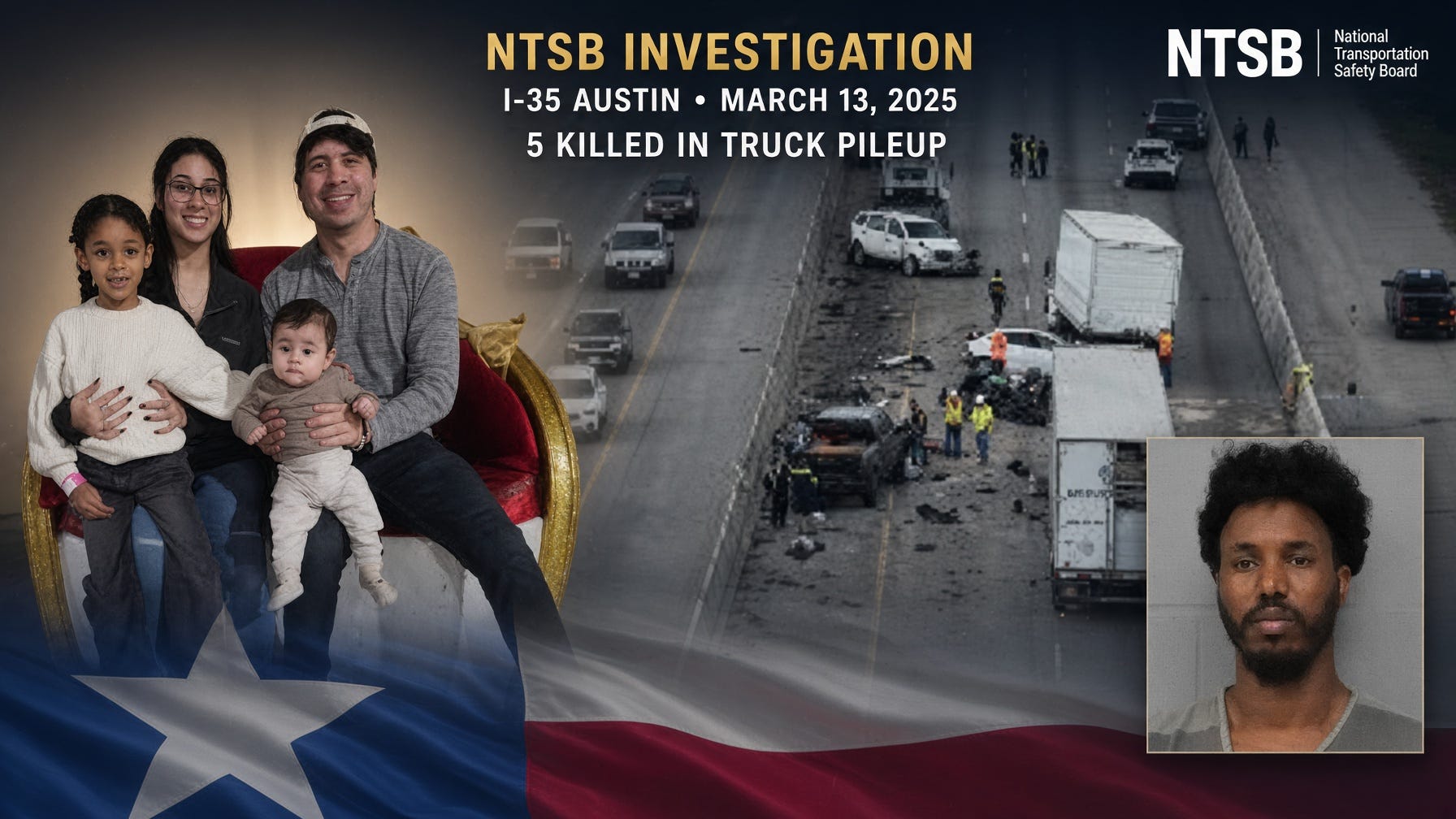
Federal investigators found the driver in the Austin crash that killed five people held a standard Texas CDL when federal rules called for a non-domiciled one; his medical card had lapsed two weeks earlier; and his carrier had no written hiring process. Dalilah's Law would force every state to audit for that exact mistake.
At about 11:20 p.m. on Thursday, March 13, 2025, southbound traffic on Interstate 35 near Parmer Lane in North Austin was backed up. Crews closed two of the three main lanes for overnight resurfacing and reduced the speed limit through the work zone to 60 mph. A 2016 Volvo VNL operated by ZBN Transport LLC, pulling a 2022 CIMC intermodal trailer in the center lane near mile marker 245.4, didn’t slow for the queue, according to the NTSB’s preliminary report. It rear-ended a Volkswagen Jetta and a Chevrolet Silverado, kept going for a tenth of a mile, and struck 15 more vehicles before it stopped.
Sergieo Daniel Lopez, 32, Natalia Helena Perez, 25, their daughter Lylah Lacy Lopez, 6, and their son Silas Lopez, 9 months, died in the Jetta. Investigators described it as an unrecognizable crumpled mess. Ma Concepcion Joaquin De Joaquin, 78, died in the Silverado, whose bed was driven into the cab. Eleven people were hospitalized.
The driver was Solomun Weldekeal Araya, 37. Austin police arrested him that night on five counts of intoxication manslaughter and two counts of intoxication assault. The arrest affidavit said his eyes were bloodshot and watery, his speech was mumbled, and a drug recognition evaluation pointed to central nervous system depressants. It said he spoke mostly Tigrinya, the language of Eritrea and northern Ethiopia, and also understood and spoke English. He told officers another vehicle cut him off and his brakes didn’t activate.
What changed in the criminal case
Toxicology came back in April 2025 with no drugs or alcohol detected. Defense lawyer Bristol Myers asked for a $1 bond per count. The Travis County District Attorney’s Office then reached an agreement with the defense to modify release conditions, and the 427th District Court approved it. Bond dropped from $1.2 million to $1,000 per charge, and Araya was released on April 30, 2025, with GPS monitoring, pretrial supervision, drug testing, and a ban on driving commercial vehicles.
On Sept. 22, 2025, a Travis County grand jury replaced the intoxication charges with an indictment on 22 second-degree felonies: five counts of manslaughter, 15 counts of aggravated assault with a deadly weapon, and two counts of aggravated assault causing serious bodily injury. The indictment alleges Araya drove at an unsafe speed, disregarded construction zone signs, left his lane unsafely, failed to brake, and failed to keep a proper lookout. District Attorney José Garza said the grand jury found probable cause. Myers called the indictment “a desperate attempt to criminalize a tragic accident,” and after the NTSB file came out this March, he said nothing in it shows the “conscious risk creation” the law requires to prove recklessness. A court setting was scheduled for May 4, 2026. Araya hasn’t been convicted of anything, and the case is pending.
What the NTSB file shows
The NTSB released hundreds of pages from its investigation, docket HWY25MH005, in March 2026. The NTSB hasn't published the final report with a probable cause finding. Documents reported by the Austin American-Statesman and KXAN say the Texas Department of Public Safety issued Araya the wrong type of commercial license. He held an employment authorization card, and federal rules required a non-domiciled CDL tied to that authorization. A summary of the file published by an Austin law firm says the card expired in October 2022 and DPS issued a standard, unrestricted CDL in 2021.
The file also shows Araya’s required medical certificate had expired about two weeks before the crash, so his license was set to be downgraded. ZBN told investigators it didn’t know. Investigators concluded ZBN had no formal safety structure, written hiring procedures, or documented employee policies. An extract from the truck’s Motive electronic logging device showed dozens of speeding alerts and several hard-braking events in the days before the crash. The NTSB built a timeline from his phone and truck systems from midnight March 10 through the crash, and KXAN reported it showed limited opportunities for sleep and a visit to an urgent care clinic. Myers says Araya wasn’t on a call, texting, or on social media at the moment of the crash, and that the truck was properly maintained.
ZBN Transport, USDOT 3734164, registered Sept. 30, 2021, listed one to three trucks and an address at 563 Curtiss Drive in Fate, Texas. It shared a Dallas apartment address at 9180 Forest Lane with other transportation companies. One ZBN truck was inspected in New Mexico on Jan. 14, 2025, under the ZBN name, and the next day in Texas under the name Bay Area Lines LLC, which could mean an equipment lease to a second carrier or a carrier hiding its record. After the crash, the NTSB file says ZBN couldn’t get replacement insurance and stopped operating.
At least four civil suits followed, naming Araya, ZBN, Amazon and Pulice Construction, which controlled the work zone. One, filed by survivor Nathan Jonard, seeks about $100 million. Amazon has denied the allegations and says Araya wasn’t its employee or agent. ZBN asked the court to apportion responsibility among all parties.
Where Dalilah’s Law fits
Section 3 of Dalilah’s Law requires every state, within a year of enactment, to audit every unexpired CDL it issued to a person domiciled in a foreign jurisdiction, revoke the ones that don’t comply, and report the numbers to DOT. It requires a federal status check before any issuance, transfer, renewal, or upgrade and caps the card at one year or the end of lawful stay. If the NTSB documents are right, Texas issued a non-citizen on a work card a standard license that outlived the card, which is the same category of error Washington admitted in 685 cases and California admitted in about 20,000. Under the bill, the eligibility question comes before the paperwork question: an employment authorization card alone wouldn’t qualify anyone for a CDL in any state.
Section 6 lets FMCSA revoke a carrier's registration if it uses a driver without a CDL issued to federal standards. ZBN had no written hiring process and didn’t know its driver’s medical card had lapsed. The bill also orders DOT to modernize the driver record notification system within three years so carriers get told when a driver’s license status changes.
Texas has its own gap. Transportation Code 522.043(b), on the books since 1995, still bars DPS from testing CDL applicants’ English and lets it issue intrastate-only CDLs to people who can’t speak English well enough to explain why they want one. Gov. Greg Abbott ordered DPS in September 2025 to enforce English proficiency on intrastate drivers, and DPS moved its CDL and learner’s permit knowledge exams to English only this June. Texas lawmakers discussed the Austin crash at a hearing this summer. Nobody has filed a bill to repeal 522.043(b). Section 2 of Dalilah’s Law would require English-only testing in 49 U.S.C. 31305, the section that sets the minimum standard for every state’s CDL program.
What the bill wouldn’t have caught
The fatigue, speeding, and hard-braking pattern in ZBN’s ELD data is an hours-of-service and carrier oversight problem, and Dalilah’s Law doesn’t touch hours of service. Neither does it address a carrier running under a second name the day after an inspection, or a shipper’s relay network loading a trailer onto a one-to-three truck carrier with no written safety program. Those questions are now before the civil courts, and after the Supreme Court’s May 14 ruling in Montgomery v. Caribe Transport II, juries will decide what a reasonable party should have checked before handing that carrier a load.
Lylah Lopez would be 7 now, and Silas would be 2. Their family’s Jetta was the first car in the line.