

Washington has told Dalilah Coleman’s story as a driver and a single license. The court file in San Bernardino County tells it as a story about a load of refrigerated freight, a broker, a shipper, a warehouse, and three Central Valley trucking companies that share a lawyer, a few miles of Highway 99, an email address, and, according to federal inspection records, at least one tractor. The bill named for her would have reached the license. Nothing in it reaches the moment the freight was handed over.
Before we start, Dalilah and her family have a GoFundMe here. Various groups like ATU Truckers have also led other support events for her, as have others. https://www.gofundme.com/f/stand-with-dalilah-stand-for-whats-right-ezekiel-2230
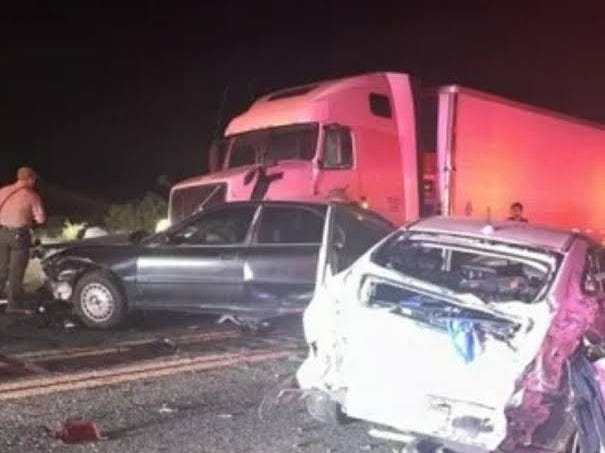
At 12:36 a.m. on Thursday, June 20, 2024, San Bernardino County sheriff’s deputies were sent to a major injury crash at U.S. Highway 395 and Calleja Road in Adelanto, on the high desert north of Victorville. Traffic had stopped for a construction zone. Michael Krause was in a Toyota Corolla in that line of stopped cars with his stepdaughter, Dalilah Coleman, 5, in the back seat. They were on their way to see her stepsister. Her father, Marcus Coleman, later told KTLA what Krause remembered: he looked back and saw headlights coming at him “really fast.” A loaded tractor-trailer rear-ended the stopped traffic, and six vehicles were involved in the wreck.
Dalilah was pinned in the back seat. Deputies from the Victor Valley Sheriff’s Station worked the scene, and she was flown to Loma Linda University Medical Center with a broken femur, two skull fractures, and swelling in her brain. She spent three weeks in a coma. Surgeons removed part of her skull to give her brain room, and she lived without it for four months. She came home after six months with diplegic cerebral palsy and global developmental delay. Her mother, Ileana Krause, has said she can’t walk and takes her nutrition through a G-tube. Michael Krause was hospitalized. Several other people were taken to hospitals that night.
The Victor Valley News ran the sheriff’s release the next morning. It said six vehicles, one of them a semi-truck with a trailer, and that one victim had been flown out, and that more information would come as it became available. It named Deputy J. Guzman as the investigator. The Department of Homeland Security, citing the California Highway Patrol traffic crash report, later said the truck driver, Partap Singh, drove at an unsafe speed and failed to stop for traffic and the construction zone.
The dashcam footage that runs with this piece is the approach to that work zone.
Part 1 of this series told Dalilah’s story the way Washington has told it: a driver who entered the country illegally in 2022, a California CDL, a bill that would close the license gap. That story is real, and it’s the one that put her father in the House gallery at the State of the Union. The civil case her family filed in San Bernardino County Superior Court, Coleman v. State of California, No. CIVSB2505947, tells a second story underneath it. That one is about how the freight got onto that truck, and whose name was on the door when it did.
The name on the door
Every commercial truck in interstate service carries a painted or stickered name on its side. Under 49 CFR 390.21, the power unit has to display the legal name and USDOT number of the motor carrier operating it. The point is simple. When something goes wrong on the highway, the trooper, the victim, and the victim’s lawyer can read the door and know who’s responsible. Operating authority is the second half of that promise. Under 49 CFR 392.9a, a vehicle doing for-hire interstate work can’t operate without the authority required, and FMCSA can put a carrier out of service for operating without it. The name tells you who. The authority tells you they’re allowed to be there, and it comes with insurance on file.
According to the family’s second amended complaint, the freight on that truck was refrigerated product belonging to Conopco, which does business as Unilever. Conopco contracted with C.H. Robinson to move it. It left a United States Cold Storage warehouse in Bakersfield headed for a Target distribution center in Rialto, and the bill of lading allegedly named C.H. Robinson as the motor carrier. C.H. Robinson brokered the load to VVS Trans Inc. The truck that pulled up to the Bakersfield dock to collect it, the complaint alleges, displayed the placards and DOT number of a different company, US Jet Trans Inc., whose motor carrier authority had been inactive for nearly a year. The plaintiffs accuse VVS of reassigning or double brokering the load to related companies and individuals. Partap Singh was driving.
Taking a load you agreed to haul and handing it to somebody else, without telling the broker or the shipper who’s paying you, is what the industry calls double brokering. When the second truck runs on a number without active authority, the freight moves under a name that doesn’t stand behind it. Those are the plaintiffs’ allegations. The trucking defendants have denied them in the filings I could find, and no court has ruled on any of them.
Bakersfield to the Inland Empire at night: take Highway 58 east across the Tehachapis toward Kramer Junction, then drop south on 395 through Adelanto to Interstate 15, which puts you on the Cajon Pass into Rialto without fighting the Grapevine and Los Angeles. A reefer load bound for a retail distribution center runs on an appointment, and the stopped traffic at Calleja Road sat on that line between the Bakersfield dock and the Rialto door.
Who the records say they are
US Jet Trans Inc. registered with FMCSA in 2014 under USDOT 2548044 and MC-887240, with a physical address at 4590 N. Berkeley Ave. in Turlock. Its last MCS-150 filing reported six power units and six drivers and listed Gurmail Singh as the company officer. FMCSA’s SAFER system now returns a single line for that number: record inactive. FMCSA’s crash file credits US Jet with three reportable crashes and no roadside inspections. A second registration, a sole proprietorship under the name Gurmail Singh, USDOT 1847725, carries the same Berkeley Avenue address in FMCSA’s census data.
Devine Transport Inc., USDOT 3311536 and MC-1052015, was registered in July 2019 at 4193 Crowell Road in Turlock with one truck. Its registration now lists 926 Kerley Lane in Turlock, names Navjot Singh as the company officer, and gives the same contact email as US Jet Trans: usjettrucking@gmail.com. The crash file credits Devine with two reportable crashes, and like US Jet, no roadside inspections.
VVS Trans Inc., USDOT 4100195 and MC-1563924, is still running. FMCSA’s census dates its registration to July 7, 2023, less than a year before the crash, and names Navjot Singh as the company officer. SAFER shows it active and authorized for property as of Sept. 21, with a physical address at 14199 Bradbury Road in Delhi, six miles from Turlock, and a mailing address at a numbered box on West Monte Vista Avenue in Turlock. Its Sept. 11, 2025 MCS-150 reports seven power units, six drivers, and 75,000 miles in 2025, hauling fresh produce and refrigerated food. In the 24 months before Sept. 21, VVS trucks were inspected 11 times. Six of nine vehicle inspections ended with the truck placed out of service, a rate of 66.7% against a national average of 22.26%. One of 11 driver inspections ended out of service, 9.1% against 6.67% nationally. FMCSA reviewed the company on Aug. 20, 2026, and recorded it as non-ratable, meaning it didn’t produce a safety rating. Its authority docket shows the original grant and four involuntary revocation actions. The liability policy on file today is $750,000 of primary coverage from Platinum Transport Insurance RRG, effective April 27, 2026. That’s the federal minimum for general freight under 49 CFR 387.9.
VVS shows zero crashes on that same snapshot. SAFER counts crashes only for the 24 months before the snapshot date, and June 20, 2024 aged out of that window in June of this year. Whatever DOT number the state tied to the Adelanto report, a broker pulling SAFER on any of these carriers today won’t see the crash that put a 5-year-old in a coma.
Shippers kept loading VVS. The same inspection records name the shipper or broker on each VVS load that crossed a scale after the crash: Big Basin Foods on Oct. 2, 2024, Grimmway Farms on Jan. 19, 2025, California Dairies on April 2, 2025, Perfect Snacks Inc. on May 29, 2025, and Americold on Dec. 1, 2025. The Americold load moved eight months after the family filed suit. None of those companies is accused of anything in the Coleman case, and an inspection captures only the loads that happened to get stopped.
On Dec. 8, 2025, Modesto attorney Lawrence T. Niermeyer filed a single answer in the Coleman case on behalf of US Jet Trans, VVS Trans, Devine Transport, Gurmail Singh and Navjot Singh. It responded to a cross-complaint from the California Department of Transportation, and it denied, “both generally and specifically,” every allegation in it. The family sued the State of California along with the trucking defendants, and Caltrans responded by suing the trucking companies. The case is assigned to Judge Michael A. Sachs. No trial date is set.
What’s past the read?
A shared lawyer isn’t evidence of anything. Small trucking companies in the same town hire the same attorney all the time because he knows the insurer and the court. A shared address or a shared email often means a family business: a father’s sole proprietorship, a son’s corporation, one person doing the paperwork for both. Plenty of honest fleets run that way. Marcus Coleman has said more than that. He told the Daily Caller News Foundation in February that “the person that hit Dalilah was a chameleon carrier,” with five or six companies built up around that one truck before and after the crash. That’s his characterization, from a father who drives a truck for a living, and the court hasn’t tested it.
The federal record on US Jet Trans is inactive today, and the complaint alleges its authority was already inactive nearly a year before the crash. If the jury finds what the plaintiffs allege, that company’s name and number were on a truck carrying Unilever’s freight, brokered by C.H. Robinson, out of a United States Cold Storage dock. That allegation doesn’t depend on who was driving or where he was born.
The truck that wore two numbers
The names in this case don’t settle anything. In FMCSA’s registration data, Navjot Singh appears as a company officer on 155 carriers, from Turlock and Fresno to Indianapolis, Brampton and Edmonton. The court file names a Navjot Singh and a Gurmail Singh, and FMCSA lists officers with those names on VVS, Devine and US Jet. Nothing in a registration record can tell you whether an officer name on one carrier is the same human being as the same name on another. A shared name with no shared phone, address, or email is a coincidence until something else ties it down, and with names this common, the paper can’t do it.
A tractor is harder to rename. Every roadside inspection records the truck's VIN and the plate it was wearing, under the DOT number of the carrier the driver claimed. One tractor, a 2016 Volvo with a VIN ending in 934116, has been inspected under two DOT numbers. Under US Jet Trans’s number, it wore Washington plate WP54723. Under VVS Trans’s number, it wore California plate ZP07328, and that inspection took place Oct. 26, 2024, four months after the crash, when the inspector wrote up the driver’s paper log. The carrier C.H. Robinson hired, and the carrier whose number was allegedly on the door, have each had that same tractor inspected under their own DOT number. The Oct. 26 inspection records more than a plate. FMCSA inspection records list the shipper or broker on the driver’s shipping papers, and for that stop the name recorded is US Jet. Four months after Adelanto, a tractor running under VVS’s number was stopped with US Jet on the paperwork, and a driver was cited for the form and manner of his paper log.
That tractor isn’t alone. I ran 11 of the VINs VVS trucks have been inspected under against the national inspection file. Five turned up under at least one other carrier’s DOT number. A 2019 Volvo ending in 900319 wore Texas plate XP36177 for K S Majha Trans LLC, DOT 2534567, and VVS plate ZP07329 on Oct. 2, 2024. A 2019 Volvo ending in 200162 first appears in 2020 under Pehaj Truck Line Inc., a New Mexico registration at DOT 2150486, and was inspected under VVS with plate ZP83905 on April 29, 2026. A 2017 Volvo ending in 986879 runs for JBC Trucking LLC of Reno, DOT 2473334, and VVS inspected it on Dec. 1, 2025. Believe Transport Inc. of Lathrop, DOT 3483216, shares a trailer with VVS and a tractor ending in 948848 that VVS last had inspected on April 18, 2024, two months before Adelanto. Believe Transport’s name also appears in the index of filings in the Coleman case, and its own inspection history includes a load recorded to USCS, stopped in Texas on June 15, 2023. United States Cold Storage, the warehouse named in the complaint, does business as USCS. The record doesn’t say which facility. Believe’s equipment moves the same way VVS’s does. A 2020 Volvo ending in 230015 has been inspected under Believe, Radiant Sky Logistics, DOT 4020810, and L B T Trans Inc., DOT 1391971, wearing Nevada plate XP78304 and California plate ZP48138, and Believe and Radiant Sky have both run that California plate. A 2024 Volvo ending in 623460 has carried three plates between Believe and Tevat Transportation Inc., DOT 3912165. LVL Trucking Inc. of Turlock, DOT 4215485, shares a tractor and a trailer with VVS. The LVL tractor, a 2016 Volvo ending in 939053, has carried three different plates.
The plates tell it a second story. California issues apportioned plates for interstate trucks in numbered runs. VVS trucks have worn ZP07278, ZP07306, ZP07328, and ZP07329. LVL’s tractor wore ZP07317. JBC’s tractor wore ZP07306 under VVS and ZP83910 under its own number, five numbers from VVS’s ZP83905 and 18 from LVL’s ZP83928. Plates issued in the same run often trace back to one registration account or one registration service, and the California DMV’s apportioned registration records would show which. That’s a public records request, and it’s the next one on the list.
None of that proves anyone did anything illegal. Carriers sell trucks, lease them to each other, and put owner-operators under their authority, and every one of those moves leaves the same footprint in the inspection file. Plate swaps happen when a truck changes hands. What the equipment records do is the thing the names can’t: they tie specific companies to specific iron on specific dates, and they keep doing it after the paperwork changes. The newest VVS inspection in the file is dated Aug. 4, 2026, when an inspector put the truck out of service for a wheel defect.
What the rules already say
In 2012, the Moving Ahead for Progress in the 21st Century Act, MAP-21, raised the broker bond from $10,000 to $75,000 and wrote 49 U.S.C. 14916, which makes brokering without authority a violation carrying a civil penalty of up to $10,000 per violation and a private right of action for anyone injured by it. A carrier that re-brokers a load it agreed to haul without its own broker authority is the textbook case. In June 2023, under a directive in the 2021 infrastructure law, FMCSA published guidance defining who counts as a broker and who counts as a bona fide agent, aimed at dispatch services and carriers moving freight they never touch.
None of those rules put anyone at the loading dock. The bill of lading and the rate confirmation name a carrier. The guard shack and the shipping clerk see a truck. No federal regulation requires anyone at the warehouse to check that the number on the door matches the number on the paperwork before the doors close and the seal goes on. The Coleman complaint is built on that gap. It accuses C.H. Robinson, Conopco and United States Cold Storage of negligent carrier selection and negligent management of the brokerage system, alleging none of them had “reasonable gatekeeping or safety procedures” to confirm the truck at the dock was the “properly authorized driver of the properly authorized and assigned motor carrier.” FMCSA’s inspection file records C.H. Robinson on loads carried by 2,359 carriers between February 2023 and August 2026. VVS isn’t one of them, so the only public record of C.H. Robinson handing VVS that load is the complaint.
The legal ground under that theory moved on May 14, when the Supreme Court decided Montgomery v. Caribe Transport II 9-0 and sent negligent selection claims against brokers to juries instead of throwing them out on federal preemption. That case put the broker on the hook for choosing the carrier. The Coleman complaint reaches one step further, to the shipper and the warehouse, and asks a jury to decide whether handing freight to the wrong truck is the same failure as hiring the wrong carrier.
The inspection file shows which trucks have hauled USCS freight since the crash, at least the ones that got stopped. Since June 20, 2024, 54 carriers have been inspected on loads recorded to USCS, from California to Pennsylvania. Plenty are fleets any warehouse would recognize: Swift, Knight Refrigerated, Marten, Prime. Of the 54, 25 run vehicle out-of-service rates above the 22.26% national average, and 35 have never received an FMCSA safety rating. Haryana Trans Inc. of California, DOT 3103855, holds a conditional rating and was stopped on a USCS load on Nov. 1, 2024. Logix Logistics Services LLC, DOT 3626756, was stopped on a USCS load in Texas on April 24, 2025, five months after a second registration under the same name, DOT 4321951, appeared in FMCSA’s records with the same officer and phone number. JJGS Davis Trucking LLC, DOT 4186202, was stopped on a USCS load in Ohio on March 18, 2025. Eight weeks later, Luisa Trucking LLC, registered in Texas as DOT 4408415, and three JJGS trucks have been inspected under it since. The records don’t show who tendered those loads, whether a broker sat between the dock and the truck, or which USCS facility they came from.
I am not only a Journalist, but also an expert witness in dozens of cases around the country, both defending the best carriers and brokers and helping litigate against carriers and brokers we believe could've taken better action and exercised due diligence. Some of the shows we have been on include Will Cain, our 60 Minutes investigation and interview, and the CBS Sunday morning investigative undercover series, where I inquired, as a carrier with my own DOT number, about how easy it is to haul for some brokers like CH Robinson. This took place with CBS and Michael Kaplan at the Mid-America Trucking Show. My focus is and has always been safer highways and removing bad actors from our industry and our roads, and to help facilitate the investigations that accomplish that. For every event you do see, there is a 1000 being undertaken behind closed doors with regulators, policymakers, insurers, and investigators.
Ironically, CH Robinson doesn't come out and say, “Hey, maybe we could do better due diligence.” They have actually allegedly moved against me personally. Media representatives from the Mid-America Trucking Show advised that representatives, or those claiming to be representatives of CHR, alleged CH Robinson employees interviewed them without consent and without declaring they were media, and that the company wanted our MATS privileges revoked. Mid-America Trucking Show media reps advised me they were taking no action, as we had remained a solid industry partner. This isn’t the first time. They have had account privileges to other investigative tools revoked because we used them to show the carriers CH Robinson was hiring. Fortunately, we have our own tools. Tools we built that the FMCSA and other investigative agencies pay to use, so we’re never empty-handed, and we do our due diligence.
We never shy away from the truth. We have countless vendors who have even tried to pass us off to retract. We don’t do that. We present the facts, and we hope those facts and those highlights help make our highways a little safer.
How the load moves
Here’s how it works when it goes wrong. A shipper tenders a reefer load to a broker. The broker posts it, vets a carrier on its screen, and sends a rate confirmation. The carrier doesn’t have a truck free, or has a better-paying load, or never had trucks to begin with. It passes the load to a related company or a cousin’s truck, and it keeps a cut. The truck that shows up at the dock wears whatever number its owner has, active or not. The clerk checks the load number and the pickup number, both of which the driver got from whoever dispatched him. The seal goes on. The bill of lading still says the broker’s name, or the first carrier’s. The truck rolls. If it delivers, everybody gets paid, and nobody ever knows. If it doesn’t, the first question at the crash scene is whose truck this is, and the answer on the door may belong to a company that, on paper, stopped operating a year earlier.
That sequence works for exactly as long as nobody at the dock looks. The pickup is the one moment the paperwork and the truck are in the same place, and the Coleman case asks a jury whether checking one against the other is a clerical step or a safety step.
The driver, and where he ended up
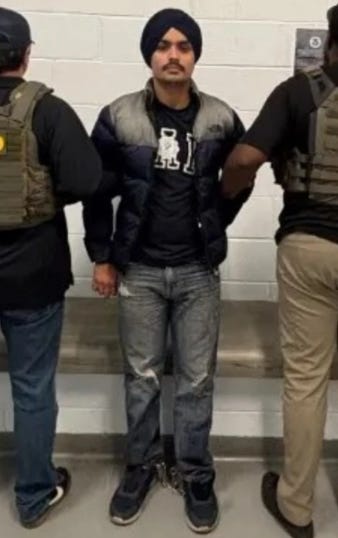
Partap Singh’s side of this has been told almost entirely by federal officials. DHS says he crossed the southern border illegally in October 2022 and was released into the country. The California DMV says the federal government approved his Employment Authorization Document from Aug. 3, 2023 through Aug. 2, 2025, then approved another from June 30, 2025 through June 29, 2030, and that it confirmed his documents through the federal SAVE system before issuing his CDL. “California followed all federal and state laws,” the DMV said. The federal government renewed his work authorization 60 days before it arrested him.
ICE picked him up in Fresno on Aug. 29, 2025, on a warrant, and DHS said he would stay in custody pending immigration proceedings. He was held at the Mesa Verde facility in Bakersfield, where Marcus Coleman and Ileana Krause went to see him with Dalilah in her wheelchair. Coleman told Fresno’s FOX26 he went in expecting to be “laying the law down.” Krause said they wanted Singh to see what he caused. Bakersfield’s KBAK reported in late September 2025 that he’d been moved to a facility in Texas. I found no public record of a removal order or a criminal charge from the San Bernardino County District Attorney’s office for the Adelanto crash. As of this month, public reporting still describes him as in ICE custody. He’s a named defendant in the civil case.
The federal government says it has held him for more than a year on immigration grounds, and no court has ruled on what happened on 395. Every public account of his driving that night traces to one crash report the public hasn’t seen. The CHP report, the sheriff’s file, the dispatch logs and the 911 calls are all subject to California Public Records Act requests.
Where Dalilah’s Law stops
The bill named for her has eight sections. Section 2 makes CDL testing English-only. Section 3 limits CDLs to citizens, nationals, permanent residents, and three visa classes. Section 6 makes it a carrier violation to knowingly use a driver without a compliant CDL, and lets FMCSA pull that carrier’s registration. Section 7 goes after foreign brokers and offshore dispatch.
Run the Adelanto crash through it. Section 3 likely reaches Partap Singh’s license, since a work permit alone wouldn’t qualify him. Section 6 reaches a carrier that knowingly put him in the seat, if FMCSA can establish which carrier that was. Nothing in the bill touches a load changing hands in Turlock, a truck wearing an inactive carrier’s number at a Bakersfield dock, or a warehouse that never checked. A driver with a perfect CDL, born in Bakersfield, could have pulled that same load on that same truck under that same number, and every failure the complaint describes would still have happened.
My read is that the fix doesn’t need a new statute for most of it. FMCSA already has authority over brokers under 14916 and over carrier marking under 390.21. A rule requiring the broker’s rate confirmation to carry the tractor’s USDOT number, and requiring the shipper to record the number on the door at pickup, would put a second set of eyes on the one moment the paperwork and the truck meet. Congress could write a pickup verification line into Section 6 before the bill moves in the lame duck. The registration side needs one more fix: the MCS-150 asks a carrier how many trucks it runs, not which ones. A registration that listed every VIN, checked against the inspection file each time a VIN shows up under a new DOT number, would turn equipment into the identity check that names can’t be. None of it costs much, and all of it would have forced someone in Bakersfield to read the door.
Who carries it
For drivers, a double-brokered load means working for someone whose name isn’t on the truck, which leaves them exposed when the insurance behind the door turns out to be empty. For carriers running clean, it means competing against rates set by companies that don’t carry the cost of their own authority. For brokers, Montgomery already made carrier selection a jury question, and this case tests whether a broker’s duty ends at the rate confirmation or runs to the dock. For shippers and warehouses, it’s the first time many of them will be asked in a courtroom what their shipping clerk was supposed to check. For insurers, it’s a reserve question on every one of those defendants. For the family, it’s a civil case that could take years, against defendants who deny everything, over a child who will need care for the rest of her life.
On Aug. 3, more than two years after the crash, Dalilah had another skull surgery. Four weeks later, on Sept. 1, her father sat before the House Judiciary Committee at a hearing on sanctuary policies. When the ranking member, Rep. Jamie Raskin, D-Md., offered his sympathy, Marcus Coleman cut him off. “I reject your guys’ sympathy,” he said.
Adam Coleman will be releasing his “Illegal Highways” documentary on this and other victim stories on 9/29 on Rumble. It’s a must-see event.
The name on a truck door is supposed to tell you who answers for it. Two years after Highway 395, the number on that door belongs to a federal record marked inactive; the tractors around it are still changing plates, and the question of who put that load on that truck is still waiting on a jury.