

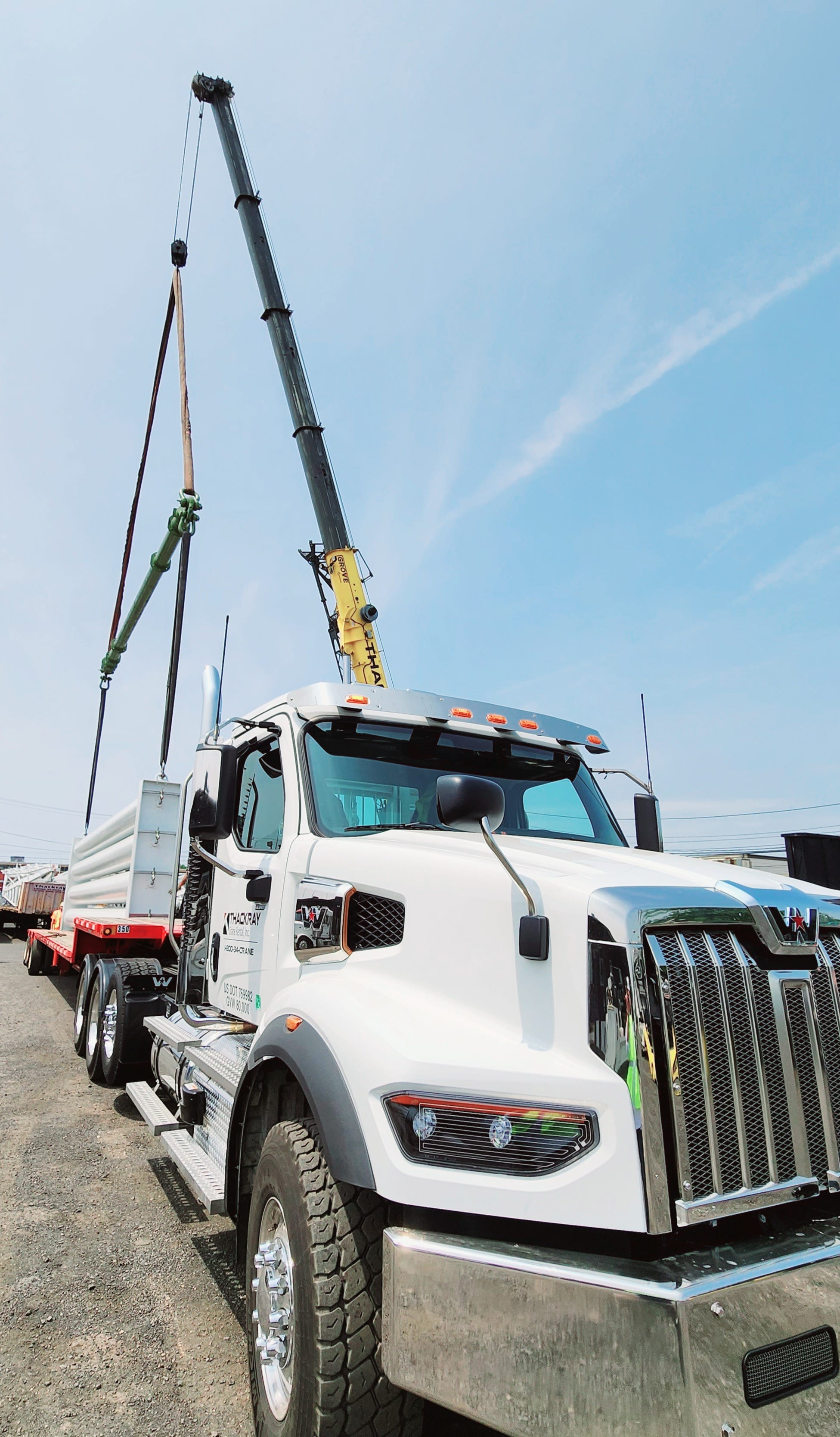
(I use Thackray Crane as a prime example here because the day I was with them loading this at their yard in Philly, executive management was there in vests and hard hats to ensure the load they were shipping for a client on their truck was loaded and secured properly.) Top-down leadership is leadership that understands risk and the hierarchy that says you can't delegate your safety responsibilities. Second, notice their equipment. It doesn’t have to be show room Pete to be well kept and maintained. Pride goes a long way in selection, vetting, and even enforcement.)
Counsel asks who selected the motor carrier that crashed into their client, and the corporate designee says some version of: we hired a broker, carrier selection is the broker’s job, we don’t control who they put on our freight. In the shipper’s mind, the freight left the dock, and the responsibility left with it. What they’re describing is delegation, and delegation is real. What they’re claiming is that delegation erased their accountability, and that claim runs against how safety responsibility has always worked in this industry, from the driver’s seat on up.
The bottom is where the rule is oldest and clearest.
The driver can’t delegate securement, even when someone else loaded the trailer.
A driver backs under a preloaded trailer at a shipper’s dock. Warehouse crew loaded it, maybe hours ago, maybe with a forklift operator the driver never saw. The driver still owns what happens next. 49 CFR 392.9(a) says a driver may not operate a commercial motor vehicle unless the cargo is properly distributed and adequately secured under the securement standards at 49 CFR 393.100 through 393.136, and the driver must assure himself of that before pulling out and again within the first 50 miles. The regulation doesn’t ask who did the loading. It asks who decided to put that load on a public highway, and the person who makes that decision is the person holding the steering wheel. There’s one carve-out, at 392.9(b)(4), for sealed loads the driver has been ordered not to open and loads packed in a way that makes inspection impracticable. The carve-out exists because the default rule is that securement responsibility rides in the cab.
The case law behind this is older than me. In United States v. Savage Truck Line, Inc., 238 F.2d 145 (4th Cir. 1956), a Navy-loaded airplane engine broke loose from a Savage truck and killed a man, and the Fourth Circuit had to sort out who owed what when the shipper did the loading. The court put the primary duty on the carrier: the carrier accepts the load, the carrier’s driver has the chance to see the defect, the carrier answers for it. The shipper is on the hook only when the loading defect is latent, hidden from the carrier’s reasonable inspection but known to the shipper. Seventy years later, courts still call it the Savage rule, and every securement case I’ve worked starts there. Notice the structure repeats all the way up the chain: the party closer to the risk carries the duty, and handing the physical task to someone else doesn’t hand off the duty unless you genuinely couldn’t have seen the problem.
The carrier’s non-delegable core
The motor carrier sits one tier up, and its non-delegable duties are written into the regs. The clearest example is the leasing rule. When a carrier pulls freight with an owner-operator’s truck, 49 CFR 376.12(c)(1) requires the lease to grant the carrier exclusive possession, control, and use of the equipment and to state that the carrier assumes complete responsibility for its operation for the duration of the lease. That regulation exists because carriers spent decades pointing at the owner-operator after a crash and saying he’s an independent businessman, not ours. The government’s answer was to make responsibility a condition of using the equipment at all. You can lease the truck. You can’t lease out the accountability that comes with running it under your authority.
The same principle runs through the rest of Part 390 and its neighbors. Under 49 CFR 390.11, whenever a duty is prescribed for a driver, the motor carrier must require its driver to observe it. Under 390.13, nobody may aid, abet, encourage, or require a violation. The driver qualification file requirements in Part 391, the drug and alcohol program in Part 382, and the maintenance and inspection duties in Part 396: a carrier can hire a compliance service to build the files, a third-party administrator to run the testing consortium, and a vendor shop to turn the wrenches, and I’ve audited carriers that outsourced all three. Outsourcing the function is legal and often smart. When FMCSA shows up for a compliance review, the party answering for the gaps is the carrier whose DOT number is on the door. In twenty-five-plus years, I have never once seen an enforcement action or a verdict land on the compliance vendor instead of the carrier. The work was delegable. The duty wasn’t.
Restatement (Second) of Torts §428 says that a party operating under a public franchise, an authority granted by the government to do something that involves an unreasonable risk of harm unless carefully done, can’t shed the duties that come with the franchise by hiring an independent contractor. Interstate motor carrier authority is exactly that kind of franchise, and §428 is one of the reasons the leased-driver defense died. The franchise carries the duty. The duty stays with the franchise holder.
Montgomery closed the broker’s escape hatch
For about fifteen years, the fight over the next tier up was a preemption fight. Brokers argued that the Federal Aviation Administration Authorization Act, 49 U.S.C. 14501(c)(1), preempted state negligent-selection claims because carrier selection relates to a broker’s services, and the circuits split over whether the safety exception at 14501(c)(2)(A) saved those claims. The Ninth Circuit said the claims survive, in Miller v. C.H. Robinson Worldwide, 976 F.3d 1016 (9th Cir. 2020). The Seventh went the other way in Ye v. GlobalTranz Enterprises, 74 F.4th 453 (7th Cir. 2023), and the Eleventh sided with the Seventh in Aspen American Insurance Co. v. Landstar Ranger, 65 F.4th 1261 (11th Cir. 2023). For a while, whether a family could sue the broker depended on which side of a state line the truck happened to crash on.
That era ended on May 14, 2026. Montgomery v. Caribe Transport reached the Supreme Court on facts that were almost embarrassing in their simplicity. Caribe Transport II held a conditional safety rating when C.H. Robinson tendered it a load of plastic pots. Conditional is not a secret. Shawn Montgomery was stopped on the shoulder of Interstate 70 in Illinois on December 7, 2017, when that carrier’s truck hit him, and he lost his leg. The Court held that a negligent-selection claim is a safety regulation of motor vehicles within the plain meaning of 14501(c)(2)(A), and that whether pulling the public record was worth ninety seconds is a question for a jury. The preemption wall came down nationwide that morning. Brokers had already been losing this argument on other grounds for years; Schramm v. Foster, 341 F. Supp. 2d 536 (D. Md. 2004), recognized a broker’s duty of reasonable care in carrier selection two decades earlier, and Sperl v. C.H. Robinson Worldwide, 408 Ill. App. 3d 1051 (2011), showed what happens when a broker’s control over the load crosses into agency. Montgomery didn’t invent broker accountability. It removed the federal shield that let brokers avoid litigating it.
The doctrinal engine underneath all of these cases is Restatement (Second) of Torts §411: a party that hires a contractor owes reasonable care to select a competent and careful one, measured against the danger of the work. Hauling 80,000 pounds on a public highway qualifies as dangerous work under any reading. Section 411 attaches to the act of hiring. The duty attaches to the act of hiring, whoever performs it, at whatever tier.
The shipper’s move, and why it doesn’t work
The shipper says: we hired a broker, so carrier selection and carrier vetting belong to the broker. As a description of who performs the vetting, that’s usually accurate. As a theory of who’s accountable, it quietly assumes that §411 evaporates at the shipping dock, and it doesn’t. The shipper made a hiring decision. The shipper selected the broker. The selection of the broker is the shipper’s own conduct, performed by the shipper’s own people, under the shipper’s own procurement process, and the question a jury gets to ask is the same one it asks at every other tier: was that selection reasonable, given the danger of the work being sourced?
The idea that shippers are strangers to safety duties doesn’t survive contact with the regulations they already live under. A shipper offering hazardous materials for transportation carries duties that no contract can move. Under 49 CFR 173.22, the shipper is responsible for proper classification, packaging, and marking, and under 172.204(a) the shipper personally certifies on the shipping paper that the materials are offered in accordance with the regulations. No shipper of drummed solvent has ever successfully told PHMSA that classification was the broker’s problem. The regulatory system already treats the party who puts freight into the stream of commerce as a party with safety obligations. The only question is how far those obligations reach into carrier sourcing, and that’s where the current litigation lives.
The counterweight is in re Home Depot U.S.A., Inc., 69 Tex. Sup. Ct. J. 721 (2026), the Texas Supreme Court held that a passive shipper of ordinary goods, one that exercises no control over the carrier’s operations, equipment, or employees, where the cargo presents no unusual risk, can’t be held liable just for shipping. The court said the plaintiffs’ theory transformed the commonplace act of shipping goods into sweeping tort liability untethered from control, conduct, and risk. That holding is correct as far as it goes, but. It doesn’t address a shipper that owns the trailers, holds its own motor carrier authority, runs a transportation subsidiary, writes safety standards into its broker contracts, or ships at a volume that generates its own carrier-safety data exposure. The distance between a passive shipper and a sophisticated transportation participant is a factual distance, and most of the national shippers I see in litigation are on the sophisticated end of it. A company that knows enough about vetting to require it in Section 8 of its broker agreement knows enough to check whether it’s happening.
The hierarchy
Here’s the structure. The driver vets the load and the equipment before putting them on the highway. That duty is regulatory and personal. The carrier vets the driver, the equipment, and its own compliance systems. That duty rides with the operating authority and can’t be leased, outsourced, or contracted away. The broker vets the carrier. That duty is now litigated in front of juries in all fifty states, and the reasonableness of the screen is the whole case. The shipper vets the broker. That duty is the newest one on the board in terms of litigation attention, and it’s the oldest one in terms of doctrine, because it’s nothing more than §411 applied to the hiring the shipper actually performed.
Each tier delegates performance downward. No tier delegates accountability downward. The reason this matters is, if your freight ends up on an unfit truck, somebody at every tier above that truck made a sourcing decision that let it happen, and the law is done pretending only one of those decisions counts.
What vetting the broker actually looks like
Since the shipper’s duty is the one the industry hasn’t built habits around, here’s what the practice looks like when it’s done, drawn from programs I’ve built and programs I’ve torn apart. Verify the broker’s authority and its surety bond. Every property broker must maintain a $75,000 bond or trust under 49 U.S.C. 13906(b), the BMC-84 or BMC-85 on file with FMCSA, and the filing history is public; a broker that has cycled bond providers or had a bond cancellation is telling you something. Ask for the broker’s carrier-vetting criteria in writing, and read them the way you’d read anything you might have to defend under oath, because you might. A screen that checks only active authority and an insurance filing is a status check. A status check tells you the carrier exists on paper. It tells you almost nothing about whether the carrier will crash. Ask what the broker does about double brokering, because a load that gets double-brokered lands on a truck nobody in your chain ever looked at, and the detection controls, matching the DOT number on the tractor at pickup against the tendered carrier, tying tracking to the actual asset, verifying the driver’s carrier affiliation, are cheap and checkable. Put minimum carrier standards in the broker agreement, then audit against them on a schedule, because a contract clause you never verify is a requirement you wrote and a duty you skipped. Look at the lawsuits the broker has faced before. Look at the carriers the broker has selected before. All of that data is available and free. Keep the records. The whole point of a vetting program, at any tier, is that when the worst day comes, you can prove what you knew, what you checked, and when you checked it.
The defendants who survive these cases aren’t the ones who found a party below them to point at. They’re the ones who can produce a dated record showing they did their own tier’s work. The chain of freight is a chain of hiring, vetting, and sourcing decisions, and every link answers for its own.
In 2002 i separated the broker from our 3pL at the manufacturer where i was logistics manger vetted carriers we vetted brokers and 3PLs individually. I understood that in the end performance and liability were never a hire and forget responsibility. The tools were always there and the technology for recording performance metrics grew insanely better. No excuse for lost loads, phantom carriers, unscripted, unreported delays. We were protected from broker payment defaults to carriers but paid the good faith carriers anyway.