

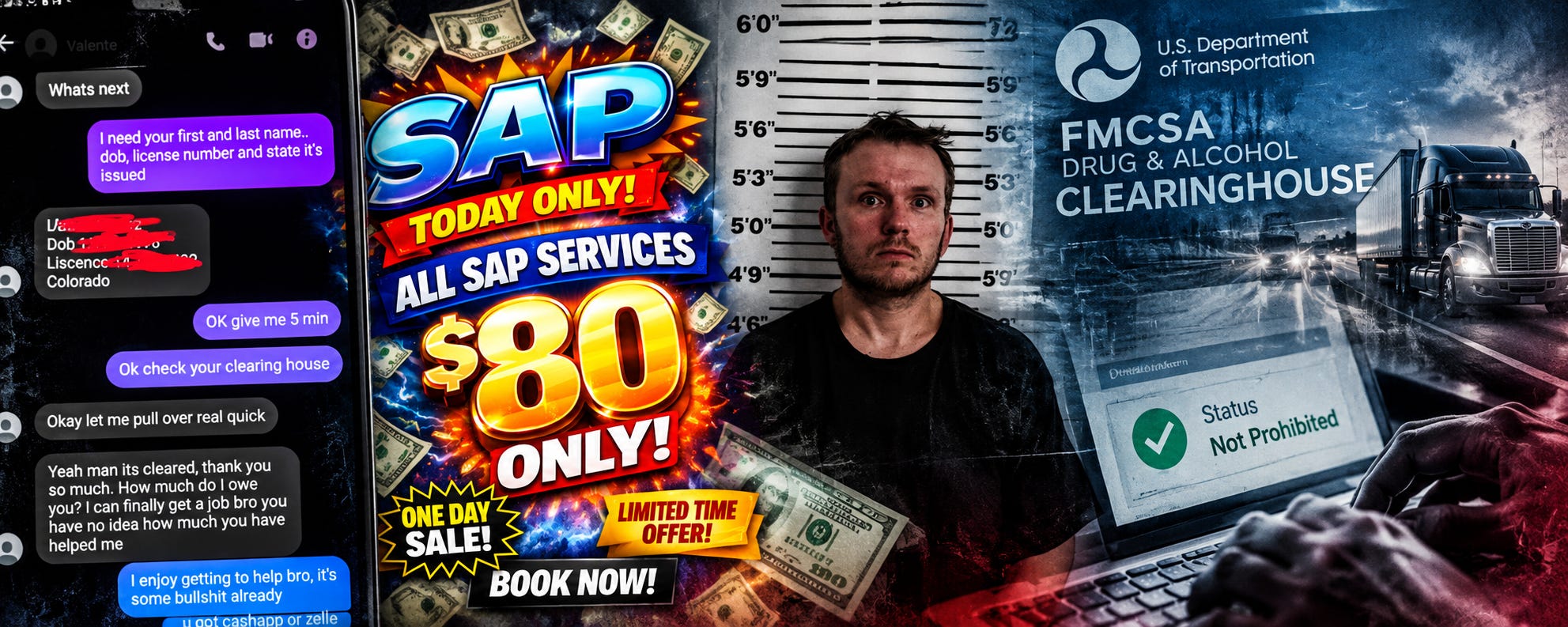
This spring, I documented how a North Carolina truck driver and a network of Facebook operators sold fraudulent return-to-duty clearances in the federal Clearinghouse for $100 to $500 per driver. FMCSA responded with biometric identity checks for new users. Six months on, there is no public indictment for the Clearinghouse fraud, no audit of the entries already made, no timeline for checking the accounts already inside, and no notice to the carriers who hired on the strength of a green screen.
The FMCSA Drug and Alcohol Clearinghouse answers one question at the moment of hire: has this commercial driver failed or refused a drug or alcohol test, and if so, has he done what federal law requires before he goes back behind the wheel? Since January 2020, every carrier that hires a CDL driver has had to ask that question through the database. When the answer is “prohibited,” the driver cannot legally operate a commercial motor vehicle until a qualified Substance Abuse Professional evaluates him face to face, prescribes treatment or education, confirms he completed it, clears him for a return-to-duty test, and sets a follow-up testing plan that can run up to five years. The Clearinghouse is the ledger that records each step. The whole return-to-duty process rests on a simple promise: a green screen means a real clinician looked at a real person.
This spring, I published three pieces showing what happens when that ledger accepts an entry from anyone. This piece pulls them together, tells you what has happened since, and more importantly, what has not.
FMCSA’s December 2025 monthly summary report, the most recent one I reviewed for the original investigation, showed 328,431 CDL holders with at least one drug or alcohol violation since the system launched. Of those, 202,345 were still prohibited, and 159,226 had not even started the return-to-duty process. Positive drug tests made up 82% of the 368,984 violations reported. Cocaine metabolite accounted for 57,075 of them. Employers, state licensing agencies, and law enforcement had run 38 million queries against the database since 2020. And the entire national pool of accounts with SAP-level access, the accounts that can enter clinical assessment dates and return-to-duty eligibility determinations, stood at 6,305 registrations. None of those registrations, as the system was built, were checked against a state licensing board or a national credentialing body before granting access.
On the other side of the ledger, 126,086 drivers had reached not-prohibited status. Of those, 85,136 had a logged negative return-to-duty test, and 40,950 had a logged follow-up plan completion. Those entries tell a carrier a driver is safe to hire. Nobody at FMCSA has publicly audited how many of them were entered by people legally allowed to enter them.
The overwhelming majority of the 6,305 SAP accounts almost certainly belong to real clinicians doing real work. Most drivers who clear the Clearinghouse did the evaluations, the classes, the counseling, and the testing, and they paid for it in money and months off the road. A prohibited driver who wants his livelihood back is a sympathetic figure, and the SAP process is expensive, slow, and uneven in quality. The volume estimates in my second piece came from a documentary record of posts, messages, and operator statements, not FMCSA’s internal data, and should be read as estimates. Everyone named in this series is presumed innocent, and the only criminal case on the public record so far is a drug and DUI arrest, not a fraud charge. All of that is true.
The problem is that none of it changes what a checkbox let a cocaine user do to a federal safety database.
Under 49 CFR 40.281, a Substance Abuse Professional must hold one of a short list of credentials: a license as a physician, psychologist, social worker, or employee assistance professional; a state license or certification as a marriage and family therapist; or certification as an addiction counselor from a recognized body such as NAADAC or IC&RC. In addition to the credential, the SAP must complete qualification training, pass a national exam, and keep up with continuing education. Subpart O of Part 40 requires a face-to-face evaluation, a treatment or education recommendation, a follow-up evaluation, and a follow-up testing plan. Under 49 CFR 382.705(d), SAPs report specific information into the Clearinghouse. The step that tells a carrier a driver passed his return-to-duty drug test, step five, is a date field entered by an employer or third-party administrator. When I reported this in March, there was no lab report upload, no link to the Medical Review Officer’s verified result, and no chain of custody behind that date. You typed it in and checked a box.
Brandon Blackburn, 34, of North Wilkesboro, North Carolina, is a truck driver. He holds none of the credentials in 40.281. According to Facebook posts, private messages, payment confirmations, and Clearinghouse screenshots I reviewed, he registered in the Clearinghouse as a Substance Abuse Professional and spent years charging prohibited drivers $100 to $350 to enter completed return-to-duty steps they never completed. Weekend specials ran $75. He advertised that veterans were free. By his own boasting, he cleared more than 600 drivers; investigative sources put the number closer to 1,000. Against the 85,136 logged negative return-to-duty results in the December 2025 data, 1,000 clearances are roughly 1 in 85.
On Aug. 20, 2025, deputies in Prentiss County, Mississippi, stopped Blackburn’s white 18-wheeler on County Road 1101 because it entered a 20 mph work zone too fast. According to Darkhorse Press, which reported the arrest Sept. 4, 2025, he was charged with DUI, careless driving, possession of paraphernalia, and felony possession of cocaine, and Justice Court Judge Ray Hall set a $5,000 circuit bond. His FMCSA inspection record from that day lists a violation of 49 CFR 392.4 for operating while in possession of drugs and a violation of 49 CFR 395.8 for a false report of duty status. He was falsifying his own logs on the same day, by the evidence I reviewed, that he was still sending green checkmarks to other drug-positive drivers over Facebook Messenger. After he bonded out, the evidence shows he kept selling clearances.
He also ran the scheme in reverse. When drivers he had cleared tried to dodge payment, he put them back on step one. “Now it’s gonna cost him 250 instead of the 100 for me to remove it,” he wrote publicly, and he described threatening “25 or 30 people that still owe me” the same way. FMCSA’s own fraud alerts page describes exactly that extortion pattern.
A driver Blackburn had cleared asked him, “Ok, so now what’s the process with my counselor?” That driver had a real, licensed SAP and was in treatment. Blackburn answered, “You done bruh.” The clinical relationship that existed to monitor that driver’s sobriety ended with a text message and a hundred dollars. In another screenshot, a driver’s freshly cleared dashboard showed a pre-employment query consent request from SMJ Freight LLC, USDOT 3972563. A real carrier, running the legally required query, got a record that had been bought.
Blackburn was not alone, and my second piece showed he was not even the biggest operator. Wayne Hudson administers a Facebook group called “SAP Friendly Trucking Companies. That’ll Hire All SAP Drivers,” documented in screenshots with 5,800 members and described in the record as exceeding 7,000. In a public comment thread under his verified account, Hudson wrote: “Im the one did Brandon RTD I know all his info and background.” In the same thread, he called Blackburn a junkie who was “not certified to do nothing.” He is not in the NAADAC SAP directory or on SAPList.com. A documented driver exchange put his price at $500 for all six steps, pay after, with no test administered. The same group that sold the clearance posted job ads for carriers willing to hire the newly cleared driver, meaning the operation could get paid twice for the same man.
David Handy posted clearance offers under his own name and, using the same phone number and nearly identical language, under the name Donny Darko: “$100 and YOU PAY WHEN YOU SEE THE GREEN LIGHT. In less than 5 minutes.” In one thread, Handy quoted $300 for all six steps, and Blackburn told him, “We need to stop undercutting each other and do at least $350.” Two operators were setting a floor price for federal safety records in a public Facebook group.
Zeph Nealy advertised from at least November 2024 through January 2026. Drivers he cleared posted public thank-you notes with their Clearinghouse dashboards attached. The earliest, from Andre Klutch Graves, is dated Nov. 18, 2024, the day Clearinghouse II took effect and a prohibited status began triggering a state CDL downgrade. Nealy was advertising on the day drivers feared losing their licenses most. He is not in the NAADAC directory or on SAPList.com.
Marc Massie came in through a different door. A screenshot showed a Clearinghouse account named “Massie Transportation, Employer Admin” with 226 negative return-to-duty test results and 309 follow-up plan completions logged. No motor carrier by that name appears in FMCSA’s registry in Texas, and the carrier he told me he owned does not appear in SAFER at all. He had described himself publicly as a licensed chemical dependency counselor, then told me the license was his wife’s, then blocked me. Driver Bradley Baucom told me Massie charged him $1,000 for a clearance and came back three weeks later demanding $500 more. The service Massie described to me, a two-hour online portal on drug and alcohol topics, is not the SAP process under any reading of Part 40.
Handy, Nealy, and Hudson did not respond to requests for comment. Massie did not respond to follow-up questions.
The business model underneath it all works like a multilevel marketing plan. A prohibited driver pays to get cleared. Once he is back on the road with a green dashboard, someone above him offers him Clearinghouse access and a commission to clear others. The record includes an operator describing keeping as little as 10 cents on the dollar and kicking the rest up the chain. Clear the addicted, recruit the cleared, keep the commissions, keep the trucks rolling. My second piece added up the documented operators and put the potential number of fraudulent clearances above 11,000, roughly 1 in 8 logged negative return-to-duty results. I stand by the method, and I want to be plain that the largest piece of that number rests on Hudson’s reported volume, which only FMCSA’s own account data can confirm or kill. That is exactly why the audit matters.
How did we get here? The Clearinghouse went live in January 2020 with self-attested registration for SAPs, third-party administrators, and employer admins. You created a Login.gov account, picked the SAP role, chose a credential from a dropdown, and checked the boxes confirming you met the requirements of 40.281. Step 10 of FMCSA’s own registration guide said it plainly: “Check the box to confirm that you are a credentialed SAP.” It is the same attested-compliance model that runs through federal motor carrier safety: ELD makers self-certify their devices, and entry-level driver training providers self-register on the Training Provider Registry. On Nov. 18, 2024, Clearinghouse II made prohibited status carry a real penalty: a state-level CDL downgrade. The rule was right. It also turned a slow, expensive clinical process into a panic, and the panic created a market. A legitimate SAP process can run $500 to $1,500 or more, plus collection costs and months of follow-up testing. The fake one ran $100 and five minutes.
FMCSA’s fraud alerts page, updated Feb. 11, 2026, carries a section titled “Fraudulent SAPs entering false Clearinghouse violations,” describing scammers who harvest drivers’ CDL numbers and dates of birth and operators who enter violations and then demand payment to remove them. On March 4, 2026, 16 days before my first piece ran, the Department of Transportation’s Office of Drug and Alcohol Policy and Compliance published a Federal Register notice listing problems it found with SAPs.
The list included “SAPs not holding an appropriate credential to act as a DOT-qualified SAP,” “SAPs were performing the RTD process in a very short timeframe to get the employee back to work quicker,” and “SAPs were referring employees solely to online programs.” Signed by ODAPC Director Douglas Simon, the notice reminded the industry that “providing SAP services while not meeting the SAP qualifications required in § 40.281” is grounds for a Public Interest Exclusion proceeding, the department’s tool for barring a service agent from the drug testing program. The department had named the problem, named the remedy, and published both before any of this series ran.
Then, on April 27, 2026, FMCSA moved. New registrants in five Clearinghouse roles, including Substance Abuse Professionals, Medical Review Officers, consortium and third-party administrators, and employers without an FMCSA portal account, now have to prove who they are by scanning a government ID and taking a selfie through an FMCSA Identity Verification app built by IDEMIA, the vendor the Department of Homeland Security uses at airports. The name pulled from the ID cannot be edited. “Safety is non-negotiable at FMCSA, and that means ensuring the systems we rely on are secure, accurate, and trustworthy,” Administrator Derek Barrs said. “By strengthening identity verification, we are closing gaps that could be exploited by bad actors.”
Barrs deserves credit for that, and I gave it to him in April. The employer-without-a-portal role is the door Massie’s account came through, and it now has a lock. Anyone trying to register the way Blackburn did would now have to put his real face and his real driver’s license on the record first.
Here is what has changed since April, and what hasn’t.
FMCSA’s announcement said that “in a later phase, FMCSA will prompt existing Clearinghouse users to complete the identity verification process,” and that it would “provide instructions on this when it is ready to implement.” Five months later, I found no announced date. The accounts that built this network were registered before April 27, when a checkbox was enough. They are the only accounts that matter to this story, and the new lock does not apply to them.
Identity is still not credential. IDEMIA confirms a registrant is the person on the driver’s license. It does not confirm that person holds a license to practice. Blackburn could have passed a selfie check on any day of his life. The question was never who he was. It was whether he was qualified to make a clinical determination about a drug-positive driver, and nothing FMCSA has announced cross-checks a SAP account against NAADAC, IC&RC, or a state licensing board. Every credential type in 40.281 maps to a database that supports a lookup.
The records have not been touched. I found no public audit of return-to-duty entries by account, no reversal of fraudulent clearances, and no notice to carriers that a driver they hired may be carrying a bought record. The drivers cleared through this network are still, as far as the Clearinghouse is concerned, clean.
The criminal cases have not surfaced. The Prentiss County arrest was bound over to the grand jury in 2025. I found no public record of an indictment, a plea, or a trial date for Blackburn as of this writing, and he did not appear among the defendants sentenced in Prentiss County Circuit Court in June. The DOT Office of Inspector General referral described in my first piece has produced no public charge. I found no federal charge, indictment, or Public Interest Exclusion against Blackburn, Hudson, Handy, Nealy, Massie, or anyone else for fraudulent Clearinghouse entries. That is not proof that no investigation exists; federal cases often stay quiet until they do not. It proves nothing has reached the public record.
The federal crackdown went somewhere else. On Aug. 31, 2026, Transportation Secretary Sean Duffy, Homeland Security Secretary Markwayne Mullin, the White House fraud task force and U.S. attorneys announced what they called a historic interagency effort against fraud in trucking: emergency removal of 110 CDL training providers tied to more than 5,000 drivers, a sweep of more than 200 schools in 23 states, an audit of third-party CDL skills testers and immigration enforcement operations. The announcement did not mention the Drug and Alcohol Clearinghouse, Substance Abuse Professionals, or drug testing fraud. The government went after the fraud that puts unqualified drivers into trucks. It has not yet gone after the fraud that puts drug-positive drivers back into them.
The law is not the obstacle. Each false entry in a federal database may be a false statement under 18 U.S.C. 1001. Collecting payment across state lines through Zelle and Cash App for those entries implicates the wire fraud statute. Entering false records into a government computer system implicates the Computer Fraud and Abuse Act. Threatening to reimpose a violation unless a driver pays is extortion by any name. Every entry, every payment, and every threat is a separate, dated, documentable event, and FMCSA holds the log of each one.
Walk the mechanism once, the way it worked before April 27 and the way it still works for anyone already inside. You fail a test. You are prohibited, and under Clearinghouse II, your state is coming for your CDL. You find a Facebook group called SAP Drivers USA or CDL Jobs SAP and DUI Friendly, where a post promises all six steps in five minutes, pay when you see the green light. You send your name, date of birth, CDL number, and state. Someone who registered years ago by checking a box logs in and types a date for an evaluation that never happened, a treatment you never attended, and a drug test you never took. Your dashboard turns green. “No open violations.” You pay by Zelle. A carrier runs its pre-employment query and gets the same green screen. You are hired. Six months later, someone in the group asks if you want to make some money clearing other drivers. You still have not been clean a day.
Who is holding the risk?
The carrier did what the law told it to do. It ran the query, and the federal database said the driver was clear. If that driver crashes impaired, the plaintiff’s lawyer will find the original violation, the fake clearance, and the fact that no test was ever taken, and the carrier’s good-faith reliance on a federal record will run straight into a negligent entrustment claim in front of a jury looking at a dead family. The carrier checked the box. The box lied. The carrier may still pay. If the fraud is ever reversed, the driver faces reinstatement of his violation and an automatic downgrade. The insurer priced a clean record that was not clean. And the legitimate SAPs, like Paul Collette, a Licensed Alcohol and Drug Counselor and former federal probation officer who flagged Blackburn to authorities and was attacked in the same groups for it, watched their credentials get undersold by people who had none.
The Clearinghouse was built so that no drug-positive driver could get back into a truck without a qualified clinician signing off. For the drivers who went through this network, it became the document that proves they did.
The fixes are not complicated. First, set a date for the existing-user identity phase and publish it. Suspend every account that cannot be verified by that date. Second, add credential verification to identity verification: match every SAP account against NAADAC, IC&RC, and state licensing records, and suspend any account that does not match pending review. Third, audit the entries. FMCSA knows how many return-to-duty completions every account has logged. Any SAP or employer admin account with hundreds of completions, no affiliated treatment provider, and completion times measured in minutes is a statistical outlier a first-year analyst could flag. Fourth, tie step five to the Medical Review Officer’s verified result so a negative return-to-duty test cannot exist in the Clearinghouse without an actual test behind it. Fifth, when an entry is found to be fraudulent, notify the driver and every carrier that queried him after the fraudulent clearance date. Sixth, use the tool ODAPC named in March: start Public Interest Exclusion proceedings against every account that provided SAP services without the credentials, and refer the entries to the Justice Department, which is already staffed and briefed on trucking fraud as of Aug. 31.
Blackburn did not get caught by an audit. He got caught because a Mississippi deputy was talking to a road crew about speeders when a white Freightliner came through the work zone too fast. That is still the only reason any part of this network has ever touched the criminal justice system.
Somewhere tonight a driver with a cocaine violation and a green Clearinghouse screen is running a load past a school bus stop, and the carrier that hired him believes, with a federal record to prove it, that he did everything the law requires. The Clearinghouse was supposed to guarantee that someone qualified had looked. For the drivers who bought their way out, it only guarantees that someone got paid.