

This week I’m pushing out several EuroChicago pieces. One revamps a previous piece and focuses more on who I believe is EuroChicago's replacement for Mimic. This is on Insurance and how four insurers sued for fraud. In one week of December 2022, three insurance representations came out of the same Chicago-area trucking network, and they can’t all be true. On December 13, Progressive Preferred Insurance Company terminated Rocket Expediting’s commercial auto policy. On December 14, Rocket bound replacement coverage through Ohio’s assigned risk plan, the state pool for carriers nobody in the open market will touch. On December 16, Floyd Inc., a related carrier run by the same man, told the federal government it was operating 112 power units while a Lloyd’s of London cargo policy sat in force declaring it ran 12.
None of that comes from a whistleblower or a leak. All of it sits in public court filings, and in documents the network signed. The reason it should matter to you, whether you’ve ever set foot in a truck or not, is that the money insurers lose to misrepresentation doesn’t vanish. It gets repriced into everybody’s premium, yours included, and when the coverage behind these fleets fails entirely, the crash victims left holding empty judgments end up on Medicaid and Medicare. You pay on both ends.
I’m going to walk through four separate insurers, four separate sets of paper, and one network, then explain the machine that converts this into your renewal notice. At the end of this you’ll probably ask the same question I did…”Why do insurers continue to write these policies?” Maybe the answer is because you, me, and everyone else are ultimately going to pay for the losses.
The network, and what its owner says it is
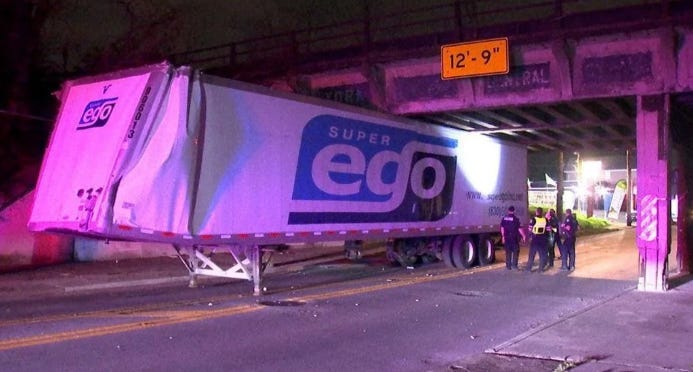
Super Ego Holding LLC is an Elmhurst, Illinois company founded by Aleksandar Mimic, a Serbian immigrant who arrived in this country on an exchange visa and built a freight operation that plaintiffs’ lawyers, insurers, and federal regulators now describe as a web of nominally independent carriers: Floyd, Rocket Expediting, Windy City National Trans, Kordun Express, Rex Trucking, Timeit Logistics, and more. Earlier this year, I took part in a 60 Minutes investigation that didn’t end there but started there, and FMCSA Administrator Derek Barrs came along as well. He said that Super Ego Holding is under an ongoing federal investigation. I’ve spent much of the past year inside the public record on this network. I say network because I believe Mimic baggage is getting him replaced with a younger version within the same network. Same book, modified script, as they learn from the current network’s mistakes and adapt to become more of a political PAC money machine. Political donations tend to right all kinds of wrongs, so I’d say they’re on the right track.
Mimic answered under oath and through counsel. CBS 60 Minutes/Paramount, Freightwaves, etc., and even I got similar demand letters; to my knowledge, we all told them to kick rocks. He says Super Ego Holding is an equipment leasing company, like Penske or Ryder, that owns no operating authority and employs no drivers. He says Floyd has no drivers, so it can’t have driver recruiters. He says the carriers that lease his trucks are independent businesses. At an April 2025 deposition in a driver misclassification case, Aaron Austin v. Floyd Inc., No. 3:24-cv-01214 in the Northern District of California, he told a plaintiff’s lawyer reading Floyd’s own recruiting ad back to him that the lawyer didn’t understand it well. We’re all just dumb Americans who can’t seem to grasp the European trucking business model. Immigrants building trucking businesses in Chicago is a real American story, and most of the people living it run honest companies. The record doesn’t raise the question of whether the story is real. The question is whether the paper matches the trucks and his words.
Insurers answered that question four times. Insurers are probably reading it all wrong too. Four different insurers claiming fraud. What are the odds they’re the ones wrong and not Mimic and Ego? I’ll leave that to you to decide.
Insurer one: AIFE, 2020
On September 11, 2020, American Inter-Fidelity Exchange, an Indiana insurer, sued Mimic personally in the Northern District of Illinois, Case No. 1:20-cv-05394, asking a federal judge to unwind a trucker’s physical damage policy as if it had never existed. Unwinding a policy that way is called rescission, and an insurer only files for it when it believes the application was false. AIFE alleged four material misrepresentations: that Mimic said he’d never operated under another name when he allegedly ran Windy City, Rex Trucking, Rex Trucking Freight, Super Ego Holding, Kordun Express, Floyd, and Time Logistics; that he named no carriers he leased trucks to when he allegedly leased, lent, and exchanged equipment with at least five of them; that he denied ever holding truck insurance under other names; and that his loss history was incomplete. The equipment schedule attached to his application listed more than a hundred tractors valued between $31,000 and $90,000 apiece. That’s a fleet’s asset base declared one truck at a time by a man who says he’s just a lessor.
Seventy-three days later, AIFE voluntarily dismissed its own case with prejudice. One page, no explanation, no settlement terms on the docket. With prejudice means AIFE can never bring those claims again, and it also means no court ever ruled on whether they were true, so I won’t tell you they were. The dismissal guaranteed that no regulator got a referral, no fraud registry got an entry, and the next insurer in line had no way to know any of it happened.
Insurer two: Progressive, 2022
The Progressive record isn’t a lawsuit. It’s an admission on the network’s own paperwork, which is better. Section 17 of the Ohio Automobile Insurance Plan application that Rocket Expediting signed in December 2022 asks for the applicant’s insurance record. The answers Rocket gave: latest carrier, Progressive Preferred Insurance Co.; policy number CA961995574; termination date, December 13, 2022; reason terminated, “failure to provide correct information.”
A major admitted insurer threw the carrier out for misinformation, and the carrier disclosed that fact on a signed application one day later, on a form that carries Ohio’s insurance fraud warning directly above the signature line. The same application lists Nina Dordevic as president with 100 percent ownership and Aleksandar Mimic as secretary, both dated into position November 20, 2020, on a carrier Mimic’s camp describes as independent. The replacement coverage that bound December 14 came through the assigned risk pool at an estimated annual premium of $927,717 against $8.17 million in declared gross receipts, on a policy that scheduled zero owned autos and 71 named operators. By mid-2023, that policy was sitting in cancel-pending status for nonpayment. Assigned risk pools exist so that carriers the market rejects can still meet federal insurance minimums, and every admitted auto insurer writing in the state shares the pool’s results. When a pool risk goes bad, the loss is distributed across the companies that insure you.
Insurer three: North River, 2023
On February 3, 2023, The North River Insurance Company, a Crum & Forster group company, sued Super Ego Holding LLC and United Ego LLC in DuPage County, Illinois, Case No. 2023LA000108. Three counts: statutory insurance fraud under 720 ILCS 5/17-10.5, common law fraud, and a declaratory judgment that four commercial auto policies are void. The mechanics North River alleges describe a system, not a claim. Coverage activated on previously uninsured trucks and trailers after the date of loss but before the loss was reported, so the equipment allegedly got hurt first and insured second. Repair and towing amounts allegedly inflated. Claims allegedly submitted for damage for which no adequate evidence ever existed.
That case is still alive three and a half years in, which makes North River the only insurer of the four that’s still litigating instead of walking. Its most recent turn was an agreed order in which Super Ego gave up the muscle behind its counterclaim and confirmed on the record that it couldn’t identify the people who ran its own claims operation, with the fraud counts heading toward out-of-court discussions. Everything in that paragraph is allegation, not adjudication, and Super Ego contests it. In the interest of full disclosure, I was briefly contacted in 2026 about a consulting role connected to the Crum & Forster side of that litigation; the engagement never proceeded, no work was performed, and everything I’ve written about the case comes from the public court file.
Insurer four: Amlin, 2023
On May 23, 2023, MS Amlin Corporate Member Ltd, the sole underwriting member of Lloyd’s Syndicate 2001, sued Floyd Inc. in the Northern District of Illinois, Case No. 1:23-cv-03253, to rescind a motor truck cargo policy as void from inception. The alleged misrepresentation here is arithmetic. On June 24, 2022, Aleksandar Mimic signed Floyd’s cargo proposal form as president, declaring 12 tractors, beneath a statement warranting that no material facts had been suppressed. On December 16, 2022, Floyd filed its MCS-150 with FMCSA reporting 112 power units. Amlin alleged Floyd operated at least 81 tractors during the policy period and backed it with seven DOT roadside inspections of Floyd trucks that never appeared on any of Floyd’s monthly equipment reports. A 12-truck cargo application and a 112-truck federal filing in the same operating year leave no innocent reading in which both are accurate.
The defendants Amlin named alongside Floyd tell you who gets hurt when this happens. Caterpillar, General Mills, C.H. Robinson, RXO, WestRock, International Paper, Mars Petcare, and other shippers and brokers were dragged into federal court because their cargo claims, roughly $645,000 in the aggregate against a $250,000 per occurrence limit, would evaporate if the policy was voided. Caterpillar’s single claim, $260,897 for a March 2023 loss, exceeded the policy limit. The case ended the way these cases end. Amlin and Floyd reached a private settlement, the court closed the file on August 2, 2024, and no public record shows a referral to any regulator or prosecutor. The allegations were never adjudicated. Two federal rescission suits against this network have now opened and closed without a single regulatory flag that the next underwriter could find, which is exactly how a Lloyd’s syndicate came to write Floyd a cargo policy two years after AIFE’s complaint had already named Floyd in a misrepresentation web.
Why your premium goes up
Insurance fraud gets talked about as staged crashes, and staged crashes are real; federal prosecutors in New Orleans convicted dozens of people for deliberately swerving into trucks, and Los Angeles has run its own versions. Underreporting is quieter and bigger. When a carrier tells an underwriter it runs 12 trucks and runs 112, the premium is priced for 12, and the exposure rides at 112. When the crash comes, and at these fleet sizes it comes, the insurer pays a loss it collected a fraction of the premium for. Insurers don’t eat that. Loss ratios feed rate filings, rate filings feed renewals, and the shortfall gets spread across every honest carrier in the pool and, through commercial auto’s pull on the broader market, into what you pay on your pickup. Assigned risk results are shared by statute across every admitted insurer in the state, so the $927,717 pool policy that went cancel-pending is a loss your insurer helped absorb whether it ever heard the name Rocket Expediting or not. Double-digit commercial auto increases have run for a decade, and mispriced risk like this is one engine behind them. When it settles these alleged fraud cases, that settlement literally draws every paying insured in the market to help pay for those losses.
The captive turn
An operator who burns through the open market has two remaining doors: the state pool, and coverage placed by people who won’t ask hard questions. This network built the second door itself. Illinois Secretary of State records show that Super Ego Insurance Agency LLC was organized in November 2020 by Biljana Mimic, an officer of Super Ego Inc., at the same Bensenville suite the network’s carriers used. In February 2023, the agency was renamed, briefly to Alas Partners and then to Millennium Insurance Group LLC, and Biljana Mimic signed the agency’s January 2026 filing as president. Millennium is an insurance agency, a seller of policies, not an insurance company, and that distinction matters legally. What the FMCSA filings show is that Millennium sits as the retail producer placing coverage across the network’s active carriers, Robert L Gast, Windy City, Prime Route, Timeit, and Floyd among them. The broker that supposedly shops the market for these independent carriers is a renamed entity the founder’s own family organized. When shared policy numbers then show up spanning separate operating authorities, that stops looking like coincidence and starts looking like one insured fleet carved across many DOT numbers, which is the signature of common control that every one of the four insurer files points at.
The risk retention group problem
The paper fronting most of those placements belongs to risk retention groups, and this is the part that lands on you hardest. A risk retention group is a member-owned insurer created under the federal Liability Risk Retention Act of 1981, licensed in one domicile state and allowed to write liability coverage nationwide with almost no oversight from the other 49. The tradeoff Congress built in is the one nobody reads: RRGs don’t participate in state guaranty funds. When a normal insurer fails, the state guaranty fund pays its claims. When an RRG fails, the claims die with it.
Universal Casualty Risk Retention Group is the FMCSA liability filer standing behind network authorities including Prime Route Transport and Xtreme Load, and its own story runs parallel to the carriers it insures. Universal was launched in 2018 out of 380 North Broadway in Jericho, New York, by Timothy Derham, a State Farm alumnus who runs Inter Insurance Agency, the managing general agent that operates the RRG, together with officers of the New York Independent Automobile Dealers Association. It was built as a captive for used car dealers, chartered in Oklahoma in 2016, and its stated book is auto dealers, servicers, and haulers. Oklahoma is the only regulator it answers to, and Oklahoma has been busy. The state’s insurance department signed a consent order with Universal in April 2022, then issued an Emergency Order of Supervision Instanter in October 2023, the step where a commissioner formally takes supervisory control of an insurer it believes is in trouble. Universal and its MGA responded by suing the Oklahoma Insurance Department in federal court in New York in May 2024, a case that was transferred to Oklahoma and closed in 2025, while the commissioner’s own enforcement action bounced through removal and remand in Mulready v. Universal Casualty, No. 5:24-cv-00762 in the Western District of Oklahoma. A dealer captive under emergency supervision by its only regulator spent that period litigating against the regulator while continuing to file federal liability certificates for trucking companies.
The current and past book shows what that dealer captive became. FMCSA insurance filings show 2,728 active motor carriers holding their federal liability filings through Universal, covering more than 16,000 power units, with aggregate filed liability limits above $2.1 billion, the large majority at the $750,000 federal minimum. The geography is a trucking map, not a dealer map: 674 carriers in California, 251 in Texas, 214 in New Jersey, and a 98-carrier Illinois cluster centered on Chicago, Schaumburg, Naperville, Aurora, and Joliet. More than half the book holds authority granted since 2021, and 497 of the carriers got their authority in 2025 or 2026. My tracking of the Super Ego network across 23 or more DOT numbers, built from FMCSA inspection and crash data, counts more than 897 crashes and 19 fatalities, with out-of-service rates roughly double the national baseline. The liability paper behind a meaningful share of the nation’s newest, highest-risk carriers is issued by a member-owned insurer that reported roughly $15.5 million in surplus this spring, operates under one state’s oversight, spent 2023 through 2025 fighting that state, and carries no guaranty fund behind any of it. That’s scary. It’s scary because a cash-strapped insurer is backing the liabilities of some of the highest-risk carriers in the country.
When that paper fails, a family with a wrongful death judgment collects nothing. The medical bills, the rehabilitation, the lifetime care for the survivor who can’t work again get picked up where uncollectable catastrophic costs always land, on Medicaid and Medicare, which means on the taxpayer. A judgment against an empty pocket is a promise from an empty pocket, and the public makes good on it whether the public voted to or not. The mass litigation now running against this network and the broader Chicago-area ecosystem around it- driver misclassification classes, injury suits, insurer fraud actions- is in part a fight over who ends up holding those empty promises.
What should happen
The fixes don’t require new law. Underwriters writing trucking should pull UCC lien records for co-debtors the way they pull loss runs, because the co-debtor web is the affiliation disclosure the application never makes, and they should read the FMCSA insurance history of an applicant’s whole network rather than one DOT number, because insurer churn across affiliated carriers is the descent pattern in motion. Illinois’ insurance fraud statute, 720 ILCS 5/17-10.5, carries referral mechanisms insurers can invoke instead of settling into silence, and an industry that built a shared claims database for personal auto decades ago has no excuse for lacking a shared record of commercial rescission actions and misrepresentation terminations. Progressive documented in 2022 exactly what Amlin discovered at its own expense in 2023, and nothing in the system carried the information across. Domicile state regulators should be matching RRG officers and producers against the federal carrier census, because for these insurers, they’re the only regulators there are. Four insurers already did the investigative work at their own cost. The record they built is public, and until somebody in a position of authority acts on it, the losses keep flowing downhill to the one party that never signed any of these applications: you.
Every fact in this piece comes from public court records in the Northern District of Illinois and the Northern District of California, DuPage County court files, Illinois Secretary of State filings, FMCSA insurance and inspection data, and documents filed in public dockets. Allegations are identified as allegations, and no court has adjudicated fraud against any party named here.
Excellent. Really enjoy your work.
This is a fantastic piece. Eye opening. Well done.