

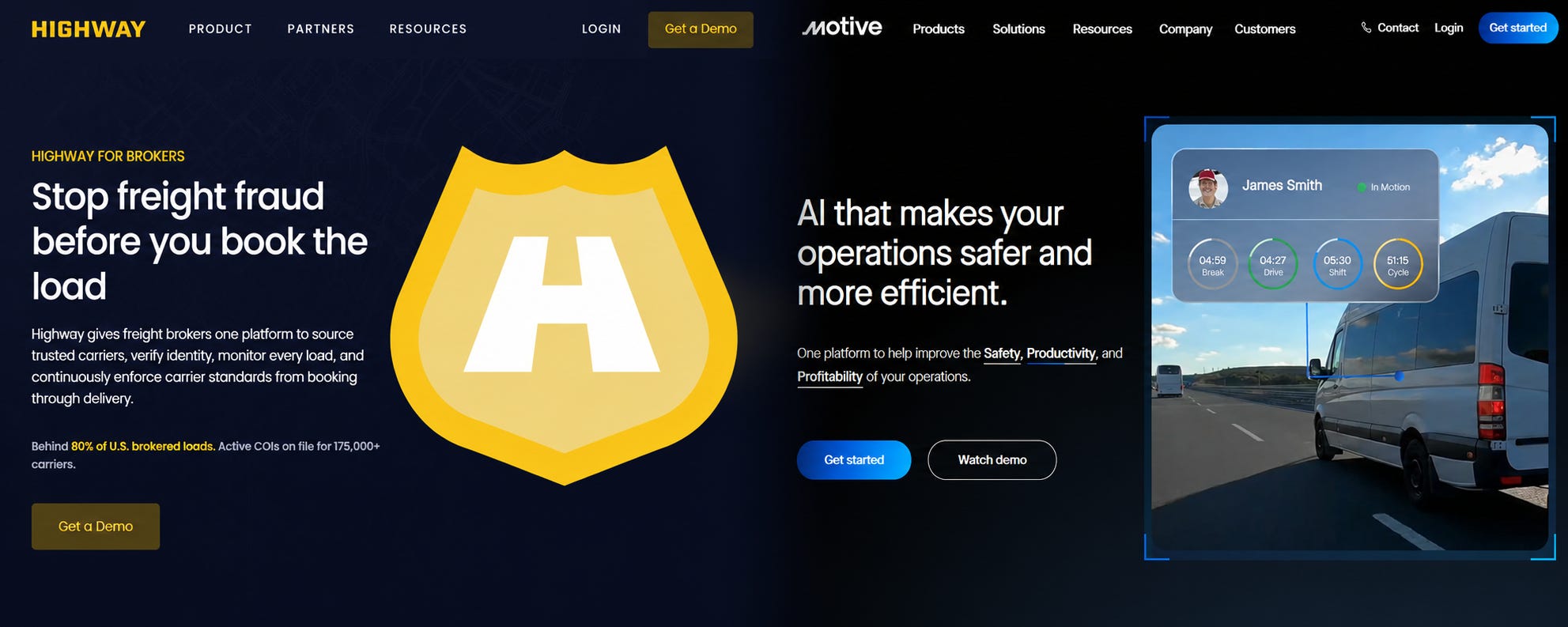
Imagine you own a house. You spend your life paying it off. You let someone live there for free; you even pay their bills. Then you hire a property manager who says, “Hey, maybe we should at least get them to pay their own water bill.” The tenant says, “Absolutely not. I’m only willing to take out the trash once a week, and I stay.” I’d feel ashamed for mooching off the homeowner. That’s what happened this week between Highway and Motive, and the tenant wrote a letter to the whole neighborhood complaining about the landlord.
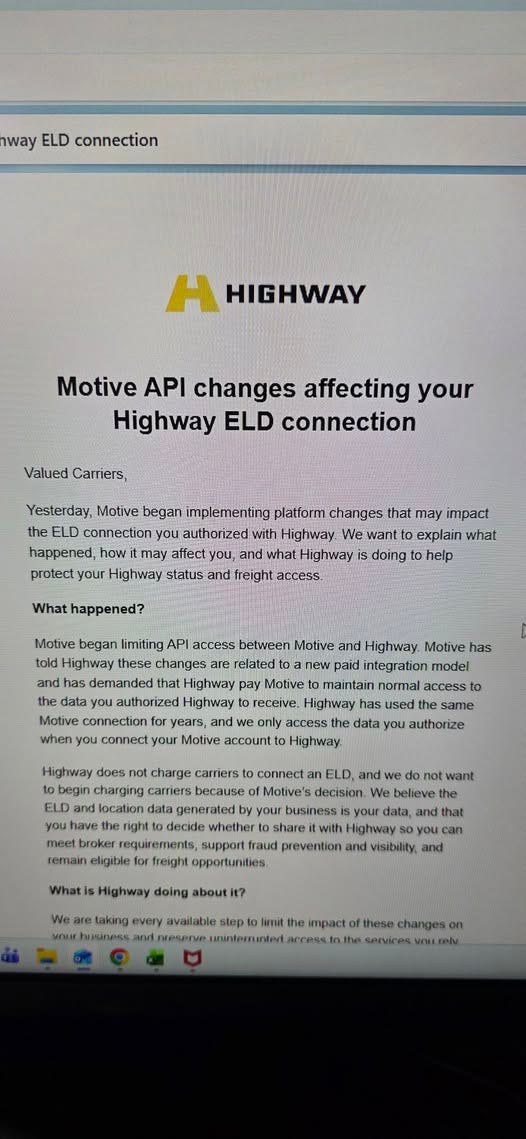
On Wednesday, Highway emailed its carrier network under the subject line “Motive API changes affecting your Highway ELD connection.” The letter says Motive began limiting API access between the two companies, tied the change to a new paid integration model, and demanded that Highway pay to maintain normal access to the data carriers authorize Highway to receive. The letter also admits, almost in passing, the fact that matters most: Highway has used the same Motive connection for years. Years of data at no cost, feeding a verification product that brokers pay real money for. Highway built an engine on data it pays nothing for, generated by infrastructure Motive builds and carriers fund. Motive asked for a fraction of that. The response was a letter telling carriers their freight access is at risk. Holding carriers hostage in a vendor dispute is every bit as shameful as milking the data for free, and Highway managed both in the same week.
Craig Fuller called it a dumb business decision by Motive and predicted churn ahead of Motive’s IPO, disclosing his Motive shares in the same breath, which is more than most commentators bother to do. His follow-up sharpened the argument into pure switching-cost math: investors care about install base and retention, fleets hauling broker freight will leave Motive because Highway’s network powers a huge share of brokerage, and swapping ELD providers costs less than going dark to most of the brokerage community. Read that argument again and notice what it concedes. The entire case for Motive losing rests on Highway’s willingness to cut carriers off from freight over a bill between two vendors. That’s not a defense of Highway’s position. That’s a description of a hostage situation, offered as evidence the hostage-taker will win. Money always wins, Craig says, and Highway sits closer to how carriers get paid. Maybe so. Sitting closest to a man’s paycheck is exactly why you shouldn’t use it as leverage. That’s a terrible look, and once the shock value fades, this will prove a bad strategy as carriers realize Highway is holding them hostage to make millions off whether they go to work or not just so they can get free data.
What it costs to make the data Highway sells access to
The word “data” makes this sound weightless, like it falls out of the sky and lands in an API. It doesn’t. Every record Highway uses to verify a carrier’s equipment starts as a physical event on a physical truck. A vehicle gateway hardwired into the ECM captures engine hours, VIN, odometer, and location. Motive leases that hardware to fleets at no upfront cost, which means Motive eats the hardware economics to get the device in the truck. The device transmits over cellular, every truck, every day, and somebody pays the carrier bill for a base of over a million registered drivers across more than 60,000 carriers, which are Motive’s own published numbers. That stream lands in cloud infrastructure built to ingest it at that scale, gets cleaned, normalized, matched to the right vehicle and the right carrier, and served back out through an API with documentation, uptime guarantees, and engineers on call when it breaks.
Raw telematics is ugly. Turning it into something a vetting platform can query in real time to confirm that a specific truck under a specific DOT number is where the carrier says it is, that’s product work, and it’s expensive product work. Motive built the well, laid the pipe, and pays the water bill. The industry calls that API infrastructure, and maintaining one at scale is a permanent engineering cost, not a one-time build. Highway connected to that pipe, made the connection mandatory for its own product, and sold the output to brokers on subscription. For years, by Highway’s own letter, the amount flowing back toward the people producing the data was nothing.
I’m not anti-Highway, and you need to understand why that matters
Anyone who’s read my work knows I’ve spent years documenting chameleon carriers, authority reincarnation, double brokering, and the fraud networks that treat FMCSA registration like a costume change. Vetting platforms are one of the few forces that have actually squeezed those operators. As recently as last week, I watched influencer accounts, some of them cozy with the exact bad actors I write about, campaigning for Highway and every other vetting platform to be pushed out of the market entirely, because verification was causing “undue stress” on carriers. It was stressing the carriers it was supposed to stress. That campaign told you everything about who fears verification and why, and I said so then, and I’ll keep saying it now.
The results are on the rate board. Spot rates hit an all-time record of $3.83 a mile in early June, above even the COVID peak, with spot pricing running over contract for the first time since 2021 and tender rejections at their highest since 2022. ACT Research put aggregate spot rates up 43 percent year over year in June, excluding fuel, and pointed to capacity contraction, enforcement, and the difficulty of keeping marginal operators in the market. Some of that is FMCSA enforcement, and some is economics, but part of it is that verification finally works well enough that the worst capacity can’t hide. For the first time in my working life, being a compliant, safe, verifiable carrier is itself the commodity. A clean record and a real risk profile are getting drivers and small fleets paid more than they’ve ever been paid, because freight that used to leak to fake carriers and stolen identities now has to clear through legitimate trucks. Highway helped build that; I won’t pretend otherwise, and I won’t join the crowd that wants to burn down the vetting layer.
Supporting a company doesn’t mean supporting everything it does, and it never should. I have people in my life I like and work with daily, and some days I still look at them and ask if they’re all right in the head. No person, no product, no vendor earns hundred-percent agreement, and demanding that kind of loyalty from your audience is how this industry ends up with cheerleaders instead of analysts. When someone you generally back fouls up, the honest move is to say so out loud. This is one of those spots.
The leverage everyone is misreading
The churn math cuts the other way. Motive claims 60,000-plus carriers and over a million registered drivers, heavy in the owner-operator and small fleet segment Highway’s broker customers actually book. After the Supreme Court’s Montgomery v. Caribe decision opened brokers to negligence liability in state courts, Highway made ELD connections mandatory for carrier identity verification, and Overdrive’s reporting found the wrong ELD or a missing connection is now the top reason owner-operators get denied freight through vetting platforms. Pull Motive’s pipe out of that, and Highway can’t deliver the product brokers pay for, because you can’t vet a carrier with data you don’t have. That’s not a churn risk for Motive. That’s an existential input problem for Highway.
The exits only run one direction too. FMCSA isn’t rubber-stamping new ELD vendors; the agency spent this year revoking noncompliant devices from its registry and ordering carriers back onto paper logs while they scrambled to replace them. Nothing comparable stands between Motive, Tenstreet, or countless other data holders and a vetting layer of their own, and Tenstreet is already in that market with a free product. It’s a lot easier to become a vetter than an ELD provider. The companies that build the hardware, pay for the telematics infrastructure, and generate the data hold the cards, not the company reselling access to it. If this drags on, the ending isn’t Motive bleeding carriers. It’s data holders deciding verification is worth keeping in-house, and every ELD and telematics vendor in the country is watching how this resolves before sending Highway an invoice of their own.
The carrier replies under Fuller’s post tell you the split is real. Some say they’d drop Motive tomorrow because Highway is the only door to their brokers. Others say they never wanted their data flowing to Highway in the first place and only connected because brokers made it a condition of getting loads. One called the speed and scale of Highway’s market power impressive and scary in the same sentence. When your leverage over an entire segment of the industry comes from carriers who connected under duress, you should think hard before reminding them of it in writing.
Motive didn’t make a decision here, and that framing matters. Motive asked to be paid for work it already performs: harvesting raw machine data off a million trucks, articulating it into something usable, and delivering it reliably enough that an entire verification industry got built on top of it. We worked, you profited, we should get paid. Asking to be paid for work that makes another company millions isn’t extraction, and it isn’t a strategy blunder. It’s an invoice.
The one-sentence fix
Highway’s cheapest move was never a pressure letter routed through carriers. The reason this fight is avoidable is blunt: everything Highway needed to say fits in one sentence. They’re right: we monetize this data, we should help pay for the cost of producing it. That sentence costs Highway some margin and zero credibility. Highway decided they’d rather run a pressure campaign through carriers instead, and that decision tells you exactly how good the free-rent arrangement was. Highway told Overdrive last year it only receives ELD data with carrier authorization and never accesses it without approval, and I take them at their word, and it’s beside the point. Consent settles who may see the data. It doesn’t settle who paid to create it.
So with tech vetters out, does that mean Carrier411 remains the vetter of choice from brokers? Tenstreet is entering this market. Genlogs is also. Garrett Allen and Searchcarriers. I even have a platform the FMCSA uses, along with Genlogs and Bluewire. The field of vetters is populated. They're not making more ELD vendors anytime soon.
I believe people should be paid for what they produce, and I believe it’s harder when what they produce makes someone else rich. That principle doesn’t bend because the producer is a well-funded ELD company instead of a driver, and it doesn’t bend because the consumer is a vetting platform I generally support. The free-rent game has been the quiet business model of half this industry for years: everyone monetizing everyone else’s work while insisting their own work deserves revenue. Highway can end this game in a single paragraph. Whether they do will tell carriers more about the company than any letter about API access ever could.