

The electronic logging device was supposed to end this. Congress mandated it, the agency built the rule around it, and the pitch was simple: hard-wire the truck to the hours so a driver could no longer run two…or five…sets of books. No more paper logbook in the glovebox and a second one under the seat. The machine is the source of truth.
A cache of internal records from an operation that called itself, among other names, the Log Office shows how that promise has been gamed. The records run for well over a year, from late 2023 into 2025, and they read like a help desk. Except the help being offered is the quiet erasure of federal violations in real time, for a monthly fee, across a stable of brand-name ELDs that get swapped out like burner phones whenever one gets caught. Chameleon carriers and chameleon ELDs, it’s all in the identity.
I have spent a quarter century around this industry as a driver, a broker, a fleet owner, an executive, and an expert witness who reconstructs the wrecks that bad logs help cause. I’ve carried five logbooks, running reefer freight up and down the East Coast, and have seen log fraud throughout my career. I have never seen it industrialized like this. This is a business.
The help desk
Strip away the brand names, and the operation works like a subscription service. A carrier signs its trucks onto one of the ELD apps. The driver gets dropped into a chat. When he runs out of hours, he asks for more, and somebody on the other end makes them appear.
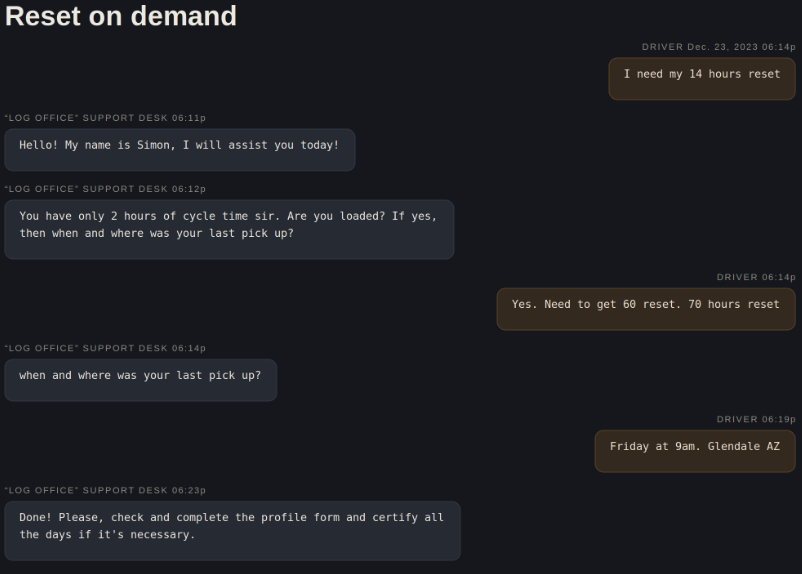
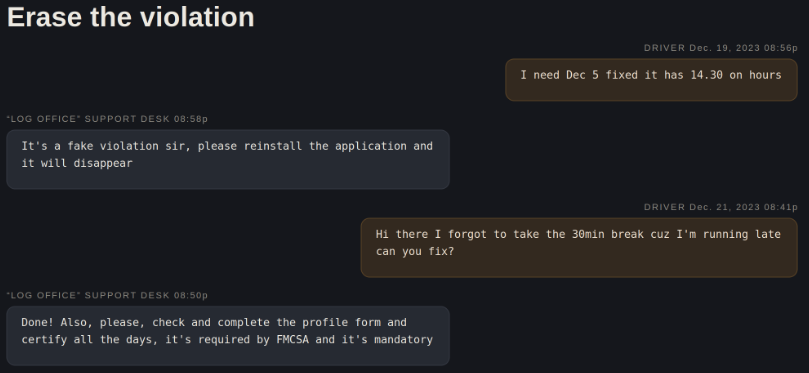
“I need my 14-hour reset.” “70 hours reset.” “Need to get 60 reset.” “Hi there I forgot to take the 30min break cuz I’m running late can you fix?” The answer comes back the same way over and over, in lightly broken English from a rotating cast of first names: “Your request is done! Please log out/log in.” And then, every single time, the tell. “Also, please, check and complete the profile form and certify all the days, it’s required by FMCSA and it’s mandatory.”
The same desk rewrote a driver’s duty status to wipe out a violation, then turns around and instructs him to certify the falsified log as accurate, invoking the federal agency by name in the process. The compliance language is part of the cover. A clean record that has been hand-edited to stay clean is worth more than a messy one, because the clean one survives a roadside inspection and a post-crash subpoena.
When a real violation surfaces, the desk has a script for that too. One driver flagged his log. The reply: It is a fake violation. Reinstall the application, and it will disappear. Thats not tech support. Those are instructions for destroying evidence on a federally mandated recording device.
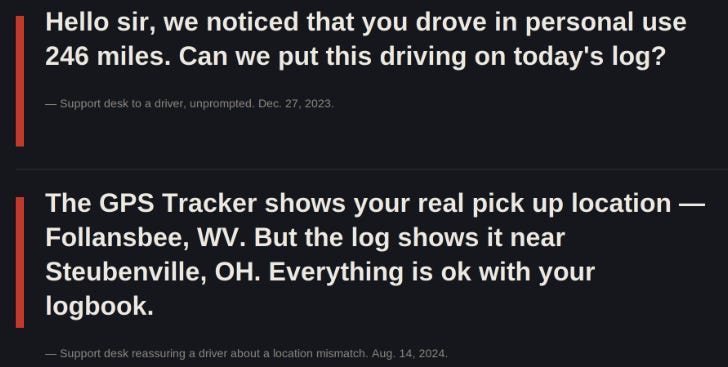
The location records get the same treatment. In one exchange, the desk reassures a driver that although the GPS shows his real pickup in Follansbee, West Virginia, the log will read a few miles off near Steubenville, Ohio, and that he should not worry about it. There is a message that walks drivers through how the app “automatically” adds an hour during the daylight-saving transition, language designed to explain away a log that runs past 24 hours in a day. There is even a note offering to move 246 miles a driver ran under personal conveyance onto his on-duty log, the manipulation running in both directions depending on what the driver needed that day.
There is the matter of names. One driver, hired under his own name but uneasy about a group chat tied to his real identity, asked that the channel be named after his company instead. The desk told him no, it would stay under his name, because this was internal communication. The drivers understood, on some level, that they were inside something they did not want their fingerprints on.
The brands are disposable. The White label is already set to go.
The operation ran on a rotating stable of ELDs. The records reference Phoenix, Robinhood, Action, Ironman, Red Fox, Extreme, and Dragon, along with a monitoring layer branded Log365 and an administrative back-end portal called Fortex. The same handful of support accounts move between the brands. The same customer support number, 815-900-2052, appears across years and apps. A separate RingCentral line is logged under the name Log Office. Telegram, Signal, RingCentral… It’s like the coding machines the Nazis used in Germany, but in trucking, 2026.
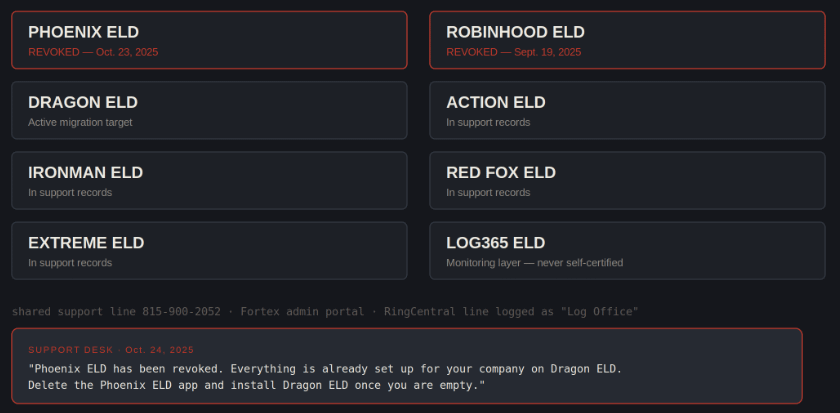
The brands are interchangeable by design, and the records show why that matters. In one message, a carrier is told that Phoenix has been revoked, that everything is already set up for the company on Dragon, and that all the driver needs to do is delete the Phoenix app and install Dragon once he is empty. No interruption. No lost data. Same back office, new label.
That is the whole trick. When the Federal Motor Carrier Safety Administration revokes one device, the network doesn’t shut down. It migrates its carriers to the next brand on the shelf and keeps editing logs without missing a day. The revocation that is supposed to be a death sentence becomes a name change.
The public revocation bears this out. FMCSA removed Robinhood from its registered devices list, effective September 2025, with enforcement of out-of-service status beginning that November. It removed Phoenix from the list in October 2025, with enforcement beginning that December, and Administrator Derek Barrs tied the action to the agency’s push to clear non-compliant devices off the road. Both of those brands appear throughout this cache. Others in the same stable remain registered. The agency knocks one down, and two are still standing, because the people behind them registered more than they needed. Literal wack-a-mole, and these chameleon ELD services are used by equally chameleon carriers, often originating from the same countries. Many use the same ghost agent services based in mailbox stores in states like Wyoming, so when litigation comes, they can’t be served. There’s no one to serve.
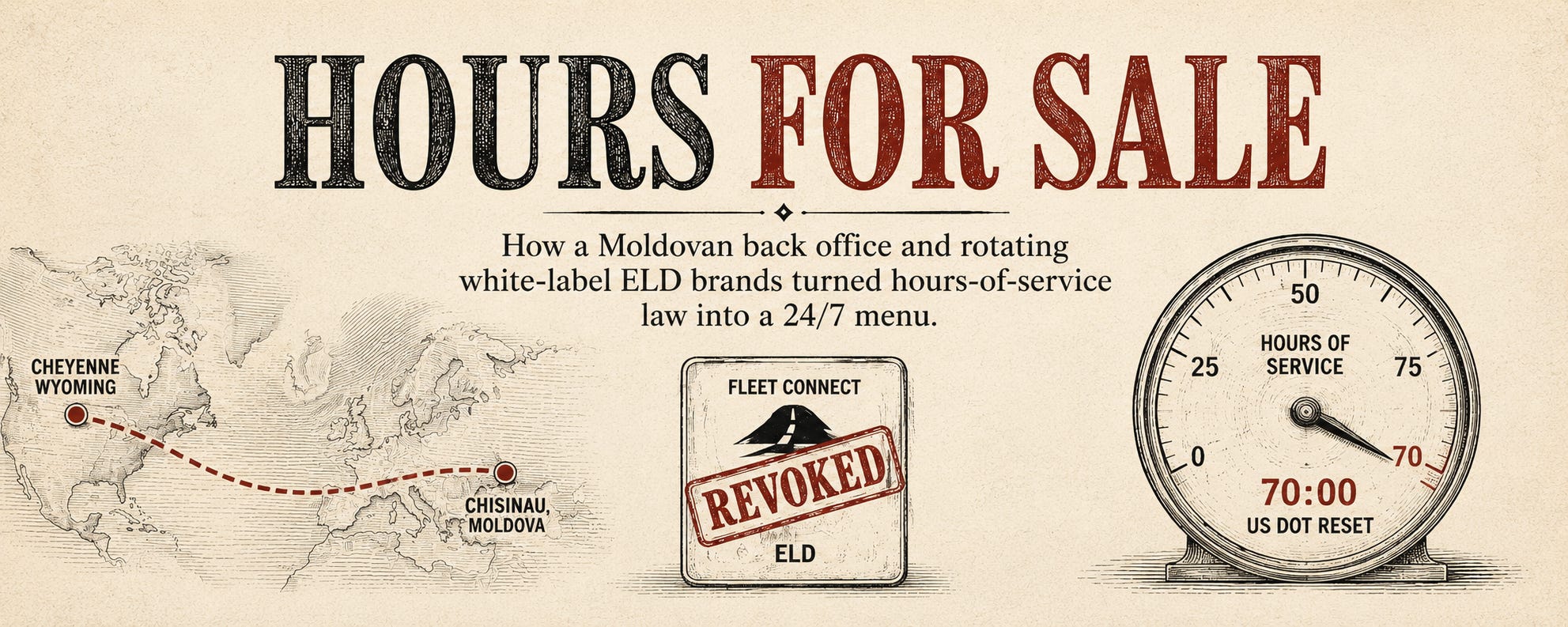
Cheyenne by way of Chișinău
Follow the paper and the operation does not live in Wyoming, where it claims to, or in any cab in America. It lives overseas. The corporate documents in the cache center on Workspace Holding LLC, registered to a suite address at 1740 H. Dell Range Blvd #281 in Cheyenne, Wyoming, and managed by a man named Radu Murzac. Two memoranda dated Jan. 3, 2022, spell out the structure. Workspace Holding is named as the issuer and owner of the software and IT systems. It names TMS One LLC as its parent. It grants the right to operate, access, administer, and maintain those platforms to a beneficiary on the other side of the world: Data Drive SRL, a limited liability company with an office at Calea Orheiului in the Rîșcani district of Chișinău, Moldova, administered locally by Ion Borozan.
A Wyoming shell holds the brand and the code, a US-facing parent sits on top of it, and the actual hands on the logs belong to a company in Moldova. The Cheyenne address is a mail-drop front for an editing operation run out of Eastern Europe. That’s why the support chatter in the deeper layers of the cache slips into Russian and Romanian between the English-language driver messages, and why the dispatch coordination references a Serbia-based outfit. The people resetting American drivers’ federal duty status are not in America, and they are not subject to a subpoena that lands in Cheyenne.
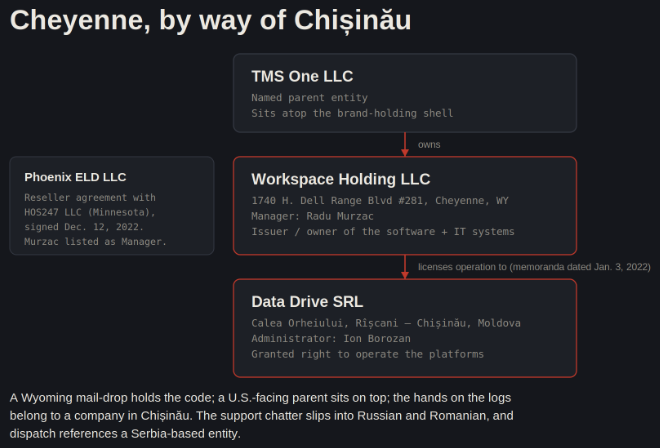
The same Radu Murzac appears on a separate, very ordinary-looking commercial document: a managed-services reseller agreement between Phoenix ELD LLC and HOS247 LLC, a legitimate Minnesota ELD vendor, signed Dec. 12, 2022, with Murzac listed as Phoenix’s manager. The network plugged into a real, registered platform as a reseller while standing up its own brands on the side. The legitimate rails and the fraudulent service desk were never as far apart as the org chart pretends. Ironically, he’s the same guy who developed ELD One, the ELD Super Ego entities of all brands carry the door sticker for.
The carriers and the drivers who talked
A scheme like this needs carriers willing to put their trucks on it, and the cache is full of them. The driver-intake messages read like a dispatch board: small carriers and their drivers handed off one after another, connected to a device, folded into the monitoring chats. The names that recur most belong to Extra Mile International, but the roster around it runs deep, a long list of one-truck and small-fleet LLCs whose drivers show up asking for hours and getting them.
Extra Mile is also where this stopped being a private data dump and became a court case.
In the Circuit Court of Cook County, Illinois, former drivers have sued Extra Mile International, alleging the fleet ran exactly the kind of hours-for-hire operation these records describe, using now-revoked ELDs to keep duty status pristine while drivers ran past their legal limits. The drivers’ filings include sworn declarations from roughly half a dozen former employees describing a Telegram group chat where extra hours could be added on request. According to the court reporting, the drivers’ lawyers established that Phoenix was linked to nine other ELDs that shared the same Cheyenne principal place of business and were organized by the same person.
What happened next, every fleet lawyer should read. In May 2025, the court ordered Extra Mile and Phoenix to preserve all hours-of-service records and the Telegram discussions about them. Extra Mile’s counsel responded that it could not preserve the records, because use of the Phoenix platform was governed by a license under which Phoenix was the sole owner and controller of the system, including any Telegram-based messaging inside the app. In other words, we cannot hand over the logs because the foreign company that edits them owns them, not us. Counsel also stated that the messaging was outsourced to a Serbia-based entity and that no one associated with the fleet was aware of any deletion.
In a deposition, the fleet’s managing partner was asked whether the monitoring company had access to modify or falsify the driver logs maintained on the carrier’s behalf. His answer, per the transcript, was that he did not know. Asked whether he could even deny that the company had that access, he could not. Asked whether he was surprised to be getting the log-monitoring service for free, he said he did not recall being charged. The fleet has faced a contempt posture for failing to produce the records. The structure that makes the fraud durable, foreign ownership of the data, a mail-drop in Wyoming, a license agreement that parks control offshore, is the same structure that makes it nearly impossible to claw the evidence back in discovery. That is not an accident. That is the design.
Why a fatigued driver is the real product
It is easy to read all this as paperwork crime, a victimless dodge to make a delivery window. It isnt.
Hours-of-service limits exist because a tired driver behind 80,000 pounds is a loaded weapon. Every “reset” sold in these chats put a driver back on the road who federal law said had to be parked. The clean log is not the point. The clean log is the alibi. When one of these trucks finally hits something, the falsified record of duty status is the first thing the carrier’s lawyer reaches for to prove the driver was rested and legal, and it is the thing that has to be torn apart, log edit by log edit, to show a jury what actually happened. I have done that work. The difference between a real ELD and one of these is the difference between evidence and a costume.
Safety is one concern, but the financial undercutting of honest, compliant, and safe American carriers is another concern. Having drivers who run two or three times as many hours increases cash flow and can lead to reduced per-mile costs and lower overhead costs. These bad actors are gutting the industry and every legitimate carrier out there, and making it harder for the compliant carriers to compete.
The timing here is its own kind of bitter. FMCSA spent this past year stripping genuinely useless paperwork out of the rules, and good for the agency that the in-cab manual and the redundant forms needed to go. The same self-certification model that lets a vendor place a device on the federal registry by simply attesting to compliance is the exact hole this network drove through. You can register a brand on an honor system, run it as a log-editing desk out of Moldova, get revoked, and have the next brand already certified and waiting. Robinhood never even fully cleared the bar, and it still booked carriers. The front door was wide open.
To its credit, the agency has started slamming it. FMCSA has purged dozens of non-compliant ELDs from its approved list and blocked hundreds more from self-certifying, and Barrs has promised tougher device vetting in future rulemakings. The MOTUS registration overhaul is built to catch shared addresses and common ownership at the point of registration, which is precisely the signature this operation throws off: ten brands, one Cheyenne suite, one manager. Catching that pattern at the registry instead of after a wreck is the entire ballgame.
Vetting the device is only half of it. As long as a foreign back office can own the data, control the app, and hide behind a license agreement, the carrier that signed up gets to claim it cannot produce its own drivers’ logs, and the people doing the editing stay beyond the reach of an American court. The fix is not one more form. It is treating the falsification of a federal record of duty status as what it is, and following the ownership all the way back to wherever the hands on the keyboard actually are.
Where brokers sit in this mess
The spot market broker system produces an absolutely toxic carrier pool. The bottom feeders of the industry. The Chameleons.
The US freight economy has been systematically rewarding the cheapest possible transaction for a decade, and an industry structure has converted almost every accountability mechanism into a checkbox. To understand where we are, you have to trace the full chain, from the consumer buying cheap goods and expecting free delivery, to the broker sourcing the cheapest possible carrier for the freight, to the carrier that can only afford to haul at that rate because it has compressed every cost including safety, to the bond that runs out at claimant 23, to the Supreme Court case awaiting a decision that will tell us whether anyone in the middle of that chain has to answer for what happens when the truck crashes.
A decade of ultra-cheap imported goods conditioned millions of American consumers to expect products to cost almost nothing and to ship for free. Large retailers with enormous logistics leverage drove shipping costs as close to zero as possible at the consumer-facing level, suppressing the market signal that tells the supply chain that moving freight over long distances costs real money. When that signal is suppressed at the consumer level, it is suppressed everywhere downstream. Shippers negotiate accordingly. Brokers find carriers accordingly. Carriers bid accordingly.
Analysis of carrier history data for CH Robinson and Total Quality Logistics, the two largest freight brokers in the country, covers 1,730 carriers across the two datasets. This is what that data shows.
CH Robinson manages 37 million shipments annually and works with 450,000 contract carriers, according to its own description. The TEA carrier history dataset documents 923 carriers with inspection records in the system. Of those 923 carriers, 30 had fatal crashes in the past 24 months, producing 46 fatalities. Seven hundred of 923 carriers (76 percent) have never received an FMCSA safety rating because they have never been subject to a compliance review. 132 have vehicle out-of-service rates at or above 50 percent. 74 have driver OOS rates of 50% or higher.
TQL’s carrier dataset covers 807 carriers. Seven had fatal crashes in 24 months, producing 18 fatal crash events and 18 confirmed fatalities. Eighty-five carriers had at least one crash. Ninety-one percent of TQL’s carrier base, 731 carriers, have never been rated by FMCSA. 143 have vehicle OOS rates at or above 50 percent. 154 have driver OOS rates at or above 50 percent. TQL has 44 carriers in its documented load history that carry an authority transfer flag in cross-reference analysis, indicating patterns consistent with a prior entity operating under a new identity. That is more than seven times the six authority transfer flags in CH Robinson’s carrier base and represents a significant concentration of chameleon carrier risk inside a single broker’s documented carrier pool.
In CH Robinson’s carrier history, Twin Carrier LLC out of Georgia, DOT 3518735, has had 62 crashes in 24 months, two of them fatal, two people dead. Three simultaneous SMS alerts. Unrated. $1,000 coverage, canceled. Also in CH Robinson’s carrier history. Twin Carrier is the primary and one of the oldest Super Ego network carriers, which also has two wrongful death murder cases pending in Pennsylvania and Ohio by two different drivers.
Koleaseco Inc., out of Michigan, DOT 667715, carries 13 crashes in 24 months, one of them fatal, with four people killed in that single crash event. Rated satisfactory on a prior review from FMCSA.
Clement Transport LLC, out of New Jersey, DOT 3371628, has had 20 crashes, one fatal, two people dead. One hundred percent Hazmat OOS rate, 24% driver OOS rate, and a 38% vehicle OOS rate, meaning every driver this carrier has had pulled from the road during roadside inspection. Every single one was put out of service after a hazmat inspection. Also in CH Robinson’s carrier history.
Cobra Inc out of Pennsylvania, DOT 3525693, 30 crashes, one fatal. Unrated. The insurer listed is Universal Casualty Risk Retention Group, a risk retention group that is a systemic concern in the commercial trucking insurance market. An RRG insuring a carrier with 30 crashes.
Contract Freighters Inc., out of Missouri, DOT 70289, is one of the larger operations in the dataset with 104 crashes in 24 months, four of them fatal, four dead. A satisfactory safety rating.
There is a mechanism that makes all of this possible, and the legal question that determines whether it changes remains open. In most pre-Montgomery/SCOTUS spot-market brokerage operations, verifying a carrier for a load typically follows this process. Confirm the DOT number exists in SAFER. Confirm the MC number is active. Confirm that a certificate of insurance is on file. Confirm they’re not rated Unsatisfactory or Conditional by FMCSA. That is it for many operations. It checks that the carrier is technically permitted to operate, which is a different thing entirely from checking whether the carrier is safe to operate, ensuring your carrier’s freight arrives safely at its destination. There’s also the fact that a large portion of US carrier fleets have no rating at all and remain “unrated.” For most brokers, when selecting a carrier for a load, a rating and an authority that can be purchased for as little as $1,200 are good enough. A carrier can pay $300, rent a rental truck, get some self-attested, non-underwritten, instant issue coverage, and you’re a trucker.
The reason this three-box process is standard in much of the spot market is exactly why the Supreme Court ruled how it did.
The Log Office, chameleon carriers, and chameleon ELD providers all figured out that the cheapest thing in trucking is a new name. Brokers had optimized the selection of cheaper carriers as standard practice. The drivers who are put back on the road at hour 15 are the ones who pay for it, and the compliant carriers are the ones who pay for it.
You could kill most of this by reverting to paper logs, because most of the drivers having their ELD edited are illiterates and functionally retarded. They could never get away with this on paper.