

Alvys recently launched its AI agent platform, and its founder retold his origin story. The version in the state registries and court records tells it a little differently.
On January 22, 2014, a man filed Articles of Organization with the Colorado Secretary of State from an apartment on West 88th Avenue in Thornton, listing himself as organizer and registered agent. The name on the file reads Darmanchev, Nick. The company that the filing created would move ninety million dollars a year in freight by its own account, spin out a software platform that has since raised $77 million in venture capital, and this week that platform, Alvys, launched an AI agent product called Foundry to considerable attention. The founder, who now signs California paperwork as Nick Darman, marked the launch by telling his origin story in an interview. He’s told it before, at conferences and on podcasts, and the tellings agree on the arc: a kid who dispatched trucks, built a brokerage, felt the pain of bad software, and built better software. The tellings don’t agree on the dates, and none of them names the brokerage.
The recent version goes like this. He started a trucking company in 2004 while studying at Georgia State, spent a few years at J.P. Morgan, and came back to trucking in 2010 with a small fleet of ten to twenty drivers. Then came the moment that now supplies Foundry’s flagship use case: drivers and owner-operators, he said, were running freight under his signs and his authority without his consent, piling up violations under his name, and he learned about it only when, in his words, “the DOT knocked on my door for an audit.” That experience led to the product pitch. Federal safety data, he argues, doesn’t reflect how safely small companies run; big fleets pay staff to watch the federal record daily and dispute errors in real time, and Foundry gives small carriers an AI agent to do the same watching for a fraction of the cost.
The story deserves a fair hearing, and parts of it hold up well. Unauthorized use of a carrier’s signs and DOT number is one of the oldest frauds in this industry; I’ve documented versions of it for years, and a small operator discovering it during a federal audit is exactly how it tends to surface. A lot like the cloned truck that runs as a clone until 30 tons of cocaine or 30 migrants are found in the back of it. A tool that watches a carrier’s federal record and flags entries that don’t match the driver roster is a legitimate product aimed at a legitimate problem. (I know because I built this and used it to bid on CPDP challenges with FMCSA.)
The family behind the story really has run trucks across ten states for two decades, the brokerage really did scale, and the software really did spin out and attract serious investors. Not every immigrant family that drives trucks builds a $77 million software company. Most don’t. Nothing that follows disputes the product or the work.
What follows is the record around the story. The origin story now exists in at least three versions. This week’s interview says the company was founded in 2004, with a return to trucking in 2010. A conference speaker biography says he dispatched for his dad’s family-owned trucking business during college and established an asset-based brokerage by 2014. Alvys’ own corporate history says the brokerage came in 2014 and leaves it unnamed. Three tellings, three timelines, no company names. The registries have the names.
The family’s federal footprint runs back twenty years. Nikolay Darmanchev holds DOT 1057164, registered in Warrington, Pennsylvania. Mariya Darmancheva holds DOT 1188803 at 6075 Standard View Drive in Duluth, Georgia. That Duluth address isn’t a terminal or a truck yard; it’s a single-family house in a Johns Creek subdivision, sold in October 2023 for $825,000. The same address anchors CDI Logistics LLC, DOT 1197492, a Georgia carrier operating under Nikolay Darmanchev that federal regulators ordered off the road on September 7, 2011, with an Unsatisfactory safety rating and two crashes on its record. An out-of-service order with an Unsatisfactory rating is the government shutting a trucking company down. The interview’s timeline puts the founder back in trucking in 2010, with the audit knock coming about a year later. September 2011 falls one year later. The story says the auditors came about the DOT number, and the public record shows no motor carrier registered to Nick Darmanchev in that window at all.
The pattern is shown in the dates. On June 16, 2011, he formed a new trucking company, Akindorf Auto Transport, in Aurora, Colorado. Eleven weeks later, the federal order landed on CDI in Georgia. A new authority stands up as the old one goes down: same operator, same freight, fresh paper, and that’s the signature of a chameleon carrier. Akindorf Auto Transport never went away. DOT 2164528, authorized to operate, insured today by Berkshire Hathaway Homestate, three trucks and four drivers on file, verified this morning. Its docket, MC752090, was granted, then involuntarily revoked, then granted again, then involuntarily revoked again, and FMCSA reports no MC number for it now. A live DOT with dead authority under it is the seam a compliance review is built to catch, and it’s been sitting open on his oldest surviving company. And DOT 1057164, registered to the literal name Nikolay Darmanchev, is authorized to operate today too.
The brokerage, every telling leaf unnamed has a name and a paper trail. The Thornton filing created Archer Atlantic Global Logistics LLC. Eighteen months earlier, in June 2012, he incorporated a company called Archer Atlantic Freight Inc. in Illinois, which dissolved in November 2014, ten months after the Colorado company opened under the same name across a state line. A trade-press profile in December 2019 described the Colorado company as ArcherHub, a Denver digital freight broker whose matching algorithm worked around the clock and was backed by a fleet of its own tractors. On March 2, 2020, an amendment in the same Colorado master file formally renamed the entity ArcherHub. That July, ArcherHub’s own blog announced the Alvys Carrier TMS to its carrier network, the company’s self-published bridge from brokerage to software. Alvys’ materials credit the internal system with scaling the brokerage past ninety million in revenue before the spin-out. The lineage isn’t my inference. It’s their press.
The surname travels the same road as the companies. Colorado has him as Darmanchev. A 2017 North Carolina filing for HickoryTranz L.L.C., the carrier arm in Asheville, carries a signature reading Nikolay Darmanchev above a typed name reading Nick Darmanchev, Member, with Nick as registered agent and Nikolay as manager at the same suite. North Carolina administratively dissolved that company on October 11, 2019, for failing to file an annual report, and the state’s profile still showed it dissolved when I pulled it last month. In September 2020, while introducing himself to the technology press as Nick Darman, CEO of Alvys, he registered a Texas company as Nikolay Darmanchev. By 2022, California Articles of Organization for Darman Group LLC were signed by Nick Darman at a Rancho Santa Fe address, minutes from Alvys’ Solana Beach office. A shortened surname isn't a secret or a crime. It’s a fact pattern across state registries: both names run at once; the freight-side entities more often use the old name and the software-side entities the new one, and that’s why the founder in this week’s interview and the ArcherHub record are the same subject.
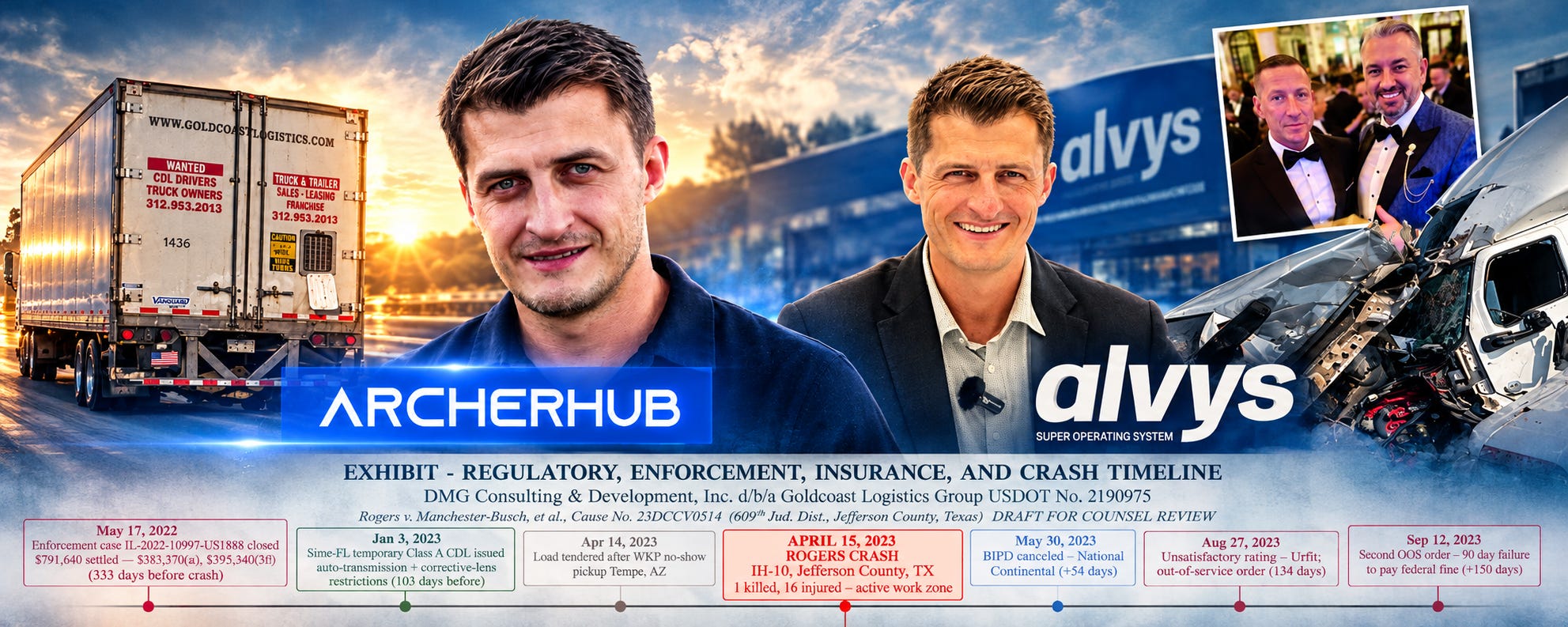
ArcherHub is not a former anything. Its broker authority, DOT 2345286, MC-799497, showed as active in FMCSA’s system when I verified it for our story a few months back. The brokerage is a defendant in Rogers v. DMG Consulting & Development in Jefferson County, Texas, added to the case on January 31, 2025. The suit arises from the April 15, 2023, crash on Interstate 10 in Beaumont that killed Brandon Rogers, after ArcherHub placed a Gold Coast Logistics truck on an Anheuser-Busch load. The allegations against ArcherHub are allegations, and the company denies negligence. What isn’t an allegation is what the carrier’s public record showed on the day of the tender. Gold Coast, legally DMG Consulting & Development, held active federal authority on April 15, 2023. Active authority was the floor, not a qualification. Already closed and sitting on the public FMCSA profile that day was a settled federal enforcement case, IL-2021-0097-US1688, closed May 17, 2022, eleven months before the crash, for $791,640, for knowingly using drivers without valid CDLs and hours-of-service violations. Against 11,946 closed enforcement cases in our data, that’s the largest single settled case in the set. The second case, the one with the known positive drug test, closed in October 2023, after Beaumont. The crash history was already running toward 150 crashes and 10 deaths. All of it in the government’s free public system, ninety seconds from the tender.
The money trail says the brokerage never receded either. Colorado UCC records show three creditors maintaining liens against Archer Atlantic at its Denver address: BMO Harris Bank from January 2019, continued in August 2023, four months after the Beaumont crash; PB&T Bank from December 2019, terminated in October 2025; and the U.S. Small Business Administration from September 11, 2020, the collateral filing behind a COVID-era disaster loan, continued on July 30, 2025. A financing statement keeps a creditor’s claim alive, not a judgment against anyone. Baxter Bailey does have Pacer federal civil claims out for Archer Atlantic for Surety bond claims. The federal government kept one alive on the founder’s brokerage last summer, five years into the venture-backed era.
The carrier didn’t stop when the government shut it down, either. Gold Coast’s authority migrated. Freight Transportation Group, the entity Dragos Sprinceana signed onto as CEO in February 2026, went out of service on April 20, 2026, weeks after I first reported the network. Cargo 24/7 is authorized and running right now, verified this morning. The authority moves, the trucks keep rolling, the names change. It’s the same machine; one runs up the ladder from where Darmanchev started it.
The launch-week thesis and the Beaumont record run in opposite directions. The thesis says federal safety data overstates the risk of small companies and needs to be disputed in real time. Beaumont documents the inverse: federal data that said everything a broker needed to know, publicly, for free, in the ninety seconds before a tender, and the load moved anyway. The reason the tension matters now is blunt. On May 14, 2026, the Supreme Court held 9 to 0 in Montgomery v. Caribe Transport II that whether a broker’s carrier selection was negligent is a question a jury gets to answer. An industry building AI to contest the safety record and an industry answering juries about ignoring the safety record are the same industry, in the same year, and in at least one Jefferson County courtroom, the same founder’s company.
A founder gets to shorten his name. He doesn’t get to shorten the record. The company formed at that Thornton apartment in 2014 still holds active federal authority, still sits in a wrongful-death docket, and still doesn’t appear in any telling of the story, which makes the origin story now circulating a biography with the middle chapter removed. The chapter has a docket number.
Very very interesting