

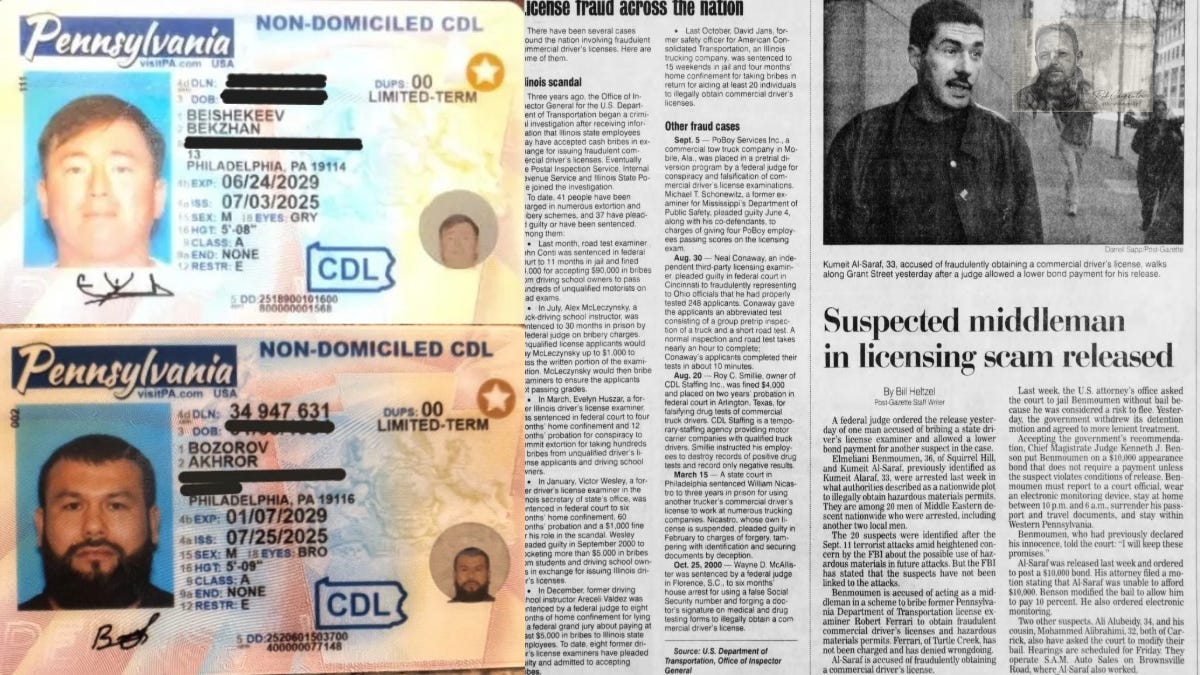
In the weeks after Sept. 11, 2001, Attorney General John Ashcroft stood at a podium and told the country that people with possible links to the hijackers had sought or obtained licenses to transport hazardous materials. The CDL system, he implied, had been compromised. The nation was at risk.
The press conference landed, and within days, federal agents arrested 10 men in Seattle, Detroit, and Kansas City for fraudulent CDL schemes. A Pennsylvania state examiner named Robert Ferrari, who had been taking bribes of $50 to $100 per license, payment left under a desk calendar, was already cooperating with authorities. He had issued hazmat-endorsed CDLs to at least 20 individuals, a middleman named Kumel Al-Saraf facilitating the transactions out of Pittsburgh’s South Squirrel Hill neighborhood.
The terrorism framing did not survive scrutiny. By 2005, the Washington Post was reporting that the men who obtained fraudulent CDLs through Ferrari were not terrorists. They were economic migrants seeking hazmat endorsements for trucking jobs. Al-Saraf received probation. Ferrari pleaded guilty to five counts of unlawful production of identification documents. One man’s auto repair shop was burned in an unsolved arson fire after the publicity. His business partner told the Post: “I’m hiding. I don’t want any more trouble.”
The terrorism case evaporated. The underlying problem did not.
The examiner who ran 10-minute tests
Ferrari was not the only case that surfaced in the immediate post-9/11 period. In August 2001, just weeks before the attacks, an independent third-party CDL examiner in Ohio named Neal Conaway pleaded guilty to fraudulently certifying 248 commercial driver’s license applications. A legitimate CDL skills test, consisting of a pre-trip inspection, basic vehicle controls, and a road test, takes approximately 45 to 60 minutes to complete properly. Conaway’s applicants completed theirs in about 10 minutes. He had been conducting group pre-trip inspections and abbreviated road tests, then certifying each applicant as if they had been individually evaluated.
Two examiners. Two states. Same failure mode: the self-certification model that defines third-party CDL testing had no meaningful verification layer. An examiner could certify anything. No one was checking.
That was 2001. It is now 2026. The self-certification model is still the foundation of CDL training and testing in the United States.
Pennsylvania says it doesn’t have a problem
Following the Feb. 3, 2026, crash in Jay County, Indiana, that killed four members of the Amish community, the office of Pennsylvania Governor Josh Shapiro issued a statement defending the state’s commercial driver licensing program. Pennsylvania has its verification processes in order. It follows federal requirements. It does not have a CDL problem. It never has.
The public record disagrees. Not on one count. On three.
Highway deaths.
Bekzhan Beishekeev is a Kyrgyzstan national who, in July 2025, obtained a Pennsylvania non-domiciled CDL through Aydana Inc., doing business as U.S. CDL, located at 524 Continental Road in Hatboro. Aydana had no presence on the FMCSA Training Provider Registry. It was not listed on Pennsylvania’s list of licensed training providers. The Pennsylvania Department of Education states explicitly that providers on that list are the only entities in Pennsylvania legally permitted to offer Entry Level Driver Training. Aydana had no website, no Google listing, and no verifiable operational footprint of any kind, despite having been incorporated more than three years earlier. PennDOT accepted the certification and issued the CDL anyway.
On Feb. 3, 2026, Beishekeev drove a commercial vehicle into a horse-drawn buggy on State Route 67 in Jay County, Indiana. Four members of the Amish community died: Henry Eicher, 50; Menno Eicher, 25; Paul Eicher, 19; and Simon Girod, 23. Beishekeev was employed by AJ Partners, a carrier connected to a network of companies, including Sam Express and Tutash Express, that federal investigators have identified as a chameleon carrier operation, entities that cycle through names, DOT numbers, and operating authority to evade enforcement accountability. He was not the only Pennsylvania-licensed driver involved in a fatal crash in 2025. FMCSA documented 17 fatal crashes that year involving non-domiciled CDL holders whose fitness could not be verified. Pennsylvania had issued approximately 12,000 such licenses.
Terrorism exposure
On Nov. 9, 2025, ICE agents arrested Akhror Bozorov in Kansas while he was working as a commercial truck driver. Bozorov, 31, is a citizen of Uzbekistan. Authorities there had issued an arrest warrant in 2022, alleging he recruited for a jihadist terrorist organization and distributed propaganda calling for jihad online. He held a valid non-domiciled commercial driver’s license. Issued by Pennsylvania. In July 2025. The same month Beishekeev got his.
Bozorov crossed the southern border in February 2023, was apprehended by border patrol, released, and granted work authorization by the Biden administration in January 2024. PennDOT ran him through the federal DHS SAVE verification database before issuing the CDL, as required. He cleared. Gov. Shapiro held a press conference the day after the arrest and said Pennsylvania had run the check again, after Bozorov was already in custody. “Ironically,” Shapiro said, “he still qualified to get a CDL.”
FMCSA launched a full audit of Pennsylvania’s CDL program following the arrest. Investigators found systemic failures beyond Bozorov: applicants approved when eligibility information had not been validated, documentation accepted that did not meet federal criteria, and examiners conducting testing without required oversight. FMCSA threatened to decertify Pennsylvania’s entire CDL program. Secretary Duffy threatened to withhold $75 million in federal funding. DHS Assistant Secretary Tricia McLaughlin was direct: “Terrorist illegal aliens should not be operating 18-wheelers on America’s highways.”
Election integrity exposure
PennDOT is not only the agency responsible for issuing commercial driver’s licenses in Pennsylvania. Under the automatic voter registration program implemented by the Shapiro administration in 2023, PennDOT is also the primary channel through which Pennsylvanians register to vote. The state’s position is that the system is clean, citizenship is verified before voter registration screens are presented, and noncitizens cannot slip through.
Pennsylvania has made that argument before. In 2019, the Wolf administration admitted that more than 11,000 noncitizens had been registered to vote through PennDOT’s system due to a verification failure. The state said it fixed the glitch in 2017. Then, in 2023, it built automatic voter registration through the same agency. In September 2025, the same period in which FMCSA was auditing PennDOT’s CDL verification and finding it systemically broken, the U.S. Department of Justice sued Pennsylvania over concerns about noncitizens on its voter rolls. Pennsylvania Secretary of the Commonwealth Al Schmidt appeared on PBS and said the system prevents noncitizens from interfacing with voter registration entirely. Pennsylvania’s response to the DOJ lawsuit and the FMCSA audit has been identical in posture: our verification works, it has always worked, and there is nothing to see.
If PennDOT’s verification infrastructure was broken enough that it issued CDLs to a terrorism suspect and a driver trained by a school that did not legally exist, both in the same month, both in the same year that FMCSA found the program systemically noncompliant, what confidence should the public have that the same agency’s voter registration verification is performing as described? No one is alleging mass fraud. The documented admission is that the system previously failed and placed 11,000-plus ineligible people on the rolls. The documented present reality is that a federal audit found that the same agency’s verification processes were broken, and the federal government is simultaneously suing the state over the integrity of the rolls that the agency feeds.
Convictions are not the bar here. Documented exposure is. PennDOT’s verification failures have now produced highway fatalities, a terrorism suspect driving commercially on American roads, and an active federal lawsuit over voter roll integrity. Pennsylvania says none of this reflects a systemic problem.
Robert Ferrari took bribes under his desk calendar at PennDOT in 2000. Pennsylvania framed it as a terrorism problem in 2001, and the cases were resolved, and the agency kept going. In 2025, the same agency issued two fraudulent CDLs in the same month: one to a terrorism suspect and one to a driver trained by a ghost school. It is now being simultaneously audited by the FMCSA and sued by the DOJ. The Governor’s office says the state doesn’t have a problem. It never has.
The public record is what it is.
An agency with a revolving door
The Federal Motor Carrier Safety Administration was created on Jan. 1, 2000, under the Motor Carrier Safety Improvement Act of 1999. Joseph Clapp became its first confirmed administrator in 2001, the same year Ferrari’s bribery scheme and Conaway’s abbreviated testing operation came to light.
In the 25 years since, the agency has processed approximately 19 leadership changes. The first 16 years produced five administrators. The last seven years produced eight, only two of whom were Senate-confirmed. In 2024 alone, FMCSA cycled through three different people in the top role. Meera Joshi, confirmed in January 2021, left 12 months later to become New York City’s deputy mayor for operations. Robin Hutcheson, confirmed in September 2022, departed 20 months after that. Sue Lawless served as acting administrator. Vinn White served as acting administrator. A senior adviser named Camire lasted two weeks in early 2025 before leaving.
Jack Van Steenburg, a retired FMCSA senior official, put the institutional damage in plain terms at an industry conference. In his last two terms at the agency, he said, there were nine different administrators. “When they’re out the door almost as soon as they get to a point where they understand what’s going on,” Van Steenburg said, “it’s very difficult to get things done.”
Derek Barrs, nominated by President Trump in March 2025 and confirmed by the Senate on Oct. 7, 2025, is the current administrator. He brings nearly 35 years of law enforcement experience to the role, more than 25 of which are focused specifically on commercial motor vehicle safety. He is the agency’s first Senate-confirmed administrator since Hutcheson departed 22 months earlier.
The narrative that shaped policy
Concurrent with FMCSA’s leadership instability, a parallel story was unfolding about the trucking workforce that would prove consequential for how seriously CDL standards were enforced.
The American Trucking Associations published its first systematic driver shortage report in 2005, though the organization had been sounding shortage alarms since the late 1980s. The thesis was consistent across every iteration: the trucking industry was running out of drivers, the gap was widening, and barriers to entry needed to come down. By 2021, ATA’s Chief Economist, Bob Costello, was projecting that the industry was 80,000 drivers short, a number that would double by 2030 unless something changed. The something included teen driver apprenticeship programs, expedited CDL issuance, and reduced regulatory friction for new entrants. The Biden White House held meetings on the driver shortage in which, according to participants, the narrative dominated every conversation. In 2021, the administration launched a formal Trucking Action Plan with an explicit goal of expediting CDL issuance.
The Bureau of Labor Statistics conducted its own analysis in 2019 and found no secular shortage. OOIDA President Todd Spencer has noted for decades that 400,000 to 500,000 new CDLs are issued every year in an industry that, even accepting ATA’s most inflated figures, was short 60,000 to 80,000 qualified drivers. “Where do they go?” Spencer has asked.
The answer, at least in part, is that they went through a system that valued issuance over qualification, and then churned out when the roads and regulations proved more than abbreviated training had prepared them for.
What lowered barriers actually produced
Motor carrier operating authority, which costs $300 to file and requires no proof of operational competence, grew 45% between July 2019 and August 2023, while freight demand grew approximately 11%, according to FMCSA data analyzed by FreightWaves. The result was a market flooded with new entrants, many undercapitalized and some operating with a compliance infrastructure consisting only of a company policy manual.
The Entry Level Driver Training regulation, which took effect in February 2022, was presented as a baseline standard. It requires no minimum number of instruction hours. Proficiency, under the regulation’s own text, is based solely on the training provider’s assessment. The provider self-certifies. The student self-certifies. FMCSA maintains a registry and conducts no systematic on-site verification of quality. The ATA, upon ELDT’s finalization, praised the rule explicitly for containing “no minimum training hours required nor new exorbitant costs.” That was the selling point.
English proficiency enforcement, required under federal regulations for commercial drivers operating in interstate commerce, was effectively suspended by guidance issued in 2016 during the Obama administration. In a five-day nationwide enforcement sweep conducted in February 2026, FMCSA deployed more than 300 investigators, conducted 1,426 on-site operations, and placed exactly one driver out of service for an English proficiency violation.
Third-party testing, the same mechanism that allowed Conaway to run 10-minute tests in 2001, remained the dominant model for CDL skills evaluation. In Washington state, examiner Hodson failed 80% of the drivers he had certified when they were retested by state officials. In Florida’s Bay County, agents seized $120,000 in cash during a June 2025 enforcement operation targeting a third-party testing operation that had issued hundreds, possibly thousands, of fraudulent licenses. In Massachusetts, a state trooper certified drivers he described internally as “brain dead” in exchange for a driveway, a snowblower, and a bag of Twizzlers.
The Training Provider Registry, established under ELDT, operated for nearly three years with almost no systematic on-site verification of any provider. In December 2025, FMCSA removed approximately 3,000 providers from the registry and issued notices to 4,000 more. By February 2026, more than 7,000 providers had been removed, flagged, or placed under active investigation, representing roughly 44% of all registered training providers in the country. When investigators arrived at some locations during the February sweep, 109 providers voluntarily delisted before the knock on the door.
The most active administration in DOT history
At the ATA Management Conference in San Diego in October 2025, Chief Economist Bob Costello said something that represented a significant departure from 20 years of organizational messaging. “What we have in the United States is a quality problem around drivers, much more so than an absolute number,” he said. ATA President Chris Spear retreated from the 80,000-driver shortfall projection the organization had been promoting for years. Neither acknowledged that the shortage narrative had shaped policy in ways that directly contributed to the quality problem they were now describing. Crazy thing was, no one ever called the ATA on this. In contrast, they invited them back to Capitol Hill for more advice. Why? Well, because that organization pays around $500,000 every year to cut out the lobbyist middleman and line the pockets of politicans that make policy decisions. What legislator is going to call out associations for being wrong when the same politicians are being paid handsomely to back ATA policy?
The current administration has not been similarly restrained. By any measurable standard, the Trump DOT under Secretary Sean Duffy has been the most active administration on commercial transportation enforcement priorities in the agency’s history. Duffy pulled $160 million in federal funding from California over CDL compliance failures, directed DHS to arrest and deport non-citizen drivers operating without proper authorization, threatened to decertify Pennsylvania’s entire CDL program, ordered a pause on non-domiciled CDL issuance, and launched the largest coordinated enforcement sweep of CDL training providers ever conducted. When a reporter asked whether deporting hundreds of thousands of drivers would create a supply problem, Duffy was direct: qualified means you earned your CDL the right way. The shortage framing was no longer a policy shield.
FMCSA Administrator Barrs brings the same orientation. His background is not regulatory; it is roadside enforcement. For an agency that spent much of the past decade cycling through acting administrators who came up through policy and planning offices, the shift in institutional posture is meaningful.
What this administration is exposing is not something it created. The 7,000-plus training providers flagged or removed in three months were operating before Barrs arrived. The Pennsylvania CDL program that issued licenses to a terrorism suspect and a chameleon carrier driver in the same month was running the same verification process it had used for years. The 17 fatal crashes in 2025 caused by non-domiciled CDL holders whose fitness could not be verified had been accumulating for the better part of a decade. The English proficiency gap that led to a single out-of-service action during a 1,426-operation sweep reflects a decade of suspended enforcement, not a problem that emerged in 2025.
The most active administration on DOT and FMCSA priorities in recent memory is doing something important. What it is doing is clearing the backlog of a system that was allowed to deteriorate across multiple administrations, both parties, and 25 years of decisions that prioritized volume over verification.
What didn’t change
Ferrari took bribes under his desk calendar. Conaway ran 10-minute tests. The terrorism framing made both cases briefly visible, then they resolved, and the architecture stayed in place. Pennsylvania’s PennDOT kept issuing licenses. The self-certification model kept running. The shortage narrative kept providing cover.
Three categories of documented public harm, highway fatalities, terrorism exposure, and voter roll contamination, trace directly to the same broken verification infrastructure at the same state agency, an agency whose leadership is now defending its record while the federal government simultaneously audits its CDL program, threatens its funding, and sues it over its voter rolls.
The fraud from 2001 was not a post-9/11 security failure. It was a regulatory failure that predated 9/11, survived the attention 9/11 brought to it, and continued producing the same results under every administration that followed, until one finally decided to count the bodies and read the files
.