

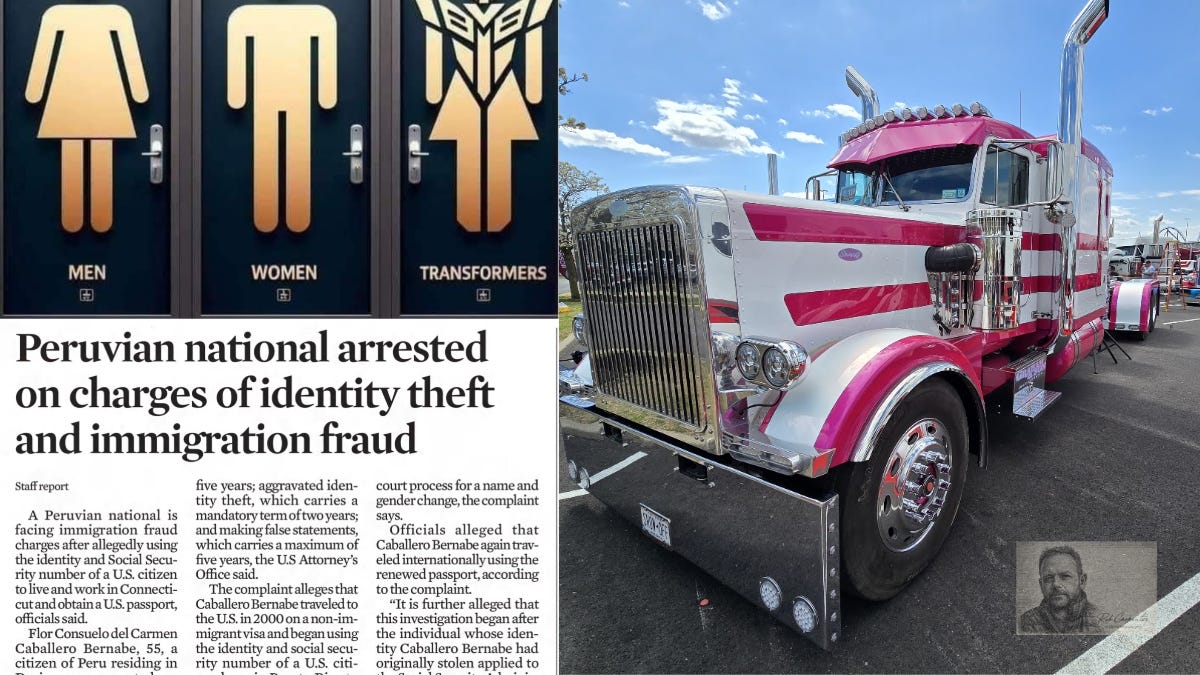
A stolen Puerto Rican Social Security number. A Connecticut CDL. A legal gender change that resets a federal identity. Twenty-two years of fraud that a disability claim finally cracked open. This is what happens when probate courts don’t talk to federal fraud databases, and an industry runs on the honor system.
Secretary of War Pete Hegseth said it best: “No more dudes in dresses.” For roughly 25 years, a Peruvian national operating in Connecticut drove commercial vehicles under a stolen identity belonging to a real, living American citizen born in Puerto Rico. She held a valid CDL. She passed the FMCSA medical examinations. She worked for at least one FMCSA-regulated carrier in Connecticut. She obtained a U.S. passport in 2005 under a stolen identity, renewed it in 2015, and used it to travel internationally.
Then in 2021, she went a step further. After two decades of living as someone else, she walked into Connecticut Probate Court, filed a petition for a legal name and gender change, and emerged on the other side as a man named Byron Ruiz. Why? Because she said that’s who and what she was.
The State Department renewed the passport under that name. She used it to travel internationally again. Byron Ruiz did not exist before that probate filing. After it, Byron Ruiz had a valid U.S. passport and a clean federal identity with no paper trail connecting it to 21 years of fraud.
The federal government did not catch it. No audit caught it. No roadside inspection caught it. No background check caught it. What caught it was the actual owner of that stolen Social Security number applying for disability benefits in 2022 and being told by the SSA that someone in Connecticut had been earning income under his number for more than two decades.
(Flor Consuelo Del Carmen) Caballero Bernabe, 55, was arrested on August 14, 2025, and charged with passport application fraud, aggravated identity theft, misuse of a Social Security account number, making a false claim of U.S. citizenship, misuse of a passport, and making false statements. She faces a mandatory minimum two-year federal sentence on the aggravated identity theft count alone, a sentence that under federal statute cannot be suspended or run concurrently with anything else. She is presumed innocent until proven guilty.
But what’s already proven, regardless of how her case resolves, is this: the system that is supposed to know who is behind the wheel of an 80,000-pound commercial vehicle did not know. For 25 years, it did not know.
Transgender Ideology Built the Loophole
The gender change that produced the Byron Ruiz passport was not incidental to this fraud. It was strategic. After 21 years of operating under a stolen identity, Caballero Bernabe used Connecticut’s probate court gender change process to generate a brand new federal identity document that had no connection to the old one in any federal database. The prior identity, the violations, the medical records, the employment history, all of it stayed behind. Byron Ruiz started clean.
That outcome was made possible by the self-attestation standard that transgender ideology drove into state law across this country. Under that standard, a petitioner walks into probate court, declares their intent to change their name and gender marker, and attests under oath that the change is not for fraudulent purposes. The court enters the order. No federal database cross-check. No SSA fraud lookup. No FMCSA driver record query. No passport fraud verification. Your word is sufficient.
Gender dysphoria is still classified as a diagnosis in the DSM-5, the American Psychiatric Association’s own diagnostic manual. It is a clinical condition, not a civil rights category. The ideological push to treat gender identity as purely self-determined and legally self-attestable, with no verification requirements and no connection to federal identity infrastructure, created the mechanism this case exploited. That is not a political opinion. That is what the court documents describe.
Anyone can walk into a probate court in most states and petition for a name and gender change. You do not have to be transgender. You do not have to provide medical documentation in many jurisdictions. You attest to your intent, and a judge signs the order. That order then flows downstream to the State Department, which issues a new passport. The new passport has no algorithmic or database connection to the identity that existed before the order was entered.
In a CDL context, that is catastrophically dangerous. FMCSA’s Commercial Driver’s License Information System tracks drivers by name and SSN. Change both through a legal process, and the connection between your old record and your new one does not automatically follow. Prior violations, medical disqualifications, accumulated inspection history, a record that should keep someone out of a commercial vehicle, none of it migrates automatically to the new identity. The new record starts clean. The system does not know they are the same person because the system does not use biometrics. It uses names and SSNs. And names and SSNs can be changed by a judge who takes you at your word.
This matters beyond this one case. Any driver with a disqualifying record could, in theory, use this same process to reset their federal credentialing history. The mechanism exists right now. This case proves someone already used it intentionally. The question is how many others have used it without getting caught.
A Name Is Not an Identity
There is a second thread running parallel to everything above, and it points to the same root failure.
Search FMCSA’s SAFER database for Harjinder Singh. You will get multiple active DOT numbers across multiple states, each attached to that name. You even get “No Name Given.” The system cannot definitively tell you which record belongs to which person. It was never designed to. It was designed on the assumption that a name, an SSN, and an address together equal a unique, verifiable human being. That assumption holds right up until it no longer does.
When the Florida Turnpike crash in August 2025 killed three people, the driver was identified as Harjinder Singh. He had obtained a CDL from Washington State, where, according to DOT’s own investigation, asylum seekers without legal status are not eligible for that credential. He failed an English proficiency assessment after the crash, getting only 2 of 12 verbal questions right. California had also issued him a non-domiciled CDL. New Mexico had done a roadside inspection and issued a speeding ticket without asking a single proficiency question.
Three states. One driver. Multiple credentials. Zero biometric verification at any point in the chain.
This is not a criticism of any cultural community or naming tradition. It is a structural problem. When any naming convention produces high concentrations of identical or near-identical names in a database built on name plus SSN as its primary identity architecture, you get verification failures. The database was built for a different demographic reality than the one currently operating in America. That gap is not going away on its own.
Whether the identity problem stems from a stolen SSN, a gender change that resets a federal record, or a common name that a database cannot distinguish, the root cause is the same every time. The industry is built on paper and promises, with no biometric foundation.
The Self-Attestation Economy
I have been writing about this for years. The entire credentialing chain in trucking runs on one assumption that keeps getting proven wrong: that people tell the truth when they say who they are.
A motor carrier applies for operating authority through FMCSA’s Unified Registration System and self-certifies ownership and entity information. Until recently, that process had almost no independent identity verification. The FMCSA is now rolling out a new initiative, in partnership with identity management firm Idemia, that requires biometric data for new carrier registrations. That is progress. It covers carrier registration. It does not touch CDL credentialing at the driver level, which is where this case, the Skyline case, the New York DMV bribery cases, and the California non-domiciled CDL failures all live.
CDL training providers self-certify. They attest that they exist, that their curriculum meets ELDT standards, and that their instructors are qualified. Before FMCSA pulled nearly 3,000 providers from the Training Provider Registry in December 2024, nobody was checking. When investigators retested 74 drivers certified by a Washington state examiner who were involved in the Skyline CDL School bribery scheme, 80% failed. That examiner had been collecting $520 to $530 per student in gold envelopes. The self-certification framework did not catch it. A criminal investigation caught it.
Medical examiners self-certify qualifications to get on FMCSA’s National Registry. Drivers elf-certify theyre long form for the med exam. Question 31 on the longform asks the driver, have you ever been addicted or dependent on drugs. Do they think theyre going to answer yes? In the Caballero Bernabe case, those examiners were processing forms for an identity that did not exist. They had no way of knowing that. The SSN matched a living person, the forms were filled out correctly under the fraudulent identity, and the certification passed. The system performed exactly as designed. The design is the problem.
Federal audits found that 53 percent of sampled non-domiciled CDLs in New York were issued illegally. California’s 2025 audit found that 25 of every 145 reviewed non-domiciled licenses were improperly issued. These are not rogue actors. These are state agencies operating within a system built on the honor code, only to be picked apart by people who have none.
The One System That Works
Here is what good looks like. We already have it. We are just not using it where it matters most.
The Transportation Worker Identification Credential (TWIC) was designed to address exactly this problem. To get one, you show up in person at a TSA enrollment center. You present documents. You get fingerprinted. You get photographed. TSA runs your biometrics against the Department of Homeland Security’s Automated Biometric Identification System, a database with records on more than 259 million individuals. The card stores two biometric fingerprint templates on a chip. When an electronic reader scans it, it matches the live holder against those stored templates in real time. You then get a separate PIN card for those fingerprints.
You cannot be someone else with a TWIC card. The fingerprints do not lie. It does not matter what name is on the SSN, what the probate court order says, or whether the identity was stolen from a living Puerto Rican citizen or reset through a gender change petition. The biology is the biology.
TWIC applies to maritime workers requiring access to secure port facilities. The CDL, the credential authorizing operation of a commercial vehicle weighing up to 80,000 pounds and carrying dozens of passengers, runs on names, SSNs, and self-attestation. I’m on my fifth renewal as of December of TIWC for HAMZAT, port, and pipeline work.
The HazMat endorsement gets closest to the right standard. HazMat CDL holders go through a TSA security threat assessment and provide fingerprints. The logic is sound: if you are carrying dangerous cargo, we need to know who you actually are. What is missing is the obvious next question. If we need biometric certainty for the HazMat driver, why do we not need it for the driver carrying 57 passengers down an interstate at 70 miles per hour? Caballero Bernabe held a passenger endorsement. She drove people for a living. No biometric check. Not once. In 25 years.
What You Need to Wrap Your Mind Around
Any carrier that employed this driver ran standard verification. MVR came back clean. Background check passed. CDL was valid. Employment eligibility cleared. Everything looked right because the stolen identity was attached to a real, living American citizen with a clean record. There was nothing to catch because the fraud was invisible to every tool the industry relies on.
No background check catches a stolen living identity. E-Verify passes it. SSN validation passes it. The MVR returns clean. You followed every rule, yet you still put someone behind your equipment who wasn’t who they said they were. That is not your compliance program failing. That is the infrastructure your compliance program is built on, and it is failing you.
The only real fix is biometric enrollment at the CDL level. Fingerprints tied to the SSN before the credential is issued, one time, verified against federal databases that actually talk to each other, no workarounds, no self-attestation, no probate court order that the State Department processes without a fraud check. We have the technology. We use it for port workers and HazMat drivers. We have decided that the people operating the buses, the tankers, the passenger vehicles, and the 80,000-pound freighters moving freight across every highway in this country do not need that level of certainty.
Twenty-two years and one claim of, I’d like to be a dude,” later, we know exactly what that decision costs.
So What?
I’ve driven a truck for more than two decades. I know what it means to have your credentials in order, and I know that everything about your right to sit in that seat is documented in a federal system. I have more credentials than most drivers. What this case tells me is that the federal system does not actually know who is sitting in that seat. It knows who signed the form.
Transgender ideology pushed self-attestation into state law because the movement’s position is that identity is whatever you say it is, and no institution has standing to question it. That ideological position, whatever you think of it in a social context, created a legal mechanism with no federal fraud detection built into it. In the case of Flor Consuelo Del Carmen Caballero Bernabe, that mechanism was deliberately and strategically used successfully for 4 years before a disability claim accidentally blew the whole thing open.
Four million people hold CDLs in this country right now. How many of them are who they say they are? FMCSA cannot tell you. The states cannot tell you. The carriers employing them cannot tell you with any certainty, because certainty requires biometrics, and biometrics are not part of the standard.
One person is sitting in a Connecticut detention facility facing decades in federal prison. Four million drivers are operating on the honor system.
That is not a safety program that will keep our highways safe. The Transportation Worker Identification Credential should be required for all transportation workers. Every single one. Today.