

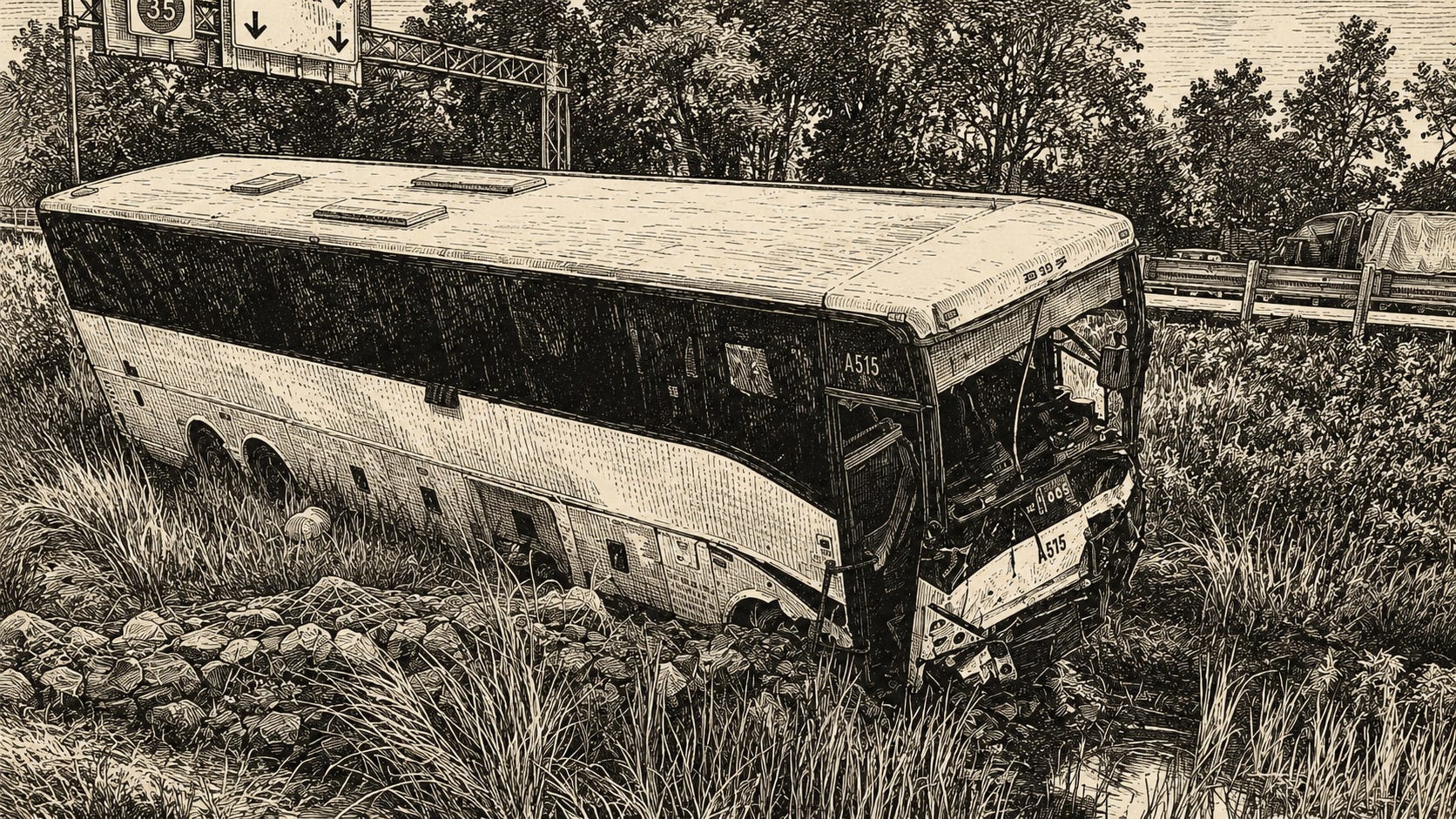
I oversaw private equity-backed passenger fleets. After 25 years in the property and passenger transportation industry, behind the wheel, in the broker’s chair, in the fleet executive’s office, and on the witness stand, reconstructing wrecks, this is the event you never want to happen. When a bus plows into stopped traffic at a work zone and kills a family, the first thing the cable networks reach for is the driver. The driver matters, but he is the last link in a chain built long before he ever turned the key. So let’s pull the chain.
What happened
Around 2:35 a.m. Friday, May 29, an E&P Travel motorcoach running the overnight New York City–to–Charlotte route came up on slowing traffic at a work zone on southbound I-95 in Stafford County, Virginia, near mile marker 146 by the Garrisonville exit. According to the Virginia State Police, the bus failed to slow. It struck a Chevrolet Suburban, which was shoved into an Acura SUV, which caught fire. Five people died. Four of them, a 45-year-old man, a 44-year-old woman, a 13-year-old girl and a 7-year-old boy, were from one family from Greenfield, Massachusetts. The fifth was a 25-year-old woman from Worcester. The bus was carrying 34 passengers. Forty-four people went to the hospital, three of them critical. The NTSB sent a go-team. The driver, identified by state police as 48-year-old Jing S. Dong of Staten Island, was injured, and charges are pending.
That’s the news. Now on to the wilder parts.
They did this before. Almost exactly this.
This was not E&P Travel’s first work zone.
On August 23, 2024, an E&P Travel bus was running up I-85 near Lexington, North Carolina, when it came up on a traffic-control vehicle performing a moving lane closure. North Carolina State Highway Patrol records show the bus failed to slow down and rear-ended the vehicle ahead. Nine people were hurt.
Failed to slow for a lane closure. Failed to slow for a work zone. Rear-end into slowing traffic. Same carrier, same fundamental failure mode, twenty-one months apart. In crash reconstruction, we call that a “repeat causation pattern,” and in a courtroom, it’s called notice, the company knew, or should have known, that it had a problem with drivers not managing speed and following distance into stopped traffic, and the documented record says nothing changed.
The Lexington wreck is a public record. That’s an NCDMV/State Highway Patrol crash report (DMV-349), and you can buy it through the state’s crash-report portal. Pull the narrative, the contributing-circumstance codes, the vehicle and driver block, and the diagram. I want to know whether the driver in Lexington is the same person who was behind the wheel on Friday.
“Satisfactory.” Seven weeks ago.
On April 3, 2026, 56 days before this crash, the Federal Motor Carrier Safety Administration completed a compliance review of E&P Travel and rated the carrier Satisfactory. A full compliance review, the deepest look the agency takes, and the carrier walked out the door with the government’s gold star still warm in its pocket. My guess is that this was a state partner agency, but we don’t know.
To translate “satisfactory” for folks who don’t live under 49 CFR. It does not mean the buses are safe. It means that when an investigator went through the paperwork, hours-of-service logs, driver qualification files, the drug-and-alcohol program, and maintenance records, the agency didn’t find enough documented, provable noncompliance to drop the hammer. It is a record grade. A carrier can keep a beautiful binder and still put a fatigued driver in a coach with worn brakes on a 600-mile overnight. The rating measures the binder. It measures a small sample. On this carrier, the two were already pointing in opposite directions, because by April, the company had a 2024 injury crash on its federal record and a driver out-of-service rate of 33.3%, meaning one of every three drivers FMCSA inspected at roadside was bad enough to be pulled out of service on the spot, against a national average of 6.67%. Five times the norm. Federal records also show three speeding citations against E&P drivers in the prior 24 months, two in Delaware and one in Pennsylvania.
A satisfactory carrier with a five-times-national driver OOS rate and a repeat work-zone rear-ender is exactly the kind of paper-clean, road-dirty operation our oversight system is worst at catching. That’s not a hot take. That’s the design flaw.
Buried in MAP-21, in the piece Congress titled the Motorcoach Enhanced Safety Act of 2012, is a command to FMCSA in plain English. Under 49 U.S.C. 31144(i), the agency must assign a safety fitness rating to every for-hire interstate passenger carrier, and for any bus company that registered after MAP-21 passed, it has to do it within two years of that company getting its authority. Then it has to reassess that rating, in the words of the statute, not less frequently than once every three years. Carriers running heavy passenger loads in urban markets are supposed to be reviewed every year. This is the law, and it was written specifically because buses carry people.
For a bus line, Congress set a hard clock, and it runs straight through E&P Travel. The company was incorporated in November 2023 and picked up its authority shortly after, which put its first mandatory federal safety rating due, by statute, no later than roughly the turn of 2026. And what sits on the federal record? A compliance review closed Satisfactory on April 3, 2026, right at the ragged edge of that two-year deadline, seven weeks before five people died.
That same 2012 law told FMCSA to build a clear, passenger-facing rating system, so a family buying a seat could compare one bus line against another the way you compare a restaurant’s health grade. FMCSA proposed that rule in 2016 and then pulled it in 2017. The simple, comparable rating the law demanded was never built. So the every-three-years mandate sits on the books while the agency still runs the old satisfactory-conditional-unsatisfactory model from the compliance-review era, the same model that just blessed E&P.
The “headquarters” is a two-bedroom apartment
E&P Travel’s address of record, on the MCS-150 and everywhere else, is 612 Charles St, Apt 89, Kings Mountain, NC 28086. That address is a unit in Mountainview Townhomes, listed elsewhere as Pine Manor Apartments, a 100-unit, two-story budget apartment complex about 30 miles west of Charlotte, where units rent for between $625 and $1,000 a month. The company contact email is ep.travel89@gmail.com. The “89” is the apartment number.
This is an interstate motorcoach carrier that, per its own most recent filing, runs four buses, employs eleven drivers, and put 471,399 miles on the road in 2025. Its national headquarters is a rented two-bedroom apartment unit with no terminal, no yard, no maintenance bay, no place to so much as park a 45-foot coach. The buses don’t operate out of Kings Mountain in any real sense; the route that crashed on Friday originated in New York City with a driver who lives on Staten Island. Kings Mountain is a mailbox.
I’m not going to pretend I haven’t seen this movie a hundred times. A North Carolina registration of convenience, a Gmail address, an apartment for an HQ, real operations in the New York metro, drivers pulled from the curbside intercity network, this is the structural fingerprint of the low-cost, loosely-affiliated “Chinatown bus” model that DOT has been chasing since the 2008 motorcoach crashes that killed forty-one people and prompted the federal Motorcoach Safety Action Plan. The model isn’t illegal, but it’s built for thin margins and thin accountability, and thin accountability is what’s lying in five caskets this weekend.
Who actually owns this thing?
The name on the federal file as the company official is Joyce Gao. According to the North Carolina Secretary of State, E&P Travel, Inc. was incorporated on November 24, 2023, by Shuo Liu, who is also listed as the registered agent.
The $5 million problem, and why those families are already short
Now on to why I keep beating my insurance drum.
Federal law sets a minimum amount of liability insurance that a carrier must carry. For a motorcoach, any passenger vehicle with a seating capacity of 16 or more, the floor is $5 million, under 49 CFR 387.9. For a smaller passenger van, 15 seats or fewer, it’s $1.5 million. Compare that to a general-freight trucker hauling property, who only has to carry $750,000. So yes, the system already recognizes that a bus full of human beings is a bigger liability than a trailer full of cardboard, and it priced that difference at roughly 6.7-to-1.
Here’s the rot: that $5 million passenger floor took effect January 1, 1985, and it has never been raised. Not once. Not for inflation, not for medical-cost inflation, not for forty years of jury verdicts. The $750,000 property floor goes back to the Motor Carrier Act of 1980 and has likewise never moved. In 2012, Congress passed MAP-21 and specifically ordered FMCSA to study whether these minimums were still adequate. FMCSA studied it, opened a rulemaking in 2014, delivered the required report to Congress, and then, in 2017, quietly withdrew the rulemaking and left the 1985 number exactly where it was.
Do the math the way an adjuster does. Five million 1985 dollars, adjusted for inflation, is somewhere around $15 million today. So the floor has lost roughly two-thirds of its real value while it sat there. We’re not even talking about a normal claim. We’re talking about five wrongful-death claims, two of them children, plus thirty-four injured, three critical. A mass-casualty motorcoach event like this generates exposure that runs into the tens of millions, easily $50 million or more before you’re done. Against a federally-mandated floor that may be as little as $5 million, sitting behind a four-bus carrier headquartered in an apartment.
You see the gap. The families from Greenfield and Worcester are going to discover what every catastrophic truck- and bus-crash family discovers: the federal “minimum” was set when gas was a dollar a gallon, and the people who could raise it decided, on purpose, not to. That’s the policy story, and it’s bigger than E&P Travel. E&P is just the latest carrier to drive a forty-year-old loophole straight into a work zone.
Who’s behind the policy, and what their book looks like
Every catastrophic motorcoach claim eventually runs into one wall: the insurance behind it. According to FMCSA insurance filings, E&P Travel’s liability coverage sits with Integon Indemnity Corporation. That name is worth a second look on its own, because Integon built its reputation in non-standard personal auto, not 45-foot coaches hauling 34 people overnight up I-95. The policy limit is the whole ballgame for these families, and a carrier riding the bare federal $5 million floor is a very different story than one carrying real excess coverage.
As for the book Integon is carrying, the numbers are big, but big needs a denominator. Across 7,706 carrier relationships, both historical and active, the book records 6,560 crashes (187 fatal), and 3,896 injuries. Spread across thousands of carriers over the years, that nets out to 0.85 crashes per carrier, and our own platform scores the insurer a 3.2 on a 100-point scale, squarely in the low-risk band. So this is not a rogue insurer. It is a large, ordinary commercial book that happens to include 243 carriers our model flags as high-risk, and now at least one that just killed five people. That is the honest version. Anybody who tells you the raw crash count alone proves the insurer is reckless is selling you something.
Five people are dead because a bus didn’t slow down for a work zone, for the second documented time. The driver will answer for Friday, as he should, but the carrier behind him was wearing the government’s “satisfactory” badge, running out of an apartment, with a known prior, against an insurance floor frozen in the Reagan administration. All of it was a choice somebody made, somewhere up the chain. Pull the chain.
My son used to cummute to classes in NYC from Boston on the Fung Wah.
I used to keep a candle burning in the Mission Church...