

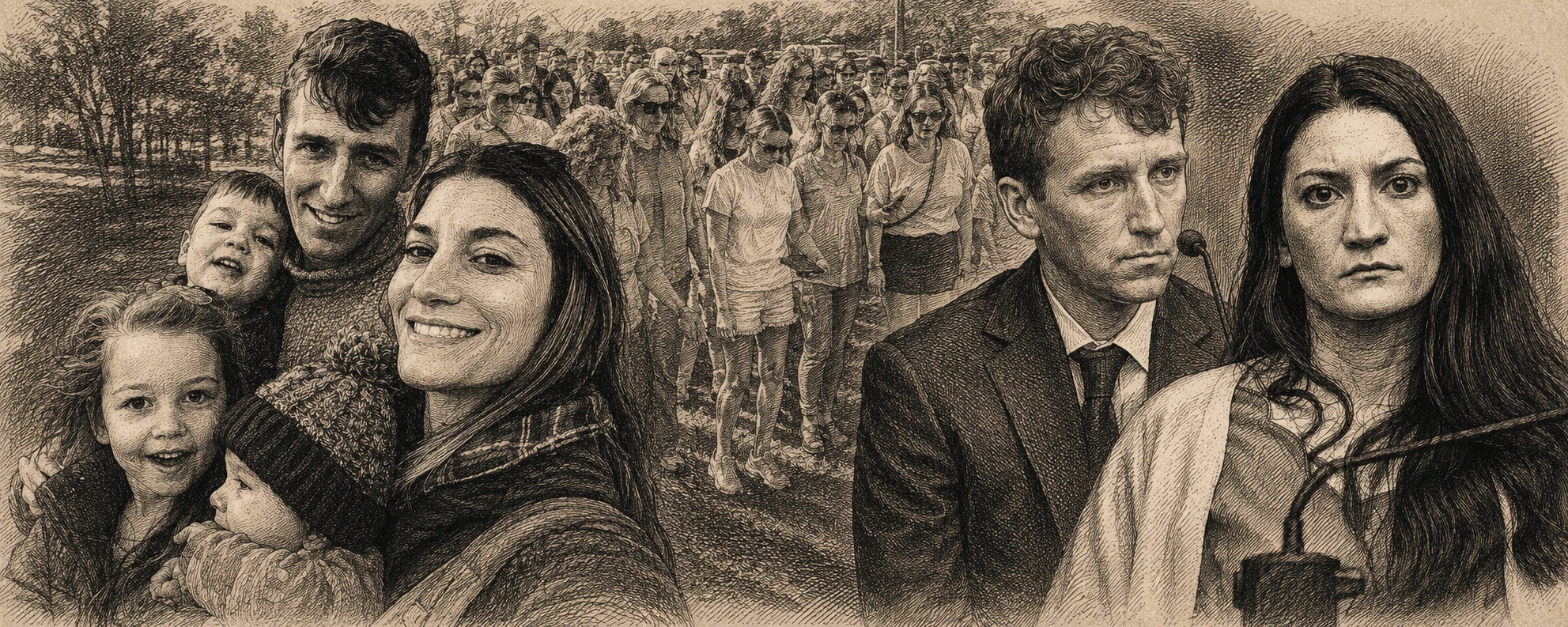
I spend my working life doing root cause analysis on catastrophes. When a truck kills a family on an interstate, my job is to trace the wreck backward past the driver, to the carrier that hired him, to the broker that looked away, to the system that let all of it keep rolling. Do that work long enough and you learn that catastrophes almost never start where they end. The Lindsay Clancy case aggravates me more than any crash file I've handled, and I've handled files with children in the wreckage. Run this one backward the same way, and you don't stop at one sick woman in a Duxbury basement. You end up where a lot of American catastrophes end up now: a collapsed consideration for other people, an epidemic of self-focus, a mental health system in open failure, and a running markdown on the value of a human life. Most would argue this has zero to do with the trucking catastrophes I typically focus on. I’d argue that as a society we’re not killers, but we’re struggling with very real issues that are affecting many people in every walk of life in a different but similar way, often resulting in fatal outcomes.
The Lindsay Clancy trial has produced a fan club. I’m not a woman, but as someone who's experienced different types and personas of them, here's my take on Lindsay Clancy, her tribe, different types of mothers, and mental health. I've spent a lifetime watching different maternal instincts from closer range than I ever wanted, and I can tell you where the sympathy belongs.
Lindsay Clancy’s murder trial opened in Plymouth Superior Court in July and is expected to run into September. Nobody disputes the facts underneath it. Her own defense concedes she strangled her three children, five-year-old Cora, three-year-old Dawson, and eight-month-old Callan, with exercise bands in the basement of the family home in Duxbury, Massachusetts, in January 2023, then cut herself and went out a second-story window. The contested question is criminal responsibility, with prosecutors arguing she acted deliberately and her lawyers arguing postpartum psychosis and a medicine cabinet holding thirteen psychiatric prescriptions. That trial doesn’t worry me. The audience does.
A trend called “Same, Lindsay” is running on TikTok right now. The format barely varies: a mother films herself holding her own toddler, tearful, while on-screen text quotes lines from Clancy’s diary that were read into the court record, and the video closes on the tag. Thousands of women have joined a Facebook group organized around the idea that they are Lindsay Clancy. Some of the videos go further than identification and into acquittal theater, arguing her innocence in a case where her own lawyer concedes she did it, or pointing the finger at Patrick Clancy, the husband who made the 911 call and buried three kids. The money followed. A GoFundMe run by Clancy’s parents is closing in on $900,000, and a second fund started by a TikTok creator has pulled in roughly the same amount again. Two million dollars in sympathy is on the table for a woman whose defense agrees she strangled her children, and almost none of it is flowing toward the father. Just as the TikTok fan club supports Clancy, many in the trucking world support killer truck operators and carriers. “It’s just part of the business.”
I come to this subject with more history than I’d like. I spent most of my life trying to figure out who I was and where I came from. That led to who I came from. That led me through a spectrum of maternal personas. My mother disappeared when I was three. My brother was six months old, and my sister was five, and I haven’t seen her since. What I remember is the window. I spent months, then years, at my grandmother’s front window looking across Grandaddy's fields waiting for a car that never turned in, long past the age when the adults around me had quietly stopped expecting one. The people who knew her said she lacked any motherly instinct, and the family record backs that up as far as I’ve been able to reconstruct it. She’d been adopted at age two by the Price family of Newport News, one of dozens of children born to a woman named Wally Gissel, who also went by Wally Kallaher. What I know of Wally comes from family accounts and the paper trail I’ve assembled doing genealogical work, and it reads like something a fiction editor would send back as too much. She worked for Eastern European organized crime, first as a woman whose job was keeping gamblers at the tables when their wallets and their better judgment told them to leave. Having babies was her job and her hustle. From roughly 1957 to 1970, she was pregnant essentially without interruption, at least one child a year and multiple children in several of those years, and the babies were sold to adoptive families around the country. She raised none of them. The plain word for that is a baby mill, and the polite historical term is gray-market adoption. Zero motherly instinct. All Hustle. As bad as they sound, they still didn’t kill any of their kids. (That were aware of.) While there is documented proof they disemboweled their partners and men feared them up and down the East Coast, they just weren't great people, let alone mothers.
Wally’s later chapter is easier to document because a federal appeals court did it for me. Wally worked in the scalloping industry alongside Carroll Zane Tillett, known on the Outer Banks as “Frog,” whose boats did more than drag for scallops. In April 1980, Tillett captained his vessel, the Cheryl Ann, offshore to meet a Colombian boat, took the marijuana aboard, and ran it back in to be unloaded onto trucks near Stumpy Point, North Carolina. That’s not family lore. It’s the Fourth Circuit’s own recitation of the record in United States v. Tillett, 763 F.2d 628 (1985). Scallop boats picking up dope bales in the Atlantic and running them into the North Carolina coast was a working business model in those years, and my bloodline was in it. My Mom’s mom, my Dad, my Dad’s dad, and even me for a time were watermen or waterwomen, and crime isn’t exclusive to drug trafficking or Frog when it comes to commercial fishing, especially Atlantic Ocean commercial fishing.
The search for her is where the rest of my life actually started, though I didn’t know it at the time. We didn't even have computers or phones then, so much of my young life ran through courthouses and libraries, pulling phone books, deed indexes, and court records, learning how paper trails work by chasing the coldest trail there is. Forty years later, I do the same thing for a living, tracing chameleon trucking companies through corporate registries and federal dockets, and every investigative skill I sell was built by a kid looking for his mother. When consumer DNA testing arrived, I tested with every company that offered a kit and folded the results into the genealogy work I was already doing, and the matches accomplished what the phone books never could. Yes, we have genealogy family trees on most of the chameleon networks we investigate because where you come from often ties to who you are. The records led me to her half-siblings, other children of Wally’s, scattered across the country with adoption papers and questions of their own. Talking with those half aunts and uncles surfaced a pattern stranger than the abandonment itself. Wally would reappear in some of their lives for short stretches, get into their heads, promise she’d be back, and then vanish again for good. She didn’t just withhold mothering. She rationed it, in doses small enough to keep the wound open. In a lot of ways, the country runs on the same ledger, a nation assembled from the successes of its best mothers and from the failures, untreated illness, and emotional damage of its worst mothers and fathers alike.
Wally and my mother weren’t killers. Some would argue that's not true, but from what we know, they only came close. They were women without the instinct, and the damage they did was real without being homicidal. They brought children into the world already compromised by the drugs and the lifestyle, then compounded it through abandonment. Research on what that does to a child goes back to John Bowlby’s 1951 World Health Organization work, which concluded that losing a mother’s care in the earliest years can harm a child’s emotional, social, and intellectual development. The modern literature on adverse childhood experiences backs him up with brain imaging, linking that kind of prolonged toxic stress to measurable changes in the systems a child uses to learn, decide, and regulate themselves. Some clinicians go further and describe emotional development stalling out near the age the wound happened. The rest of us file all of that under growing up the hard way. There’s even a grim economic logic to it. A woman like Wally could have believed in abortion, but where’s the money in that? Live births were the product. Perverse as it sounds, that incentive structure meant dozens of us exist who otherwise wouldn’t, myself included. I’m not required to admire the machine to acknowledge I came out of it.
Today I don’t even think about it. I’m 45 years old. My relationships and behavior are very much a by-product of those women. I am seldom attached. I trust no one. I keep my interactions limited and my circle very small. I had to learn to be a father and a parent because I wasn’t taught those things. The grandparents who raised me tried, but they were pre-40s babies and pre-20s babies, and they were tough and isolated in their own right. I’m largely thankful for it, seeing how portions of society raised after 1990 are turning out.
The instinct runs the other direction in my family too, and the contrast taught me more than the abandonment did. My father was plenty fouled up in his own ways, but his mother and her mother were good people. They took all of us in and raised us as their own. They expected work out of us, on the farm and on the property, and there was nothing soft about the arrangement, but the operating principle was that children in the family get raised, period. My wife and her mother sit at that same end of the spectrum, the kind who do everything for their kids and then look around for more to do. Between Wally at one pole and them at the other sits most of the population, and the distance between those poles is the thing nobody making TikTok understands.
Matt Walsh spent a whole documentary in 2022 asking people to define a woman, and the ones willing to answer mostly landed where biology lands: the sex that bears children. I’m with them on the definition, and the claim that a man can become one has never survived contact with anything I’ve actually watched women do. What the definitional fight misses is the second question, the one nobody makes a documentary about. Grant the category, and you’ve said almost nothing about the person standing in it. The capacity to give birth is close to universal among women, while the instinct to mother is not, and it isn’t distributed evenly even among the women who have it. I’ve done enough genealogical work to know that my maternal line’s mitochondrial DNA, the genetic signature passed unchanged from mother to child, runs unbroken from Wally through my mother to my sister and me. The same molecular thread produced a woman who sold her children, a woman who abandoned hers, and branches elsewhere on the tree that would’ve taken in every stray in the county. The chromosomes define the category. They don’t issue the instinct.
Somewhere along that spectrum you also find the women whose story runs through a clinic instead of a delivery room, and even they aren’t one category. There are women, and I’d put them at the crazier end of things, who get pregnant with the termination already planned. There are far more who get pregnant and conclude, with real grief, that ending it is the only workable option, not just for them but for the child too. I’m not litigating that debate here. I’m making a narrower point: none of the women anywhere on this spectrum, the abandoners, the over-mothers, the women in the clinic waiting room, have done what Lindsay Clancy’s defense concedes she did. The line between every one of them and a woman who kills her born children isn’t a matter of degree. It’s a different category of act. I’d argue that for any killing of any child born or unborn, but that's an argument for another time.
The data says so too. Parents kill their children in this country about 500 times a year, and a 32-year federal dataset of more than 94,000 filicide arrests found those killings made up 15 percent of all murders in the period, with a third of the victims under a year old. The forensic literature, going back to Phillip Resnick’s 1969 classification, sorts the motives into five bins: altruistic, acutely psychotic, unwanted child, accidental, and spouse revenge. Postpartum psychosis is real; it’s rare, and the research is the stereotype: psychosis-related child homicide is uncommon even among mothers who kill, and the psychiatrists who saw Clancy in the weeks before the killings testified they observed no signs of it. Whether a Plymouth County jury buys the defense is the jury’s job. What’s not in dispute anywhere, in any of the literature, is that thousands of women publicly announcing they’ve had the same thoughts is not a mental health awareness campaign. It’s a performance, and the currency being chased is attention.
Lindsay Clancy’s story is real. She was a labor and delivery nurse, a woman who spent her working life bringing other people’s children into the world. In the months before the killings, she sought help repeatedly and got a revolving cast of providers instead of one doctor who knew her, and her defense counts thirteen psychiatric medications prescribed across that stretch. Her lawyers say a voice told her it was her last chance to kill the children and herself, and her diary, the same one now being mined for TikTok captions, recorded a woman coming apart in real time. Some of her online defenders go further and put the blame on Patrick, which is a strange place to put it, since Patrick is the man who made the 911 call and buried three children. Almost nobody in the comment sections mentions what he did next. Within days of the killings, before his wife was even arraigned, he publicly asked the world to forgive her. Whatever sympathy the “Same, Lindsay” crowd is performing, that man held the genuine article, and he spent it on her.
Sympathy for her plight and judgment of her act aren’t in competition, and holding both at once is what adults do. Every one of us carries something across a life: hormonal upheaval, health crises, mental illness, medications that help and hurt in the same week. Millions of American women move through postpartum depression every year, a smaller number move through genuine postpartum psychosis, and the overwhelming share of them harm no one. The literature counts parental killings in the hundreds per year against millions of struggling parents, which makes the act not an outcome of suffering but an outlier from it. Strangling three children one at a time in a basement isn’t what suffering looks like. It’s what the rarest and worst failure looks like, and no era in recorded history has found it relatable. Ours is the first to build a content format around it.
The mental health crisis underneath all of this is real. Mental health conditions are now the leading cause of pregnancy-related death in the United States, accounting for more than a quarter of those deaths in the CDC’s most recent review data, ahead of hemorrhage and heart conditions, and federal review committees judge the overwhelming majority of those deaths preventable. More than one in five American adults deals with a mental illness in a given year, and roughly half of them get no treatment at all. Clancy’s revolving cast of providers and her thirteen prescriptions aren’t an anomaly in that system. They’re its signature. A country that treated maternal mental illness the way it treats hemorrhage would’ve had one doctor watching her instead of a rotation of strangers with prescription pads. All of that is true, and none of it moves the line. The same crisis that produced her is sitting on the other side of the camera, because many of the women in the “Same, Lindsay” videos describe symptoms from the same cluster of disorders, and instead of treatment they’ve found an audience. Some of them have traveled the whole distance, from confessing the thoughts to normalizing them to arguing they justify the act. A diagnosis that once sent people looking for help is being worn as an identity and offered as a defense, and when suffering becomes a license, the sick get sicker, the children get less safe, and nobody in the transaction gets treated.
That’s the part that tells you where society is headed. A generation ago, a woman who stood in a kitchen after book club and said she’d thought about drowning her daughter wouldn’t have collected followers. She’d have collected a visit from social services. The stigma argument doesn’t explain the change, because postpartum depression is more openly discussed now than at any point in history, and rightly so. What changed is that being seen became its own economy, and in that economy proximity to the worst act a parent can commit trades as content. Women are branding themselves as almost-killers for engagement, on camera, under their own names, building a record any prosecutor would frame and hang on the wall if one of them ever did act. We’ve written before about how the value assigned to a human life has been marked down until everyone is expendable to some degree. This trend is that markdown reaching the nursery.
My sympathies in the Clancy case go to Patrick Clancy and to Cora, Dawson, and Callan, and I’d argue yours should too. Compassion for women sliding toward the darkness of postpartum illness is right and necessary, and the place for it is a doctor’s office before the fact, not a comment section after three funerals. I grew up as living proof that a woman can fail her children about as completely as it’s possible to fail them and still never cross the one line that can’t be walked back. Killing your children is that line. A society that can’t hold it isn’t confused about mental health. It’s confused about what a child is worth.
I think this is where your root-cause analysis and mine separate. I don’t read women saying “Same, Lindsay” as identifying with what happened to those three children. I hear women identifying with everything that happened before them. I begged for help. My husband didn’t recognize how far gone I was. My doctor dismissed me or handed me another prescription. Nobody listened when I said something was terribly wrong. I was drowning in front of people who loved me, and everyone still expected me to function.
Patrick is relevant to that conversation, but not because he is the keeper of where our sympathy is allowed to go. Lindsay was deteriorating, cycling through providers and medications, had been hospitalized, and was struggling badly enough that additional help had been brought into the home. Yet we keep coming back to the fact that nobody specifically told Patrick she couldn’t be left alone with the children. That is part of what women are talking about. At what point do the people closest to a woman recognize what is happening, listen to the woman herself, without waiting for a doctor to formally tell them she is no longer okay?
And there is another piece of this that I don’t think can be separated from it. Look at what happens when women try to have this conversation. I did, and within hours hundreds of men were calling me emotional, mentally unstable, stupid, telling me my children should be ashamed of me, I shouldn’t be allowed to vote, accusing me of defending a murderer, and sending things privately that were substantially worse. The response to women saying “you aren’t listening to us” was to immediately demean the women saying it. That mentality does not begin in a comment section. The internet just makes it louder and gives men permission to say publicly what women have encountered privately in marriages, workplaces and doctors’ offices for generations.
That is why dismissing these women as a “fan club” or treating their stories as evidence that society no longer values children bothers me. It collapses two completely different things. Empathizing with the illness, the dismissal and the failure to intervene is not celebrating the outcome. Cora, Dawson and Callan are dead. Nothing about recognizing the failures preceding their deaths diminishes the enormity of that fact.
Andrea Yates was 25 years ago. Five children died and we had a national conversation about postpartum psychosis, treatment failures and what can happen when a profoundly ill mother remains responsible for children. A quarter-century later, three more children are dead and women are telling us that they still recognize the road that led there. Because nothing changed on the road.
They aren’t saying “I identify with killing my children.”
They’re saying “I recognize that road, because I have been on it.”
If we’re actually doing root-cause analysis, we cannot dismiss the people pointing at the upstream failures simply because what happened downstream is horrific. Those are precisely the people we should be listening to.
This is a painful 14 minute read. Well written. The author himself was abandoned by his biological mother. Then does a deep dive into his DNA geneology revealed disturbing revelations in his own family tree. My own husband is uncovering uncomfortable secrets in his parents’ genealogical DNA search. He was’t adopted. But the scars from family secrets do carry on to future generations.