

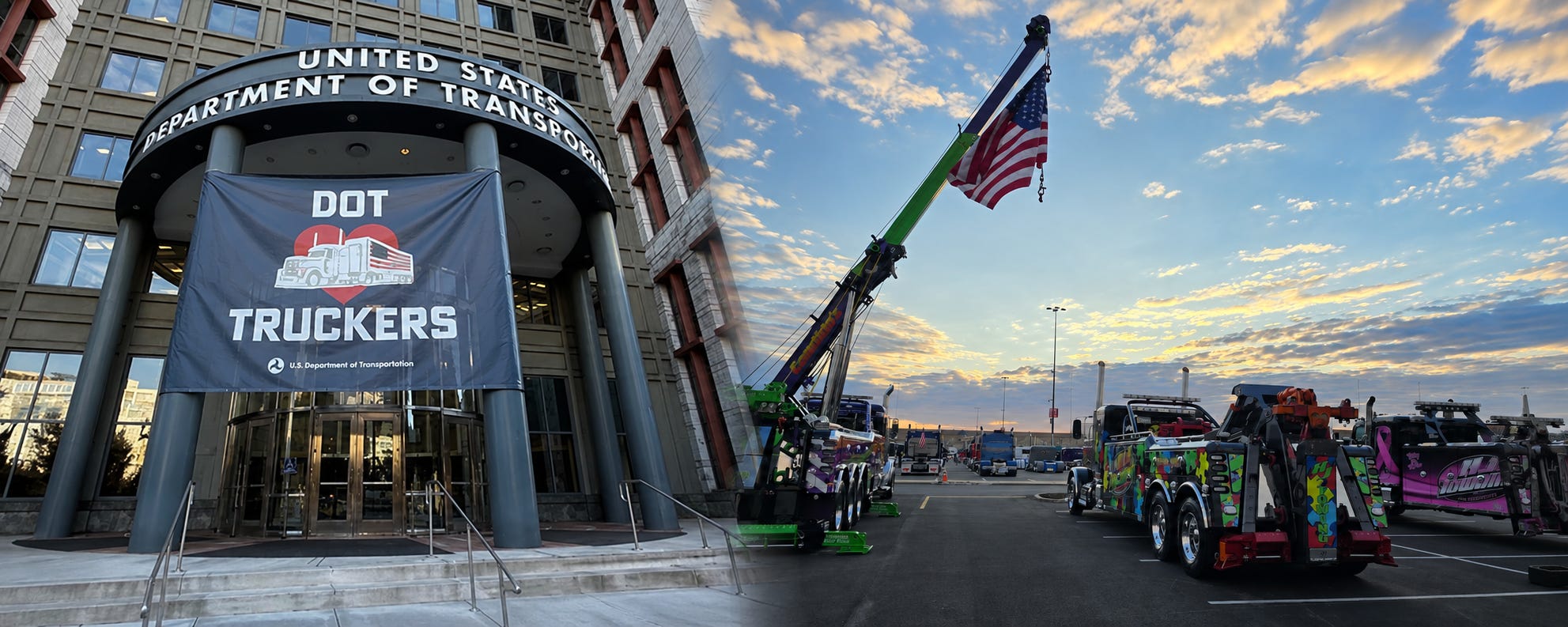
The petitioners’ reply brief in Lujan v. FMCSA was due Wednesday, July 29. Final briefs and the deferred appendix are due August 5. Oral argument is set for September 15 before the U.S. Court of Appeals for the D.C. Circuit, and when it ends, the court will decide whether the rule that took effect March 16, restricting non-domiciled CDL eligibility to H-2A, H-2B, and E-2 visa holders, survives on the merits. I’ve written about this rule three times since December, once about the court fight, once about why the final rule was a win worth defending, and once about the four problems it hands fleets. This is the fourth piece, and it’s about what actually gets decided in that courtroom, because most of what people think is at stake on September 15 already got decided in May, and most of what people think got decided in May didn’t.
The procedural history. FMCSA issued an interim final rule on September 29, 2025, published at 90 Fed. Reg. 46,509, effective immediately, on a good-cause theory that advance notice would trigger a surge of applications from drivers about to lose eligibility. The D.C. Circuit stayed it on November 10 and upgraded to a full emergency stay on November 13, finding the petitioners likely to succeed on at least three claims: FMCSA skipped the state consultation required under 49 U.S.C. § 31308, the good-cause justification didn’t hold, and the agency couldn’t articulate a net safety benefit when it conceded the displaced drivers would be replaced by less experienced ones. That was a loss, and it was an earned one. You don’t get to declare an emergency out of a problem you tolerated for twenty years and expect a federal court to nod along.
The agency asked for abeyance, went back, and did the consultation it had skipped. During the IFR comment period, FMCSA sent consultation letters to every state and got responses from eight state agencies and licensing authorities, AAMVA, and nineteen state attorneys general. It held a call with the state driver licensing agencies on October 2, 2025, and put the rule on the table at a CDL roundtable on November 4. Then it published a final rule on February 13, 2026, RIN 2126-AC98, Docket No. FMCSA-2025-0622, effective March 16, with a preamble that answers the comment record point by point, including the ones that hurt. The same petitioners, driver Jorge Rivera Lujan, asylum seeker Aleksei Semenovskii, AFSCME, and the AFT, with Public Citizen Litigation Group as counsel, filed their petition for review on February 12, the day before publication, docketed as No. 26-1032. King County, Washington, which runs non-domiciled CDL holders in its transit fleet, filed on March 4, No. 26-1046, and the clerk consolidated the cases the next day. Both moved for an emergency stay of the new rule.
On May 5, the same court that stopped the September version refused to stop the February version. Two judges to one, with Judge Robert Wilkins noting he would have granted the stay. The panel found the petitioners hadn’t shown a likelihood of success against the final rule, which means the panel found, at least preliminarily, that the agency cured the defects that killed the interim rule. Same agency, same court, same petitioners, opposite outcome, and the only variable that changed was the process. That’s the lesson, and it’s the one I argued for in February when people were telling me the final rule didn’t go far enough. Durable beats fast. The emergency declaration was fast. It’s dead. The final rule was slow. It’s in effect, and it has now survived the exact test its predecessor failed.
The rule itself hasn’t changed since I last walked through it, so I’ll keep it brief. Non-domiciled CDLs and CLPs are limited to holders of H-2A agricultural, H-2B seasonal non-agricultural, and E-2 treaty investor visas. Every applicant runs through SAVE, the federal immigration status verification system operated by USCIS, and presents an unexpired foreign passport with an unexpired I-94. EADs alone no longer qualify, which removes asylum seekers, asylees, refugees, DACA recipients, and TPS holders from eligibility, and renewals now happen in person. FMCSA’s analysis says about 97 percent of the roughly 200,000 current non-domiciled CDL holders won’t qualify at renewal, draining the pool by 30,000 to 40,000 drivers a year as credentials expire. Nobody gets pulled over and stripped of a card. The population ages out at the DMV counter, one renewal, transfer, upgrade, or reinstatement at a time.
The May 5 order tells you two members of one motions panel thought the petitioners were unlikely to win. The merits panel in September may be composed differently; it will have full briefing instead of emergency papers, and Wilkins’ position tells you at least one D.C. Circuit judge finds the petitioners’ argument persuasive. The petitioners’ theory is that FMCSA decided the outcome first and assembled reasons afterward, that the rule is arbitrary and capricious because the agency never produced data connecting domicile status to crash risk, and that it discriminates by immigration status without justification. Their anchor numbers come from the comment record itself: the five crashes FMCSA cited in the IFR were calculated by opponents at 0.13 percent of 2025 fatal truck crashes, and non-domiciled holders at roughly five percent of the CDL population. Those numbers were good enough to win a stay in November. Whether they’re good enough to win vacatur in September against a rebuilt record is the whole case.
The rebuilt record stops arguing crash statistics and attacks the premise that crash statistics were ever the point. The agency’s position is that the rule fixes a bifurcated vetting standard. A domestic applicant gets run through CDLIS and the Problem Driver Pointer System, so a suspension in Ohio follows him to Texas. A foreign-domiciled applicant’s driving history sits in databases no state can reach, and he doesn’t surrender his foreign license to get the U.S. credential, so the record the state can’t see runs both backward and forward: he can be driving on the foreign license in another country during the same years he holds the U.S. card. The three surviving visa categories were identified in consultation with the State Department and DHS because their consular vetting and interagency screening function as a proxy for the driver history check the states can’t perform. On the data, FMCSA concedes the count can never be complete, and explains why: MCMIS, FARS, and CDLIS have no field recording whether a license was non-domiciled, so the agency reviewed 2025 fatal crash reports manually, cross-referenced them with the licensing states, and counted only crashes where the non-domiciled CMV driver was at fault. That review found 17 fatal crashes in 2025 caused by non-domiciled holders, 30 people killed and more than 40 injured, with USCIS confirming a “substantial likelihood” that none of those drivers would have been eligible under the new rule, and the agency identified no at-fault fatal crash caused by a driver who would remain eligible. Most of the 17 drivers had held their initial CDL less than two years. Whether a merits panel accepts a hand-built illustrative sample in place of the statistical showing the November court demanded is, in my read, the question the whole argument turns on.
The amicus lineup filed over the past six weeks tells you this stopped being a trucking case somewhere along the way. Twenty-three states with Republican governors, Florida through West Virginia, filed for FMCSA last week, arguing the rule answers a string of preventable fatal crashes and that recent Supreme Court decisions leave states unable to police the problem alone. Their exhibit list opens with the Harjinder Singh crash, the illegal U-turn on a Florida highway by a driver licensed by California while in the country unlawfully, three dead in the passenger car. A comparable roster of states with Democratic governors filed for the petitioners, arguing the surviving visa categories are precisely the ones where federal screening surfaces unsafe driving history, so the state licensing function was never the failure point. The Teamsters and the Sikh Coalition are in as amici on the petitioners’ side, and the court warned everyone it views duplicative briefing in consolidated cases with disdain.
The Lujan case is also not the only federal action FMCSA is defending on the foreign-driver enforcement front, and the second one is a self-inflicted wound. On June 12, the Sikh Coalition sued FMCSA in the U.S. District Court for the District of Columbia, Case No. 1:26-cv-02099, and the suit isn’t about the non-domiciled rule at all. It’s a FOIA case about enforcement of English language proficiency. When the agency rescinded the 2016 ELP guidance and issued MC-SEE-2025-0001 on May 20, 2025, restoring out-of-service placement for violations of 49 CFR § 391.11(b)(2), it published the enforcement memo with the driver interview procedures, the interview question examples, and the highway sign assessment materials blacked out under FOIA exemption (b)(7)(E). The Sikh Coalition, which supports the ELP requirement on its face, filed a formal FOIA request on July 8, 2025, and was told the request was waiting in the queue; they sued to compel a determination under 5 U.S.C. § 552(a)(6)(A). ELP enforcement itself is running hard: Secretary Duffy posted in December that more than 9,500 drivers had been placed out of service under the standard, and 2025 MCMIS data in the complaint shows over 49,000 ELP-coded violations across the four violation codes. I support that enforcement.
For fleets, nothing about September 15 changes the operating posture I described in March, and waiting for the ruling to act is still the losing play. The rule is in effect. State licensing agencies are processing renewals under it right now. A driver holding a non-domiciled CDL keeps operating until the next licensing transaction, and that transaction- renewal, transfer, upgrade, replacement, or reinstatement- is where eligibility gets retested. If the court vacates the rule this fall, drivers terminated in the interim become a wrongful-termination question. If the court upholds it, drivers retained without eligibility review become the negligent-retention exhibit in the next crash case. The answer to both is the same file: audit the driver qualification files now, document the visa category and SAVE verification for every non-domiciled credential in the fleet, get employment counsel’s read on termination exposure and safety counsel’s read on retention exposure, and make the decision in writing either way. The carriers who did that in March are done. The ones who didn’t have six weeks before argument.
The agency wins more of this case than it loses. The November stay turned on process defects the agency has since cured, the May panel said so out loud, and appellate courts do not lightly vacate a rule the same circuit declined to stay on a fully argued emergency motion. The petitioners’ strongest ground remains the data, and the agency’s answer is now on the record: this was never a crash-rate regulation, it’s a verification regulation, the databases that would prove or disprove the statistical case don’t record the variable, and courts give agencies room to fix a licensing system that 28 cited jurisdictions demonstrably broke. The open question worth watching at argument is whether the panel makes FMCSA answer the one question from November it still handles by reframing rather than by evidence: how a rule that swaps experienced drivers for less experienced ones produces a net safety gain. If FMCSA has a good answer on September 15, this fight is over. If it doesn’t, we’re doing this a third time.
A driver who should never have been behind the wheel of a commercial vehicle put me in a hospital for the better part of a year, so I don’t come to this rule neutral, and I’ve never claimed to. What I claim is that the record now in front of the D.C. Circuit was built the right way, by an agency that lost on process, took the loss, and did the work. The FOIA case shows what happens when it forgets that lesson. Whatever happens on September 15, the February rulemaking is the version of federal regulation this industry should want more of, and the redacted ELP memo is the version it should want less of, and both are sitting in Washington courtrooms right now to prove the difference matters.