

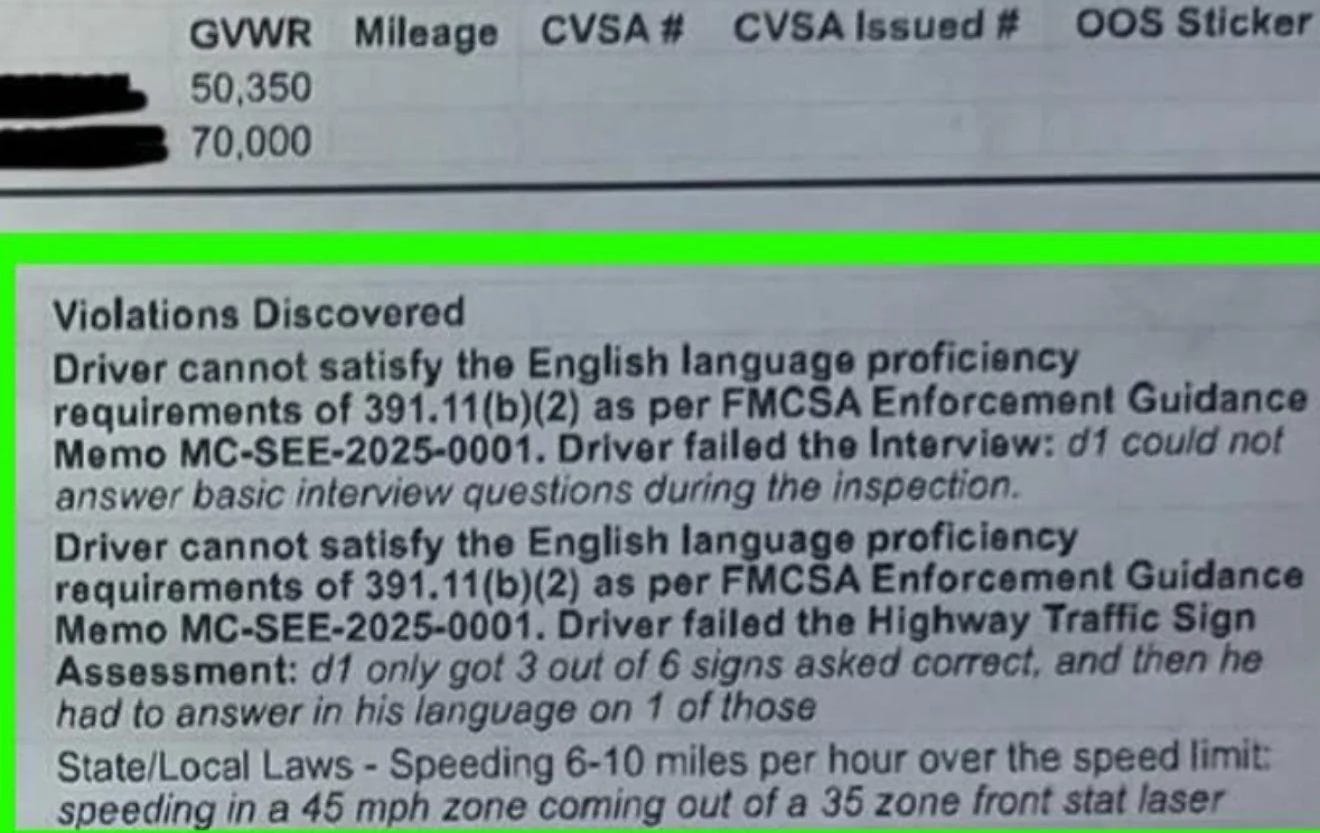
An out-of-service order is the strongest thing a roadside inspector can do without an arrest. It should end the trip. A truck with a defect serious enough to meet the North American Standard Out-of-Service Criteria gets a sticker and cannot move until it is fixed. A driver who is not qualified to be behind the wheel gets parked, and the carrier has to send someone who is. Federal regulation is blunt about the vehicle side. Under 49 CFR 396.9(c)(2), no motor carrier shall require or permit any person to operate, nor shall any person operate, a vehicle declared and marked out of service until the required repairs are complete.
Since June 25, 2025, English language proficiency has been part of that system again. That is the day the Commercial Vehicle Safety Alliance’s emergency amendment took effect, making a violation of 49 CFR 391.11(b)(2) a driver out-of-service condition. The U.S. Department of Transportation has been counting ever since. In its Sept. 30, 2026 enforcement release, FMCSA said more than 31,200 drivers had been placed out of service for English proficiency since the April 2025 executive order.
That number tells you how many orders were written. It does not tell you whether any of them worked.
That question has been open for almost a year. When FreightWaves reported Secretary Sean Duffy’s 9,500 figure in December 2025, OTR Solutions COO Grace Maher asked a fair question: “Where are the pictures of the trucks on the road?” I spent years as a compliance director and fleet executive, and I have reconstructed crashes for litigation since. I know an out-of-service order is only as good as what happens after the officer drives away. So I went and looked at the trucks.
FMCSA’s public daily inspection records from May 13, 2025 through Oct. 29, 2026: 4,253,960 inspection reports, joined to 10.9 million violation records from FMCSA’s Safety Measurement System files. Every report carries the vehicle identification number of the inspected unit, its plate and the USDOT number it was operating under. The driver’s identity is not in the public file. The VIN is. So the analysis follows the truck.
English proficiency measured from June 25, 2025, the day it became an out-of-service violation. The inspection file holds 30,497 English proficiency out-of-service orders on inspections with a usable VIN, spread across 26,893 trucks. In its August 2026 proposed rule, the agency reported 19,045 English proficiency out-of-service orders between June 25, 2025 and March 19, 2026, against just 33 in the first half of 2025.
Of those 30,497 orders, 14,325 trucks showed up at a later inspection. And 2,576 times, the truck’s very next inspection ended in another English proficiency out-of-service order. That is 18% of every truck that came back. Eighty-two trucks drew a second English proficiency order the very next day. Another 319 drew one within a week. A total of 2,955 trucks have two or more English proficiency out-of-service orders, 508 have three or more, and one truck has eight.
An English proficiency order parks the driver, not the truck. A carrier that gets a driver put out of service can legally send a qualified driver to pick up the load, and that truck can be back on the interstate the next morning without breaking a single rule. A truck that draws a second English proficiency order doesn’t prove the same driver was behind the wheel, because the public file doesn’t identify drivers. I also stripped out 85 same-day repeats in the same county, because most of those look like one stop written up twice. None of the numbers in this story count them.
If it was the same driver, an out-of-service order was ignored. If it was a different driver, the carrier put a second driver in that seat who could not pass the same two-step roadside assessment. Either way, the carrier is responsible. Section 391.11 says a motor carrier shall not require or permit a person to drive a commercial motor vehicle unless that person is qualified, and 391.11(b)(2) defines qualified to include reading and speaking English well enough to converse with the general public, understand highway traffic signs and signals, respond to official inquiries and make entries on reports and records. English proficiency is a hiring standard. Roadside is just where the hiring gets graded.
The consequences for ignoring an order are already in place. Under 49 USC 31310, a driver found to have committed a first violation of an out-of-service order is disqualified for at least 180 days and faces a civil penalty of at least $2,500. A second violation means two to five years. An employer that knowingly allows or requires a driver to operate in violation of an out-of-service order faces a civil penalty, and one that does it knowingly and willfully faces criminal exposure. The law is not the gap. Detection is.
When you look at which carriers carry the most English proficiency violations on U.S.-plated trucks, the list is not a scattering of one-truck operators. It is five fleets, and all five list physical addresses in Laredo, Texas.
Forza Transportation Services Inc., USDOT 2490721, MC 862551, reported 1,078 power units and 1,422 drivers on its Feb. 27, 2026 MCS-150. Since mid-May 2025, its U.S.-plated trucks have been cited for English proficiency 245 times, with 212 of those ending in a driver out-of-service order, across 206 different trucks in 28 states plus federal inspections. That is roughly one in five of the power units Forza declared to the federal government. FMCSA’s live system showed Forza with active authority and no out-of-service order as of Oct. 31.
Select Dedicated Solutions LLC, USDOT 1877140, declared 329 power units. Its trucks drew 168 English proficiency citations and 140 out-of-service orders across 126 trucks, or 38% of the declared fleet. Texas International Enterprises Inc., USDOT 2196912, declared 297 power units and drew 164 citations and 122 orders across 117 trucks (39%). FJ Carrier Logistics LLC, USDOT 3162922, declared 230 power units and drew 156 citations and 137 orders across 100 trucks (43%). Tradex Logistics Inc., USDOT 2360323, declared 201 power units and drew 127 citations and 111 orders across 93 trucks (46%).
These five fleets run one or two citations per truck. This is not one bad driver getting caught over and over. It is a hiring pattern showing up across a fleet, in state after state, and it lands on every broker that tendered those loads and every shipper whose freight sat on a shoulder while dispatch found a replacement driver.
FMCSA’s April 16, 2026 enforcement FAQ lays out three violation codes for 391.11(b)(2). Codes 391.11B2Q and 391.11B2S are hard-coded as out-of-service. Code 391.11B2Z covers drivers operating inside the U.S.-Mexico border commercial zones, and it is hard-coded as not out-of-service. In the agency’s words, SafeSpect “does not allow enforcement personnel to alter the out-of-service designation” on any of the three. The August 2026 proposed rule would write that exception into a new 391.11(c)(2): a driver found in violation inside a commercial zone will not be placed out of service unless there is evidence the driver has operated or intends to operate beyond the zone.
The inspection file holds 72,492 border zone English proficiency citations, and only 157 carry an out-of-service flag. The single most-cited truck in the country for English proficiency is a 2022 Ram, VIN 3C7WRAKT1NG396328, operating under USDOT 2787417, registered as J Octavio Rodriguez Tovar and RTH Transportes. It was cited 48 times between June 16, 2025, and Sept. 17, 2026, under four variants of a Mexican plate. It was never taken out of service, and under current policy it could not be. The next four most-cited trucks follow the same pattern, all Mexican-plated, 38 to 46 citations each, zero orders. That is policy working as written. Whether a citation that can be written 48 times on one truck with no consequence is enforcement or record keeping is a question for the docket.
English proficiency is the newest out-of-service condition. It is not the biggest. The same method applied to vehicle out-of-service orders produces numbers an order of magnitude larger.
From May 13, 2025 through Oct. 29, 2026, the inspection file holds 652,660 vehicle out-of-service stops across 517,800 trucks, after collapsing duplicate write-ups of the same truck on the same day in the same county into one stop. In 1,699 cases, the same truck was placed out of service again within a day: 1,452 the next day and 247 the same day in a different county. In 8,580 cases, the next vehicle out-of-service order came within a week. A total of 24,265 trucks have been placed out of service three or more times in that window, and 4,220 have been placed out of service five or more times. The single highest count is 28 vehicle out-of-service stops on one Freightliner, VIN 1FUJGLCK49LAE2141, operating under USDOT 2403092, Bullet Transport Services MX S de RL de CV, on Mexican plate 20EP1K.
A vehicle out-of-service order ends when the repair is made. A truck put out of service for a leaking tire at 9 a.m. can have the tire replaced by noon and be legal the rest of the day. Two out-of-service orders on the same truck a week apart can be two separate failures, both fixed. The inspection file does not record the repair certification, so it cannot tell you which orders were honored.
What it can tell you is when the same truck is parked for the same thing, again and again.
Match every out-of-service violation code on the power unit and the driver to the VIN, then look for the identical code on the same truck at a separate, later stop. A total of 27,095 trucks were placed out of service for the exact same violation at two or more stops. In 9,592 cases, the repeat came within 30 days. In 3,095 cases, the repeat occurred within a week.
The most common repeat was tires leaking or inflated below 50% of maximum pressure (violation code 393.75A3-TAOL), on 4,576 trucks. Second is no record of duty status in the prescribed method, 395.8A1-HOSP, on 4,033 trucks. Third is no valid medical certificate (391.41APC) on 3,740 trucks. Fourth is operating a commercial motor vehicle without a valid CDL (383.23A2-LCDLN) on 2,526 trucks. English proficiency (code 391.11B2Q) ranks fifth at 2,394 trucks, and brakes out of service (396.3A1-BOS) ranks sixth at 1,958 trucks.
A truck that is placed out of service twice for no valid CDL is a truck the carrier kept handing to unlicensed drivers. A truck parked twice with brakes out of service is either a truck that never got fixed or one that keeps failing because the maintenance program isn’t real. Neither of those is a roadside problem. They are carrier problems that roadside keeps catching one stop at a time. Two U.S. trucks show what that looks like up close.
The first is a 2022 Ford F-350, VIN 1FT8W3DT4NEE58321, on Florida plate 18FCHH. A one-ton pickup pulling for hire is a hotshot rig, and this one covered a lot of ground. Between May 23, 2025, and May 20, 2026, it was inspected 16 times in 10 states: Illinois, Idaho, Wisconsin, Mississippi, Louisiana, Tennessee, South Dakota, Montana, Florida, and Pennsylvania, and every one of those 16 inspections ended with at least one out-of-service violation. Twelve included a vehicle out-of-service order.
For its first 10 inspections, through Feb. 23, 2026, the truck ran under Beta Auto Transport LLC, USDOT 4333977, MC 1692478, North Charleston, South Carolina. On Feb. 9, 2026, in Idaho, a single inspection logged 20 violations: nine out-of-service, seven on the vehicle, and two on the driver. On April 9, 2026, in Pennsylvania, the same truck on the same plate was inspected under Gomes E David LLC, USDOT 4022108, MC 1517341, an Orlando carrier that reported one power unit and one driver. That stop logged 22 violations. Twelve days later, on April 21 in Tennessee, it was operating under Knockout Hauling LLC, USDOT 4438695, MC 1747518, Winter Garden, Florida, which reported two power units. Under Knockout, it was put out of service in Wisconsin on April 29 for four driver out-of-service violations and one vehicle, and again in Wisconsin on April 30 for another driver out-of-service violation. It was inspected twice more, in Tennessee on May 12 and Illinois on May 20, with out-of-service violations both times.
As of Oct. 31, FMCSA’s live system showed Gomes E David under a federal out-of-service order dated May 16, 2026, with its for-hire authority revoked. Beta Auto Transport’s for-hire authority was revoked, though its USDOT number remained active. Knockout Hauling’s USDOT number was inactive. One truck, one plate, three carriers, and none are cleared to haul for-hire freight today.
The second truck never left Texas. It is a Freightliner, VIN 1FUJBBCK18LY25779, operating under Tripple J Haulers LLC, USDOT 3755911, of Eagle Pass, Texas. Tripple J’s MCS-150 reports one power unit and one driver, and it was last updated Aug. 29, 2023. FMCSA’s live system shows an active USDOT number and no for-hire operating authority on file. Between May 16, 2025 and Oct. 15, 2026, that one truck was inspected 26 times. Fifteen of those inspections ended with a vehicle out-of-service order. It was placed out of service for brakes on March 4, March 26 and May 15, 2026, and drew further 396.3(a)(1) out-of-service violations on Sept. 4 and Oct. 15.
Across those 26 inspections, the truck displayed 24 different Texas plate numbers. They run 77N120N, 27P120N, 59S188N, 61S188N, 26P222N and on up through 17U943N and 38R010P, and the three-digit block in the middle climbs in step with the calendar, as if each plate came off the same counter. The inspection file does not say what kind of registration those are, and I am not going to guess in print. A plate exists so an officer, a toll authority and a crash investigator can tie a vehicle to its owner. This truck showed 24 different plate numbers in 17 months and kept rolling.
That leads to the last pattern in the data, the one brokers and insurers should care about most. After an English proficiency out-of-service order, the truck’s next inspection showed it operating under a different USDOT number 2,574 times. The fair concession is large here. Trucks are sold. Owner-operators lease on to new carriers. Power-only and lease programs move tractors between authorities every day, and the median gap between the order and the next stop was 102 days. Most of these are ordinary commerce.
85 of those switches came within a week of the order. 307 of them were between carriers that FMCSA’s network data already links through a shared officer, phone number, address, email or plate, built from FMCSA census and registration records. In 102 cases, the old and new carriers share an officer. When the truck stays the same, the people stay the same and only the DOT number changes, that is not a sale. That is the chameleon move, and it resets the safety history every broker and underwriter is relying on.
CVSA first added English proficiency to the out-of-service criteria in 2005. It removed the provision in 2015, and in 2016 FMCSA issued policy memo MC-ECE-2016-006, which inspectors widely read as cite but do not park. For nine years, a driver who could not answer an officer’s questions got a violation and drove on. On April 28, 2025, Executive Order 14286 directed DOT to rescind that memo and restore out-of-service enforcement. FMCSA issued enforcement guidance memo MC-SEE-2025-0001 in May 2025. CVSA’s board used an emergency provision in its bylaws to approve the change without the usual member vote, effective June 25, 2025. FMCSA revised its roadside FAQ on April 16, 2026, and on Aug. 10, 2026, published a notice of proposed rulemaking at 91 FR 51422, docket FMCSA-2026-0826, to codify English proficiency as an out-of-service violation in 49 CFR 391.11.
The agency’s numbers show how fast the shift happened. From Jan. 1 through June 24, 2025, inspectors recorded 7,812 English proficiency violations and 33 out-of-service orders. From June 25, 2025 through March 19, 2026, they recorded 60,399 violations and 19,045 orders. The proposal spends pages on the border zone, the cost to carriers and the cost of replacement drivers. It does not attempt to measure whether parked trucks came back, or how often.
From the carrier’s side. You run a fleet out of a border city. Your driver gets put out of service for English proficiency outside Joplin. The order is a piece of paper in the cab and a record in a database. You send a relief driver, or you do not. If you do not, the only way anyone ever finds out is if another officer happens to inspect that same truck and that same driver before the load is delivered. If you do, the relief driver may be no more qualified than the first, and nothing in the system connects the second failure to the first except the VIN, which nobody is reading as a pattern. If the truck gets parked enough times, you move it to another authority you control, and the history starts over at zero.
The out-of-service order was built to stop the truck. For thousands of trucks, the data shows it stopping the trip.
The fix does not require Congress. FMCSA already collects the VIN on every inspection and scores carriers in the Safety Measurement System from those same records. First, flag any VIN placed out of service for the identical violation at two separate stops within 30 days, and route the carrier to a focused investigation of the program that violation points to, whether that is maintenance, hours of service, driver qualification or hiring. Second, make the out-of-service history follow the VIN. When a truck that was placed out of service appears under a different USDOT number within 30 days, and the two carriers share an officer, address or phone in FMCSA’s own census, treat it as a reincarnation signal, not a new entrant. Third, treat English proficiency out-of-service orders as what 391.11 says they are, a carrier qualification failure. A fleet where 40% of the declared power units have drawn an English proficiency order has a hiring problem that a compliance review can find in an afternoon. Fourth, publish border zone 391.11B2Z citations by carrier, so the public can see whether the exception is being used for short drayage in the zone or as a permanent shelter. All four can be done with authority FMCSA already has.
For brokers and shippers, A carrier’s safety rating and out-of-service percentage are carrier-level averages. The VIN history is truck-level fact, and it is public. For insurers, a fleet with repeat out-of-service orders on the same units is a loss run waiting to happen, and a truck that changes DOT numbers is a truck whose history the application will not show. For plaintiffs’ attorneys, a prior out-of-service order on the same truck for the same defect is notice, and notice is the difference between an accident and negligent entrustment. For the family in the minivan behind that F-350 on an Idaho interstate, none of the averages matter. What matters is whether the truck in front of them should have been parked.
On April 29, 2026, an officer in Wisconsin put that F-350 out of service. On April 30, a Wisconsin officer put it out of service again.
An out-of-service order was supposed to be the last word at the roadside. For thousands of trucks, it is just the first stop of the week.
The other piece is that a driver who fails the proficiency test should be arrested and have to make bail, with a condition not to drive commercially.
You're driving without a license at that point. As far as I know someone driving a car without a license gets arrested.
So why is the driver just let go?