

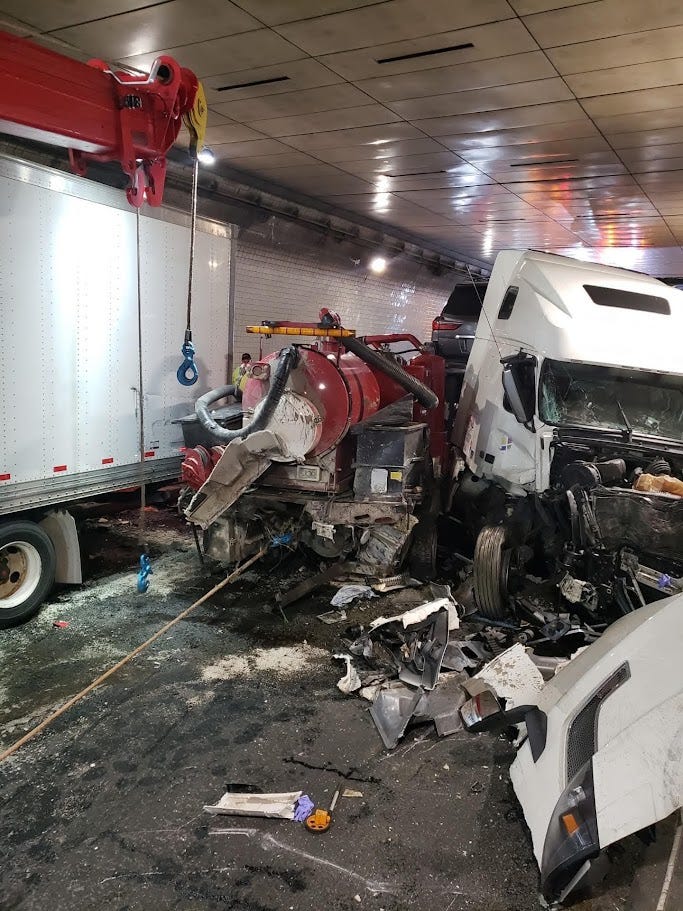
James Richardson was seriously injured when a truck operated by Night Dream Inc. hit him at 53rd and Western in Chicago. He litigated. He won a $1 million settlement. He signed the release and delivered the documents.
He collected nothing. Night Dream’s insurer was Spirit Commercial Auto Risk Retention Group, and by the time the settlement came due, Spirit was in receivership in Nevada. Because Spirit was a risk retention group, Richardson had no access to the guaranty fund in Nevada or in Illinois. The appellate court that reviewed his case acknowledged the unfairness and could do nothing about it. A judgment, a settlement, a signed release, and an empty bag.
That is what trucking’s shadow insurance market does to the people it hits. This is about how big that market is, what it looks like in the federal data, and what happened when the government started wiring the easiest money in American history to the carriers riding on it. The short version: one in three carriers on the road today is running on paper nobody underwrote, the dead insurers left 1,770 bodies in their books, and roughly $1.9 billion in pandemic relief went to trucking entities whose own federal registration proves they weren’t eligible for it.
None of this required a leak or a subpoena. Every number below comes from matching federal databases that have been public the entire time. Nobody ever put them on the same desk.
The worst paper
Insurance is the last real barrier to entry in trucking. Strip away the paperwork, and here is how you become an interstate motor carrier in America: you file for a free, unvetted DOT number; you spend $300 and file for authority; you pay $25 and designate a process agent; and an insurer files a BMC-91 on your behalf. That last step is the entire gate. The new entrant audit is largely an educational formality most carriers pass from a kitchen table. The safety rating system is so backlogged that most carriers will never be rated at all. The insurance filing is the one moment where somebody with money on the line is supposed to look at you and decide whether you belong on the road.
That gate has been dismantled from two directions at once, and we put a size on each direction.
From below, you have instant-issue paper. There are programs today that will bind liability coverage on a brand-new authority the same day it applies, priced by algorithm, no loss history because there is no history of any kind. Nobody in that chain loses money if the carrier turns out to be a disaster. The MGA got paid at binding. The fronting company got paid to lend its name. The risk lands on a reinsurer three layers away or on a thinly capitalized vehicle that was never going to pay a large claim anyway. When I classify the active filings in the federal database by whether real underwriting stood behind them, 71,953 carriers, 34 percent of everything on the road with a current filing, come back non-underwritten. One in three.
From the side, you have the risk retention group. Congress created RRGs in the Liability Risk Retention Act of 1986, during a genuine liability insurance crisis, to let businesses in the same industry band together and insure themselves. The design has two features that matter. An RRG is chartered in one state and can then write in all fifty, with the other forty-nine federally preempted from regulating it. RRGs are barred by federal law, at 15 U.S.C. 3902, from participating in state guaranty funds. For a hospital system insuring its own professional liability, the model works. For commercial trucking liability, where the losses are sudden, catastrophic, and land on strangers who never chose the insurer, it is a machine for privatizing premiums and socializing the wreckage. Today, 7,034 active carriers are riding on it, and they carry 16 percent more crashes per carrier than everyone else, on books that skew toward small fleets that should, if anything, crash less. The paper knows.
Federal Motor Carriers Risk Retention Group was run into liquidation in 2011. The man regulators identified as controlling it through its program manager then stood up Spirit Commercial Auto RRG in Nevada in 2012. Spirit collapsed in 2019 with roughly $199 million in unpaid losses against about $42 million in assets, a forensic audit that found at least $30 million missing, and a state civil complaint calling the whole arrangement a vast fraudulent enterprise. Premium trust money found its way into a cryptocurrency hedge fund. While Spirit was still writing, a third RRG with ties to the same network was formed in North Carolina. Same playbook, three charters, two insolvencies, and no mechanism anywhere in the system that said stop.
One year after Spirit, Global Hawk Risk Retention Group failed in Vermont. Its filings claimed $42.7 million in assets. Regulators went to the banks and found $609,489. Six hundred nine thousand dollars, against $11.9 million in case reserves on 224 open claims. The court’s liquidation order said the 1,008 trucks it covered were effectively uninsured. Federal prosecutors charged Global Hawk’s president, Jasbir Thandi, with misappropriating more than $19 million, including more than $1 million wired to an entity in the British Virgin Islands, and he has since pleaded guilty to two counts of conspiracy to commit insurance fraud.
Put a number on what those three companies left behind. Over their operating lifetimes, Federal Motor Carriers, Spirit, and Global Hawk held 21,035 carrier relationships across 19,588 distinct motor carriers. Those carriers ran up 49,812 crashes in the record, 1,478 of them fatal, 1,770 people dead, 23,519 injured. Every one of those policies was sold with no guaranty fund behind it by insurers that no longer exist, and every claim that matured after the collapses chased a liquidation estate instead of a check. Fifty-nine of those carriers managed to be insured by all three companies in turn, riding one collapsing RRG into the next. Forty-one of the filings, to this day, have never had a cancellation recorded in the federal system. The insurers are dead. The paperwork does not know it.
Underneath all of it sits a floor set when Jimmy Carter was president. The $750,000 federal minimum dates to 1980. Adjusted for ordinary inflation, it would be north of $2 million; adjusted for medical inflation, which is what actually drives crash costs, closer to $3.7 million. The minimum is not a safety rule. It is a compensation rule. It exists so that when a carrier kills or maims somebody, the loss falls on the enterprise that created the risk instead of on the family, on Medicaid, and on the rest of us. We have the data. It’s built on FMCSA’s own data.
The easiest money
Put that market next to the spring of 2020, when the federal government started wiring disaster money to anyone with a business identity. I matched the SBA’s own bulk loan data against FMCSA’s insurance filings, carrier by carrier, exact legal name confirmed against physical state, insured entities only. The match: 27,923 insured motor carriers received $2.35 billion in Economic Injury Disaster Loans.
Some of it is exactly what the program was for. In March, April, and May of 2020, motorcoach and limousine operators, who show up all over this data with the largest loans, watched their entire industry stop existing in a week. A charter bus company taking $500,000 in April 2020 is not a scandal. By June, spot rates were fine, and by the fall the industry was entering the most profitable stretch small trucking had ever seen. Rates went vertical and stayed there for eighteen months. The loans kept flowing.
Sort the money by the type of insurance paper the recipients ran on, because in trucking, the paper tells you which carrier the recipient is. Cross the shadow market against the loan data, and 1,086 carriers running on RRG paper collected $79.6 million in EIDL money.
Some of that is defensible. The biggest single book belongs to the OOIDA Risk Retention Group, the owner-operator association’s long-standing mutual: 235 carriers, $12.3 million, and owner-operators were exactly the businesses the early-2020 market genuinely hurt. But OOIDA’s role in this market deserves a second look. Its leadership has testified against raising the federal insurance minimum at least six times, its COO sits as secretary on the national RRG association’s board, and that association’s own marketing credits OOIDA with leading the charge that killed a proposed increase to $4.5 million per truck. Meanwhile, OOIDA championed aggressive English-proficiency enforcement, which became an out-of-service offense in June 2025, and carriers insured by risk retention groups draw ELP citations at a rate 38% higher per inspection than the rest of the fleet. Hold the two positions side by side. Fight to keep the paper cheap; fight to take the drivers who ride on it out of service. They only look contradictory until you notice what they have in common: in both, the carrier keeps buying the policy right up until the roadside inspection ends the trip. The premium clears either way. Whatever else that is, it is not the voice of the small trucker. It is the voice of the paper.
Then there is the Spirit lineage, still collecting. County Hall, the third RRG tied to the network that produced two liquidations, shows 78 matched carriers drawing $6.57 million in disaster loans through the same season receivers were still counting what was missing from the last collapse. Universal Casualty, an insurer whose book I have reported on in connection with a multistate carrier network now in federal litigation, shows 108 carriers matched to $11.05 million.
Then there is the finding that should have stopped the SBA. Global Hawk was seized by Vermont regulators in the spring of 2020; its liquidation order entered June 8. In the data, twelve EIDL disbursements totaling $649,200 went to carriers whose insurance filing of record was Global Hawk, every one of them approved between June 5 and September 4, 2020. During and after the liquidation. A carrier shows a Global Hawk policy effective March 17, 2020, riding that paper straight through the collapse. On September 4, 2020, the SBA approved it for $150,000. Its Global Hawk filing lapsed two days later. Federal disaster money, approved to a carrier insured by a corpse, two days before the paperwork showed it.
One more thing the data coughed up. There is a suite at 30 N Gould Street in Sheridan, Wyoming, a registered agent’s mail drop, lawful to use. FMCSA shows 95 registered motor carriers at that address. The SBA’s loan data shows 115 EIDL recipients there, totaling more than $5.1 million to one mailbox, and most of the recipients are not trucking companies. They are e-commerce shells, crypto consultancies, supplement brands, an outfit called American Pillowcase. Two federal systems accepted the same empty suite as a place where businesses exist, because the door checks nothing.
The costume
The insured match undersells the problem, because the insured carriers were the ones who at least owned a filing. Widen the match to every motor carrier in the SBA data, EIDL and Paycheck Protection Program both, and the full picture is 85,493 carriers and $7.99 billion. Then sort by one column: the DOT registration date.
On Aug. 26, 2020, an entity registered for a USDOT number. Registration is free. It takes about three minutes. Nobody at FMCSA reviews it. On Sept. 1, six days later, an insurance filing became active on it, written by United Financial Casualty, a Progressive subsidiary that quotes and binds trucking policies online. On Sept. 2, one day after the insurance and seven days after the company, the SBA approved that company for a $150,000 EIDL loan.
EIDL had one bright-line eligibility rule: the business had to be in operation on Jan. 31, 2020. That business certified that it met that rule. Its federal registration says the company came into existence 208 days after the deadline.
It was not unusual. It was just first. There are 17,631 carriers in the match whose USDOT numbers were created after Jan. 31, 2020. They received $1.46 billion in EIDL funds across 18,144 loans. PPP had its own cutoff, Feb. 15, 2020; run the same test and 8,357 carriers with post-deadline DOT numbers collected $478 million. Combined, roughly $1.9 billion in pandemic relief paid to trucking entities whose federal birth certificate postdates the eligibility deadline the money was conditioned on.
A DOT registration date is not a conviction. A landscaping business that bought a truck in June 2020 was a real business in January. An intrastate hauler that went interstate mid-pandemic had a life before its DOT number. Some fraction of those 17,631 carriers has an innocent explanation, and any individual name on the list deserves the presumption that it might be one of them. The aggregate does not need individual guilt to mean something. When 17,631 entities certify a start date that their own federal paperwork contradicts, the question stops being about the borrowers. It becomes a question about the system that never checked. The SBA had the FMCSA registration date. Both datasets are federal. Both are public. They don’t communicate. We downloaded and merged them.
Look at what the machine actually was. Three pieces. The free federal identity: a bare DOT number requires no fee, no fitness review, no human, just a request filled out online. The instant insurance: quote online, bind online, certificate in your inbox, and the certificate looks identical whether you have run freight for twenty years or registered last Tuesday. The self-certified loan: EIDL ran the application through an algorithm confirming the documents existed rather than a person confirming the business did. Stack the three, and ten minutes of form-filling becomes a credible, insured, federally registered business entity, ready to receive federal money. Need to move a load to keep up appearances? Rent a truck for the day.
The data shows the machine running at speed. In the match, 1,073 carriers registered their DOT number in 2020 and had loan money approved within 90 days of registration; the median gap between the DOT number and the loan was 46 days, and $77.3 million went to companies younger than a season. Among post-deadline carriers, 79 verified entities had held their insurance for 60 days or less on the day the SBA said yes. Twenty-two of them held it for two weeks or less. The median policy in that group was 25 days old.
Wildest finding of all: of the $7.99 billion in matched EIDL funds, $5.55 billion, 69 cents of every dollar, went to 56,858 carriers with no federal insurance filing history of any kind. Not lapsed. Not canceled. Nothing, ever. Some of that is legal and expected; private and purely intrastate carriers owe FMCSA no filing, but for more than two-thirds of the dollars, the recipient’s entire relationship with federal transportation regulation was a free form. The DOT number, the one that costs nothing and asks nothing, was the sole federal credential behind $5.5 billion in federal lending. The registration architecture I have described for years as a safety hole turns out to double as loan collateral.
The fingerprints
Free DOT registrations carry neither shame nor scrutiny, and self-certified loans carry only what the borrower typed. Insurance filings carry dates and names. So take every EIDL loan attributable to a specific liability insurer whose filing was in force on approval day, $1.04 billion across 11,369 loans, and count backward from the approval to the day the policy took effect.
The national median is 351 days. The typical carrier that received pandemic relief had been carrying its insurance for about a year by the time the check arrived. It bought the policy to run trucks, not to dress up an application. Roughly one loan in ten, 10.8 percent, went to a carrier whose paper was less than 60 days old. New businesses exist. That is the baseline.
Now sort by insurer, and watch certain books fall out of the distribution. At Blue Hill Specialty, 41 percent of the loans in the book went to carriers whose policy was less than 60 days old on approval day. Four times the national rate. United Wisconsin, 32.5 percent. Trisura Specialty, 32.1. Manufacturers Alliance, 29. Qualitas, 27.5. American Sentinel, 25.7. Among the RRGs, A-One Commercial ran at 24.1. These are not enormous books; Blue Hill’s figure comes from 39 loans, Trisura’s from 81, A-One’s from 29, and small books can produce loud percentages, which is why the baseline matters. A book where four in ten federal borrowers bought their insurance on the way to the loan window is not a book that looks like trucking. It is a book that looks like paperwork.
For contrast, look at OOIDA’s book, the largest RRG lender population in the match at 200 borrowers. The median borrower there had held its policy for 647 to 1,114 days by the time the loan arrived. Two or three years. The share with fresh paper ranged from zero to 3.4 percent. Owner-operators who had carried their coverage since before anyone had heard of Wuhan hit a real economic wall and took the relief the program existed to provide. That is what the program was for, and that is what a membership organization’s book looks like. Hold that picture next to a book where four in ten borrowers were new arrivals, and you no longer need me to editorialize about the difference. The problem a legitimate RRG like OOIDA faces in its role as leadership of the RRG Association, where other not-as-great RRGs live.
EIDL’s public data does not disclose loan performance. PPP’s does, and PPP tells you how the story ended. Among matched carriers whose filing history includes a risk retention group, 5.84 percent of PPP loans were charged off, $20 million in confirmed taxpayer losses. Among carriers on traditional paper, the charge-off rate was 2.36 percent. Two and a half times the default rate, concentrated in the corner of the insurance market with the least regulatory oversight, the corner that has collapsed repeatedly from Spirit to Global Hawk to Universal Casualty. When an RRG collapses, its insureds’ crash victims wait in line at a liquidation. When its insureds’ federal loans default, the taxpayer eats that too. The public paid for both ends of the same book.
One structural point. The insurers behind the pandemic-born carriers, the week-old policies and day-old loans, were not fringe RRGs. They were the largest, most legitimate writers in the non-standard market: Great West, the Progressive family, Lancer, Wesco. Every one of those policies was legal to sell and legal to buy. The observation is about the missing man. Trucking insurance used to come with an underwriter, a human being whose job was to ask who you were and whether your story held together before the certificate printed. Instant-issue replaced that person with a rating engine. The underwriter was never designed to be a fraud checkpoint for federal lending, but he was one, the way a bank teller is a checkpoint, just by being a person who looks at you. In 2020, when a self-certified loan program needed the private market to vet its applicants, the vetting had already been automated.
So here is where four datasets and one investigation land. The registration pathway that lets an unvetted entity put trucks on American highways is the identical pathway that let unvetted entities into the federal loan portfolio. FMCSA gave the identity away for free and made no fitness determination. The insurance market sold the credibility layer with no underwriter at the door. The SBA wired the money with no loan officer in the loop. Three agencies and an industry, each removing its own gate for its own defensible reasons, and nobody responsible for the fact that all the gates were gone at once. Congress is being told, right now, that the data does not exist to evaluate any of this. The data exists. It is public. What does not exist anywhere in the federal government is a single desk where the insurance filing, the loan record, the crash file, and the corporate registration are read together.
The filing dates told us which borrowers dressed for the occasion. The insurer names told us whose counter they dressed at. The charge-off rates told us, three years later, which paper was covering businesses and which paper was covering stories. The government did not just fail to catch the paper carriers. It printed the paper.
Rob, you are continuing to do God's work here. Everyone should hear about this.
Four out of Ten..... those are not good odds.