

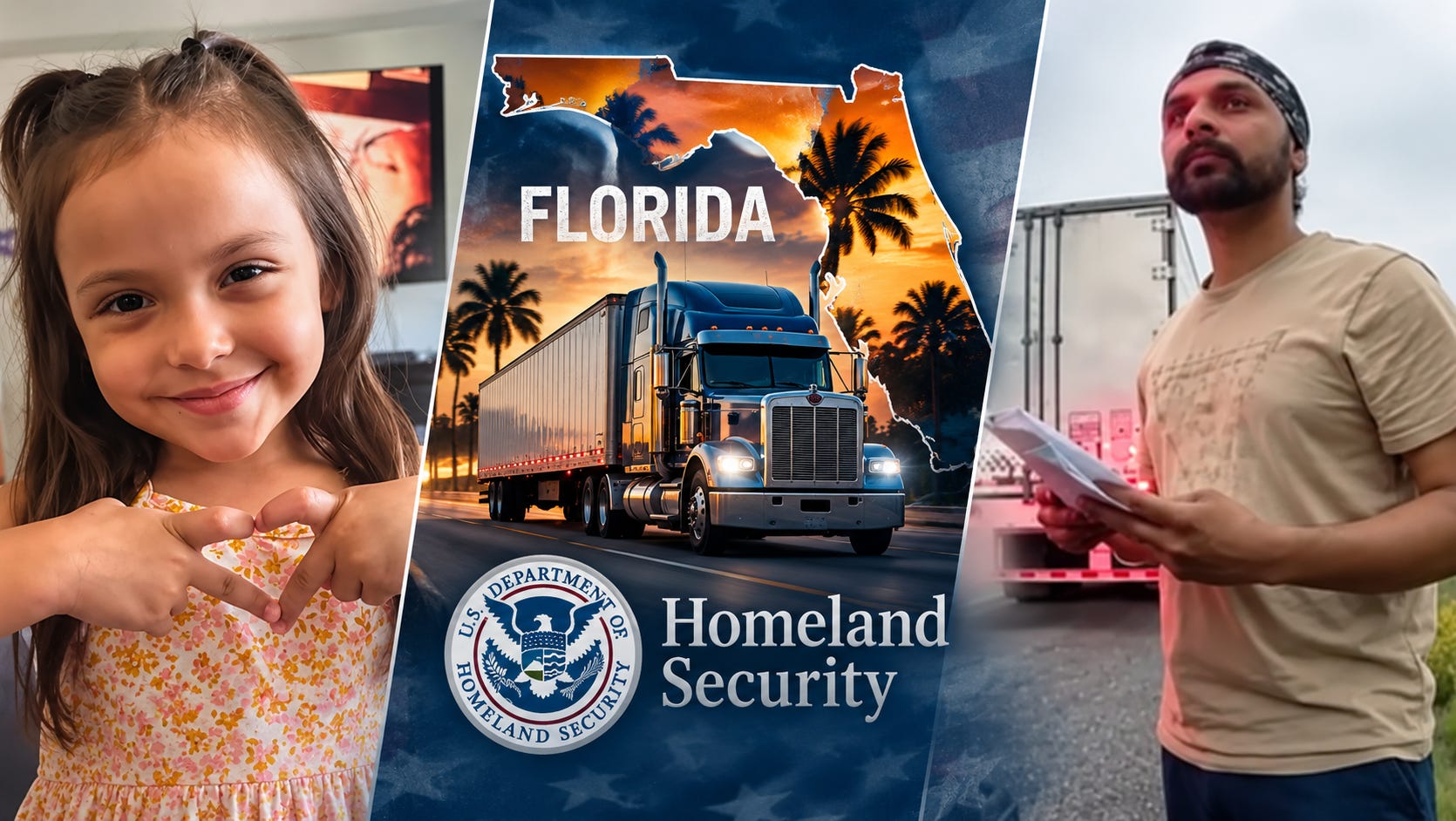
We’re kicking off Dalilah’s Law, a month-long series to emphasize the crashes and stories that led us to a crash that disabled a child and led to her being the name on the bill. How we got here, why we’re still here, and why the bill needs to pass but hasn't yet passed.
Harjinder Singh is still in the St. Lucie County Jail without bond; the Supreme Court won't hear Florida's case against California and Washington; and the carrier that dispatched him has lost its authority. Congress hasn't passed the bill that would have kept him from getting either license
Herby Dufresne was 30 and lived in Florida City. Faniola Joseph was 37 and lived in Pompano Beach. Rodrique Dor was 54 and lived in Miami. On Aug. 12, 2025, just before 3 p.m., they were riding north on Florida’s Turnpike near mile marker 171 in St. Lucie County in a 2015 Chrysler Town and Country. Ahead of them, the Florida Highway Patrol says, a 2024 International tractor-trailer pulled into an “Official Use Only” crossover and tried to turn around, and the trailer swung across every northbound lane. The speed limit there is 70 mph. The minivan went under the trailer’s left side. Two of the three died at the scene, and the driver died that evening at Lawnwood Hospital in Fort Pierce. The truck driver and his two passengers weren’t hurt.
The driver was Harjinder Singh, 28, from Rataul village in Punjab’s Tarn Taran district. DHS says Border Patrol arrested him near San Ysidro on Sept. 20, 2018, two days after he crossed, and that his immigration case had been pending since. Florida charged him with three counts of vehicular homicide, placed an ICE detainer on him, and flew him back from Stockton, California, on Aug. 21, 2025, with Lt. Gov. Jay Collins escorting him onto the plane. He pleaded not guilty in September. He’s been held without bond, and his case has cycled through docket calls in Fort Pierce, most recently an in-person hearing in May. No trial date has been published. His lawyers, Natalie Knight-Tai and Tejinder Bains, say they’re giving him the defense any defendant is owed, and a petition asking Gov. Ron DeSantis for leniency has drawn more than 2.6 million signatures, most of them from India.
Two states, two cards
Federal law allows one CDL per person. Washington issued Singh a standard full-term CDL on July 15, 2023. California issued him a limited-term, non-domiciled CDL on July 23, 2024, while the Washington license was still active. The Commercial Driver’s License Information System exists to catch exactly that, a second license issued in a second state, and it didn’t. His work authorization had been denied on Sept. 14, 2020, and approved on June 9, 2021, and under the rules in effect when both states licensed him, a work authorization document was the key to a non-domiciled CDL.
Washington has since admitted its part. On Oct. 1, 2025, the state Department of Licensing told Overdrive that Singh should have received a non-domiciled credential and that its review found 685 cases between Jan. 1, 2018, and Aug. 31, 2025, in which a driver got a standard CDL instead of a non-domiciled one. The department said all 685 were qualified and entitled to a CDL, only on the wrong card. Washington records also show Singh failed the state’s CDL knowledge exam 10 times between March 10 and May 5, 2023, before he passed. California says it issued his non-domiciled license after he failed his first test there and then passed.
After the crash, FMCSA investigators gave Singh the roadside English proficiency assessment. He answered 2 of 12 verbal questions correctly and identified 1 of 4 highway signs. Six weeks before the crash, on July 3, 2025, New Mexico State Police had stopped him for speeding. Bodycam footage shows him asking the trooper, “Maybe in this, this my ticket, on my license, how many years?” The English out-of-service criterion had taken effect June 25. New Mexico said there were no communication issues, and DOT’s preliminary review found no English assessment was given.
The carrier
Singh drove for White Hawk Carriers Inc., USDOT 2866642, MC 960440, of Ceres, California. Its FMCSA record over the two years before the crash carried more than 80 violations, including nine unsafe driving violations, 19 hours-of-service violations with 10 false logs, a driver on a suspended CDL, a driver operating while disqualified, and an air brake restriction violation. Its driver out-of-service rate was 13.4%, about double the national average of 6.67%. Great West had already scheduled White Hawk’s insurance for cancellation on Aug. 19, a week after the crash.
The company’s paper trail ran through a UPS Store box at 2908 E. Whitmore Ave., Suite H 293, in Ceres. A brokerage with the same name, White Hawk Carriers Inc., USDOT 3710077, MC 1301740, used that box as its mailing address and listed a physical address at an apartment on Harbour Cove Drive in Sparks, Nevada. State records tie White Hawk’s 2016 founding to Navneet Kaur, who was also listed as a director of White Star Trucking of Modesto, which closed in 2013. Twelve of White Hawk’s 18 listed trailers also appeared under other DOT numbers, and at least six trailer VINs showed up in the inspection histories of both White Hawk Carriers and White Hawk USA.
Within days of the crash, FMCSA’s SAFER snapshot showed White Hawk’s motor carrier authority as not authorized. The broker authority has since been revoked. Florida Attorney General James Uthmeier subpoenaed the company. Those actions happened after three people died, and they happened because a governor, a Cabinet secretary, and a national press corps were watching.
Florida’s lawsuit ends
In October 2025, Uthmeier asked the U.S. Supreme Court for permission to sue California and Washington under the court’s original jurisdiction over disputes between states. Florida argued that federal law preempts the two states’ laws barring licensing clerks from asking about immigration status, and that their CDL practices amounted to a public nuisance. On May 26, 2026, the court denied Florida leave to file, without explanation. Justice Clarence Thomas, joined by Justice Samuel Alito, dissented, writing that the court can’t refuse to hear suits between states and that Florida “has nowhere else to bring” its claims. That leaves the question of how California and Washington licensed Singh to FMCSA’s program reviews, its funding penalties, and Congress.
What Dalilah’s Law would change
Section 3 of Dalilah’s Law, as amended in the House Transportation and Infrastructure Committee on March 18, would limit CDLs to citizens, nationals, and lawful permanent residents domiciled in the issuing state, with non-domiciled licenses only for H-2A, H-2B, and E-2 visa holders. An asylum seeker with a work authorization document, as Singh was, wouldn’t qualify in any state. The state would have to confirm status through a federal system before issuing, transferring, renewing, or upgrading; the card could last no more than a year, and every state would have to audit its unexpired non-domiciled licenses within a year and revoke the ones that don’t comply.
Section 2 would make the English test at the DMV counter mandatory, with knowledge and skills tests given only in English, and would make a first English out-of-service order a disqualifying offense. Section 6 would let FMCSA revoke registration from a carrier that uses a driver without a CDL issued to federal standards or without the English qualification. White Hawk lost its authority through a crash and a political firestorm. Under Section 6, the violation itself would be grounds.
FMCSA has already done much of this by rule. The non-domiciled final rule took effect March 16, 2026, and the D.C. Circuit refused to stay it in May. On Sept. 15, a different panel heard the challenge on the merits and pressed the government hard, questioning whether the E-2 exception works as a proxy for driving records. If that panel strikes the rule, the eligibility limits go away, and states return to the work authorization standard that licensed Singh. That’s the argument OOIDA President Todd Spencer made to House Speaker Mike Johnson in July, and the reason the bill’s supporters want a floor vote before the court rules.
What the bill wouldn’t fix
Dalilah’s Law doesn’t address the carrier network in Fort Pierce. Nothing in it addresses a trucking company and a brokerage sharing a name and a UPS box across two states, trailers moving between DOT numbers, or a carrier with 10 false logs in two years staying authorized until a crash. Section 7 bars brokers based outside the United States, and White Hawk’s brokerage was in Nevada. The New Mexico stop is a training and enforcement failure the bill addresses only by requiring DOT to issue consistent English enforcement guidance within a year.
After the Ashley Chapman crash in Gloucester, Virginia, I watched the carrier, Lucky Dog, double its violations and telematics events in the 30 days after the wreck while its driver went to prison for three years. The Fort Pierce record looks the same from the carrier side. The driver sits in a county jail. The people who put him in the truck and cleared him to haul answer to a subpoena and a revoked authority, and nobody has been charged.
Three families in South Florida buried Herby Dufresne, Faniola Joseph and Rodrique Dor 13 months ago. The crash put English proficiency and non-domiciled licensing on the front page of every newspaper in the country. The law that would make those fixes permanent is still waiting for a vote.