

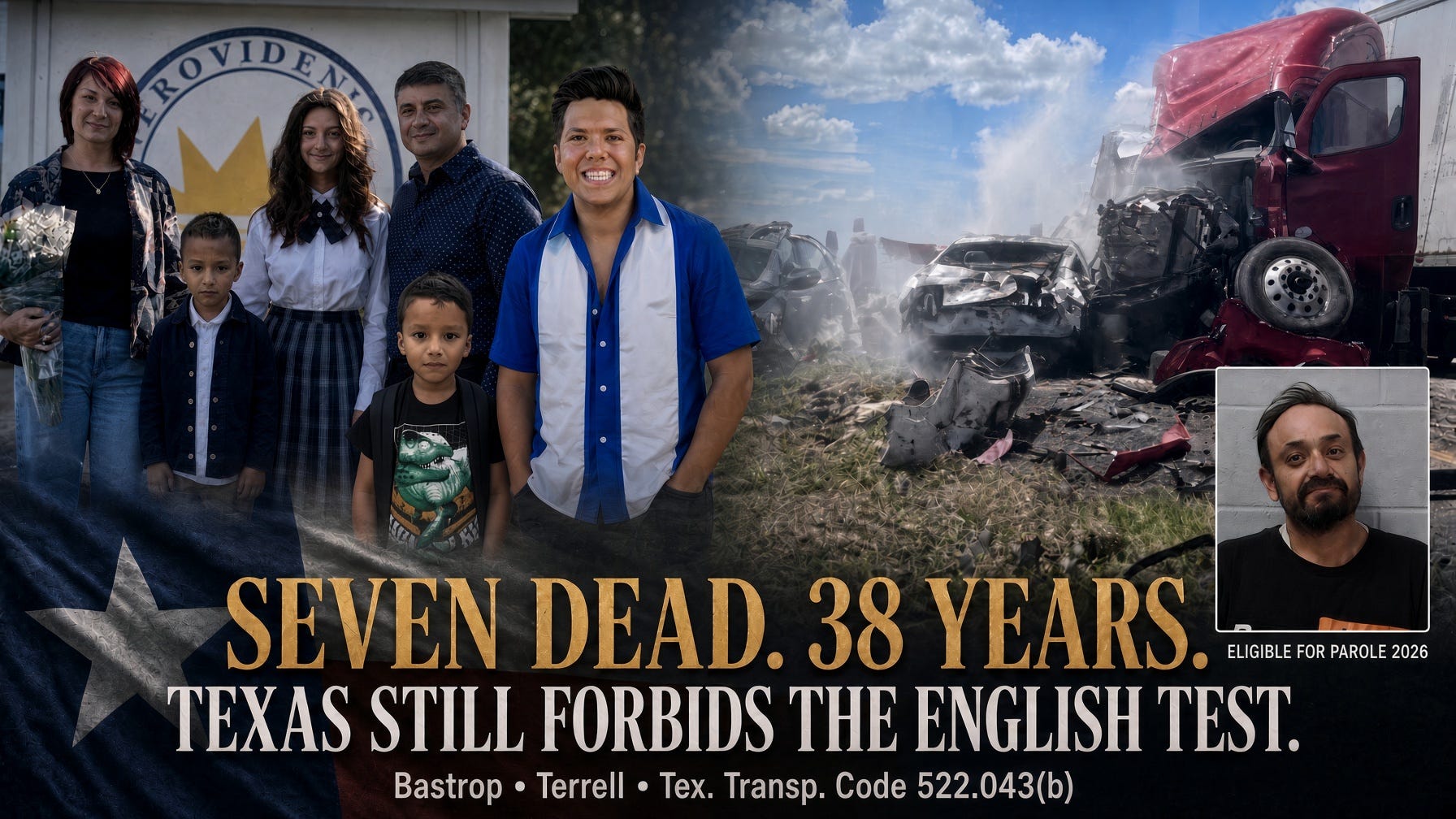
Two Texas crashes that killed seven people ended in prison sentences totaling 38 years. The English proficiency standard is now enforced at the roadside and is headed for a federal rule, but Texas Transportation Code 522.043(b) is still on the books, and only Dalilah’s Law would override it by statute.
A cocaine-impaired concrete truck driver killed a 5-year-old on a school bus in Bastrop County. A Hope Trans driver who fell asleep killed five people on Interstate 20. A year after I wrote about both, the drivers are in prison, one of them already eligible for parole, and the English proficiency fight has moved from a memo to a proposed rule and a bill nobody has scheduled.
At 2 p.m. on March 22, 2024, a Hays CISD school bus was bringing 44 pre-kindergarten students and 11 adults from Tom Green Elementary back from a field trip to the Bastrop Zoo on State Highway 21. The bus had no seat belts. A concrete pumper truck coming the other way drifted across the double yellow line. The bus camera shows the driver steering right, and the truck hitting the bus head-on about halfway into its lane. The bus rolled onto its side. Ulises Rodriguez Montoya, 5, died. Ryan Wallace, 33, a University of Texas doctoral student driving behind the bus, died too. Eighteen people went to hospitals.
The truck driver, Jerry Hernandez, told Texas Department of Public Safety troopers he’d smoked marijuana the night before, used cocaine that morning and slept about three hours. The federal Drug and Alcohol Clearinghouse had listed him as prohibited from driving a commercial vehicle since April 2023 after a cocaine positive, with an earlier refusal to test in September 2020 and a marijuana positive in December 2022. His employer, FJM Concrete Pumping LLC, didn’t check. Owner Francisco Martinez Jr. told investigators he never verified the CDL status or queried the Clearinghouse. FMCSA declared Hernandez an imminent hazard on March 29, 2024.
Hernandez pleaded guilty in June 2025 before 423rd District Judge Chris Duggan to two counts of manslaughter. On Sept. 18, 2025, he was sentenced to 18 years on each count, running concurrently. In April 2026, he became eligible for parole review in mid-April, and Hays CISD wrote to the Texas Department of Criminal Justice opposing his release. Jason Feltoon, a lawyer for survivors, put it this way: “The court said 18 years. Not two.” Nine civil suits against Hernandez and FJM have been consolidated. FJM carried the $500,000 minimum policy required for its operation, and the lawyers for the families have said that won’t cover dozens of injured children.
Terrell
Fifteen months after the Bastrop crash, a different kind of driver failure killed five people on Interstate 20 near Terrell. On June 28, 2025, Alexis Osmani Gonzalez-Companioni, driving a Hope Trans LLC truck with a postal load, told investigators he fell asleep and drove into stopped traffic. Zabar McKellar, 52, Shawn McKellar, 45, Kason McKellar, 15, Billy McKellar, 79, and Nicole Gregory, 49, died. FMCSA’s August 2025 compliance review found that Hope Trans used drivers before they passed pre-employment drug tests, skipped post-accident alcohol testing, and ran a 46.2% vehicle out-of-service rate; it proposed an unsatisfactory rating. In June 2026, Gonzalez-Companioni pleaded guilty and was sentenced to 20 years.
Neither crash turned on English. Hernandez was a Texan with a drug record the system already had. Gonzalez-Companioni’s failure was fatigue on a solo route that postal rules said needed a team. I put them in a piece about English proficiency last year because both happened in the one state whose law forbids its licensing agency from testing it, and that law hasn’t changed.
What Texas law still says
Texas Transportation Code 522.043(b), enacted by the 74th Legislature in 1995, says the Department of Public Safety “may not administer examinations or tests relating to the applicant’s proficiency in the English language.” If an applicant can’t speak enough English to tell DPS staff why he wants a CDL, the department may issue him one restricted to intrastate commerce. It was still current law in August 2026. Nobody proposed repealing it at the Texas legislative hearing on foreign CDLs this summer, where lawmakers discussed the Austin I-35 crash and the trucking industry asked them to bar Mexican and Canadian license holders from intrastate work.
Texas has moved around the statute. Gov. Greg Abbott ordered DPS in September 2025 to enforce English proficiency for commercial drivers, including intrastate license holders, and told Commercial Vehicle Enforcement troopers to run English reviews at roadside. In June 2026, DPS announced it would give CDL and learner’s permit knowledge exams only in English. Federal officials say about 26,000 drivers nationally have been removed from the road for failing English proficiency over the past year, and about 30,000 commercial licenses were canceled as improperly issued. Those are administrative moves. The statute still tells DPS it can’t test.
What the federal side did
The English requirement in 49 CFR 391.11(b)(2) says a driver must read and speak English well enough to talk with the public, understand highway signs and signals, respond to official inquiries, and make entries on reports and records. In 2016, FMCSA told inspectors not to put drivers out of service for it. President Trump’s executive order of April 28, 2025, reversed that. FMCSA issued guidance on May 20, 2025, setting a two-step roadside assessment: an English interview with no interpreters or translation apps, followed by a sign recognition test, and the Commercial Vehicle Safety Alliance made failure an out-of-service violation effective June 25, 2025. The April 1, 2026, printed criteria carry it, and FMCSA replaced its 2025 memo with policy MC-SEE-2026-0002, last updated April 16, 2026.
On Aug. 10, 2026, FMCSA published a proposed rule, Docket FMCSA-2026-0826, to write the out-of-service consequence into the regulations. The proposal’s own numbers show what happened when enforcement came back. From Jan. 1 to June 24, 2025, inspectors wrote 7,812 English violations and put 33 drivers out of service. From June 25, 2025, through March 19, 2026, they wrote 60,399 violations, and 19,045 ended in out-of-service orders. Violations written inside border commercial zones along the Mexican border don’t carry out-of-service orders. The comment period runs 60 days from publication, into early October. On Aug. 31, DOT removed 110 CDL schools from the Training Provider Registry after matching roadside English failures back to the schools that trained those drivers, and said the 110 were tied to more than 5,000 drivers who failed.
California, New Mexico and Washington drew federal funding threats last year over English enforcement. DOT pulled about $40 million from California for refusing to enforce English proficiency at roadside, separate from the $160 million fight over its non-domiciled licenses that the D.C. Circuit heard on Sept. 11.
What Dalilah’s Law would add
A regulation can be rewritten, and a memo can be rescinded, as the 2016 memo showed. Section 2 of Dalilah’s Law, labeled Connor’s Law at the March 18 markup after Connor Dzion, the 18-year-old killed in Florida in 2017 by a truck driver who couldn’t read the police warning signs, would put the standard in 49 U.S.C. 31305. The secretary would have to ensure a person may operate a CMV only if he can read and speak English well enough to talk to police, understand signs, respond to official inquiries, and fill out reports. An inspector who finds a driver can’t meet it would have to put him out of service. A first English out-of-service violation would become a disqualifying offense under 31310. States would have to give knowledge and skills tests only in English. American Sign Language counts. DOT would have a year to write the rule and issue guidance for consistent enforcement across states.
Section 31305 sets the minimum standards every state’s CDL testing program has to meet, and the new English subsection in the bill doesn’t limit itself to interstate drivers. A state statute barring the licensing agency from testing English would sit in direct conflict with a federal requirement that the tests be given in English, and Section 4 of the bill would put up to 8% of the state’s core highway formula money at stake the first year and up to 12% after that. Texas could keep 522.043(b) on the books, but it would cost the state money every year it did.
Section 6 reaches the FJM side of Bastrop. A carrier that knowingly lets someone drive without a CDL issued to federal standards would face suspension or revocation of its registration. Since Nov. 18, 2024, the Clearinghouse II rule has required states to downgrade the CDL of a driver in prohibited status, which would have taken Hernandez’s license before March 2024 if it had been in effect.
The data behind English enforcement is thinner than the politics. FMCSA hasn’t published a study linking English proficiency to crash rates, and in the first round of the non-domiciled fight the D.C. Circuit noted that FMCSA’s own numbers showed the excluded drivers crashing at a lower rate. Fatigue, drugs, equipment, and carrier oversight account for most of the fatal crashes I’ve reconstructed. Neither Texas crash in this piece was a language failure. FMCSA’s post-crash assessment put English at the center of Harjinder Singh’s case; investigators found Connor Dzion’s driver couldn’t read the warning signs, and a driver who can’t read “Road Work Ahead” or answer a trooper is a risk whose cost shows up in the work zone, not in a regression table. The Laredo Motor Carriers Association has been running free weekend English classes with DPS officers to teach drivers what the roadside assessment asks, a fix that keeps a qualified driver working.
The man who killed Ulises Rodriguez Montoya was already in a federal database as prohibited from driving, and his employer never looked. Texas still has a law that tells its own licensing agency not to ask whether the next applicant can read the sign.