

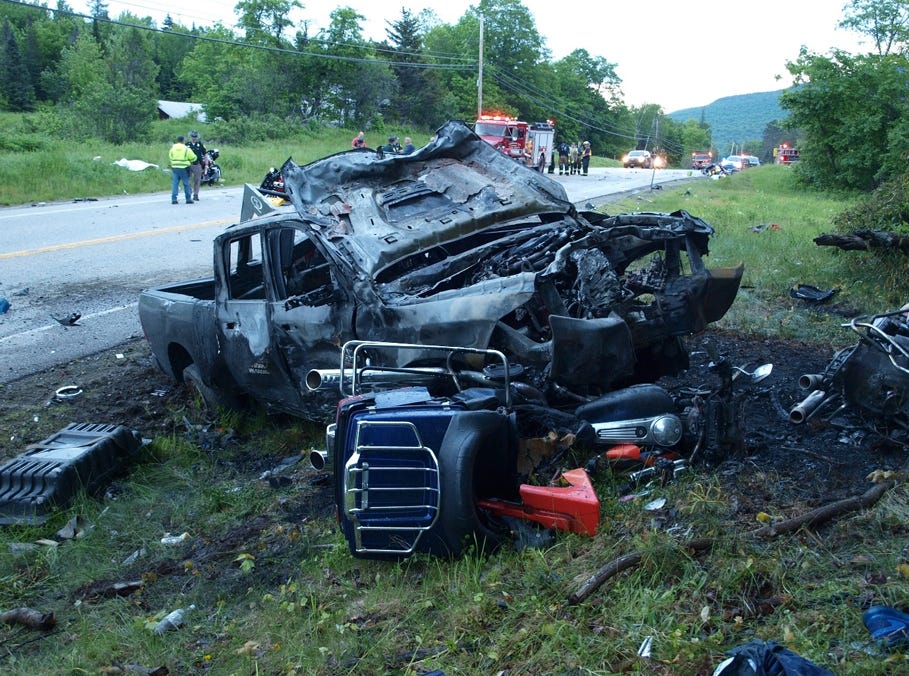
On May 11, 2019, Volodymyr Zhukovskyy failed a field sobriety test in a Walmart parking lot in East Windsor, Connecticut, and refused a urine test. Connecticut suspended his privilege to drive in that state and sent the notice to the Massachusetts Registry of Motor Vehicles, the agency that issued his commercial driver’s license. That notice should have ended his commercial driving. Instead, it went into a backlog of unprocessed out-of-state violation reports, and his CDL stayed clean on paper.
Forty-one days later, at about 6:30 p.m. on June 21, 2019, the 2016 Dodge pickup he was driving for Westfield Transport, towing a flatbed car hauler, crossed the center line on U.S. Route 2 in Randolph, New Hampshire, and went through a formation of riders from the Jarheads Motorcycle Club, Marine veterans and their spouses headed to a charity event at the American Legion post in Gorham. Seven died: Albert “Woody” Mazza Jr., 59, the club’s president; Edward “Taz” Corr, 58, and his wife, Jo-Ann Corr, 58, of Lakeville, Massachusetts, weeks from their 38th anniversary; Michael “Fritz” Ferazzi, 62, of Contoocook, New Hampshire; Daniel “Danny Boy” Pereira, 58, of Riverside, Rhode Island; Aaron “Stitches” Perry, 45, of Farmington, New Hampshire; and Desma Oickle, 42, of Concord, New Hampshire. Prosecutors said Zhukovskyy had taken heroin, fentanyl, and cocaine that day, swerved repeatedly before the collision, and told police he caused it.
This is the run of cases behind my argument that Congress needs to pass Dalilah’s Law. I’ll start with the concession, because this one needs it. Zhukovskyy came to the United States from Ukraine at 10 and held lawful permanent resident status. He spoke English. The parts of the bill that get the airtime- English proficiency and the limits on who can hold a CDL- wouldn’t have touched him. The part that would have is the least glamorous section in the bill. And the company that put him in that truck sits in a gap that Dalilah’s Law doesn’t close at all.
Where the case stands today
Here’s the update, as of Oct. 3, 2026.
New Hampshire kept Zhukovskyy off its roads for the longest term its law allows, and that term is over. After the crash, the state suspended his driving privileges. He asked for them back. In May 2024, Administrative Law Judge Ryan McFarland of the Department of Safety found he had driven in an unlawful or reckless manner that contributed to the crash. On July 10, 2024, McFarland set the suspension at the seven-year maximum but dated it from June 24, 2019, three days after the crash. The state had asked for the seven years to start in 2024, which would have run to 2031. McFarland credited Zhukovskyy’s testimony that he had been sober for five years. Zhukovskyy appealed, and in May 2025 Merrimack County Superior Court Judge Martin Honigberg upheld the finding, writing that the hearings examiner reasonably called his decision to keep driving “a gross deviation” from what a reasonable person would do. The suspension expired June 24, 2026.
I found no public report that Zhukovskyy has applied for a license in New Hampshire or anywhere else since it expired. His Massachusetts license status isn’t public. When the Boston Globe asked in 2024, the RMV cited state privacy law.
The Connecticut case that should have stopped him in 2019 finally closed in 2025. On April 14, 2025, he entered an Alford plea in Hartford Superior Court to operating under the influence for the East Windsor arrest, meaning he didn’t admit guilt but conceded the state had enough to convict. He got 18 months of probation, 100 hours of community service, and random drug testing. That probation runs into the fall of 2026. It is the only criminal conviction he has from 2019, and it came almost six years after the arrest.
His immigration case hasn’t moved. Immigration and Customs Enforcement took him into custody on Aug. 10, 2022, the day after a Coos County jury acquitted him. An immigration judge ordered him removed on Feb. 3, 2023, and his lawyers sought asylum. ICE had paused repatriation flights to Ukraine in March 2022 after Russia invaded, and he was released under an order of supervision in April 2023. I found no public record that the removal order has been carried out.
Coos County Superior Court Judge Peter Bornstein dismissed eight impairment-related charges before the case reached the jury, ruling the state hadn’t proved he was impaired at the moment of impact. The defense put the blame on Mazza, whose blood alcohol content was .135, and argued the collision happened on the double yellow line. On Aug. 9, 2022, after less than three hours of deliberation, the jury acquitted Zhukovskyy of seven counts of manslaughter, seven counts of negligent homicide and one count of reckless conduct. Gov. Chris Sununu said the seven bikers did not receive justice. Attorney General John Formella said he believed the state proved its case.
The company
Westfield Transport hired Zhukovskyy on June 18, 2019. The crash happened on his first trip, three days later. Federal rules give a motor carrier 30 days after hire to pull a new driver’s motor vehicle record and employment history under 49 CFR 391.23. Westfield didn’t need the 30 days. The National Transportation Safety Board found it ran no background check.
The owners didn’t need one either. Dunyadar “Damien” Gasanov told federal investigators he met Zhukovskyy the day he hired him. Prosecutors later established he had known him for years and knew about his drunken driving charge. What a background check would have shown, according to the employer records the NTSB collected: a 2013 Massachusetts drunken driving arrest that cost him his license until December 2016; a 2014 Ohio guilty plea to driving on that suspended license and handing an officer someone else’s ID; a 2017 drug possession conviction; a December 2018 firing from Universe Express over suspected drug use; a Feb. 11, 2019, drug paraphernalia arrest in Baytown, Texas; and on June 3, 2019, a rollover in Baytown in a Mack hauling cars for FBI Express, which fired him four days later for not completing a post-crash drug test in time and for the crash. Westfield hired him 11 days later.
The NTSB’s review was wild. Of 150 driver logs investigators examined, 28 were falsified. The company told drivers to disconnect their phones from their electronic logging devices so driving time wouldn’t record, and its manager showed investigators how it was done. The board found Westfield tried to add Zhukovskyy to its insurance policy about an hour after the crash. In the 18 months after the carrier graduated from FMCSA’s new entrant program, it logged 48 roadside inspections and 23 out-of-service violations, with a driver out-of-service rate of 20.8%, nearly four times the national average, and three BASICs in alert. FMCSA rated it moderate risk and never ran a compliance review. After the crash, FMCSA’s own investigators recommended an imminent hazard order. The agency declined. By August 2019, Westfield and its sister company, East Transport, told FMCSA they were out of business.
The NTSB tied at least 21 motor carriers to the Gasanovs through shared vehicles, drivers, addresses, and officers. When investigators went to Zhukovskyy’s family home in West Springfield, they found a DAKS Express sign on the mailbox, and vehicles marked Vlad’s Transport in the driveway. Zhukovskyy had dispatched for Vlad Transport, which had no USDOT number. County Transport shared three trucks with identical plates and VINs and then refused a safety audit. East2West Transport, started Aug. 22, 2019, was managed by a former Westfield driver and employed a Westfield driver with a suspended license. When I reported in January, DAKS Express and East2West still held active authority.
Dunyadar Gasanov was indicted on falsification of records, conspiracy, and a false statement. His brother Dartanyan Gasanov, the company’s listed president, treasurer, secretary and director, was indicted on one count of falsification of records, accused of logging himself off duty on three occasions between April 1 and June 20, 2019, when prosecutors say he was driving Westfield trucks. That count carries up to 20 years.
Dunyadar pled guilty in August 2024 to three counts of making false statements to federal investigators, including the lie about how long he had known Zhukovskyy. Prosecutors asked for a year. On Nov. 21, 2024, U.S. District Judge Mark G. Mastroianni sentenced him to two months, 12 months of supervised release with no commercial driving, and a $300 special assessment.
Dartanyan tried to plead guilty in 2021, and the court didn’t accept the plea. He has pleaded not guilty since and is presumed innocent. His trial was set to start March 2, 2026, in Springfield before Mastroianni, and he reportedly turned down a plea offer with no prison time. Seven months after that date, I haven’t found a verdict, a plea, a dismissal, or a sentencing reported anywhere, and the U.S. Attorney’s Office in Massachusetts hasn’t announced one. If that case resolved quietly, nobody told the families.
The driver: acquitted in New Hampshire, a probation sentence in Connecticut six years late, a removal order on a shelf, and a suspension that ended in June. One owner: two months. The other: no public resolution. The carriers around them: some still running.
Why Dalilah’s Law, and why it’s not enough by itself
H.R. 5688 cleared the House Transportation and Infrastructure Committee 35-26 on March 18, 2026. As of today, it has gone 199 days without a floor vote. On July 15, the Owner-Operator Independent Drivers Association wrote Speaker Mike Johnson demanding one. Critics call the bill immigration policy dressed as road safety. Randolph is the case that answers them, because nothing about it turns on citizenship. It turns on paper.
Section 5 amends 49 U.S.C. 31311(a) to require every state to disqualify a driver from operating a commercial vehicle for the same reasons and periods another state disqualified him under 31310, and to act when DOT notifies it that a driver was convicted of an equivalent offense in a foreign country. It also amends 31310(g)(1) so the disqualification rules for serious offenses in a personal vehicle apply to drivers required to hold a CDL, not only drivers who happen to hold one.
Federal rules already told Massachusetts to post Connecticut’s report and act on it. The registry had the notice and didn’t open it. A state’s own audit after the crash found tens of thousands of out-of-state notices that were never entered into drivers’ records, and Registrar Erin Deveney resigned days after Randolph. Writing reciprocity into statute doesn’t make a clerk open a file. It gives DOT a clean statutory hook, and Section 4 attaches money to it by withholding federal highway funds from states that don’t comply. A backlog in a box becomes a line item a governor has to answer for. That’s the value.
Section 6 hits the same failure on the employer’s side. It orders the driver record notification system modernized within three years so carriers learn when a driver’s license status changes. A carrier that wanted to know would have known. A carrier that didn’t want to know would have had a harder time pretending.
What Dalilah’s Law doesn’t touch is the Gasanovs. It has no penalty for a carrier that knowingly puts a disqualified driver behind the wheel and nothing aimed at the affiliate web the NTSB mapped. On Sept. 28, Rep. Brandon Gill of Texas filed H.R. 10620, Barron’s Law, named for 8-year-old Barron Ritchey, killed on Interstate 35 near Hillsboro in April 2023. It would fine a carrier $25,000 for knowingly employing a driver who is ineligible under federal law, $100,000 if that leads to serious injury or death, deny registration for three years after a revocation, and fine any carrier $25,000 for using a successor or affiliated company to dodge a revocation or safety sanction. That last clause reads like it was written about East Transport and East2West.
Here’s the catch, and it’s the whole argument. On paper, Zhukovskyy wasn’t ineligible on June 18, 2019. His CDL was valid because Massachusetts never posted the Connecticut suspension. A carrier penalty keyed to ineligibility only bites if the state record is right, and the state record only matters if carriers have to check it before the first load, not 30 days after. Section 5 fixes the record. Section 6 pushes it to the employer. Barron’s Law, or something like it, makes ignoring it expensive. Pass the first one, and the next owner who hires a man he’s known for years, knowing his history, at least can’t hide behind a clean license.
The Jarheads were buried in 2019. The man who hit them has finished the longest suspension New Hampshire allows, the owner who lied about hiring him finished his two months, and the other owner’s case has gone quiet. The notice Connecticut sent is still the cheapest thing in this whole story to fix.
Congress has had it for 199 days.
Rob, one question your Delilah series raises for me is whether FMCSA evaluated these cases for criminal referral—and if no referrals were made, why? FMCSA does not prosecute, but 49 U.S.C. § 521(b)(6)(A) already provides criminal penalties for knowing and willful violations of covered federal motor carrier safety requirements. For carriers and owners, death is not required.
Were referrals made and declined by DOJ, or did these cases never reach prosecutors? We need that distinction.
And in the push for Delilah’s Law, why wasn’t this existing criminal enforcement avenue strengthened as well—with clearer referral requirements, accountability for those decisions, and stronger penalties for knowing and willful violations? Keeping dangerous carriers off the road matters. So does holding the people who knowingly put them there accountable. A civil fine cannot remain an acceptable cost of doing business.