

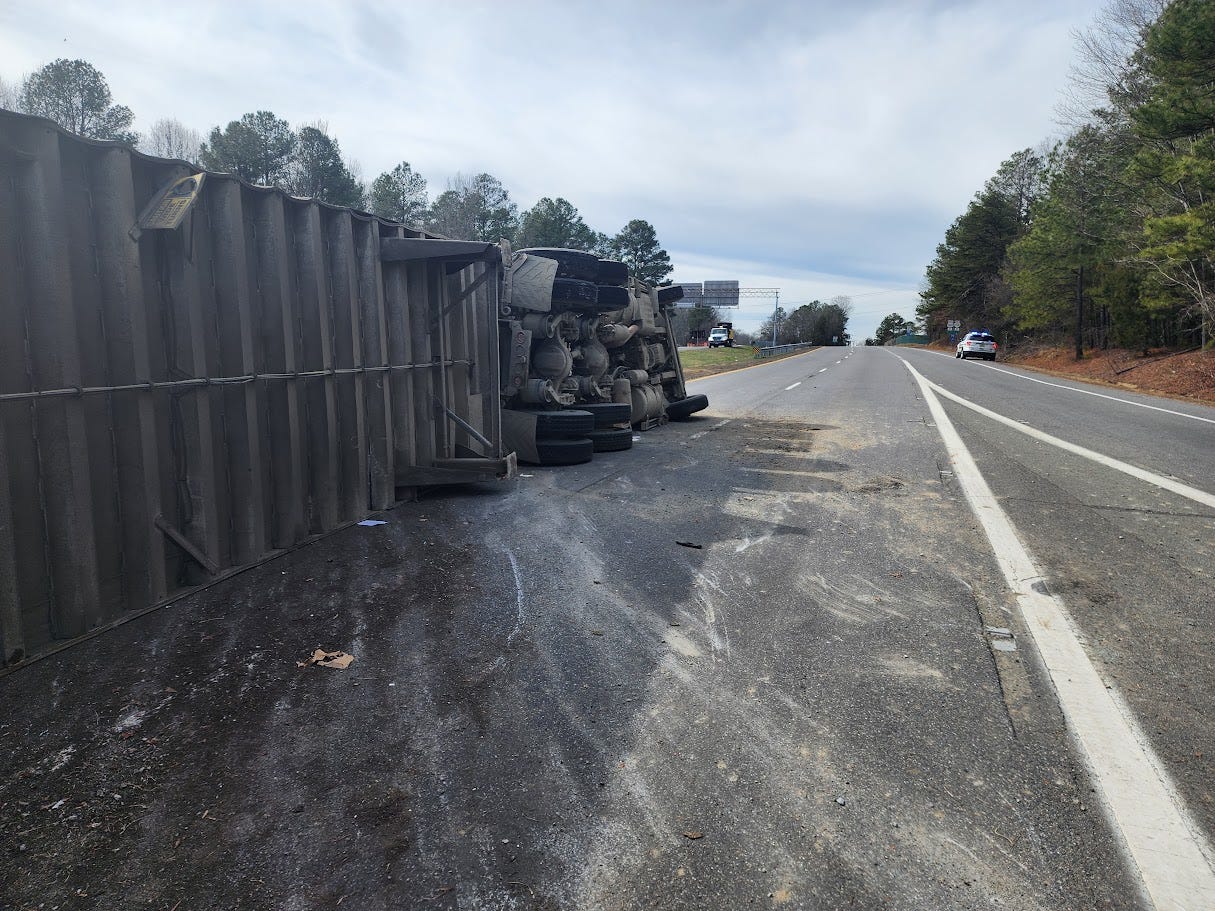
This photo is one of about 50 rollovers I’ve worked on. From the armchair, most would say it goes too fast into the curve, or too top-heavy, or both. The real reason was that the driver had a stroke, and his speed and control became secondary. There are all kinds of data on rollovers, but there are also all kinds of variables, controls, and conditions that contribute to all that noise. So I started thinking about data noise and night crashes and fatigue and ELDS. Ten in the morning: 2.66 deaths per hundred crashes. Two in the morning: 5.27.
Same trucks. Same drivers. Same roads. Twice the funerals.
Here’s the whole day, every reportable truck crash in the federal file:
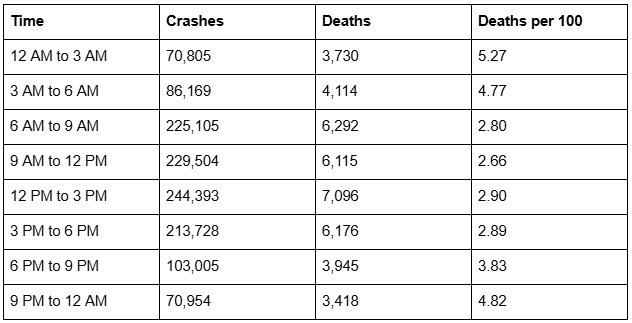
Nine at night to six in the morning accounts for 18.3 percent of truck crashes and 27.5 percent of the deaths. If the overnight hours killed at the same rate as midmorning, 5,199 people in this file would still be alive.
Why this number
Most trucking statistics fall apart on the denominator. Somebody says a corridor is dangerous, and it turns out they counted crashes without counting how many trucks drove it. Somebody says a state is the worst for cargo theft, and it turns out that state just fills out more paperwork. I have spent the last week taking apart federal datasets, and most of them do not withstand scrutiny.
This one does, because it never needs to know how many trucks were on the road. It is a rate, and the denominator is the number of crashes. I am not asking how often trucks crash at 2 a.m. I am asking, once a truck has crashed at 2 a.m., how often somebody dies. Traffic volume cannot touch that. Neither can exposure, miles, or fleet size.
MCMIS only records crashes that meet the federal threshold: a fatality, an injury requiring transport, or a tow-away. There are no fender benders in here diluting anything. Serious crashes compared to serious crashes.
What the industry says kills people at night
Hours of service exist because of fatigue. That is the entire premise. Eleven hours driving, fourteen-hour window, ten hours off, thirty-four-hour restart. Every one of those numbers is a fatigue number. FMCSA has justified the fatigue rules for as long as they have existed, and every fight over them since has been an argument about hours.
The 2013 restart rule went further than any of it. It required two consecutive periods between 1 a.m. and 5 a.m. before a driver could reset. That was not about hours. That was about circadian rhythm. The government looked at the overnight hours, decided they were where drivers get killed, and tried to legislate people out of the dark. Congress suspended it in December 2014. It was dead by 2017.
So the mainstream position is clear, and it has been consistent for thirty years: the driver is tired, the tired driver makes the mistake, the mistake kills somebody. Regulate the hours, prevent mistakes, save lives.
That is a testable claim. MCMIS records whether the truck driver got cited.
The test
If tired drivers are causing the overnight deaths, they should be more often at fault at night. Fault shows up as a citation. So I ran the citation rate by hour, dropping the unknowns and pendings so the number means cited versus not cited.
Ten in the morning: 25.9 percent of truck drivers were cited. Ten at night: 23.2 percent. Two in the morning: 24.3 percent. Flat. Slightly lower at night, if anything. Across every hour of the day, in 1.2 million crashes, the share of truck drivers who did something a cop wrote down does not move.
The crash is no different at 2 a.m. Somebody just dies.
It is not the roads either
The obvious objection is geography. Night driving is rural driving; rural roads are worse, and the roads are doing the killing. So I split it by trafficway type and compared the same two windows.
On a two-way divided highway with a positive barrier, the safest road classification in the file, the fatality rate at midmorning is 1.88. At 2 a.m. on that same road, it is 5.47. That is 2.91 times worse. On a divided highway with an unprotected median, 2.88 goes to 6.43. On undivided two-lane, 3.41 goes to 5.15.
The effect holds on every road type. It is not rural. It is not the pavement.
Look at which road takes the biggest hit. The safest one. The interstate is the best place in America to crash a truck at ten in the morning and one of the worst places to crash one at two. The engineering that saves you in daylight stops saving you in the dark, because what kills you in the dark is not the thing the barrier was built to stop.
What is left
Two things do not care whether the driver was tired. Speed. Empty road, higher speeds, more energy in the impact. That is physics; it does not need a tired driver to work.
Nobody is coming. A wreck at 2 a.m. on an empty interstate does not get called in by the next car, because there is no next car. Somebody finds you when somebody finds you. Then the ambulance drives further, from a station running a night crew, to a hospital that may not have a trauma surgeon in the building. Every minute of that is a minute you are bleeding.
I can’t prove the response gap from MCMIS. There is no field for how long it took the ambulance. What I can prove is that the crash was the same, the fault was the same, the road was the same, and the person died anyway. Whatever is doing the killing happens after the impact, not before it.
Where I could be wrong
A citation is a proxy for fault, not fault itself. Fatigue is the most under-cited cause in the business because you cannot write drowsy on a ticket. If a cop can prove speed, he writes speed. If he suspects a guy was falling asleep, he usually writes nothing. So this does not prove fatigue is irrelevant. What it proves is narrower and still damaging: the citable fault distribution does not shift at night, and the industry’s fatigue-first framing must explain it.
MCMIS also records crashes trucks were involved in, not crashes trucks caused. At 2 a.m., the other driver is more likely to be drunk, and MCMIS does not record the other driver’s citation. Some of this gap belongs to them. I can’t tell you how much from this file.
Neither of those objections gets you back to the mainstream position. If drunk four-wheelers are driving the overnight death rate, that is still not a fatigue problem, and hours of service still does not fix it.
What we regulate and what kills
We have spent three decades regulating cause. Hours, breaks, restarts, sleeper berth splits, and now the ELD to enforce all of it. Every one of those rules is designed to stop the tired driver from making the mistake.
The data says the mistakes are not happening more at night. The dying is. Nobody regulates consequences. There is no rule about how fast a truck can go at 2 a.m. on an empty interstate, and there is no rule that would get a paramedic there faster. Those are the two things left standing after you control for fault and road type, and neither one has a docket number.
I have testified in enough of these cases to know how the reconstruction goes. We spend the deposition on the logbook. Eleven hours, fourteen hours- when did he take his break? What does the ELD say? We are all standing around the driver’s clock while the actual answer is sitting in the response time and the speed at impact, and nobody puts those in the report because there is no box for them. So no one knows what they are unless someone went out, measured, and figured them out.
One point two million crashes. The kill rate doubles at 2 a.m., and the fault rate does not move.
We have been arguing about the wrong number.
Sadly, one of the things that has been completely overlooked is what were the statistics back when you could split your log. Granted that I think we had more experienced drivers back then as a general rule and drivers back then weren’t afraid to tell a dispatcher to get stuffed when they got tired. A few things changed such as Walmart thinking it’s okay to levy a 500 dollar fine for the load being late even as their distribution center is in Atlanta and subject to the interstate being shut down. The fine is one thing but then refusing to unload the truck for a week is a whole other matter. Apparently might makes right and that is why my wife has been banned from shopping at Walmart for over ten years. Most trucks today are regulated at 62 to 65 mph so maybe speed is not the factor that it once was but perhaps there should be a box on any citation indicating if there’s a governor on the truck. Also, maybe there should be a box indicating whether the other vehicle was cited. Though it might not be totally relevant it might help begin collecting data that would be more helpful. Another factor in night accidents might be visual illusions; truck driver are subject to many of the same visual illusions that pilots have to deal with.
Please explain the acronyms shown in your post - MCMIS, FARS, etc. I’m not a transportation geek but love reading well reasoned essays on a variety of topics.