

A Dallas jury just priced the three-box vetting process. The carrier’s record was public the whole time; does it matter, and why did we need a judicial mandate to do what was morally and ethically necessary?
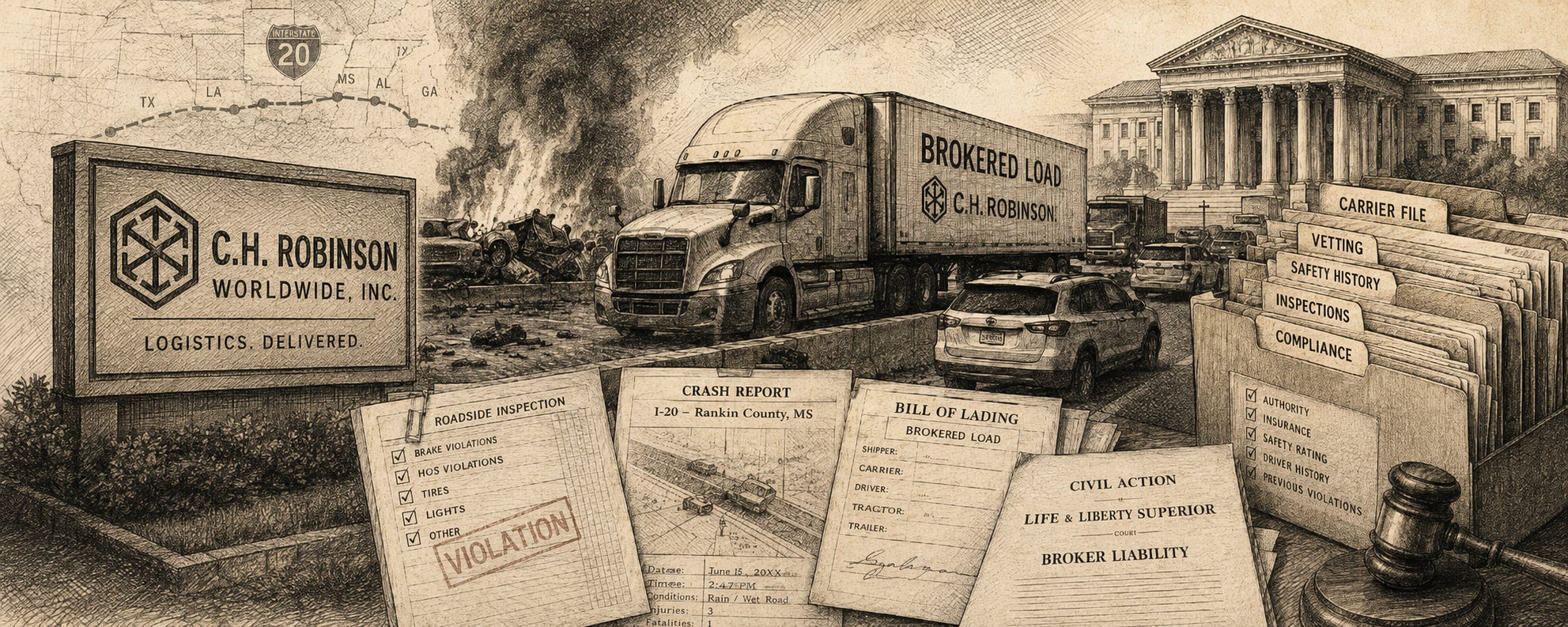
On July 23, a Dallas County jury returned a $604 million advisory verdict against C.H. Robinson, motor carrier Lupus Superior LLC, and its driver in Lipe v. Lupus Superior. The case comes out of a March 2021 crash on Interstate 20 in Mississippi, where a Lupus Superior tractor-trailer ran into stopped traffic and set off a six-vehicle pileup that caught fire. Jennifer Lipe, Benjamin Brewer, and Rhoderick Coleman died in their vehicles. Rodney Hawkins and Gabrielle Broussard were injured. All three of the people who died left children behind, and the plaintiffs were represented by Arnold & Itkin.
The precision is the story, not the headline. The verdict is advisory and compensatory, not punitive, and it hasn’t been finalized by the court. C.H. Robinson disclosed it in an 8-K and says it will appeal if the verdict is entered as final. The jury apportioned Robinson’s several share as a broker at $139 million. The path from $139 million to the full $604 million runs through the jury’s finding that treated the broker as the employer of the third-party carrier’s driver, which pulls the driver’s share onto Robinson’s balance sheet. That employer treatment is where the appeal will live. Stephens’ first look Friday morning framed it exactly that way, and noted that even a settlement well below the verdict would exhaust the company’s entire auto liability tower on a single claim. The market cap is $24 billion. The auto liability program is not built for nine-figure single claims because, until fourteen months ago, the legal system did not produce nine-figure single claims against brokers.
I have no role in the Lipe case. I do work on both sides of the expert witness fence, but most know I generally only take defense work unless it’s some egregious plaintiff case. I’m an expert witness or consultant retained in other CH Robinson cases where broker-liability matters, including a case in Ohio with plaintiff counsel Michael Leizerman, and I worked on the CBS Sunday Morning piece this spring that put C.H. Robinson’s carrier vetting on camera, after the 60 Minutes Super Ego investigation I contributed to in April. The parallels between the cases I do work and the one I don’t are constant. They are the same case with different names on the caption. Super Ego-related carriers, led by Twin Carrier, appear in the roadside inspection data hauling C.H. Robinson-annotated freight more often than nearly any other operation in the pool, and the same names surface across the carrier histories of the margin-based spot market brokers generally.
Fourteen months from Montgomery to a verdict
On May 14, 2026, the Supreme Court decided Montgomery v. Caribe Transport II, LLC, 9 to 0, Justice Barrett writing. A negligent-hiring claim against a freight broker is not preempted by the FAAAA, because the safety exception at 49 U.S.C. 14501(c)(2)(A) preserves state authority to regulate safety with respect to motor vehicles, and requiring a broker to exercise ordinary care in picking the truck concerns motor vehicles. Justice Kavanaugh, joined by Justice Alito, wrote separately that the case was closer than the majority let on, then landed in the same place: “Truck safety is a matter of life and death.” The Seventh Circuit’s Ye v. GlobalTranz line, the industry’s preemption shield since 2023, stopped being good law that morning. When I wrote about the pending decision in April, the question was whether the people who select the carriers bear any responsibility for who they select. The answer arrived in May. The invoice arrived Wednesday, and it is the first verdict against C.H. Robinson since the Court cleared the path.
The standard now is ordinary care, and ordinary care is measured against what you could have known. That is why the carrier’s file matters more than the crash itself.
What the Lupus Superior file actually says
Lupus Superior LLC, DOT 2370470, MC 816979, runs out of Grand Prairie, Texas with 23 power units and 27 drivers. Its FMCSA safety rating is Satisfactory, and per the Transportation Intermediaries Association’s own statement on this verdict, that rating has stood since 2014 and was reaffirmed as recently as this past April. Hold that thought, because a Satisfactory rating is a status, not a pattern. The status says a compliance review at some point found the carrier adequate. The pattern lives in the roadside data, and the roadside data on this carrier reads differently.
The federal crash file on this DOT number logs 26 crashes since 2013, seven fatalities, and fifteen injuries, including the March 25, 2021 Warren County, Mississippi crash at issue in Lipe, a 2017 fatal in Rockwall, Texas, a 2023 fatal in Texas, and a December 2024 crash in Hempstead County, Arkansas with one dead and four injured. At the time of this week’s verdict, the carrier’s estimated BASIC measures sit above FMCSA intervention thresholds in two categories, Unsafe Driving and Hours-of-Service Compliance, which matches what has been publicly reported about the case. Its 24-month vehicle out-of-service rate runs 28.6% against a national average around 21. The recent violation history is the ordinary grammar of a fleet under strain: speeding 11 to 14 over, three times since mid-2024; a seatbelt violation in December; tires leaking below half inflation pressure placed out of service, inoperative brake lamps placed out of service, a flat with fabric exposed placed out of service, and a run of ELD paperwork violations. The insurance filing is $750,000 in BIPD primary coverage, the federal minimum set in the early 1980s, written by an insurer our platform tiers as high risk, and the docket history on MC 816979 shows 28 authority actions over thirteen years, the bulk of them involuntary revocations followed by reinstatement, the churn signature of coverage lapsing and getting cured. Seven distinct insurers appear in the recent filing history. Insurers who look closely do not stay, or do not stay cheap, and the carrier finds another one. That is measured. Every item in this paragraph comes from public federal records that were sitting there before the freight moved.
The equipment tells its story. Inspection records tie 50 VINs on this authority to 17 other carriers. Twenty-seven of those shared VINs connect to a single Dallas operation called M & J Superior LLC, DOT 2487937, and more connect to SHOX LLC, registered in the same Grand Prairie. The same Volvo tractors and Wabash trailers show up under different DOT numbers in different states across the same time window. Shared equipment in inspection records is an observed fact. It does not by itself establish common ownership, affiliation, or wrongdoing, and I am not asserting any of those things about these companies. What it establishes is that a broker running a real vetting process would have questions after seeing that shared data, because equipment moving between authorities is the raw material of the reincarnation problem this industry calls chameleon carriers, and the pattern is checkable in about the time it takes to pour a coffee. In my system, you can bulk-drop 2000 VINs and plates, and it’ll give you a list in under a minute of every plate that’s run under every VIN for every carrier it touched, when, where, and how often. In some cases we see 13 plate swaps on 1 VIN across 8 carriers in six months.
The dataset behind the anecdote
In April I published an analysis of 923 carriers documented in C.H. Robinson’s carrier history through FMCSA roadside inspection records, the dataset behind the 60 Minutes and CBS reporting. Those records exist because when an officer stops a truck with a load on board, the inspection captures the carrier, the shipper, and the freight parties off the bill of lading. Nobody self-reports it. I refreshed that pull today. Of the 923 carriers, 30 had fatal crashes in the trailing 24 months, and the fatality count attached to those carriers has climbed from 46 in April to 50 now. Fifty deaths is not a rate or a model output. It is a body count inside one broker’s documented carrier pool, counted since spring. Six hundred ninety-nine of the 923, 76%, have never received a safety rating of any kind. One hundred thirty-two run vehicle out-of-service rates at or above 50%, 74 run driver out-of-service rates at or above 50%, and six carry authority transfer flags from our cross-reference analysis. A separate pull of raw inspection records from February 2023 through January of this year shows 3,433 roadside inspections where a C.H. Robinson entity appears as the annotated shipper or freight party, spread across 2,277 distinct carriers, with 644 of those inspections producing at least one out-of-service violation and 563 carriers going out of service at least once while hauling that annotated freight. Matching those DOT numbers to current carrier records identifies 2,163 carriers, and the ratings distribution remains the same shape as the smaller set: 1,625 of the 2,163 (75%) have no safety rating at all. Fifty-four currently hold a Conditional rating and one holds an Unsatisfactory rating, and seventeen of those Conditional or Unsatisfactory carriers appear in the inspection data hauling annotated freight in 2025 or later, the most recent on January 21 of this year. The ratings shown are the carriers’ current ratings, not necessarily the rating on the day of the stop, so I will state only what the records state. Conditional is the exact rating Caribe Transport held when C.H. Robinson tendered it the load that took Shawn Montgomery’s leg, and the exact fact pattern the Supreme Court just held a jury gets to weigh.
To see the list of carriers that have been inspected roadside with CHR as a shipper, you can go here and search that.
Some of the names in the fatal-crash column are large fleets whose raw counts reflect scale, and per-unit rates are the way to read a 400-crash number at a 10,000-truck carrier. The names that should stop a load are the small ones. Twin Carrier LLC out of Georgia, DOT 3518735, now shows 59 crashes in 24 months, two fatal, two people dead, unrated, insured at $1,000 on a canceled filing, and it appears 21 times between June 2023 and November 2025 in the roadside data hauling freight annotated to C.H. Robinson. Twin Carrier is the oldest and primary carrier in the Super Ego network, with wrongful death litigation pending in Pennsylvania and Ohio. Koleaseco Inc of Michigan carries a fatal crash that killed four people in a single event, on a Satisfactory rating from a prior review. Fremont Trans of Kansas shows 53 crashes and three fatal events, unrated, on a canceled $1,000 filing. AD Express Trucking of Michigan shows 24 crashes and three dead, unrated, insured through Prime at a $750 filing that was canceled. Many unrated, with fatal crashes, with canceled minimum-limits filings from the bottom shelf of the trucking insurance market. Every one of these records was public before every one of these deaths.
The Carrier of the Year math, and who knew the network first
C.H. Robinson named Super Ego a Carrier of the Year and credited it with an operation of more than a thousand trucks. Super Ego Holding, the single entity, has never fielded a thousand units under its own authority. The only way you get to that number is consolidation, adding up the fleet counts across the constellation of related entities that federal investigators, myself, other litigators, and the 60 Minutes team spent a year mapping. I can’t tell you how Robinson arrived at its figure. Robinson can, and a plaintiff’s lawyer in the Pennsylvania and Ohio Twin Carrier cases can ask, because a broker that counted the network’s trucks for an award has a hard time later claiming it could not see the network.
There is a second party that maps these networks earlier and better than any journalist, and it is the factoring companies. Super Ego’s freight bills run through Triumph, which means Triumph can explain how C.H. Robinson pays those invoices and where the money lands across the operating entities. The mechanism is that, before the bodies drop, the factors already know who is associated with whom, because that is how they protect their money. A factor perfecting its interest in a carrier’s receivables files a UCC-1 financing statement naming the debtor entities, and those filings are public record in the state registries. The affiliation map that takes an investigative team months to build from inspection records exists in the lien filings on day one, drawn by the people with the strongest financial incentive to draw it accurately. None of that is an allegation against any factor. Factoring is legal; the liens are them doing their job. The point is narrower and worse for the brokerage industry: the knowledge exists, it is written down, it is filed with secretaries of state, and “we had no way to know these carriers were connected” gets harder to say under oath when the payment rail knew.
The relationships tighten the loop further, and every piece of this is on the record. C.H. Robinson vets its carriers through Highway. Highway’s CEO is Jordan Graft, who previously ran TriumphPay, the payments network inside Triumph Financial, where his brother Aaron Graft is CEO. In April 2023, TriumphPay and Highway announced a strategic data partnership, combining TriumphPay’s freight-spend and payments data with Highway’s carrier identity and equipment data to catch double-brokering. Two brothers, two companies, one announced data pipeline: one verifies the carrier at the front door, the other moves and finances the money behind it. I am not suggesting anything improper about that arrangement; fighting payment fraud is exactly what those datasets should be combined for. The observation is about capability. The vetting layer and the payment layer of this industry have publicly demonstrated they can join their data and map which carriers and entities tie together, right down to who is hauling more freight than their equipment could physically allow. The capability exists when the money is at risk. What we should be doing as an industry is vetting carriers for entry on a load as diligently as we vet them to file UCC liens protecting factor money.
What vetting looked like when we asked on the record
For the CBS Sunday Morning piece this spring, we asked C.H. Robinson on the record what a carrier has to do to get hired. The answer, in substance, was clear: Highway’s screening. So we called Highway and asked what their screening requires, and the answer, in substance, was that the criteria are up to C.H. Robinson, and what Highway itself confirms is that the carrier has authority, a DOT number, and insurance on file. Follow that loop around one full turn. The broker points to the vendor, the vendor points back to the broker, and what actually gets verified at the bottom of the stack is the same three boxes I wrote about in April: authority active, MC active, certificate on file. The identity-verification layer the industry added is real, and it matters for fraud. It does not answer the safety question, because it was never built to. A carrier can clear every identity check ever devised and still be a 23-truck operation with seven fatalities in its crash file, two alerting BASICs, and a $750,000 minimum filing from its seventh insurer in recent memory. Compliant is a status. Safe is a pattern. Defensible is a record of your own diligence, and after Wednesday, defensible is the only one of the three a jury will grade you on.
What’s most telling to me about broker vetting is that many of these brokers saw no real need to vet any more than they absolutely had to; prior to Montgomery, the carrier histories in this article show exactly that. That means brokers are now changing course to accommodate a judicial mandate that they vet carriers better. Prior to that judicial mandate, why didn’t brokers find it morally or ethically appropriate to vet the carriers and to perform as much due diligence as possible?
The litigation footprint was already there for anyone who pulled it. A PACER party search I ran today returns 253 federal party records for C.H. Robinson entities, 194 civil cases, 136 of them with Robinson as a defendant, stretching from the 2004 Joliet potato-load verdict through Miller in the Ninth Circuit to a dozen open matters filed in the last eighteen months. The company has been litigating the question of what it owes for carrier selection for twenty years. What changed in May is that the preemption exit closed, and what changed Wednesday is that a Dallas County jury put a number on the open question. My question is: why did we need a judicial mandate to compel what should’ve been our own logical, moral, ethical responsibility for who we put on the highways?
What the money says
The financial arithmetic explains why this verdict lands harder than its appeal odds suggest. C.H. Robinson trades around $205 with a $24 billion market cap, and the stock slipped about 2 percent premarket Friday on the 8-K. Wall Street expects the company to earn roughly $6 a share this year across about 118 million shares, call it a bit over $700 million in net income. The full $604 million is most of a year’s profit. The $139 million several share alone approaches a quarter’s worth. Sell-side analysis published Friday put the company’s auto liability tower at a $10 million retention under $135 million in limits, which means even a settlement in the low-to-mid nine figures exhausts the entire program on one claim. That tower was sized for a world where the preemption defense held and broker exposure ended at nuisance value. That world ended May 14. Every excess and contingent auto underwriter writing brokerage risk is re-running their models this quarter, and the renewal conversations will not be about premium first. They will be about the vetting file, because the underwriter’s exposure now runs through the same ordinary-care question the jury answers, and underwriters, unlike regulators, can decline the account. Insurance is about to become the enforcement mechanism the safety rating system never was.
Then there is the question of who actually writes the check, because three defendants share this verdict and only one of them can pay it. Lupus Superior’s filed coverage is $750,000, the federal minimum, so the carrier’s insurer is good for roughly one-eighth of one percent of the number, and a 23-truck LLC has no balance sheet behind the policy. The driver has less. Under Texas proportionate responsibility rules, a defendant generally pays its own apportioned share unless its responsibility crosses the 50 percent bar, and the route around that math here is the employer finding: if Robinson is treated as the driver’s employer, the driver’s share lands on Robinson, and Robinson’s is the only balance sheet in the caption that exists. Most people watching this case will say the multi-billion-dollar entity pays because it has the funds, and they’re right, but the deeper point is that the outcome was engineered decades ago. The $750,000 minimum has sat unchanged since 1980, which is about $2.9 million in today’s dollars going the other direction, and it guarantees that in any catastrophic crash involving a minimum-limits carrier, the policy exhausts before the funerals are paid for and the recovery moves up the chain to whoever selected the carrier and can satisfy a judgment. For thirty years the brokerage model captured the margin of the cheap carrier while the cheap carrier’s empty policy capped everyone’s practical exposure. Montgomery moved the uncovered remainder onto the entity that captured the margin, and Lipe is the first demonstration of what that transfer looks like at scale.
That is measured. This next part is my read. The stock ran from a 52-week low of $95 to over $200 on an operating-margin story, and part of the margin in spot market brokerage is the spread between what the shipper pays and what the cheapest available carrier will take. The data in this article is what the cheapest available carrier looks like. Montgomery attached liability to the spread, and Lipe put a price on it, which means some portion of the margin the market has been capitalizing at 34 times earnings was never margin at all. It was unpriced risk, carried by the people in the other lane, and the repricing of that risk back onto the balance sheets that earned it is what this verdict starts.
If you broker freight, your carrier file became your court file fourteen months ago, and the Lipe verdict is the first invoice priced under the new standard. The data you will be examined against is public, it is cheap, and it is timestamped, which means the only fact in dispute at your trial will be whether you looked. If you run a shipper’s carrier qualification program, the same discovery requests are coming for your routing guide, because the ordinary-care logic doesn’t stop at the broker’s desk. The Tennessee owner-operator from my April piece got a $312 check from an exhausted bond. The families in Lipe got a verdict that will spend years on appeal. The next case gets decided by whichever party kept the better file, and for the first time in the history of this industry, that is more likely to be the plaintiff.
The Lipe verdict is advisory, subject to post-trial proceedings, and C.H. Robinson has said it will appeal a final judgment; a verdict is not a final adjudication of liability. Carrier data cited above comes from public FMCSA sources (MCMIS inspection and crash records, SAFER, L&I filings, SMS output) as aggregated by Tea Technologies’ Highway Intelligence & Risk Platform, and reflects the carriers’ own records, not safety events attributable to any broker or shipper. Shared-equipment and network observations describe records, not conclusions about ownership or conduct. Earnings and market figures reflect publicly reported prices and consensus estimates as of July 24, 2026, and nothing here is investment advice. Nothing here is a legal conclusion about any party or pending matter. Verify critical carrier status against official FMCSA systems before making business decisions.