

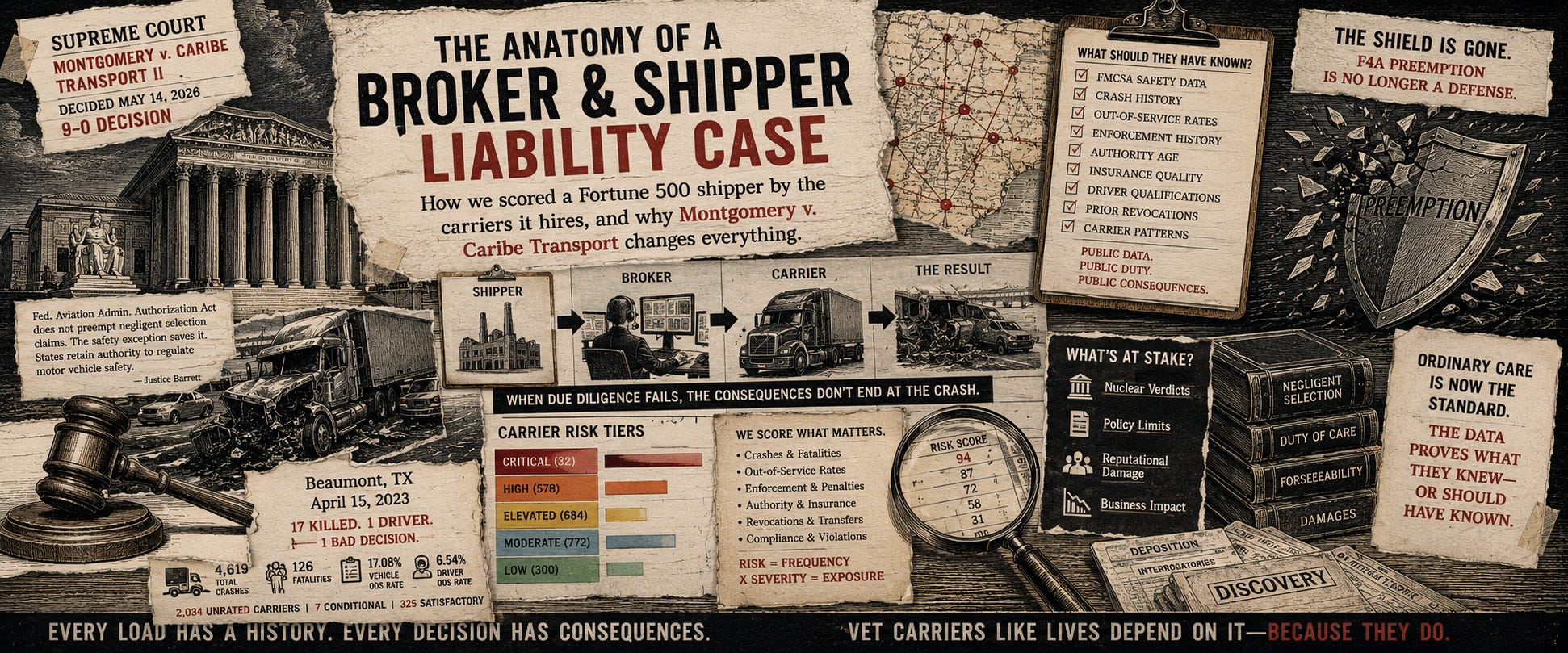
This week, the Supreme Court of the United States told every freight broker in America that the federal preemption defense is over. Nine justices. Zero dissents. Montgomery v. Caribe Transport II, decided May 14, 2026, held that a negligent hiring claim against a freight broker is not preempted by the Federal Aviation Administration Authorization Act. The safety exception saves it. States retain authority to regulate motor vehicle safety, and requiring a broker to use ordinary care in selecting a carrier concerns motor vehicles. Justice Barrett wrote it in eight pages. The freight brokerage industry spent nearly a decade and millions in legal fees building a fortress out of F4A preemption. The Supreme Court knocked it down a month earlier than expected.
Shawn Montgomery lost his leg in Illinois in 2017 when a Caribe Transport truck slammed into his parked vehicle. C.H. Robinson brokered the load. Caribe had a conditional safety rating and a driver who had been previously cited for careless driving. Montgomery sued. C.H. Robinson said federal law blocked it. The Seventh Circuit agreed. The Supreme Court reversed. Unanimously.
That’s the legal framework. So, what comes next? This ruling does not just open the door to broker liability. It opens the door to something much bigger. It opens the door to asking what the broker knew, what the shipper knew, and what both of them should have known about the carrier they selected to haul their freight and ultimately put on the road. The data to answer those questions is available at the national scale.
The case that proves the point
On April 15, 2023, a Gold Coast Logistics truck hauling Ghost Energy drinks for Anheuser-Busch killed Brandon Rogers on Interstate 10 in Beaumont, Texas. Seventeen people were hurt or killed. The driver, Leandre Sime, was operating under a Florida temporary commercial driver’s license. He is under criminal indictment. The broker was ArcherHub, a Colorado-incorporated company whose actual dispatching workforce of more than 200 people operates from Chisinau, the capital of Moldova. ArcherHub was covering a fallen load. The original carrier dropped off. ArcherHub scrambled to fill the gap. A Gold Coast truck showed up.
Gold Coast, formerly DMG Consulting and Development Inc. under DOT Number 2190975, was owned and operated by Dragos Sprinceana, a Romanian immigrant who ran 350 power units out of Elgin, Illinois, and now spends most of his time at Mar-a-lago. Sole officer. Sole director. Sole shareholder. No board. No compliance committee. No VP of Safety. Just Dragos. His old Gold Coast COO actually runs the same equipment under a new company, Pony Express. Shocking.
Gold Coast trucks were involved in 150 crashes, 10 fatalities, and 86 injuries in FMCSA roadway crash records. The Illinois Workers’ Compensation Commission adds at least seven more injuries that never appeared in a federal database, including two workers injured four days apart in April 2022 who both filed emergency death and permanent total disability petitions. The company’s federal enforcement history is the single worst in the currently analyzed FMCSA enforcement dataset. I will get to those numbers in a moment.
The formal federal revocation of Gold Coast’s operating authority did not come until August 27, 2023, 134 days after Brandon Rogers died. On April 15, Gold Coast technically retained active authority despite having incurred one of the largest civil penalties in history, totaling nearly $ 900,000 across two enforcement cases in about a year’s time. So, with a record like that, even if he somehow kept his authority, who would broker him freight? The answer is a lot of people.
Active authority is not a safety qualification
The right question, and the question Montgomery v. Caribe Transport now makes fully litigable in every state courthouse in America, is what ArcherHub’s carrier file on DOT 2190975 showed when the dispatching decision was made, and whether any reasonable carrier qualification standard would have approved that truck for an Anheuser-Busch load given what was already publicly documented on that date.
Tea Technologies platform enforcement analysis of 11,946 closed FMCSA enforcement cases with recorded settlement amounts identified Gold Coast’s first enforcement case, IL-2021-0097-US1688, closed May 17, 2022, with a settled amount of $791,640, as the single largest settled FMCSA enforcement case in the entire dataset. National rank: number one. One hundredth percentile. The violations included 49 CFR 383.37(a), knowingly allowing drivers to operate without valid CDLs, and 395.3(a)(3)(i), hours of service violations. That case closed less than 11 months before the Beaumont crash. It was public. It was in SAFER. It was sitting right there for anyone who looked.
A second enforcement case, IL-2023-0120-US1713, closed October 19, 2023, after the crash, added another $97,990 in settled penalties for violations, including for using a driver who had tested positive for controlled substances. Combined federal enforcement total across both cases: $889,630. Carrier-level cumulative enforcement ranking across 11,307 motor carriers with enforcement history: number one. The single highest cumulative settled enforcement exposure in the dataset.
FMCSA civil penalty settlements are commonly negotiated downward from the original proposed penalty. The original proposed penalty exposure on that $791,640 case was almost certainly higher. We have a FOIA request pending to find out how much higher. The fact that the settled amount alone ranked first nationally tells you something about the scale of what FMCSA found inside that operation.
That is what was publicly available before the crash. Not after. Before. The question is not whether Gold Coast had a license. The question is whether anyone in the chain from Anheuser-Busch to ArcherHub to the dispatching desk in Chisinau pulled up the FMCSA profile and read what it said. Montgomery v. Caribe Transport says you can now ask that question under oath.
Scoring the shipper by the carriers it hires
This is where the work we have been doing becomes directly relevant to what Montgomery just made possible.
FMCSA roadside inspection records include shipper information. When a truck gets pulled into a weigh station or stopped on the shoulder, the inspector records the carrier, the driver, the vehicle, and, in many cases, the shipper identified on the electronic bill of lading. That means we can work backward from inspection records to build a dataset of carriers associated with a specific shipper’s freight movements. Not the shipper’s complete procurement roster. Not every load they have ever tendered. But a federally documented, inspection-derived view of which carriers were actually pulling that shipper’s product on the road.
We did exactly that for Anheuser-Busch.
The dataset contains 2,366 unique DOT-numbered carriers appearing in FMCSA inspection documentation, for which Anheuser-Busch was identified as the shipper. Those carriers collectively show 4,619 total crashes in the 24-month reporting window, including 1,510 injury crashes, 111 fatal crashes, and 126 recorded fatalities. The weighted vehicle out-of-service rate across 5,456 inspections is 17.08 percent. The weighted driver out-of-service rate is 6.54 percent. The dataset includes 7 Conditional-rated carriers, 325 Satisfactory-rated carriers, and 2,034 carriers with no safety rating. That last number is the one that should scare you, because ‘unrated’ does not mean safe. It means FMCSA has not gotten around to looking yet.
We ranked every carrier in the dataset using a composite score based on fatal crashes, fatality count, injury crashes, total crashes, crash rate per power unit, vehicle out-of-service rate, driver out-of-service rate, safety rating severity, prior revocation indicators, authority transfer indicators, and BASIC alert flags. The model is designed to put the worst public safety performers at the top. It is a triage tool, not a legal conclusion. But it tells you something when you sort 2,366 carriers by safety performance and the names at the top include carriers with 60-plus crashes, 50 percent vehicle OOS rates, driver OOS rates over 100 percent on small inspection samples, and fatal crash histories that would disqualify them from any professionally run supply chain.
Thirty-two carriers in the Anheuser-Busch shipper dataset were assigned to the critical risk tier. Five hundred seventy-eight scored at the high-risk tier. Eighty-four carriers showed at least one fatal crash. Four carriers showed prior revocation indicators. Five showed authority-transfer signals consistent with purchased or transferred operating authority rather than with organically built companies.
This is the caliber of the carrier pool touching one of the most recognizable consumer brands on the planet.
Why this matters after Montgomery
Before May 14, 2026, a freight broker could point to F4A preemption and argue that carrier selection decisions were shielded from state tort liability. That argument worked in the Seventh Circuit. It worked in the Eleventh Circuit. It kept C.H. Robinson out of the Montgomery case for years. It kept dozens of other brokers out of dozens of other cases.
That shield is gone.
What replaces it is a factual inquiry into what the broker knew, what the broker should have known, and whether the broker exercised ordinary care in selecting the carrier. Justice Barrett wrote that requiring a broker to exercise ordinary care in selecting a carrier concerns motor vehicles. Justice Kavanaugh, concurring, wrote that if brokers can be held liable for disregarding poor safety records, they have a strong incentive to do business only with safe and reliable motor carriers. Kavanaugh also cautioned that the ruling should not be read to mean that brokers will routinely be subject to state tort liability following truck accidents. He is right about that. The ruling does not create automatic liability. It enables asking the question.
The question is no longer just about the carrier on the crash load. The question is about the pattern. What carriers does this broker habitually select? What carriers does this shipper habitually approve? What does the historical carrier selection profile look like across hundreds or thousands of loads? Is there a pattern of selecting carriers with elevated crash histories, OOS rates, enforcement exposure, authority-age problems, or chameleon-carrier indicators? If there is, was the carrier on the crash load an outlier, or was it consistent with the way the broker or shipper has always done business?
That is the question the Anheuser-Busch carrier dataset answers. That is the question Tea Technology’s shipper and broker scoring methodology is built to answer. That is the question that every plaintiff’s attorney reading Montgomery will start asking in discovery within weeks.
How we build the score
Tea Technology’s Highway Intelligence platform ingests FMCSA carrier data across authority, insurance, inspection, crash, enforcement, and compliance datasets. We score individual carriers on a 0 to 100 scale using crashes, out-of-service rates, violations, revocations, authority age, and insurer quality. That carrier-level score has been the backbone of the platform since launch.
The shipper and broker scoring layer works differently. Instead of scoring the entity directly, we score it based on the carriers it touches. If a shipper’s freight repeatedly appears on trucks operated by carriers with elevated crash histories, high OOS rates, enforcement exposure, prior revocations, or authority transfer signals, that pattern produces a shipper risk profile. The same logic applies to brokers. If a broker’s load history shows a pattern of dispatching carriers with poor safety profiles, that pattern is now discoverable, scorable, and, after Montgomery, litigable.
We are not guessing about carrier quality. We are measuring it against the same federal data that FMCSA uses to rate carriers, the same data that is publicly available in SAFER, and the same data that any broker or shipper with a carrier qualification process is supposed to review before they put a truck on the road. The difference is that we are aggregating it, ranking it, and presenting it in a format that makes the pattern visible instead of buried across 780,000 individual carrier profiles.
The Beaumont crash in context
Jennifer Rogers is raising three children without their father. Brandon Rogers died on April 15, 2023, at the wrong moment on the wrong highway. The truck that killed him was owned by a carrier whose federal enforcement record was the single worst in the national enforcement dataset. The broker that dispatched it was operating from a 200-person office in Moldova. The shipper whose product was on the truck is one of the most recognizable brands in the world. The driver held a temporary CDL and is now under criminal indictment. The carrier’s owner, Dragos Sprinceana, was photographed at Mar-a-Lago while owing nearly a million dollars in unpaid federal safety fines and named a dead man as the company’s registered agent under penalties of perjury.
Brian Beckcom of VB Attorneys in Houston has 17 plaintiffs in Jefferson County, Texas. The Montgomery ruling was handed down six days ago. The preemption defense that would have shielded the broker from a negligent selection claim in many circuits is no longer available. The data to prove what the broker and shipper should have known about Gold Coast is public, documented, and now scored.
The anatomy of a broker and shipper liability case is not complicated. A carrier with a publicly visible, measurable safety profile is selected to haul freight. Someone gets killed. The question is whether the people who selected that carrier exercised ordinary care. Montgomery says you can ask that question. The data shows that, in many cases, the answer is no.
What comes next
The first wave of post-Montgomery negligent hiring suits will be filed within weeks. Plaintiff’s attorneys who have been sitting on broker liability claims waiting for the circuit split to resolve now have a unanimous Supreme Court opinion clearing the path. The insurance market has not yet priced this exposure. When it does, freight broker premiums will adjust. The adjustment will be severe for brokers who cannot demonstrate a documented, data-driven carrier selection process. It will be less severe for brokers who can show that their vetting methodology is systematic, repeatable, and grounded in publicly available safety data.
The carriers a broker habitually selects, their safety profiles, their authority ages, their crash histories, their inspection outcomes, all of that is now part of the risk profile that an underwriter will evaluate. The carriers that a shipper’s freight repeatedly appears on are now part of the shipper’s risk profile too.
For the freight industry, this is the moment when carrier selection stops being a back-office function and becomes a boardroom liability question. The data exists. The legal framework exists. The only thing that was missing was the ability to ask the question in court. Montgomery supplied that.
The trucks are still rolling. The question is: who is on them, and who put them there?