

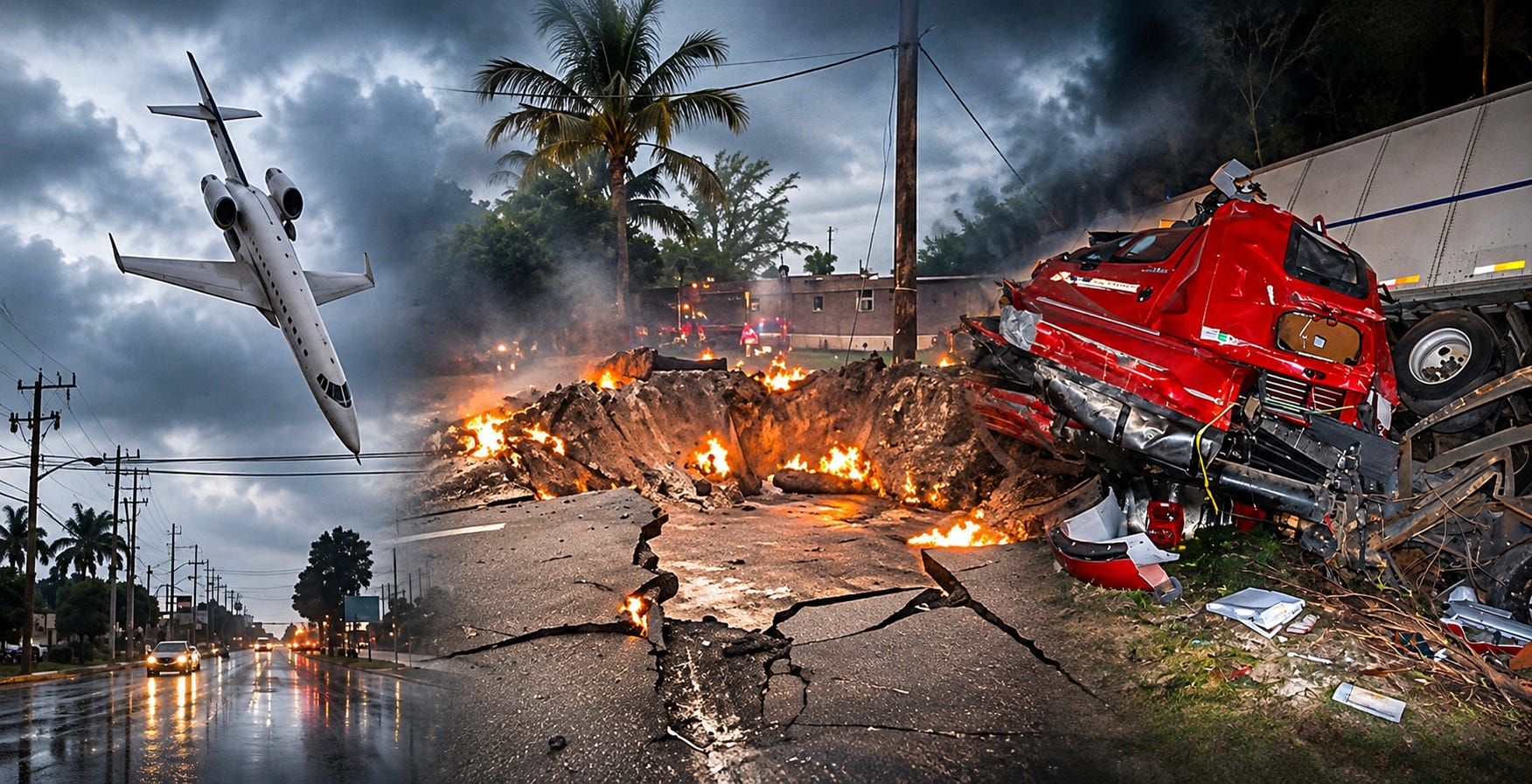
Where’s the airplane? Photos from Greenacres, Florida, show a crater in Military Trail, a burned mobile home, scorched pavement, and a column of black smoke. There is no plane. No wing, no tail section in somebody’s yard, nothing you would recognize from photos. I’ll break down why, but in truck recon crash math.
This is the anatomy of the crash, the anatomy of the investigation that started the moment it hit, and where both line up with what we do on the highway.
I am trained to reconstruct truck crashes. My training runs through the Institute of Police Technology and Management, Northwestern University’s heavy vehicle forensic and crash recon programs, the National Transportation Safety Board’s highway crash investigation course (one of the last before they closed this to the public about 6 years ago), the International Association of Arson Investigators’ fire curricula, and a host of others. My casework runs from interstate rear-end fatalities to tanker fires. Airplanes are a different machine, with a different investigating agency and a different rulebook. The physics is not different. Energy is energy and momentum is momentum, and the same equations I use to back a truck’s speed out of its crush damage explain why almost nothing is left of this jet.
The Federal Aviation Administration said the Learjet 60 departed Austin-Bergstrom International Airport bound for North Eleuthera Airport in the Bahamas with nine people aboard and crashed at about 12:50 p.m. Transportation Secretary Sean Duffy said all nine were killed. The FAA said the jet fell from 35,250 feet to 8,750 feet in a little over a minute, about 350 feet per second. On air traffic control audio captured by LiveATC.net, the crew reported light clear ice, moderate turbulence and an outside air temperature of minus 47 degrees Celsius, picked up precipitation, asked for and received a climb to 37,000 feet, then declared a mayday and reported an overspeed condition. The last words to the controller were, “We’re going to crash into the ground.”
Whether recon or claim management, In a truck case, the first thing I build is a time-and-distance picture. I pull the engine control module, CDR, etc., the electronic logging device, the telematics and the dash camera, and I lay the event out second by second. Aviation has its own black boxes, and we’ll get to those, but the public already has the equivalent of telematics: ADS-B, the position and altitude data the jet broadcast as it flew. A radar and track analysis built on National Weather Service Miami Level II radar puts the jet at 35,250 feet at 17:48:07 UTC after it was lifted by an updraft in a storm core, at 31,350 feet at 17:48:39 and at 8,750 feet, the last valid altitude, at 17:49:23.
Subtraction in planes is the same as subtraction in a highway skid analysis. In the first 32 seconds, the jet lost 3,900 feet, about 7,300 feet per minute, which lines up with the crew’s radio call of 8,000 feet per minute. In the next 44 seconds, it lost 22,600 feet. That’s about 30,800 feet per minute, or 514 feet per second straight down. Total: 26,500 feet in 76 seconds, which matches the FAA’s 350 feet per second average.
Speed. Flight tracking at 10,125 feet showed a ground speed of 298 knots and a vertical speed of 30,976 feet per minute down. In truck reconstruction, when a vehicle is moving in two directions at once, you resolve the vectors. Here, 298 knots is about 503 feet per second forward and 30,976 feet per minute is about 516 feet per second down. The square root of the sum of the squares gives a speed along the flight path of about 721 feet per second, or 491 mph, with the nose pointed roughly 46 degrees below the horizon. Video of the final seconds shows it steeper still. From 8,750 feet at that descent rate, the jet had about 17 seconds left.
Every energy calculation starts with mass. On a truck case, I pull it from the bill of lading and the scale tickets. Here I start with the manufacturer’s numbers: a standard basic operating weight of 14,772 pounds, a maximum zero fuel weight of 17,000 pounds and a maximum takeoff weight of 23,500 pounds. Add seven passengers and their bags, then subtract the fuel burned over two hours and 13 minutes at the type’s typical 230 to 250 gallons per hour, and my estimate of the jet’s weight at impact is about 18,500 pounds, or 8,400 kilograms. The NTSB will have the actual load sheet. A thousand-pound swing either way doesn’t change anything.
So..why the crater? Well, Kinetic energy equals one half the mass times the velocity squared. I spend a lot of time in front of juries explaining what that squared term means: double the speed and you quadruple the energy. At 18,500 pounds and 491 mph, N722BD was carrying about 203 megajoules of energy. That’s the equivalent of roughly 107 pounds of TNT.
In truck terms, A fully loaded 80,000-pound tractor-trailer at 65 mph carries about 15.3 megajoules. The Learjet weighed less than a quarter of that truck and carried 13 times its energy, because it was moving 7.5 times faster and 7.5 squared is about 57. A 4,000-pound car at 60 mph carries about 0.65 megajoules. The jet carried about 300 times that. This is also why I have written extensively on what a truck means when a tanker full of fuel becomes weaponized in an act of terror. Different articles, some already written but a consideration and shameless plug to drive this home.
Momentum has its own story. Momentum is mass times velocity, not velocity squared. The jet’s momentum was about 1.84 million kilogram meters per second against about 1.05 million for the loaded truck, only 1.75 times as much. In recon, we say momentum tells you where things go and energy tells you how much gets destroyed. In a truck-and-car collision, I use conservation of momentum to work out departure angles and speeds. This crash had nothing to collide with but the earth. All of it was energy, and it all had to go somewhere in a fraction of a second.
On the highway and in trucks, we measure crush and we map how far a bumper, frame rail, or cab was pushed in, apply stiffness coefficients for that vehicle and calculate the energy the structure absorbed. Truck frames and car crumple zones are built to absorb energy and protect the people inside. A jet fuselage is a thin aluminum tube that’s mostly air, built to hold cabin pressure and carry flight loads. It was never built to stop itself against the ground at 491 mph, and against 203 megajoules, its crush capacity is close to zero.
Engineers who design nuclear plant containment structures against aircraft impact use a load-and-time method that treats the airplane as crushing progressively from the nose back while the rest of it keeps arriving at full speed. Applied to this Learjet 60, it is 58 feet, 8 inches long, about 17.9 meters. Divide that length by a speed of 219.6 meters per second and the entire airframe arrives at the impact point in about 0.08 seconds. Average force is roughly the airframe’s mass per meter times velocity squared, which works out to about 22.6 meganewtons, or 5 million pounds of force, sustained for 80 milliseconds. The peaks would be higher where the engines and the wing box hit.
For the people aboard, deceleration is velocity squared divided by twice the stopping distance. If the cabin stopped over 16 feet of collapsing structure and soil, that’s about 490 times the force of gravity. Over 10 feet, it’s about 820 g. Air Force Col. John Paul Stapp rode a rocket sled to 46.2 g in 1954 and survived, and that run is still the benchmark for human tolerance. This impact was 10 to 20 times past it. Nobody survives that, and they would not have known it happened.
On April 19, 1988, Sandia National Laboratories ran a real F-4 Phantom fighter on a rocket sled into a 12-foot-thick concrete block at a nominal 215 meters per second, about 480 mph. That’s within a few miles per hour of this crash. Sandia found that the engines caused most of the impact force. The high-speed film shows the rest of the airframe dissolving against the wall.
On Oct. 25, 1999, the Learjet 35 carrying golfer Payne Stewart hit a field near Aberdeen, South Dakota, at a steep angle and at about 600 mph, according to the lead federal investigator at the time. It left a crater 42 feet long, 21 feet wide and 8 feet deep, and a reporter at the scene described the airplane as reduced to little pieces of metal. The NTSB report for that is here
As a betting man, I estimate that N722BD still had 2,000 to 2,500 pounds of Jet A aboard. At about 43 megajoules per kilogram, 2,300 pounds of fuel holds roughly 45,000 megajoules of chemical energy, about 220 times the energy of the impact itself. On a truck fire, I’m used to a pair of saddle tanks feeding a fire that takes a tractor down to the frame. Here, the impact atomized the fuel, and the fire worked on what it left. Open fuel fires burn well past aluminum’s 1,220-degree Fahrenheit melting point. What survives a crash like this is the dense stuff like engine cores, landing gear, heavy fittings, and fragments.
That’s the anatomy of the crash. The anatomy of the investigation is where trucks and planes start to look like cousins.
On a fatal truck crash, the scene belongs to state or local police and their reconstruction team. A Commercial Vehicle Safety Alliance inspector may do a post-crash Level I inspection. The NTSB takes only a small number of highway crashes. Within hours, the carrier’s insurer has a rapid response team rolling, plaintiff lawyers are sending preservation letters, and everybody is racing to lock down the ECM, the ELD records, the telematics and the camera footage before they’re overwritten.
In aviation, the NTSB has the lead from the first minute, and it said it was sending a go-team with a media briefing set for Monday in West Palm Beach. The FAA supports. The NTSB’s party system brings in the operator and manufacturers, here likely Bombardier and engine maker Pratt and Whitney Canada, under the board’s control. A preliminary report usually comes within about 30 days and a final probable cause determination in 12 to 24 months. The data sources rhyme with mine. ADS-B is the telematics. The ATC recording is the 911 call and the dispatch log. Federal charter rules generally require a cockpit voice recorder on a two-pilot turbine jet with six or more passenger seats, so investigators will look for one in the crater. Maintenance logs, training records and duty time are the driver qualification file and the hours-of-service audit.
On a truck, my black boxes are the engine control module, which on most heavy diesels stores hard-brake and last-stop event data, plus the telematics unit, the ELD and the cameras. None of it is built to survive a crash. It survives by luck, and you have to download it. Passenger cars are different: 49 CFR Part 563 standardizes the event data recorders most of them carry, and reconstructionists read them with the Bosch CDR tool. Heavy trucks have no such mandate. An airplane’s recorders are built for exactly this kind of day. The NTSB lists the survival standard for cockpit voice and flight data recorders as a 3,400 g impact for 6.5 milliseconds and a 1,100-degree Celsius fire for 30 minutes, four to seven times the average deceleration this crash produced. Charter rules require a cockpit voice recorder on a two-pilot turbine jet like this one, but the charter flight data recorder rule starts at 10 passenger seats, so this jet may not have carried one. If it didn’t, ADS-B, radar, the voice recorder and whatever the avionics and engine controllers stored become the core of the reconstruction. If the voice recorder came through the fire, it will tell investigators more than any truck download ever told me.
A highway crash report forces you to document the scene before it changes, and the same checklist applies here. Light and visibility: midday, with storms in the area. Surface: dashcam video shows a wet roadway. The scene diagram: the crater, the debris field and the area of impact get mapped, now usually with drone photogrammetry and a total station, the same tools we use on an interstate. Witnesses: the dashcam and phone videos of the final dive are the independent witnesses, and they need the same authentication and timing work I’d do on a truck’s dashcam. Third parties: a mobile home was destroyed, power went out across the area and about 600 people in a nearby community were expected to be relocated. Hazardous materials: burning jet fuel in a roadway and the storm drains under it is an environmental cleanup, and the Village of Palm Springs said it was monitoring the effect on water and sewer service. Emergency response: Palm Beach County Fire Rescue declared a mass casualty incident. Every one of those boxes is in a Florida long-form crash report, and every one will be in the NTSB docket.
The first question I always ask on a truck case is who the motor carrier was. Who held operational control, who dispatched the load, who owned the equipment, who brokered the freight. Aviation asks the same question in different words. FAA records list the jet’s registered owner as LR60271 LLC, a Delaware company using a registered agent’s address in Wilmington. Industry fleet listings place N722BD on the Part 135 charter certificate of Aurora Aviation Inc., which does business as Upper Jets at Fort Lauderdale Executive Airport. A Florida charter marketplace advertised the tail for booking. Owner, certificate holder and seller of the trip are three different companies. Anyone who has worked a trucking case with an equipment LLC, a motor carrier and a broker will recognize the structure. Whether this flight was flown as a charter or as a private flight is one of the first things the NTSB will nail down, because the rules, the training and the liability all follow from it.
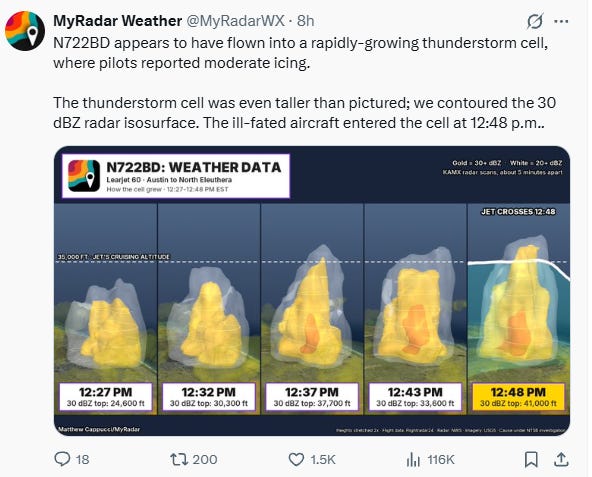
Then there’s weather. Usually in litigation where weather plays a part, there are weather expert witnesses that will come in and we work with them to review weather at the time. NWS Miami radar shows the jet level at 35,000 feet inside a thin anvil cloud at 12:46 p.m., then entering the core of a thunderstorm at 12:47:51 with storm tops near 45,000 feet, reflectivity of 25 to 35 dBZ at its own altitude and an updraft strong enough to lift it to 35,250 feet before it began to fall. A separate radar and temperature review posted on X describes the same cell as a rapidly building convective tower that lofted heavy moisture and put the jet inside it at 12:47 to 12:48 p.m. FAA thunderstorm guidance tells pilots to regard any storm with tops at 35,000 feet or higher as extremely hazardous and to stay at least 20 miles from any storm that is severe or shows an intense radar echo. A highway crash report asks the same question in plainer words: what were the weather and road conditions, and did the driver adjust to them? A trucker who drives into a squall line at 70 mph gets judged under 392.14. A flight crew that flies into a building thunderstorm gets judged against that guidance, the weather radar on the panel and whatever the operator’s manual told them to do.
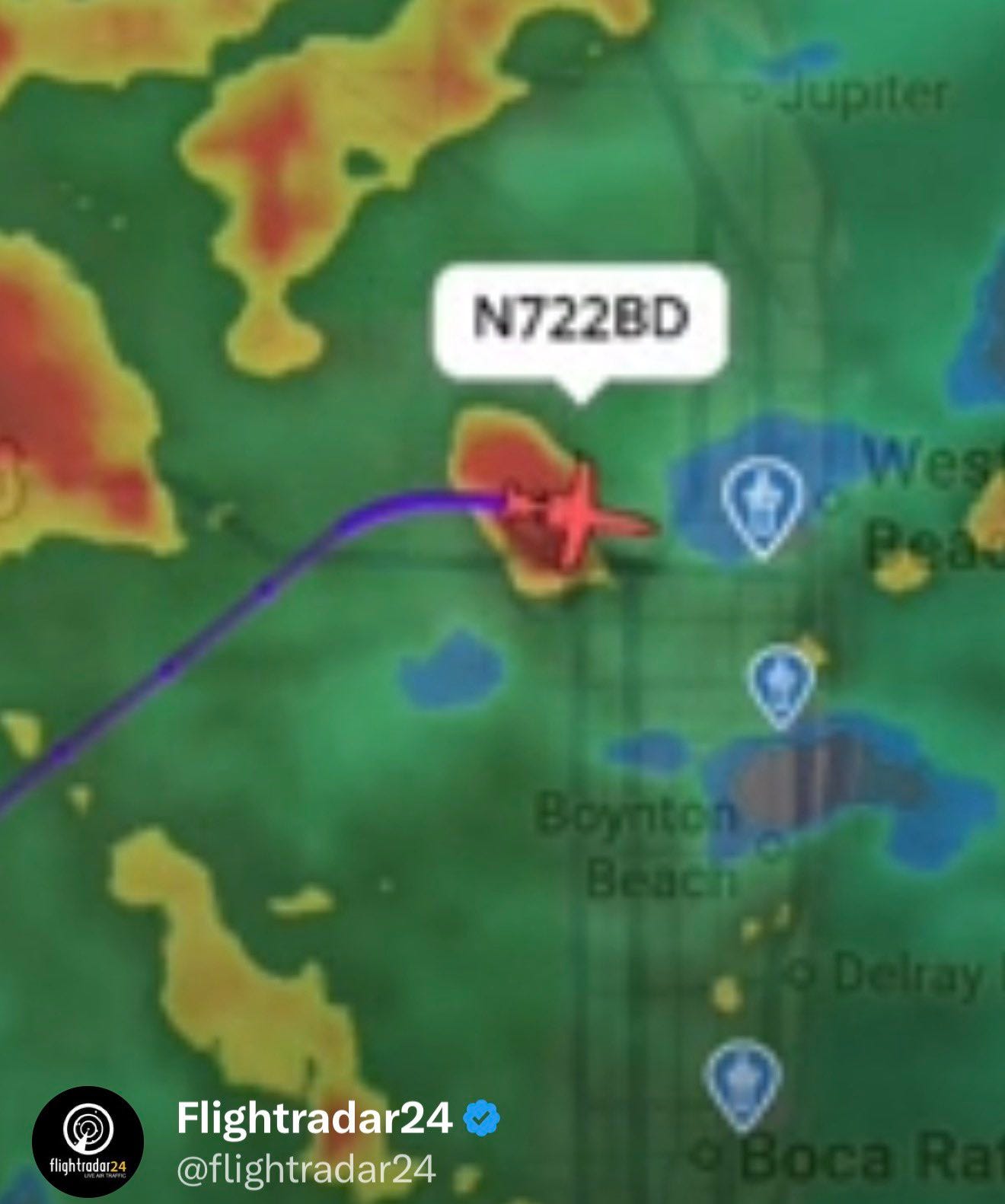
On the radio, the crew reported ice at minus 47 Celsius. Supercooled liquid water essentially can’t exist below about minus 40, so whatever was hitting that airplane was more likely ice crystals than the wet, clear ice that builds on wings at lower altitudes. Ice crystals in the core of a thunderstorm are known to clog the pitot probes that feed airspeed indications, which is what started the chain on Air France Flight 447 in 2009. An overspeed call, a steep bank in a transcript of the recording circulating online, and a spiral that tightens as the nose drops would all be consistent with an upset in convective weather. Consistent is not proven. Some people reviewing dashcam footage claim the tail was missing on the way down. That isn’t verified, and the debris field will settle it. If pieces of the tail turn up away from the crater, the airplane began breaking up in flight. On the highway, we read a debris field the same way: parts upstream of the point of impact tell you something was let go before the collision.
Human factors are part of every truck reconstruction I do, and they’ll be part of this one. Experience, training, duty time and the decision to fly through that line of weather will all be examined. The crew and passenger names have not been officially released. Social media has already named the pilot as Nathalia Filgueiras. Nobody should build a story on it until the medical examiner and the NTSB confirm it. In my world, a deposition doesn’t overrule the logbook. Online speculation doesn’t overrule the investigation. She can be seen flying here:
When I take a truck case, the crash itself is half the file. The other half is paper, and we pull it the same way every time: the driver qualification file, the hours-of-service records, the drug and alcohol testing history, the medical card, the license and endorsements, the training records, and the maintenance file on the tractor and trailer. The NTSB pulls the same categories on an airplane. The regulation numbers change. The questions don’t.
FMCSA sorts that paper into seven buckets it calls BASICs, the Behavior Analysis and Safety Improvement Categories behind its Safety Measurement System: Unsafe Driving, Crash Indicator, Hours of Service Compliance, Vehicle Maintenance, Controlled Substances and Alcohol, Hazardous Materials Compliance and Driver Fitness. Aviation regulates almost all of those categories, often more strictly. What it lacks is a scoreboard. The FAA publishes no public safety score for charter operators comparable to the SMS percentiles anyone can pull on a motor carrier, so charter customers lean on private audit ratings from firms such as ARGUS and Wyvern. When you review the BASICs one at a time, overlaps and gaps show up fast.
Who was qualified to sit in the seat. I started working on my pilot’s license here in Virginia and I was shocked that for $12,000 and a 40-hour course I could have a pilot’s license to fly a plane.
A tractor-trailer driver needs a Class A commercial driver’s license under 49 CFR Part 383, entry-level driver training under Part 380 for anyone licensed since February 2022, and a driver qualification file under Part 391 that includes a road test, a motor vehicle record review and an inquiry into the last three years of employers. Charter captains are held to a higher standard. If this trip was flown under Part 135 with paying passengers, the pilot in command of a turbojet had to hold an airline transport pilot certificate with a Learjet type rating under 14 CFR 135.243. An unrestricted ATP requires a pilot to be at least 23 years old with 1,500 hours of flight time under 14 CFR 61.153 and 61.159. The second in command needs a commercial certificate with an instrument rating under 14 CFR 135.245. If the trip was flown under Part 91 as a private flight, those charter floors fall away and the legal minimums drop sharply. That is why the Part 91 versus Part 135 question matters so much. It’s the aviation version of asking whether a truck was running as a for-hire motor carrier or a private carrier. Once the crew is officially identified, you can check their certificates in the FAA airman registry the same way I pull a CDL status.
Age is the first line in both rulebooks. A driver must be 21 to operate a commercial motor vehicle in interstate commerce under 49 CFR 391.11, and most states let 18- to 20-year-olds drive only within state lines, usually with tighter hazmat limits. Aviation builds a ladder instead. A pilot can solo an airplane at 16, earn a private certificate at 17 and a commercial certificate, the license to be paid to fly, at 18. The airline transport pilot certificate a Part 135 captain on a passenger jet needs requires age 23 and 1,500 hours under 14 CFR 61.153 and 61.159. A restricted version is available at 21 under the rules Congress ordered after the 2009 Colgan Air crash, and it was built to put first officers in airline cockpits, not captains. Put the two side by side and a 20-year-old commercial pilot can legally fly for hire in some jobs at an age when federal rules won’t let a 20-year-old haul a load from Florida into Georgia. That 20-year-old can’t captain a charter jet full of paying passengers.
Hours of service come next. A truck driver gets 11 hours of driving inside a 14-hour window after 10 hours off duty, with a 30-minute break after eight hours of driving and a 60- or 70-hour weekly cap under 49 CFR Part 395, all recorded on an electronic logging device. A two-pilot charter crew on an unscheduled trip is limited to 10 hours of flight time in any 24 consecutive hours and must have at least 10 consecutive hours of rest in the 24 hours before the assignment ends under 14 CFR 135.267. This crew had been airborne a little over two hours, so the flight time itself isn’t the issue. The question investigators ask is the one I ask on every fatigue case: what the crew did in the 72 hours before departure, whether they flew in the day before, where they slept and how long they had been on duty before wheels up.
Drug and alcohol testing runs on nearly identical clocks. Under FMCSA’s rule at 49 CFR 382.303 and the FAA’s at 14 CFR Part 120, a post-accident alcohol test must happen within eight hours and a drug test within 32. When the crew dies, there is no collection to run, so toxicology moves to the medical examiner and the FAA’s forensic toxicology laboratory. The history before the crash lives in the operator’s random testing records and, for pilots, in the FAA’s Pilot Records Database under 14 CFR Part 111, the aviation cousin of the FMCSA Drug and Alcohol Clearinghouse.
Medical qualification works the same way with different paperwork. A CDL driver carries a medical examiner’s certificate good for up to 24 months from an examiner on the FMCSA National Registry under 49 CFR 391.41 through 391.49. A professional pilot carries a first- or second-class FAA medical certificate from an aviation medical examiner, renewed on a shorter cycle depending on age and class. Investigators will pull both pilots’ medical applications, which require disclosure of conditions and medications, the same way I pull a driver’s long-form physical.
Training and checking are stricter in aviation than in trucking, and I want those records first. A Part 135 pilot must pass a competency check every 12 months under 14 CFR 135.293. The captain must pass an instrument proficiency check every six months to fly under instrument rules under 135.297, plus an annual line check with a check pilot under 135.299. Trucking has nothing like a recurring check ride. On this crash, the training records that matter most are upset recognition and recovery, high-altitude weather, ice crystal icing and unreliable airspeed procedures.
Then the machine. On a truck, I pull the Part 396 file: the systematic inspection and maintenance program, the annual inspection, the driver vehicle inspection reports, brake and tire records and open recalls. On a jet it’s the maintenance logs under 14 CFR 91.417, the inspection program the operator follows under 14 CFR 135.411 and the manufacturer’s schedule, the status of every applicable airworthiness directive under 14 CFR Part 39, and the records on the pitot-static and air data system, the autopilot and Mach trim, and the weather radar. That radar isn’t optional on this kind of flight. Federal charter rules require approved airborne weather radar on large transport category airplanes carrying passengers and bar starting an instrument flight when thunderstorms may reasonably be expected along the route unless that radar is working, under 14 CFR 135.175. The trucking parallel is 49 CFR 392.14, which requires extreme caution in hazardous conditions and requires a driver to stop when conditions become dangerous enough. In both worlds, the weather rule is written around judgment, and judgment is the hardest thing in the file to reconstruct.
The claims side runs in parallel. In trucking, the carrier’s insurer has adjusters and defense counsel moving within hours, and the first fight is over preserving the electronic data. In aviation, the underwriter on the hull and liability policy moves just as fast, but the NTSB controls the wreckage and the party process restricts what the companies involved can release while the investigation runs. The rule I give clients holds in both worlds: the paper written before the crash is worth more than any statement given after it.
One last piece of math, because a lot of people say this weekend that flying private is safer than driving. It depends on what you count. In absolute numbers, trucks win the grim contest easily: crashes involving large trucks killed 5,340 people in 2024, according to the National Highway Traffic Safety Administration. Per mile, drivers of those trucks are among the safest on the road, with an occupant fatality rate of 0.28 per 100 million miles in 2024 compared with 1.05 for passenger cars. Per hour of exposure, the picture flips for charter flying. The overall traffic fatality rate was 1.10 deaths per 100 million vehicle miles in 2025, which at an average 35 mph works out to roughly 0.04 deaths per 100,000 hours on the road. On-demand Part 135 charter flying ran 0.319 fatal accidents per 100,000 flight hours in 2019, the worst year in a decade for that sector. Airlines are the safest way to travel. Charter jets are not safer than driving, hour for hour.
The math explains the crater. It explains why there’s no airplane on Military Trail and why the investigators will spend weeks on their knees in a hole instead of walking around a wreck. It doesn’t explain why a jet that crossed the Gulf of Mexico at 35,000 feet ended up inside a storm cell a few miles from its destination’s coastline. That’s what matters to nine families, and only the investigation can answer it.
Worksheet
Descent: 35,250 ft (17:48:07Z) to 31,350 ft (17:48:39Z) = 3,900 ft / 32 s ≈ 7,300 fpm. 31,350 ft to 8,750 ft (17:49:23Z) = 22,600 ft / 44 s ≈ 30,800 fpm ≈ 514 ft/s. Total 26,500 ft / 76 s ≈ 349 ft/s (FAA: ~350 ft/s).
Speed at 10,125 ft: GS 298 kt = 503 ft/s; VS 30,976 fpm = 516 ft/s; resultant √(503² + 516²) ≈ 721 ft/s ≈ 491 mph ≈ 219.6 m/s; path angle atan(516/503) ≈ 46°.
Mass (estimate): BOW 14,772 lb + ~1,600 lb pax/bags ≈ 16,400 lb ZFW; fuel remaining est. 2,000 to 2,500 lb = ~18,500 lb (8,400 kg). MTOW 23,500; MZFW 17,000.
Kinetic energy: ½ × 8,400 × 219.6² ≈ 202.5 MJ ≈ 48 kg (107 lb) TNT at 4.184 MJ/kg. Sensitivity: 400 mph ≈ 134 MJ; 550 mph ≈ 254 MJ.
Truck: 80,000 lb (36,287 kg) at 65 mph (29.06 m/s): ½ × 36,287 × 29.06² ≈ 15.3 MJ. Ratio ≈ 13.2.
Car: 4,000 lb (1,814 kg) at 60 mph (26.82 m/s) ≈ 0.65 MJ. Ratio ≈ 310.
Momentum: jet 8,400 × 219.6 ≈ 1.84 × 10⁶ kg·m/s; truck 36,287 × 29.06 ≈ 1.05 × 10⁶; ratio ≈ 1.75.
Crush duration: 17.9 m / 219.6 m/s ≈ 0.08 s. Average force: (8,400 / 17.9) × 219.6² ≈ 22.6 MN ≈ 5.1 million lbf.
Deceleration: v²/2d: d = 5 m = ≈ 4,820 m/s² ≈ 490 g; d = 3 m = ≈ 8,040 m/s² ≈ 820 g.
Fuel energy: 2,300 lb = 1,043 kg × 43 MJ/kg ≈ 44,900 MJ ≈ 220 × KE.
Exposure comparison: 1.10 deaths / 100M VMT ÷ (100M mi / 35 mph = 2.86M hr) ≈ 0.038 deaths per 100,000 vehicle-hours.
The aviation figure is fatal accidents per hour; the road figure is deaths per hour; units differ, direction holds.