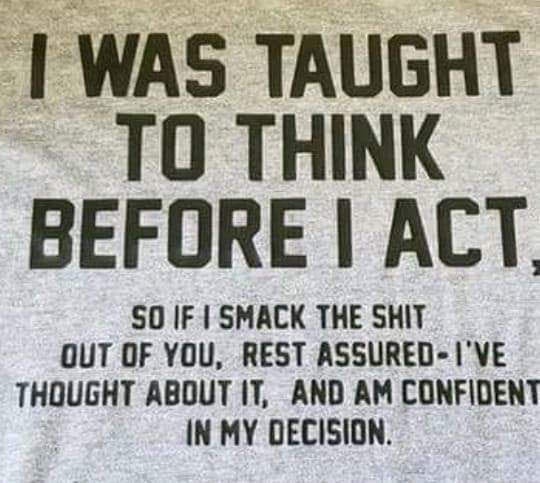
We used to understand that decisions have consequences. What the hell happened?
I was eight years old when I stole a Matchbox car from Value City in Newport News, VA. It cost a dollar. My grandmother, born in 1938, the daughter of a hog farmer, didn't yell at me. She didn't ground me. She didn't lecture me in the car.
She drove me to the police station and turned me in.
A eight-year-old. A dollar toy. And this woman, who loved me more than life itself, marched me into a police station and made me face what I had done. (For the record they played along and made me do volunteer work in the jail for the day but it made an impression.)
That's the world I was raised in. That's the foundation that was laid for me by people born in the 1930s and the teens, people who understood something that seems to have evaporated from American society: your decisions are yours, and so are the consequences.
My grandmother and her generation were serious people. They did not cover for you. They did not make excuses for you. They did not blame the system, the store, the opportunity, or the circumstances. You made a choice. You owned it. End of story. Just because you were their tribe and they loved you it didn't mean that they were going to accept your failures.
They didn't abandon you. They loved you enough to let you face the music because they understood that was the only way you'd learn. That was love. Real love. Not the hollow, enabling, excuse-making love we've substituted for it today.
Consequences Are Real
Here's a statement that shouldn't be controversial but somehow has become radical: if you do stupid things, stupid outcomes tend to follow. In other words, Fuck around and you might have to find out.
If you eat garbage food every day, you're probably going to gain weight. If you never exercise, your health will decline. If you associate with criminals, you'll likely end up in criminal situations. If you drive drunk, you dramatically increase your chances of killing yourself or someone else. If you physically resist law enforcement, the encounter is going to escalate.
None of this is complicated. A child can understand cause and effect. Yet we've built an entire cultural infrastructure dedicated to separating actions from their natural consequences, and then expressing shock and outrage when reality refuses to cooperate with our delusions.
We've become a society that believes we can say anything, do anything, act any way we want, and there should be no consequences. When consequences inevitably arrive, as they always do, because that's how the universe works, we have an entire vocabulary ready to deploy: unjust, racist, bigoted, fascist, oppressive, systemic.
Anything and everything except: "I made a bad decision."
What We Lost After 1990
Something shifted in American culture, and I've spent a lot of time trying to pinpoint when and why. The best I can figure is that those of us born before 1990, or at least those raised by people with pre-war values, were the last generation to be taught that our decisions have consequences and that no one was coming to save us from ourselves.
The generation that survived the Depression and fought World War II didn't have time for excuses. They couldn't afford them…literally. You worked or you starved. You made good decisions or you suffered. There was no safety net of blame to catch you. The feedback loop between action and consequence was immediate and brutal.
They raised their children with that same understanding, even as prosperity grew and the stakes lowered. And those children, the Boomers, for all their faults, largely passed it on. Somewhere along the line, the chain broke.
We started protecting children from consequences. We started making excuses for bad behavior. We started treating accountability as trauma. We decided that self-esteem was more important than self-awareness, that feeling good was more important than being good.
We raised a generation, multiple generations now, who genuinely believe that their choices shouldn't have negative outcomes. That if something goes wrong, it must be someone else's fault. That personal responsibility is just a phrase people use to victim-blame.
Tribalism is a Problem
We've organized our entire society around defending our tribe's bad actors instead of holding them accountable.
The far left does something indefensible, and the center-left stays silent or makes excuses. The far right does something indefensible, and the center-right stays silent or makes excuses. Nobody wants to break ranks. Nobody wants to be seen as disloyal.
My grandmother's generation didn't work that way. If you were in their tribe and you broke the law, you were getting turned over to face punishment. Being family didn't exempt you from consequences, it made the accountability more certain, because they weren't about to let your bad decisions drag down everyone else.
That's what we've lost. The willingness to say: "I don't care if you're on my team. What you did was wrong, and you need to face the consequences."
Instead, we've created a culture where calling out bad behavior on your own side is treated as betrayal. Where loyalty to tribe trumps loyalty to truth. Where the only bad actors are the ones wearing the other team's jersey.
This is how you get extremism. When the center refuses to police its own fringes, the fringes define the whole. When consequences only apply to the other side, nobody has any incentive to behave. The entire system of accountability collapses.
This Isn't a Left or Right Problem
I'm not writing this as a partisan screed. Bad decision-making and consequence-avoidance are equal opportunity afflictions.
If Donald Trump decides to take action against a foreign leader, there will be consequences, maybe not immediate, maybe not direct, but they will come. Decisions at that level ripple outward in ways that can take years to fully manifest. That's not a political statement; that's just how the world works.
If Gavin Newsom decides to buck federal DOT regulations on non-domiciled CDL programs and tell Secretary Sean Duffy to pound sand, he shouldn't be shocked when $200 million in federal funding gets held up. You don't get to ignore federal requirements and then act surprised when the federal government responds. That's cause and effect. That's consequences.
Businesses close every day because leaders made bad decisions. We don't always blame the economy or the market or the competition. Sometimes, often, it's just someone at the top who made a series of choices that led to failure. In business, at least, the feedback is usually clear enough that we can admit it.
In our personal lives? In our politics? We've lost the ability to say: "This outcome happened because of the choices that were made." Instead, we construct elaborate narratives that absolve the decision-maker of any responsibility.
The Decisions Define Us
I've made some of the worst decisions a person can make. I've lived through consequences that I wouldn't wish on anyone. I know what it's like to have your life fall apart because of choices you made.
I'm standing here telling you: it was on me. Every time. Even when circumstances were hard. Even when other people contributed. Even when the system was stacked against me. At the end of the day, I made decisions that got the ball rolling, and I had to own what followed.
That ownership, that willingness to say "I did this" is the only thing that ever allowed me to change. You cannot fix what you won't acknowledge. You cannot improve decisions you refuse to take responsibility for. You cannot grow as a person while simultaneously insisting that nothing is ever your fault.
Every single decision we make has a consequence: The school we choose. The people we marry. The content we consume. The food we eat. The friends we keep. The risks we take. The lines we cross.
Every one of these decisions moves us in a direction. They compound over time. Good decisions tend to produce good outcomes. Bad decisions tend to produce bad outcomes. It's not always linear or immediate, but the pattern holds.
The question is whether we're making these decisions deliberately, with clear values and principles guiding us, or whether we're just reacting, and then blaming everyone else when things go sideways.
The Foundation of Good Decisions
Here's what my grandmother and her generation understood and we've forgotten, good decision-making requires a foundation.
You need values. You need principles. You need boundaries that you will not cross, lines you will not step over, regardless of the circumstances or the temptation.
These can't be situational. They can't be flexible. They can't be negotiable based on whether they're convenient in the moment. They have to be bedrock, the things you won't do, full stop, because doing them would violate who you fundamentally are and the fundamentals of what right is. Not right by society standards but moral and ethical right.
If those values and principles are grounded in something good and wholesome and righteous, you will tend to make good decisions. If they're not, if you have no foundation, no boundaries, no lines, then you're just making it up as you go along. That's when the really catastrophic decisions happen.
The people I see who are most lost, most unhappy, most prone to blaming everyone else for their circumstances, they almost always share one thing in common: they have no foundation. They have preferences, not principles. They have impulses, not values. They have no framework for evaluating decisions beyond "what do I feel like doing right now."
Then they're shocked when a life built on impulses produces chaotic results.
What It Would Take to Fix This
I don't have a magic solution. I don't think there is one. Cultural shifts of this magnitude don't reverse easily but I know where it would have to start: with individuals deciding, actually deciding, to hold themselves accountable first. To stop making excuses. To stop blaming systems and circumstances and other people for the results of their own choices.
Then extending that same standard to the people around them. To their families. To their political allies. To everyone on their "team."
It would mean telling people you love that they screwed up when they screw up. It would mean acknowledging when your side does something wrong instead of immediately pivoting to whataboutism. It would mean valuing truth and accountability over tribal loyalty.
It would mean raising children the way my grandmother raised me: with love, with support, but with an absolute unwillingness to shield them from the consequences of their own choices.
It would mean becoming, once again, serious people who understand that actions have consequences and that no one is exempt from this basic law of the universe.
I don't know if we can get there. I really don't. But I know that we have to try, because the path we're on, where everyone is a victim, where nothing is anyone's fault, where consequences are always someone else's problem, that path leads nowhere good.
We all have to decide: Are we going to be the kind of people who own our decisions? Or are we going to spend our lives explaining why nothing is ever our fault?
That choice, that decision, is still ours to make.
And yes, there will be consequences.