

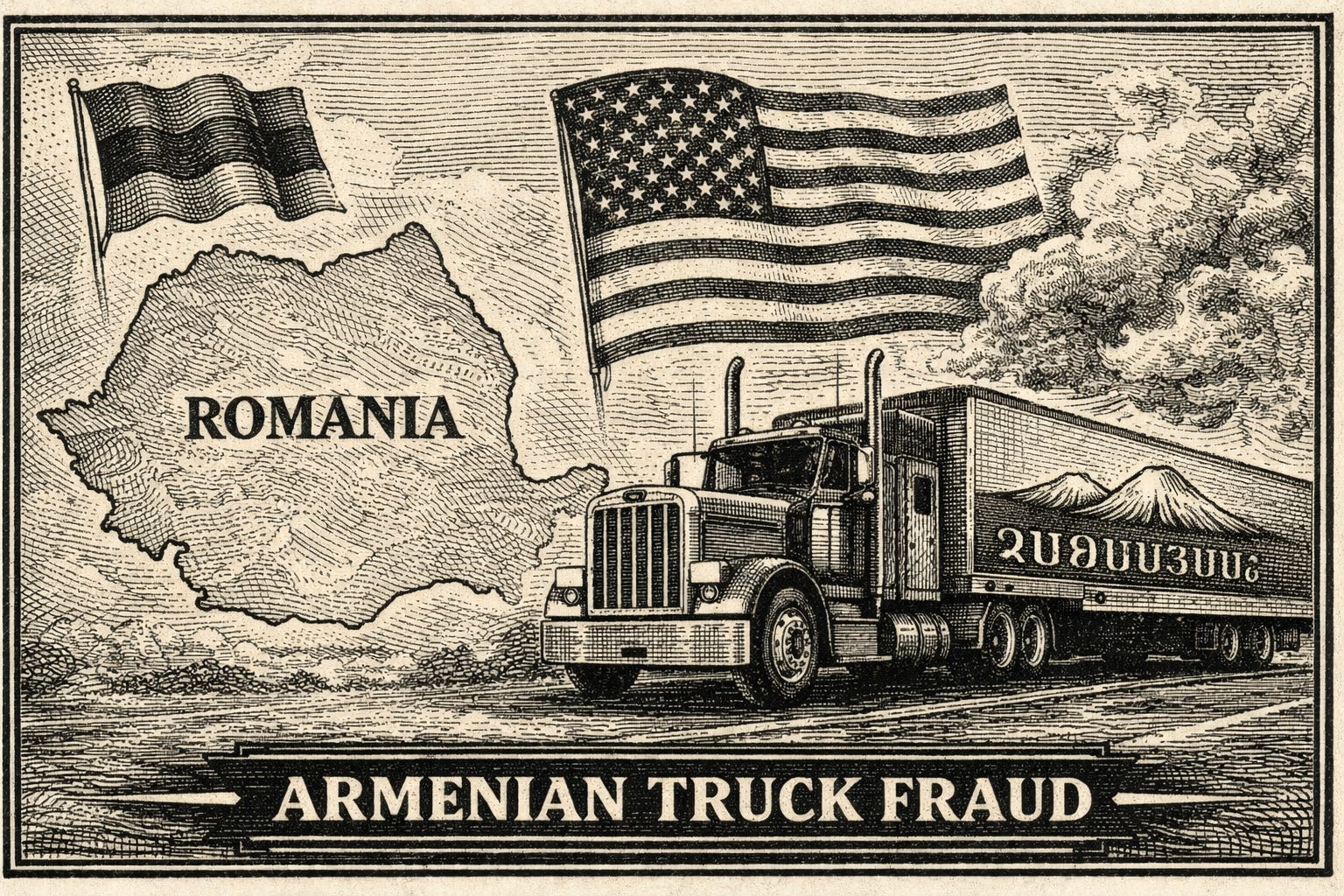
THE OLD ROAD
The stagecoach was the first freight network in America. Gold moved on it. Mail moved on it. Land moved on it, deeds folded into saddlebags crossing deserts where there was no law to speak of. And men robbed it. They robbed the coaches in Arizona. They robbed them in Missouri. They robbed them in Pennsylvania. The outlaw and the freight network have been traveling the same road since before the United States was old enough to know what either one was.
Rail came next, bringing the same parasites with it. The Pinkertons were not hired to guard trains because the trains were safe. They were hired because an organized criminal enterprise understood, before the economists did, that transportation infrastructure is wealth in motion, and wealth in motion is the most vulnerable kind of wealth there is. Jesse James did not need a doctorate in logistics to understand that a train carrying payroll was a better target than a bank. He just needed to know the schedule.
Modern trucking is roughly 100 years old. The first Motor Carrier Act was passed in 1935. The interstate highway system that made long-haul trucking economically dominant was not complete until 1992. The regulatory framework that governs the industry today, the USDOT numbers, the FMCSA, the commercial driver’s license system, the broker bond requirements, the new entrant monitoring program, all of it was built, patched, amended and inadequately funded across a span of time that a single working trucker can remember from start to finish.
The American trucking system is not ancient. It is not hardened by centuries of adversarial pressure. It is a young system, built for access and speed, designed in a more trusting era, operating today in an environment that has changed fundamentally around it. And the criminals who exploit it did not arrive yesterday either. The families and networks now running freight fraud in Southern California, in the San Fernando Valley, in Glendale and Burbank and North Hollywood, some of them have been at this since before there was an FMCSA to evade.
The people who built those networks are not all gone. In some cases, they are still alive, still in the industry, still operating, their methods refined by decades of practice and their infrastructure layered deep enough that the regulatory apparatus has never successfully reached the core. This is the story of how that happened, who built it, what it looks like now, and why the window to dismantle it is closing faster than the government seems to understand.
THE ORIGINALS
In 2003, two childhood friends from Glendale, California, graduated from Glendale High School and started a company. Steve Avetyan and Alfred Megrabyan called themselves, without apparent embarrassment, ‘the originals.’ They did not mean original in the artistic sense. They meant they were the first. The first to figure out how to build a scalable freight fraud network in America using the Armenian immigrant community as both labor force and protective camouflage.
The network they built, the All State Association, headquartered in San Fernando, California, would eventually generate revenues of between $500 million and $600 million a year. It would operate branches in Glendale, North Hollywood, Burbank, and Las Vegas. It would employ hundreds of sales agents, directly or indirectly. It would finance the startup of more than 500 transportation companies and brokerages across Southern California and beyond. It would recruit agents in Armenia. And it would operate a factoring company, Royalty Capital Inc., registered in Nevada but sharing an address and key officers with All State itself, that would allow the money from the network to move through a financial instrument before anyone could trace its origin.
Before Steve Avetyan was ‘the originals,’ there was his uncle.
Rubik Avetyan, 55 at the time of sentencing, of Sunland, California, was the patriarch. He ran a trucking fraud scheme with his sons, Alfred and Allen Avetyan, that targeted 165 brokers and carriers over a 10-month period beginning in 2008. The scheme was straightforward: they created a motor carrier called State Transport Inc., registered in Harrisburg, Pennsylvania, using false and altered identification. They obtained loads from brokers. They gave those loads to legitimate carriers who actually hauled them. Then they collected payment from the brokers and paid nothing to the carriers. The difference went into the Avetyan family accounts. The carriers, small operators running one or two trucks, absorbed losses they were never meant to survive.
On March 4, 2011, U.S. District Judge A. Richard Caputo sentenced Rubik Avetyan to 50 months in federal prison. His sons, Alfred and Allen, each received 60 months. The family was ordered to pay $1,118,723 jointly in restitution to their 165 victims. The DOT Office of Inspector General, the U.S. Postal Inspection Service, and the Bureau of Alcohol, Tobacco, and Firearms worked the case.
Steve Avetyan was never charged. He called the scheme his uncle did ‘stupid things.’ He said they deserved to go to jail. He also said, in the same conversation with FreightWaves in 2021, that his uncle and cousins were ‘again working in the industry after completing their jail sentences.’ The network did not stop when Rubik went to prison. It reorganized. It scaled. It became something Rubik’s generation could not have imagined.
THE FRANCHISE MODEL
Steve Avetyan compared the All State Association to a McDonald’s franchise. It was the most honest thing he said in any public interview. The franchise model is exactly what he built, and understanding it is essential to understanding why it is so difficult to prosecute and why it has grown to the scale it has.
Here is how the franchise operates. A person, almost always from the Armenian immigrant community in Southern California or from Armenia itself, approaches All State. All State finances them to start a motor carrier or brokerage. The startup gets a USDOT number, a load board presence, and access to All State’s technology platform, which tracks truck and trailer availability across freight lanes nationwide. The startup pays All State 20 percent of revenue. In exchange, they get what Avetyan described as ‘the back-end stuff’: capital, financing, truck access, software, and the tools to build the business.
A small trucking company or brokerage operating legitimately cannot afford to pay 20 percent of revenue to a parent organization and remain viable. The math does not work unless the revenue is generated through fraud. Double-brokering loads without authorization, not paying the carriers who actually haul the freight, generating fraudulent invoices through the factoring company, and collecting money that does not belong to you is how you make 20 percent viable. The franchise model incentivizes fraud because fraud is the only way to afford the franchise.
The results are visible in the data. Investigators examining Southern California motor carrier registrations found more than 400 active MC numbers registered to addresses in Glendale, Tujunga, North Hollywood, and Burbank. Those cities could ‘maybe hold between five and ten legitimate trucking companies,’ according to one freight industry investigator who spent two years mapping the network. The other 390-plus registrations are something else. They are the franchise.
Load board provider DAT shut down 300 users for alleged network-related fraud. Carrier411, which tracks carrier behavior through broker and shipper reports, documented more than 1,000 FreightGuard reports against companies in the network. Brokers who filed complaints described being harassed with phone calls and emails until they removed the reports. In one documented case, an employee of a network-connected company threatened to harm himself unless a FreightGuard report was taken down. The network protects itself not just through legal and corporate structure, but through intimidation.
THE WASHING MACHINE
The factoring company is where the scheme becomes money laundering, and understanding why requires a brief explanation of how freight factoring works.
When a carrier hauls a load, they invoice the broker or shipper for payment. Standard payment terms in freight are net 15 to 30 days, meaning the carrier waits 2 to 4 weeks to get paid. For a small trucking operation running on thin margins, that delay creates constant cash flow pressure. Factoring companies solve that problem by purchasing the invoice at a discount, typically advancing 90 to 95 percent of the invoice value immediately, then collecting the full amount from the broker or shipper when it comes due. The carrier gets cash today. The factoring company makes a few percent on the transaction.
In a legitimate operation, factoring is a straightforward financial service. In the Glendale network, it is the mechanism by which stolen money is washed clean.
Here is the cycle. A carrier in the network double-brokers a load, meaning it takes a load from a broker, finds a cheaper carrier to actually haul it, pockets the difference, and then fails to pay the carrier who did the work. The moment the load is dispatched, the network carrier submits an invoice to Royalty Capital, or Crossroads Services, or Asteria Corp, the three factoring entities that industry investigators and carriers on TruckersReport have identified as operating in the orbit of All State. The factoring company advances 90% of the invoice amount immediately. The money is in hand before any dispute can be raised.
When the shipper or the original broker pays the invoice in full, the funds flow back to the factoring company. If the shipper disputes the invoice because the load was double-brokered without authorization, the factoring company holds a fraudulent receivable that it will never collect. But if the factoring company is owned by the same family running the fraud, the loss is fictional. Money moved from the left pocket to the right pocket, and the carrier who actually hauled the load never got paid.
Royalty Capital Inc. is documented in California Secretary of State filings as owned by Steve Avetyan. Its mailing address is the same as the All State Association in San Fernando. Its business filings list Armen Karibyan, the CEO of All State Trucklines, as a corporate officer. Royalty Capital and All State share an office in Las Vegas. The factoring company and the brokerage are not separate businesses serving each other at arm’s length. They are the same business, and they are designed to be.
Carriers and brokers throughout the industry have learned that a company factoring through any of these three entities is almost certainly part of the Glendale network, and the freightguard reports, unpaid invoices, and load board complaints that follow confirm it.
THE CALL CENTERS
The Glendale network is the domestic infrastructure of Armenian freight fraud. But it is not the only model, and the domestic infrastructure, as sprawling as it is, is arguably the less sophisticated half of what has been built.
In January 2025, the U.S. Attorney for the Eastern District of Pennsylvania filed criminal charges against Serj Gevorgyan, also known as Seryozha Gevorgyan, for running nine fraudulent motor carrier entities from call centers located in Armenia, 6,000 miles from the freight lanes his companies were allegedly robbing.
The nine entities Gevorgyan allegedly controlled were: SGSH Trans LLC (USDOT 3214913), Next Level Brokerage Inc. (USDOT 3602905), Smartdrive LLC (USDOT 3602241), Key Solutions Group Inc. (USDOT 3336195), Meelemann and Co. (USDOT 3738505), S4S Logistics Inc. (USDOT 3821559), Yellow Elephant Corp. (USDOT 3975319), Blue Joker Inc. (USDOT 3980883), and Pink Donut Freight Inc. (USDOT 3980888). Additional entities, including Premier Capital and Lowcoster LLC, were also identified in the investigation.
Each company was registered with FMCSA as a legitimate motor carrier. Each listed U.S. business addresses that were virtual office, mailbox services, or an entirely fictitious location. Each used nominee names as stated owners and officers, individuals who had little or no actual involvement in the companies’ operations. Each claimed to be a U.S.-based, domestically controlled carrier. None of it was true.
The actual operations ran from call centers in Yerevan. Staff monitoring American load boards during U.S. business hours, achieving that coverage by working evening and overnight Armenian shifts, would accept loads on behalf of Gevorgyan’s companies, immediately re-broker them to legitimate carriers at lower rates, collect payment from the shippers, and not pay the carriers. The call centers had scripts, systems, quality control, and management. They maintained the fraud convincingly enough to delay detection for months or even years.
The choice of Armenia as a base of operations was not sentimental. It was strategic. Operating from Yerevan places the command structure beyond the practical reach of U.S. law enforcement. Search warrants in Pennsylvania do not execute in Armenia. Raids that could happen in a day in Philadelphia require months of diplomatic process in Yerevan, if they happen at all. Extradition from Armenia, even when secured, can be fought through foreign courts for years. The criminal who runs his operation from 6,000 miles away has purchased himself time, and in freight fraud, time is money.
The multi-agency coalition that eventually built the Gevorgyan case included the DOT Office of Inspector General, Homeland Security Investigations, IRS Criminal Investigation, the U.S. Postal Inspection Service, the Diplomatic Security Service, the Social Security Administration OIG, the Department of Labor OIG, and Health and Human Services OIG. Eight federal agencies. Three to four years of work. The result was the filing of a criminal information in January 2025. Whether Gevorgyan will actually stand in an American courtroom to face those charges depends on the outcome of extradition proceedings that remain unresolved.
THE ORGANIZED CRIME BACKDROP
The Glendale brokerage network and the Yerevan call center network are not unrelated phenomena. They are two expressions of a single underlying reality: Armenian Organized Crime, a Russian mafia-affiliated transnational criminal organization that has made Los Angeles County a center of U.S. operations, is embedded in American trucking at a depth that freight fraud statistics do not capture.
In May 2025, federal authorities arrested 13 alleged members and associates of rival Armenian organized crime syndicates in California and Florida. The charges included attempted murder, kidnapping, illegal firearm possession, bank and wire fraud, and cargo theft totaling more than $83 million from Amazon alone. The Artuni Enterprise, led by Ara Artuni of Porter Ranch, had enrolled as Amazon carriers, contracted for legitimate trucking routes, diverted from those routes mid-transit, and stolen the shipments. Artuni and his rival, Robert Amiryan of Hollywood, had been in a violent power struggle for control of the San Fernando Valley since 2022, a struggle that included an attempted murder ordered by Artuni and a retaliatory kidnapping organized by Amiryan.
Federal affidavits described the organization as avtoritet, the Russian term for ‘authority,’ the rank structure used by Russian mafia-affiliated criminal networks. Armenian Organized Crime operates with the infrastructure and hierarchy of an international cartel, as Homeland Security Investigations puts it, because that is what it is. The trucking component is not an anomaly. It is a core revenue stream, one that has been running for decades and has grown more sophisticated with each passing year.
The connection between the organized crime layer and the brokerage franchise layer is not always documented in public records. What is documented is the overlap of geography, ethnicity, family ties, and operational methods. The Rubik Avetyan family served their time and returned to the industry. The Artuni Enterprise committed $83 million to cargo theft through trucking routes. The Gevorgyan call center stole millions through double-brokering from 6,000 miles away. These are not isolated actors. They operate in the same ecosystem, share the same regulatory vulnerabilities, and, in some cases, the same factoring infrastructure.
HOW THE SYSTEM ENABLES IT
For about $1,500, anyone in the United States can register with the FMCSA to obtain a motor carrier authority. There is no background check. No proof that trucks exist. No verification that the listed officers are real or that the listed address is occupied. The system accepts the application, processes the payment, and issues a USDOT number. That number is the key to the freight network. With it, you can access load boards, accept freight, and collect payments worth hundreds of thousands of dollars before anyone realizes you never intended to deliver.
The $75,000 broker bond serves as a financial backstop that carriers can claim against when a broker does not pay. But the bond only applies to brokers. A motor carrier, which is what Gevorgyan’s companies are registered as, does not need a bond. And nothing prevents a registered motor carrier from immediately starting to broker loads without authorization, which is illegal but undetectable in real time. By the time complaints accumulate and FMCSA identifies the pattern, the entity has already stolen what it came for and can dissolve and re-register under a new name in days.
FMCSA has roughly 1,000 employees to police approximately one million active motor carrier authorities. The new entrant monitoring program is supposed to catch bad actors within the first 18 months through audits and enhanced scrutiny. But there are not enough investigators to audit every new entrant, audits are often delayed until late in the window, and a network that registers nine companies at staggered intervals spreads its red flags across multiple monitoring periods. By the time the pattern connects, the money is gone.
The 18 months are too long. The verification at registration is too thin. The bond exemption for motor carriers is a loophole the size of a freight lane. The enforcement staffing is inadequate by an order of magnitude. These are not secrets. They have been documented in inspector general reports, congressional testimony, industry trade publications, and the court filings in every major freight fraud prosecution over the past 15 years. The government knows. It has always been known. The fixes have not happened because they cost money that Congress has not appropriated, and because the freight industry, which has every interest in low barriers to entry, has lobbied against the regulations that would raise them.
WHAT KILLS IT
Secretary of Transportation Sean Duffy and FMCSA Administrator Derek Barrs stood before thousands of truck drivers at the Mid-America Trucking Show in Louisville in late March 2026 and made promises. Barrs announced active investigations into chameleon carriers, identity theft, registration issues, fraudulent ELD devices, and CDL fraud. He said FMCSA was ‘working actively with FBI, ATF, DOJ, DHS’ on cases that crossed into federal criminal territory. Duffy said spot rates would go up as fraud was purged from the system. Both men said the right things.
The test is not the speech. The test is whether the structural fixes follow. Speeches at trade shows do not close the bond loophole. Speeches do not triple FMCSA’s investigative capacity. Speeches do not implement AI-driven pattern recognition to flag the registration anomalies that Gevorgyan’s nine companies should have triggered on day one. Speeches do not require physical verification of business addresses or video confirmation of stated owners. Speeches do not renegotiate extradition treaties with Armenia or create real-time intelligence sharing with foreign law enforcement.
What would actually kill the network is unglamorous and expensive. It is mandatory to have site inspections for all new entrants within 90 days. It is a bond requirement that extends to motor carriers who broker loads. It is a broker bond scaled from $75,000 to $250,000 or higher. It is a registration system that cross-references phone numbers, email addresses, and physical addresses across all applications to flag suspicious commonalities. It is 500 additional FMCSA investigators. It is a central fraud database that carriers can actually access to check a broker’s payment history before hauling a load. It is TWIC cards and biometric identification for every owner, officer, and operator in the industry, creating an accountability trail that follows the freight.
Some of that is coming. Some of it will not. The factoring fraud angle, the money laundering dimension of the scheme, is where federal investigators beyond FMCSA have the most leverage, because once the money flows through a financial instrument rather than a direct freight payment, the jurisdiction shifts to the financial crimes units that have more tools, more resources, and longer memory. The IRS Criminal Investigation Division was on the Gevorgyan case for a reason. If the factoring companies connected to the Avetyan network are shown to have facilitated the laundering of double-brokering proceeds, the cases that follow are not freight fraud cases. They are RICO cases.
The Rubik Avetyan conviction in 2011 did not end the network. It was reorganized and scaled. The Gevorgyan indictment in January 2025 did not end the offshore call center model. New entities will emerge with different names and USDOT numbers, while retaining the same Armenian call centers. The May 2025 arrests of 13 Armenian organized crime members in California and Florida did not decapitate the organization. The power struggle between Artuni and Amiryan was a franchise dispute, not an existential crisis.
What kills it is sustained, multi-year, multi-agency pressure applied at every layer simultaneously: registration, enforcement, prosecution, financial crime, and international cooperation. That has never happened. The question is whether the current administration’s stated commitment to freight fraud is the beginning of that sustained effort or another cycle of well-intentioned speeches followed by inadequate follow-through.
The founders of this network are, in some cases, still alive. The infrastructure they built is 30 years old and running at a scale that dwarfs anything Rubik Avetyan envisioned from Sunland. The window to dismantle it before it becomes so embedded that it is structurally irreplaceable is not permanent.
The stagecoach robbers are long dead. The railyard thieves are long dead. The trucking fraudsters of 2026 are, in several documented cases, the same families that started doing this when the regulatory architecture was still new enough to have obvious gaps. Those gaps have been widened, not closed, by 30 years of underfunded enforcement and deferred structural reform.
The road belongs to whoever shows up to take it. Right now, too much of it still belongs to the wrong people.
SOURCES AND DOCUMENTATION
DOT OIG Case Report: Rubik Avetyan et al., U.S. District Court Middle District of Pennsylvania, sentencing March 4, 2011. Available at oig.dot.gov.
Criminal Information: United States v. Serj Gevorgyan, Eastern District of Pennsylvania, filed January 29, 2025. Nine Subject Companies identified: SGSH Trans LLC (DOT 3214913), Next Level Brokerage Inc. (DOT 3602905), Smartdrive LLC (DOT 3602241), Key Solutions Group Inc. (DOT 3336195), Meelemann and Co. (DOT 3738505), S4S Logistics Inc. (DOT 3821559), Yellow Elephant Corp. (DOT 3975319), Blue Joker Inc. (DOT 3980883), Pink Donut Freight Inc. (DOT 3980888).
ICE/DOJ Press Release: Thirteen Members and Associates of Rival Armenian Syndicates Arrested, May 20, 2025. Cases prosecuted by the U.S. Attorney’s Office, Central District of California.
FreightWaves Investigation: ‘CEO Denies Ties to Sophisticated Double-Brokering Scheme in Southern California,’ July 13, 2021; ‘Former Employees Shed Light on Sophisticated Double-Brokering Network,’ January 5, 2022.
California Secretary of State: Royalty Capital Inc. officer filings, All State Association filings, corporate records for Armen Karibyan.
TruckersReport Forum: ‘Glendale CA Double-Brokers’ thread, identifying Royalty Capital, Crossroads Services, and Asteria Corp as factoring entities connected to the network.
The Tea Substack: ‘Day 30. Armenian Ghost Fleet,’ October 6, 2025, by Rob Carpenter. Comprehensive analysis of Gevorgyan’s fraud mechanics and FMCSA systemic failures.
FMCSA SAFER Database: DOT numbers for All State-affiliated entities confirmed active and inactive.
Great article, Rob Carpenter — everything you laid out is spot on.
One piece I’d add from experience: in many of these cases, the “unpaid carrier” that surfaces weeks later isn’t actually a victim. They’re often a **chameleon carrier** tied into the same network.
We’ve seen this pattern repeatedly — about 2–3 weeks after delivery, a carrier will reach out claiming they hauled the load and never got paid. But after doing deeper analysis, cross-referencing MCs, warehouses, and even Google reviews, the connections start to show. These entities are often operating in coordination, not independently.
This isn’t just double brokering — it’s a layered system designed to create confusion, delay detection, and extract payment from multiple angles.
Appreciate you shedding light on this. The more transparency we bring, the harder it becomes for these networks to operate.