

Tomorrow I’m pushing out a pretty wild story of ten fatalities and one of the questions was, “why didnt the FMCSA catch this at the time?” Well, it’s simple; they didn't fill out an OP1 application for authority. They filled out the free application for the free DOT number. No questions asked.
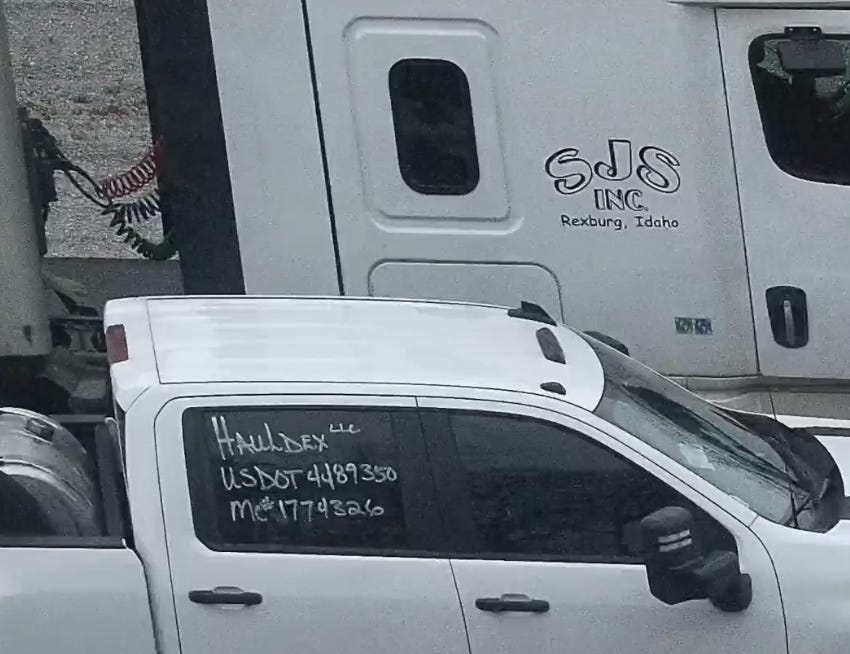
While the industry debates crash accountability and carrier fitness, there’s a registration pathway that costs nothing, asks nothing, and reports nothing, and hundreds of thousands of people are using it to operate commercial vehicles on American highways without a shred of operating authority scrutiny.
Everybody wants to know why some of these carriers in serious crashes look the way they look when you pull up their profile. No authority. No inspection history worth talking about. No real footprint of any kind. Sometimes, just a DOT number, a few trucks, and a lease agreement with somebody bigger.
Here is the answer. The DOT number and operating authority are not the same thing, and the gap between them is where a significant portion of the accountability problem in this industry lives.
According to FMCSA’s own registration data, as of early 2026, there are over 2 million registered entities holding DOT numbers in the United States. As of December 2023, only 787,189 of those had what FMCSA classifies as recent activity operating in interstate or intrastate hazmat service. That’s roughly 787,000 carriers out of 2 million registered. The remaining gap, somewhere north of 1.3 million entities, sits in the system with a DOT number and no meaningful footprint of recent regulated activity.
Now, some of those are legitimately private carriers, hauling their own goods with their own trucks and not subject to the operating authority requirement. That is a legal and legitimate category. Private carriers who move their own product are not required to hold a Motor Carrier number because they are not operating for hire. They just need a DOT number. The system accounts for that. Of the roughly 787,000 with recent activity, about 197,500 registered as private carriers. Another 67,600 registered as both for-hire and private. Those categories make sense, and those operators understand what they are.
The problem is the other people with free DOT numbers who are for-hire in everything but paperwork.
Here is what happens in practice. You want to drive a truck and make money. You do not want the overhead and responsibility of running your own authority, maintaining your own insurance policy at the levels a for-hire carrier must carry, filing the OP-1 application, paying the $300 application fee, and going through a 21-day waiting period that includes a public protest window where your fitness can be challenged. That is the operating authority path. That is what you are supposed to do if you want to haul freight for compensation in interstate commerce.
Or you can get a free DOT number, lease yourself and your truck to a carrier that already has authority, and go to work under their MC number, their insurance, and their DOT on the door. The magnet goes on the truck. Their name is in the window. Their number is what gets scanned when a trooper runs the plate at a weigh station. You are now operating under their authority, and every safety event that occurs while you are under that lease, every violation, every out-of-service order, every crash, goes into their CSA file, not yours.
Any safety events are attributed to the leasing carrier’s USDOT number, not the owner or lessor’s DOT number shown on the vehicle. That is the regulatory architecture. The carrier with the door magnet takes the hit. You drive away clean.
This creates an incentive structure that should make every safety director and risk manager in the country deeply uncomfortable. The owner-operator’s own DOT number, the free one, the one with no authority attached, the one that required nothing to obtain, stays pristine no matter how the underlying driver behaves. They crash under a lease, and the crash hits the carrier. They get put out of service under a lease, and the OOS rate hits the carrier. They accumulate HOS violations under a lease; the hours-of-service BASIC takes the weight. They move to the next carrier’s authority and repeat the process.
Meanwhile, the carrier side of this equation has a problem that is equally structural and equally understood. The reason many carriers do not crack down harder on leased owner-operators the way they do on company drivers comes down to a word every HR department and labor attorney knows: misclassification.
An owner-operator is legally an independent contractor. That designation brings specific requirements about how the relationship must be structured. Under 49 CFR Part 376, the lease agreement must grant the authorized carrier exclusive possession and control of the equipment for the duration of the lease. From the moment the lease is active and the equipment receipt is signed, the carrier is responsible for compliance. But the owner-operator remains an independent contractor, not an employee, and that distinction matters operationally every day.
A carrier may require that leased owner-operators remain in its drug and alcohol testing program. They can set minimum safety standards as a condition of the lease. But the further they go in dictating day-to-day operations, the closer they get to establishing an employment relationship, which triggers misclassification exposure. The difference between requiring a contractor to follow federal hours-of-service regulations and requiring them to call dispatch every two hours, follow a specific route, use a specific fuel card, and take breaks at specific times is a legal line that has defined litigation and Department of Labor enforcement actions for decades.
So the carrier is in a bind. They are on the hook for everything that happens under that lease; they cannot control the driver the way they control an employee, and if they try to control too much, they risk reclassifying the entire contractor workforce as employees, with back wages, benefits liability, and potential tax penalties.
The free DOT number and the lease structure are not separate problems. They are two legs of the same stool. The DOT number without authority gives the driver the appearance of a business entity, which is often what justifies the independent contractor classification in the first place. I have my own DOT number. I am a business. I am not your employee. The carrier accepts that framing because it provides operational flexibility and removes the cost of direct employment. It also removes meaningful direct control. When something goes wrong, federal regulations require the carrier to absorb the cost.
This is not a new problem. It is the same lease problem that trucking has been wrestling with since the original FMCSA lease regulations in 49 CFR 376 were written. We have written about the mechanics of the lease relationship before. What is worth examining here is how the registration architecture either supports or undermines any effort to actually fix it.
Operating authority, the OP-1 process, requires an applicant to identify themselves, provide business information, wait through a 21-day public comment period during which existing carriers can protest the application, file proof of insurance at minimum levels, file a BOC-3 process agent designation, and pay the application fee. That process produces a fitness determination. The agency is deciding whether this entity has the apparent willingness and ability to comply with federal regulations before it is authorized to haul freight for the public.
A free DOT number requires none of that. You fill out the MCS-150 form with your basic business information, you self-classify your operation type, and the number is issued. No fitness determination. No public comment period. No insurance verification at the time of issuance. No 21-day waiting period while the industry decides whether your application warrants protest. You are in the system. Update the form every two years, and you stay there.
FMCSA’s own data show 787,189 carriers had recent activity as of December 2023, broken down as 519,420 for-hire, 197,563 private, and 67,667 operating as both. The total registered entity count is over 2 million. Somewhere in the gap between the 787,000 active regulated carriers and the 2 million registered DOT numbers is a significant population of entities whose regulatory relationship with the federal government amounts to a form they filled out online for no charge.
The question this raises is not whether every one of those entities is a safety risk. Most are not. Plenty are legitimately private carriers moving their own equipment legally. But the system cannot easily distinguish between a legitimately private carrier hauling their own product and someone who obtained a free DOT number specifically to establish the appearance of an independent business entity in support of a lease arrangement with a for-hire carrier, with every safety consequence flowing to the carrier and none of it flowing back to the DOT-only entity that is actually the moving part.
That distinction matters enormously in crash investigations. When a serious accident happens, and the responding trooper runs the DOT number on the door, they are looking at the leasing carrier’s profile. That is where the insurance information lives. That is where the crash goes. If the investigators want to examine the actual driver’s own DOT history, they have to run a separate query on a number that has never been subject to a fitness determination, that has never had an inspection attributed to it directly and that may have a completely clean CSA profile because every event in that driver’s actual operating history has landed on someone else’s file.
It is not that the driver’s history disappears. Their CDL record exists separately. Their inspection history as a driver exists. But the organizational view, the SAFER snapshot that shippers, brokers, and carriers pull to make business decisions, is the carrier’s profile. If you want to see what a leased owner-operator’s own DOT number looks like in SAFER, go pull a few. Find ones you know are active drivers leased to major carriers. Then look at their individual DOT profile. In many cases you will find almost nothing there. Not because they are safe. Because every event went somewhere else.
The fix for this is not simple. You cannot require every owner-operator who wants to lease onto a carrier to obtain full operating authority, because the private carrier exemption and the intrastate exemption both have legitimate purposes, and stripping them would catch a significant population of lawful operators who do not meet any threshold for for-hire status. What you can do is require that safety events be tracked in a way that follows the driver entity, not just the leasing carrier. You can build into the CSA architecture a mechanism to attribute violations, OOS events, and crashes to the individual DOT number of the operating unit, regardless of which authority they were operating under at the time.
You can also revisit whether the 21-day protest period and the OP-1 fitness determination should have an analog for DOT-only entities that are clearly functioning as de facto for-hire carriers through lease arrangements. FMCSA has the statutory authority to make fitness determinations. They use it for operating authority applicants. Whether a version of that determination should apply when an entity holds a DOT number with no authority but shows a pattern of operating under lease arrangements with for-hire carriers is a regulatory question that has not been seriously engaged.
What the data tell us right now is that there are over 2 million DOT numbers in the FMCSA system, fewer than 800,000 of them with recent active regulated status, fewer than 520,000 of them for-hire carriers who went through the OP-1 process and had their fitness determined before going to work. The rest are operating in categories that receive substantially less scrutiny before and after issuance.
The industry asks after every serious crash why nobody was watching. Sometimes the answer is that the system designed for watching was watching somewhere else.