

For years, over a decade, I’ve been paid by folks from the tech community to advise on their builds to ensure the fleet tech we all rely on today is operationally efficient and useful, but also compliant and risk-focused. I always said that, as much as you Y-Combinator, VC, PE, programmers, developers, and product managers pay me to advise on building systems that meet operational and regulatory requirements, if I ever learn to build these things, you’re in trouble. We learned and are still learning to build, but since February we’ve pushed out some stuff. Not everyone’s in love with it, and that’s fine. Unfortunately, competition has a way of showing whether we’re in this for the betterment of the industry or to make dollars, and the dollar chasers have surprised me. Over our 15 years in app and fleet tech consulting, we’ve focused on building real tools that solve real problems.
Hazmat and dangerous goods is probably the most sensitive freight on our highways, and even drivers like me with Hazmat endorsements don’t always understand which placards to use. When to use which placards. When commodities require segregation. When more than one placard is needed. When no placard is needed but training is still required. What’s ERG? What’s routing? What and how do I segregate? If I have a crash and/or spill, who do I call?
Hazmatverifi is a browser-based tool, but we’re working on the Android and iOS rollout and approval. It’s mostly free. There is a fee if you use the shipping paper and load build functions, but all the knowledge-based portions are free. You can add it to LoadVerify and build the load and shipping papers with QR code, telematics tracking, and driver/vehicle verification.
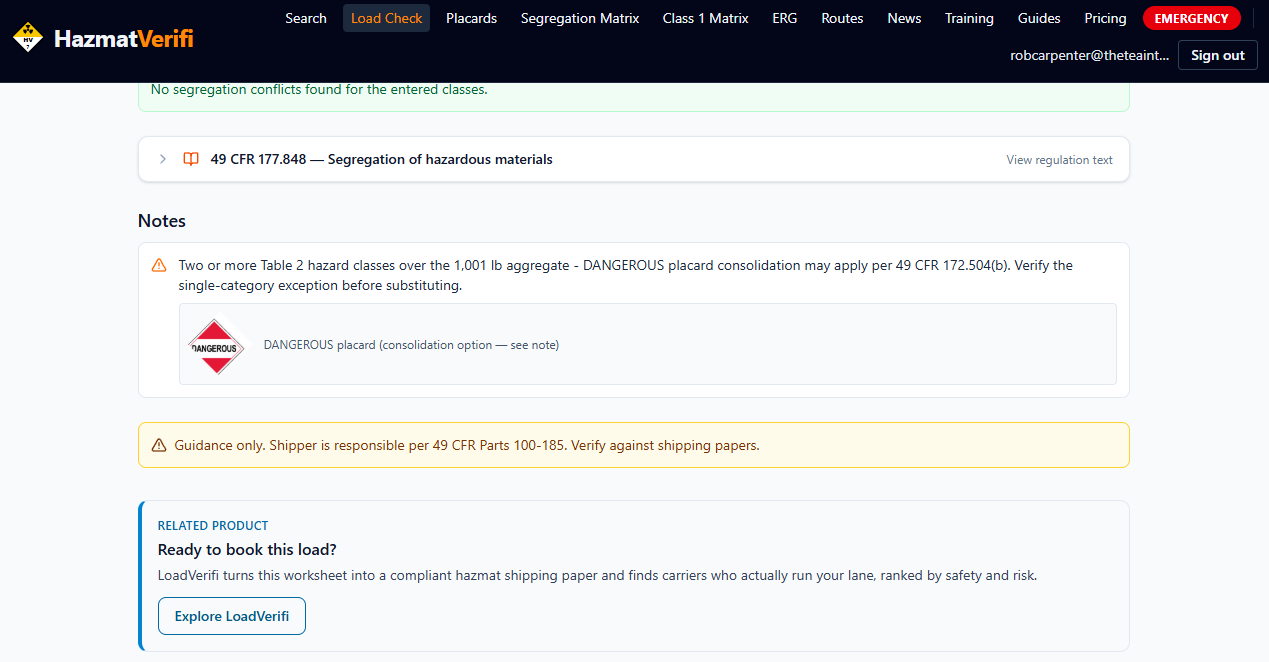
Let’s build a hazmat load. Instead of two thousand pounds of 1,3-dimethylbutylamine, a Class 3 flammable liquid, and 2,500 pounds of a Division 4.1 flammable solid. Same trailer, same trip. The first question is easy: at 4,500 pounds aggregate, both materials need placards. The second question is where people get it wrong. Can you hang one DANGEROUS placard instead of FLAMMABLE and FLAMMABLE SOLID?
The rule says you can, sometimes. Under 49 CFR 172.504(b), a vehicle carrying two or more categories of Table 2 materials in non-bulk packages may use the DANGEROUS placard instead of separate placards. Then comes the exception. When 2,205 pounds or more of one category is loaded at one facility, use that category’s placard. The flammable solid on this load is 2,500 pounds. FLAMMABLE SOLID goes on the truck, DANGEROUS or not.
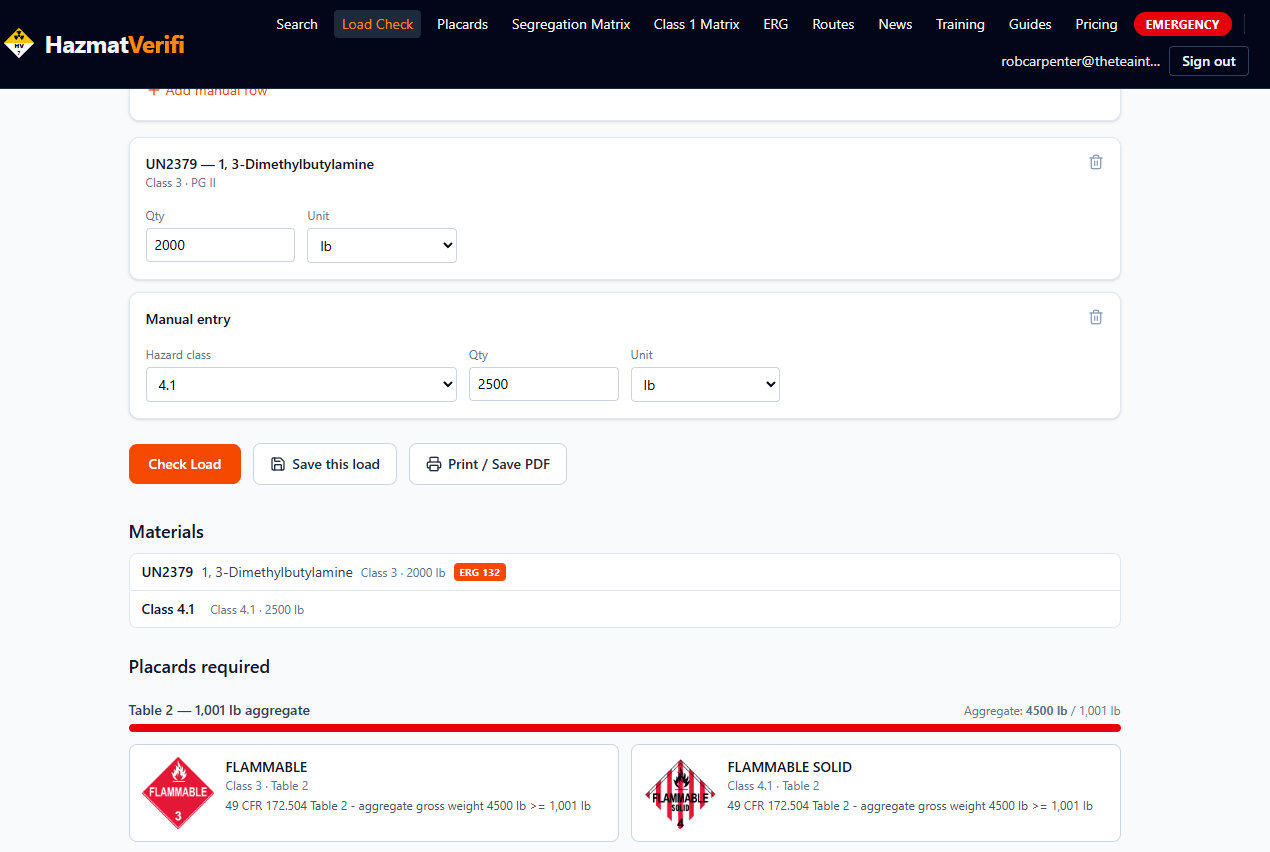
The same result flags the DANGEROUS placard option under 49 CFR 172.504(b) and tells the user to check the single-category exception before substituting.
After a release, the questions are nearly always the same. What was on the truck? Was it marked the way the rules say? Was it loaded next to something it shouldn’t have been? None of those answers are secret. They sit in federal tables anyone can read, if you know which table and you have time to read it at a shipping dock at 2 a.m.
That’s the reason for HazmatVerifi. The Hazardous Materials Table lives in 49 CFR 172.101. The placarding rules live in 172.504. The highway segregation table lives in 177.848. First-response guidance lives in PHMSA’s Emergency Response Guidebook, the paperback in the door pocket. State route restrictions live on an FMCSA registry. HazmatVerifi puts all of it in one place, and every reference tool on it is free, no account required.
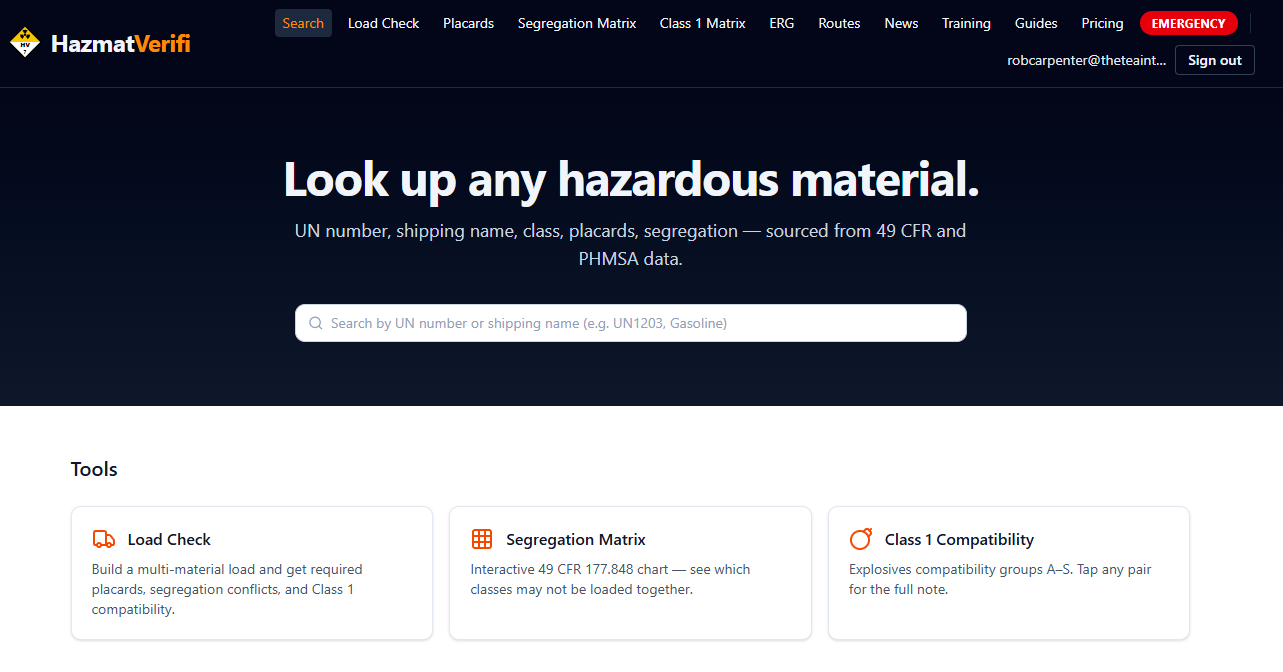
HazmatVerifi searches by UN number or shipping name, with Load Check, the segregation matrix, and the Class 1 compatibility table one tap away.
The stakes aren’t abstract. In 2025, the PHMSA incident data recorded 25,447 hazardous materials incident reports from highway transportation, 93% of every hazmat incident report filed across highway, air, rail, and water that year. Most of those are small releases that never make the news. All of them start with somebody on a dock or in a cab making a call about what’s in the trailer.
Load Check is where most people start. You add every hazmat on the load by UN number or shipping name, or by hazard class when you don’t have the number handy. Each result shows its hazard class, packing group, and ERG guide number as you type. Enter quantities in pounds, kilograms, gallons, or liters, and Load Check returns the required placards, segregation conflicts, and any Class 1 explosives compatibility problems. The placard math follows 172.504. Table 1 materials, such as Poison Gas and Dangerous When Wet, get placarded at any quantity. Table 2 materials don’t need placards until the vehicle carries 1,001 pounds or more of them in aggregate. The bar across the result shows exactly where your load sits against that line.
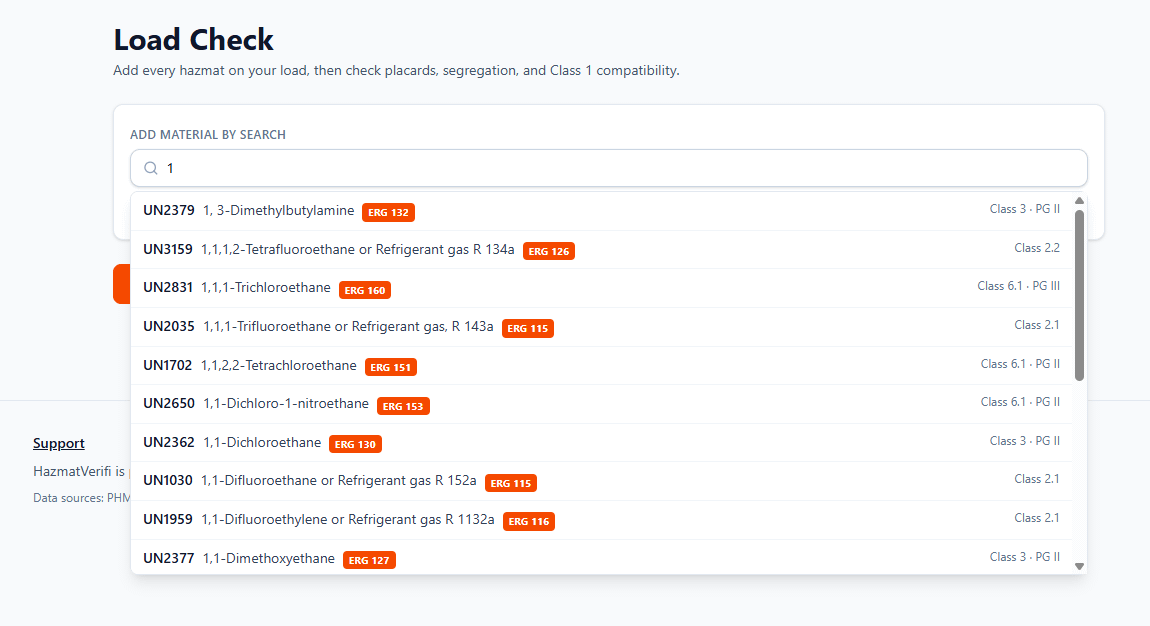
Load Check searches the Hazardous Materials Table as you type, showing each entry’s hazard class, packing group, and ERG guide.
That 1,001-pound line has a limit you need to know. It doesn’t apply to bulk packagings. A cargo tank of gasoline gets placarded at any quantity, and Load Check doesn’t ask whether your packaging is bulk. Every result ends with the same line: guidance only; the shipper is responsible under 49 CFR Parts 100 through 185; verify against the shipping papers. The tool does the arithmetic. The shipper still signs the paper.
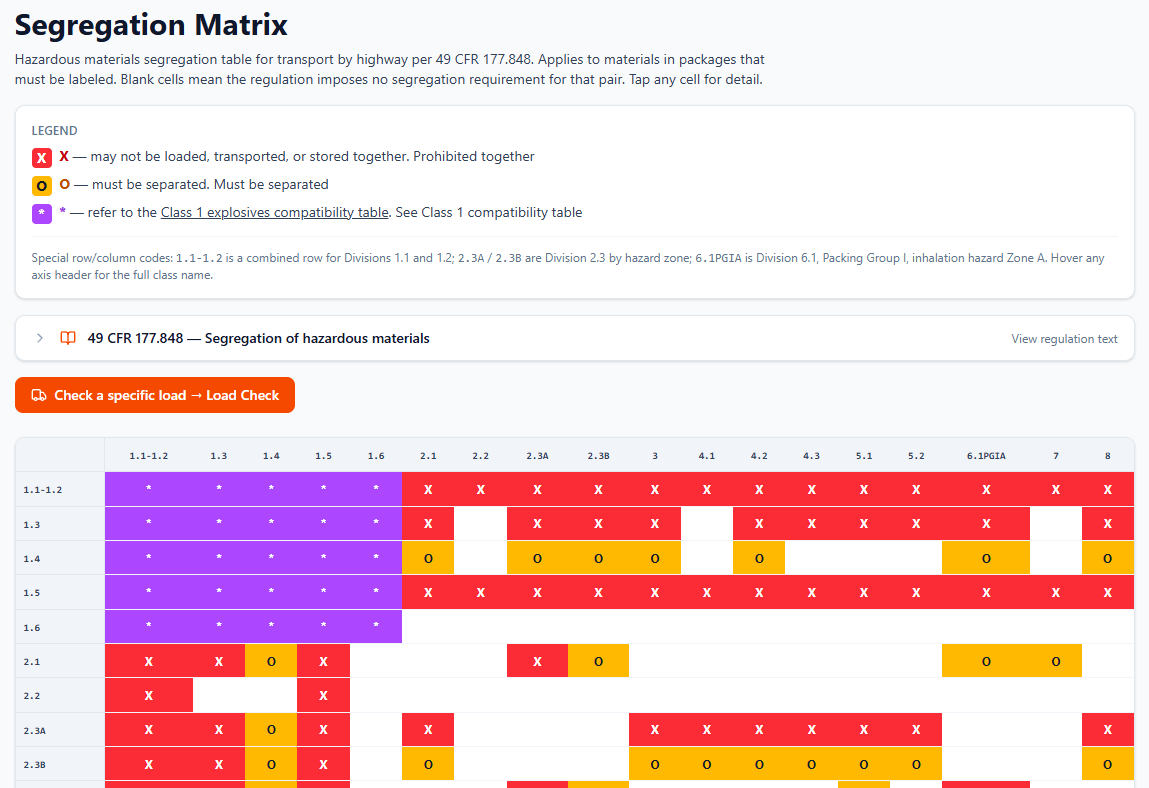
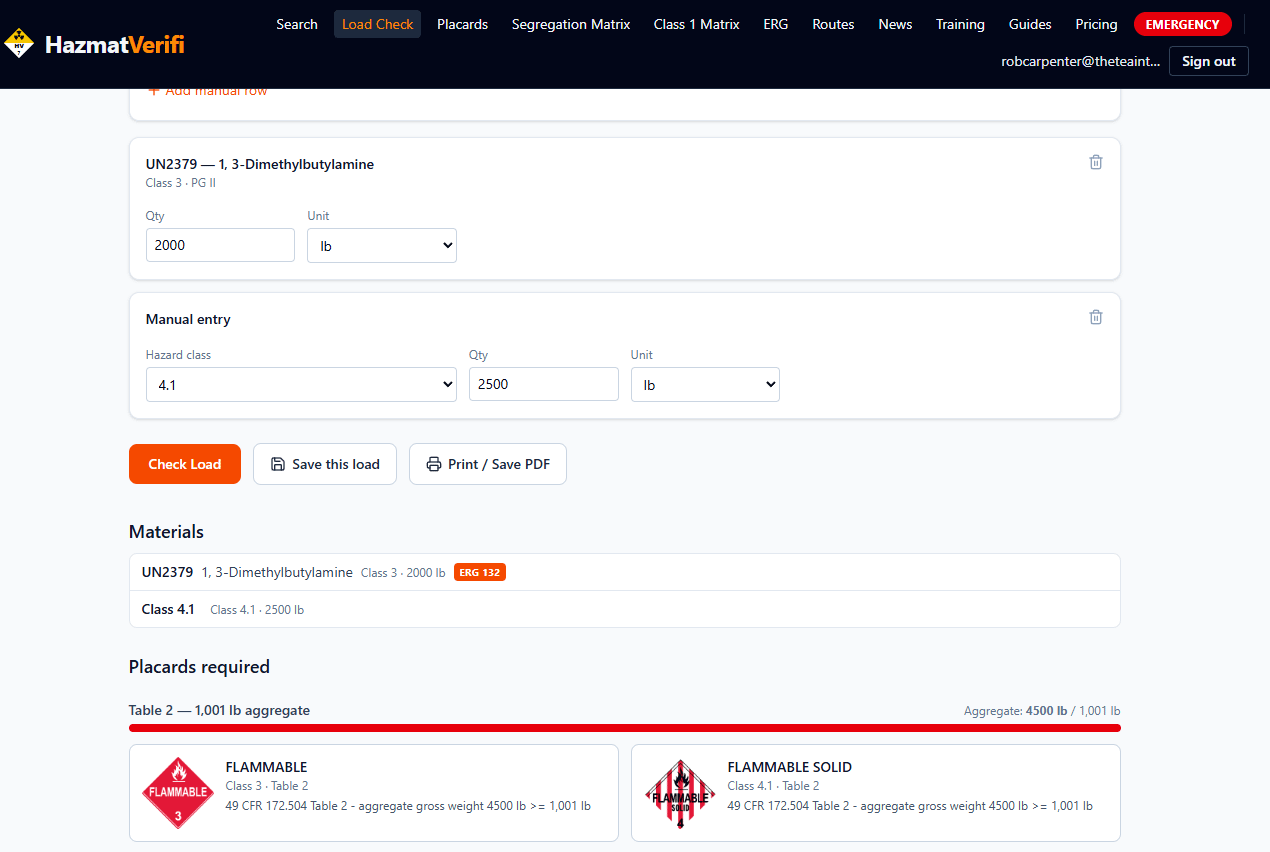
Segregation comes back on the same screen, and the full table has its own page. In the 177.848 highway segregation table, an X means two classes may not be loaded, transported, or stored together in the same vehicle. An O means they can share the vehicle only if they’re separated so the materials couldn’t mix if a package leaked. An asterisk sends you to the Class 1 explosives compatibility table. Tap any cell for the details, or open the regulation text right there.
The 49 CFR 177.848 highway segregation matrix: X means prohibited together, O means must be separated, and an asterisk points to the Class 1 table.
When something goes wrong, the order matters, and the emergency page is built for a phone in a shaking hand. Call 911 first. Then call the emergency response number on the shipping paper, which the rules require to be monitored the entire time the material is in transportation. Then report the release to the National Response Center at 800-424-8802. Under 49 CFR 171.15, the person in physical possession of the material must call the NRC to report a reportable incident as soon as practical, and no later than 12 hours after it happens. The page also says what people often miss: calling a private emergency response service doesn’t satisfy the NRC requirement.
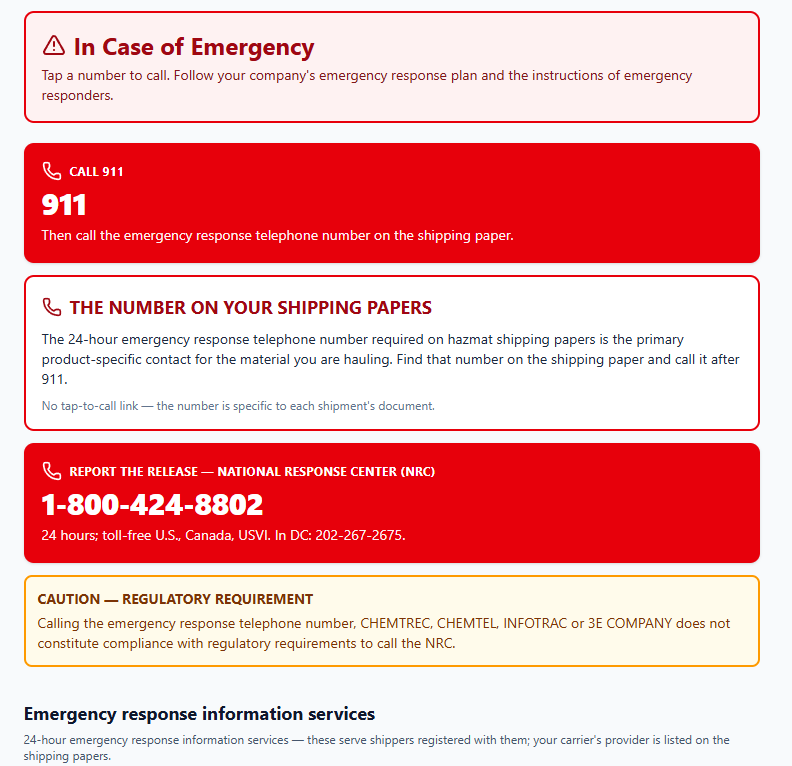
The emergency page puts 911, the shipping paper’s emergency number, and the National Response Center in the order to call them.
The site carries the full 2024 Emergency Response Guidebook from PHMSA, Transport Canada, and Mexico’s transportation ministry. That’s all 64 guides, from Guide 111 for mixed loads and unidentified cargo through the gases, flammables, toxics and corrosives, searchable by UN number or shipping name. Every material page links to its guide, so a first responder or driver can go from four digits on a placard to the right guide in one tap.
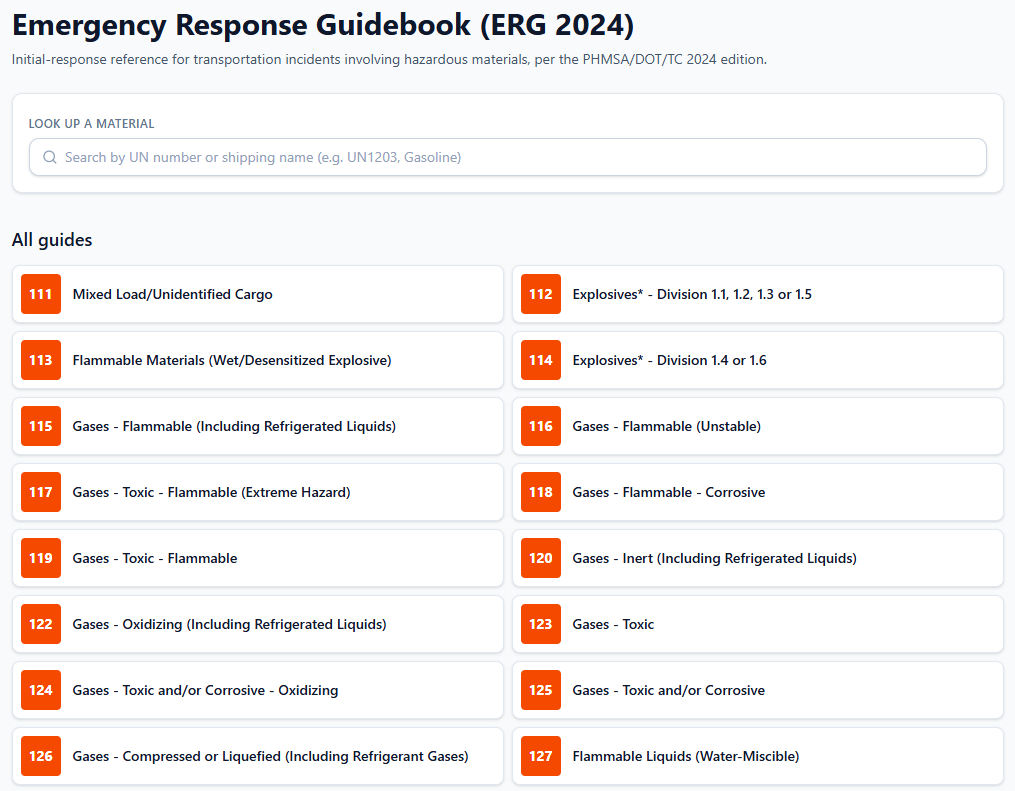
The 2024 Emergency Response Guidebook on HazmatVerifi, searchable by UN number or name, with every guide listed.
Routing is part of the job too. The routes page pulls designated and restricted hazmat routes state by state from FMCSA’s National Hazardous Materials Route Registry, with a reminder to confirm current restrictions with the state before dispatch, because designations change. The guidance library collects official federal, state, and industry publications by commodity, from ammonium nitrate and anhydrous ammonia to cargo tank rollover prevention and chlorine.
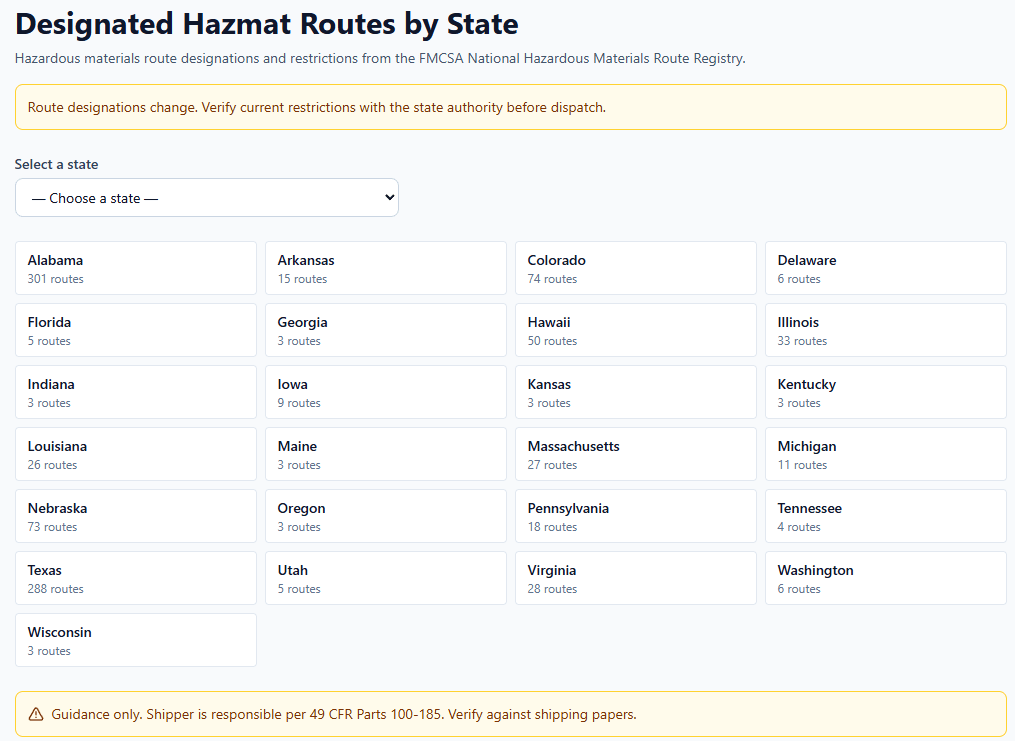
Designated hazmat routes by state from the FMCSA National Hazardous Materials Route Registry.
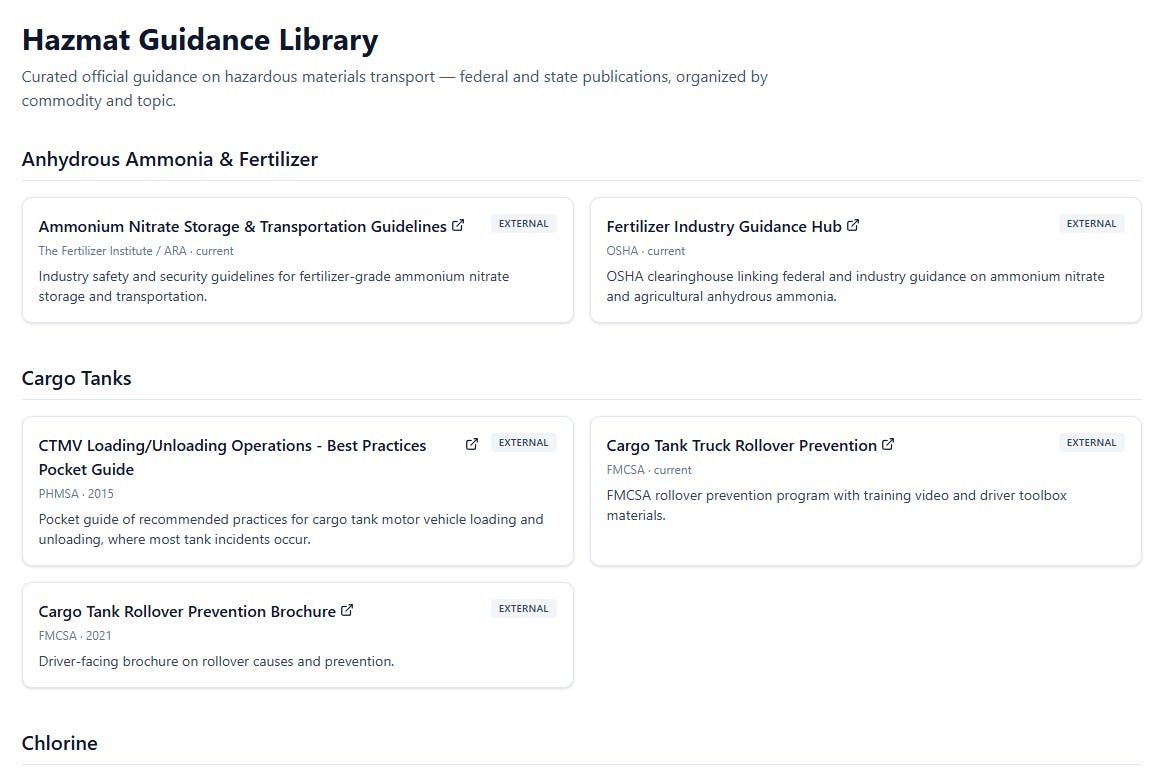
The guidance library organizes official hazmat publications by commodity and topic.
Knowing the rule isn’t the same as being trained on it, and the regulation says so. Under 49 CFR 172.704, every hazmat employee needs training in four areas: general awareness and familiarization, function-specific duties, safety, and security awareness. That training has to be repeated at least once every three years. HazmatVerifi’s training page explains the requirement and links to function-specific hazmat training from TruckSafe Consulting. Full disclosure: I’m vice president of compliance at TruckSafe.
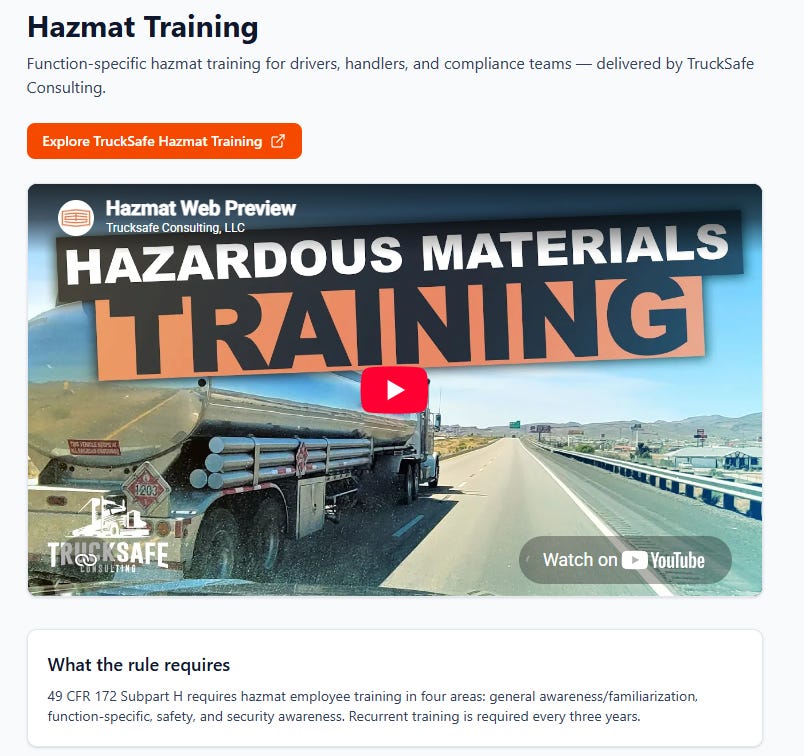
The training page explains the 49 CFR 172 Subpart H requirement and links to TruckSafe Consulting’s hazmat training.
Everything above is free: the lookup, every ERG guide, the segregation checker, Class 1 compatibility, routes, the guidance library, and Load Check for up to three materials per load, with no account. Pro is $9 a month or $90 a year. It removes the three-material limit, saves loads so a dispatcher can rerun a regular mix without rebuilding it, and prints a one-page load summary. That summary is a planning worksheet, not a shipping paper. The person offering the material still certifies the shipping paper.
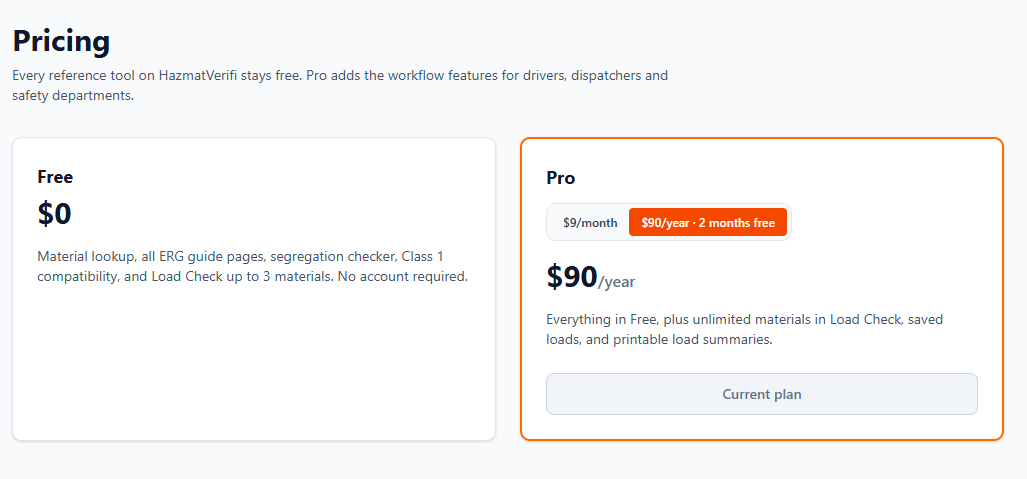
Every reference tool stays free. Pro adds unlimited materials, saved loads, and printable summaries for $ 9/month or $90/year.
The hazmat rules were always public. What a driver or a dispatcher never had was all of it on one phone screen, in the order the job asks for it: what it is, what goes on the truck, what can’t ride together, and who to call when it goes wrong.
The 2,500 pounds of flammable solid on that load was never a trick question. It was a table lookup and some arithmetic. The trouble was always finding the table.
Rob Carpenter founded Tea Technologies, Inc., which owns HazmatVerifi and THE TEA Highway Intelligence Platform. He is vice president of compliance at TruckSafe Consulting and serves as an expert witness in commercial motor vehicle litigation