

Somewhere between an Army ammunition plant and a Strategic Seaport, a commercial tractor is pulling a tactical vehicle on a lowboy toward a fixed sail date. The vehicle on the trailer is exempt from EPA emissions standards under the national security exemption, because the Department of War decided long ago that a fighting vehicle which immobilizes itself over a broken wire in its exhaust plumbing is militarily unacceptable. The truck pulling it enjoys no such protection. It’s a post-2010 on-highway diesel, which means it carries the full federal aftertreatment stack, and buried in that stack is a computer whose job isn’t just to report emissions faults but to enforce compliance by progressively shutting the truck down. The Department protected its tanks from the emissions kill switch and left the switch installed on the trucks that carry the tanks. The exemption stops at the trailer.
I spent part of this summer writing an addendum to a surface freight security assessment on exactly this problem, prepared alongside my NDTA work, and I’ve spent another part of it talking to the men the emissions regime chewed up along the way. Some of them got presidential pardons in July. Some of them are still felons. All of them are pieces of the same story, which is that the government built a compliance mechanism into the civilian truck fleet that the government itself now admits is broken, fed it a fluid we mostly import from adversaries, and never once assembled those facts into a single picture of what it means for the freight system that moves national defense cargo.
What the derate actually does
Start with the plain version. Every modern diesel truck carries a system that injects a urea solution called diesel exhaust fluid into the exhaust to neutralize nitrogen oxides. If that system detects a problem, the truck punishes the driver in stages. First a warning. Then it caps speed at 55 miles per hour. Then the engine computer cuts torque, typically 25 to 40 percent, so the truck can’t pull a grade or hold highway speed. On the next shutdown and restart, the truck limits itself to roughly five miles per hour and won’t move faster until a technician clears the fault with a scan tool. The industry calls this an inducement strategy. A driver on the shoulder of an interstate with 45,000 pounds of freight and a truck that will only do five miles an hour calls it something else.
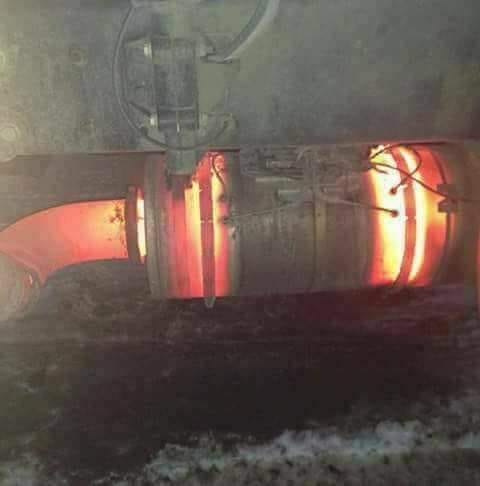
Here’s the part most people outside a shop never learn: the trigger usually isn’t an empty tank or a lazy driver. Technical guidance across the industry is consistent: the leading causes of these events are the emissions hardware itself. Failed NOx sensors returning false readings. DEF quality sensors reacting to contamination. Crystallized fluid clogging injectors. A tank heater that dies in cold weather. The fluid is so sensitive that a single penny dropped in a storage tank contaminates 10,000 gallons, and half a tablespoon of dirt ruins hundreds more. The system that enforces clean-air compliance is exquisitely reactive to conditions that have nothing to do with whether the truck is actually polluting, and it responds the same way to all of them: it parks the truck.
The government already conceded the defect

I don’t have to argue that this is a design failure, because the regulator that mandated it has said so in writing. Beginning in August 2025, the EPA directed manufacturers to stop forcing trucks into immediate limp mode over low DEF. In February 2026, the agency demanded DEF system failure data from engine manufacturers for independent review; eleven of fourteen complied. In March 2026, it announced it would no longer require DEF quality sensors. On July 8, 2026, the EPA signed a proposed rule for Model Year 2027 and later heavy-duty engines that would replace the derate with an audible and visible warning, under docket EPA-HQ-OAR-2026-0728. On its own Diesel Exhaust Fluid page, the agency says the derate strategy “has caused needless frustration, operational delays, and real economic hardship” and describes trucks limited to performance levels as low as five miles per hour. Sixteen years after requiring manufacturers to build a mechanism that strands loaded trucks on interstate shoulders, the EPA now describes that mechanism the way a plaintiff’s attorney would.
The agency even proved it understands the stakes, just not all the way. Ambulances and fire apparatus were carved out of the immediate-derate regime years ago, because a fire truck losing power at a structure fire was correctly judged intolerable. Nobody has ever explained why that reasoning stops at the ambulance bay door. A tractor hauling munitions out of an ammunition plant, or a tactical vehicle to a seaport on a fixed sail date, is in a mission posture that’s materially indistinguishable from the emergency vehicle the EPA already recognized. The carve-out exists. It just wasn’t drawn to include the trucks that move national defense freight.
The men the system made into felons
On July 3, President Trump pardoned nine people and six businesses convicted of Clean Air Act violations for deleting or defeating these systems, calling them people persecuted for fixing their trucks. The list runs from Ryan and Wade LaLone of Diesel Freak in Michigan, who, along with their shop, drew probation and more than $760,000 in penalties, to Barry Pierce of Gorilla Performance in Idaho, who served four months and took a $1 million fine, to Mackenzie Spurlock, an Alaska Air National Guard veteran whose Matanuska Diesel shop was raided by armed EPA agents. Senator Dan Sullivan described it as a “military-style tactical raid” over modifications meant to keep trucks from shutting down in subzero Alaska conditions, which is exactly the cold-weather failure mode the hardware is known for. Pierce’s defense of his business was economic: an aftertreatment repair can run $13,000, and plenty of owner-operators can’t absorb that bill once a year to stay legal. The DOJ had already stopped criminal prosecution of defeat device cases in January. The pardons finished the thought.
I’ve sat with some of the men who got those pardons, and I’ve sat with men who were charged and convicted for the same conduct and never made anyone’s clemency list. The line between the two groups isn’t principle. It’s timing and visibility. And I want to be honest about the other side of this ledger, because my readers deserve better than a cheer for deletes. A prosecutor in one of the pardoned cases documented trucks that, after tampering, emitted 30 to 1,200 times the pollutants of a legally configured truck. That’s real; the health harm behind it is real, and the EPA’s enforcement division has counted deletions on the order of 550,000 diesel pickups alone. Some of the delete-service markets I’ve tracked on Facebook and Telegram are run by the same fleets already flagged for ELD tampering, which tells you the underground isn’t populated only by frostbitten Alaskans with unfixable sensor faults. Both things are true at once. The mandated system is unreliable enough that honest operators get stranded by it, and the response to that unreliability has produced a tampered population big enough to matter, with real pollution attached. A mandate the honest operator can’t reliably satisfy, and the dishonest operator simply ignores, is the same structural pattern I document everywhere else in this industry, from carrier vetting to hours of service.
That fork matters for defense freight specifically. The pardons decriminalized deletes at the federal prosecutorial level; they didn’t legalize them. The civil penalty structure, on the order of $45,000 per tampered engine, stays on the books. Consent decrees still bind. California still enforces on its own authority. So the carrier pool hauling military loads splits into exactly two populations: compliant trucks that can be immobilized by a five-dollar sensor, and deleted trucks operating in open regulatory violation whose liability, after the Supreme Court’s Montgomery decision, now flows up the selection chain to whoever hired them. There’s no third population.
The fluid we import from the people we’re deterring
Now the part almost nobody puts next to the derate. Diesel exhaust fluid is 32.5 percent high-purity urea and 67.5 percent deionized water. The water is domestic. The urea largely isn’t. Urea comes from ammonia, ammonia comes from natural gas, and the global export market is concentrated in Russia, Qatar, Saudi Arabia, Algeria, Egypt, and China. In 2023, the Russian Federation was the single largest source of United States urea imports. China is the world’s largest producer. There’s no strategic reserve of DEF-grade urea, and because agricultural fertilizer and DEF draw from the same pool, a fertilizer shock tightens the trucking supply at the same moment.
This isn’t theoretical, because it already stopped an allied nation’s trucks. In October 2021, China restricted urea exports to protect its own fertilizer market. Within weeks, South Korea, which imported nearly all its DEF-grade urea from China, hit a national crisis: roughly two million diesel cargo trucks were immobilized, drivers queued for hours, prices rose more than eighty percent, and the government rationed supplies. The detail that should stop every logistics planner in Washington cold is what Seoul did next. The Korean defense ministry released about half of a military urea stockpile to civilians as a loan, because keeping civilian freight moving mattered more than holding the reserve. Australia hit the same wall two months later and stood up a national task force, pushing one domestic producer to ramp DEF output roughly 800 percent. The United States brushed the same edge in 2022, when Russian supply constraints and a rail dispute threatened DEF deliveries that S&P Global estimated could sideline a tenth of the national trucking fleet. We got lucky. Luck isn’t a supply chain.
Why this is a Department of War problem
The Department doesn’t move its freight on its own trucks. It moves it on several hundred commercial carriers and a long tail of subcontractors and owner-operators, somewhere between hundreds of thousands and a few million loads a year depending on how you count. Every post-2010 tractor in that pool needs DEF to roll and carries the derate to enforce it. An adversary doesn’t need to breach a single military system to slow a force-projection movement. It only needs to touch the civilian trucks that carry it, and through the urea market it already holds a share of the one consumable those trucks can’t run without. A country that builds the cranes at our strategic ports doesn’t need to be told this. Export policy did it to Seoul as a side effect.
And here’s the gap in the fix everyone’s celebrating. The EPA’s proposed rule ends the derate for Model Year 2027 and later engines. The millions of trucks already on the road, including essentially the entire current defense freight carrier pool, keep the switch. The recommendations I put in front of the assessment audience are the same ones I’ll put here, because they don’t require new law. Extend the emergency-vehicle inducement flexibility to defense freight on fixed sail dates, and put the Department on the record in the docket. Treat quality-controlled DEF as a class of supply and pre-position it at the seaports, depots, and ammunition plants instead of trusting the truck stop. Commission a real defense-industrial-base study of DEF-grade urea, because the largest import source being Russia should be sufficient justification on its own. And score emissions posture in carrier vetting, since a tampered fleet is a liability and a neglected aftertreatment fleet is a mobility risk, and both are now knowable.
The men who got pardoned in July were the human wreckage of a mandate the government has now admitted was defective. The urea tank on every truck in the defense carrier pool is the strategic wreckage still waiting to happen. South Korea already showed us the ending where a defense ministry drains its own stockpile to keep freight moving. I’d rather we read that chapter than live it.
I retired from the parts department (ASE certified) of a heavy truck dealer five years ago and I would have no chance of guessing how many tank and exhaust sensors we replaced and what percentage was warranty and had to be shipped for exam.
DEF is one of the biggest tragedies ever dropped on the industry--since the "Double Nickel". But, the regulators said " They have been using it in Europe for years--must be good". (Insert male bovine excrement)
The pre-positioning recommendation has a chemistry problem.
DEF doesn't store like fuel. Urea hydrolyses slowly in solution, and heat accelerates it yyou're looking at roughly a year at moderate temperatures and considerably less somewhere hot. Past that the concentration drifts out of the ISO 22241 window and the sensors you're worried about start reading it as contaminated. So a stockpile sitting at a Gulf Coast seaport becomes the exact fault condition that triggers the derate.
The fix is to stockpile the wrong half. Solid urea prills are stable for years, take almost no space, and 67.5% of finished DEF is deionized water you can make anywhere. Store the urea and the blending capacity, not the fluid. That also makes the strategic case cleaner, since the thing being reserved is the imported input rather than a warehouse of mostly water on a rotation schedule.
One more thing on the industrial base study. Fertiliser-grade urea won't substitute. The DEF spec is tight on biuret and metals, so domestic capacity existing isn't the same as domestic capacity that qualifies, and that distinction is where a study like that usually goes wrong.