

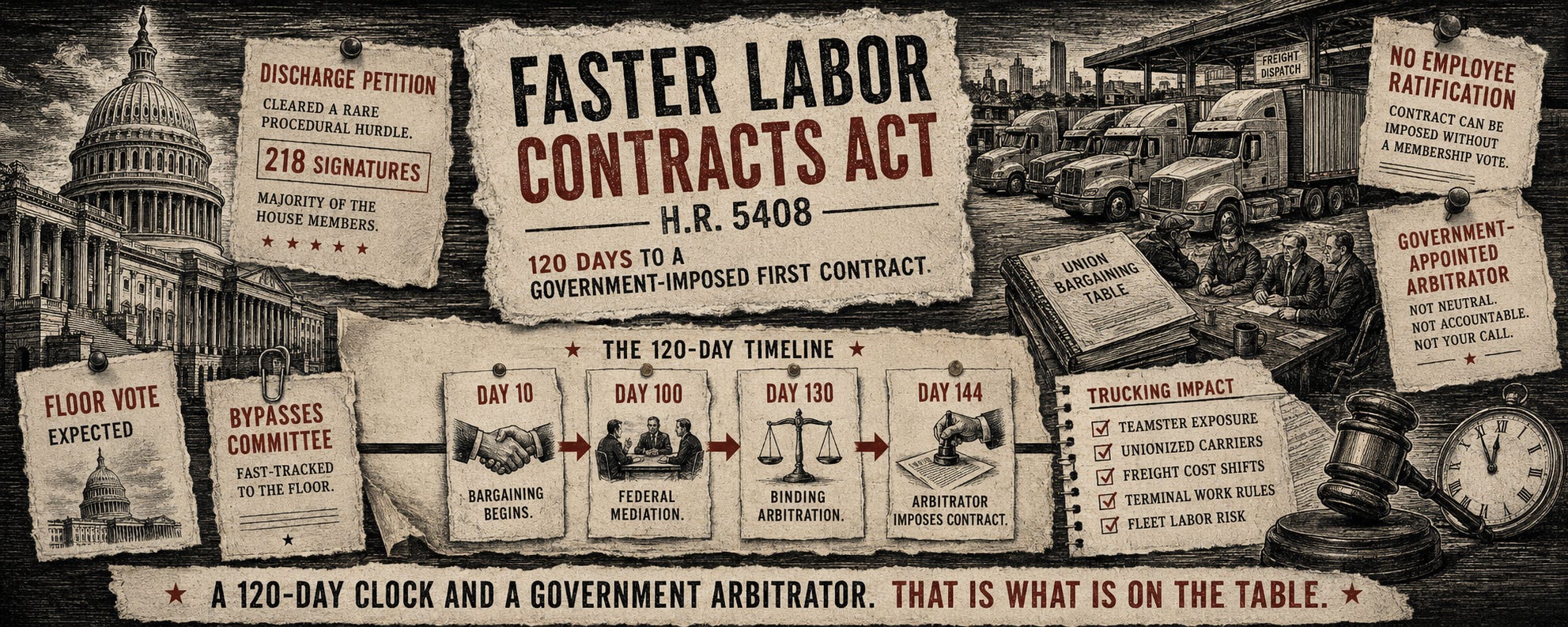
While most of the trucking industry has been focused on tariffs, ELD enforcement, Chameleon carriers, fraud and the non-domiciled CDL crackdown, a labor bill just cleared one of the rarest procedural hurdles in Congress and is headed to a floor vote that it is widely expected to win.
I have to start off by saying I am not pro-NLRB. My grandfather, Roman Gissel of Gissel Packing, literally started with nothing and shut down an empire rather than bargain with the NLRB, and the Gissel Packing case remains the fundamental case law for NLRB bargaining cases. Today, the NLRB is back at it. H.R. 5408, the Faster Labor Contracts Act, reached 218 signatures on its discharge petition on May 20, 2026. A discharge petition forces a bill out of committee and onto the House floor for a vote, bypassing committee chairs, regular order, and the normal legislative process. It is one of the most aggressive procedural tools available in the House, and it almost never succeeds. This one did. The floor vote is expected this month.
If you run trucks and you have union exposure, or you think you might someday, pay attention.
The Faster Labor Contracts Act would amend the National Labor Relations Act to impose a compressed, federally mandated timeline for first-contract negotiations between an employer and a newly certified union. Here is the sequence:
Day 10 after union certification, the employer must begin bargaining. Day 100, if no agreement has been reached, federal mediation is triggered through the Federal Mediation and Conciliation Service. Day 130, if mediation fails, binding interest arbitration is initiated. Day 144, an arbitration panel is seated and empowered to impose a complete first collective bargaining agreement covering wages, benefits, work rules, and all related terms.
That is a maximum of 120 days of actual bargaining, 90 days of negotiation, plus 30 days of mediation, before a government-appointed arbitrator writes your labor contract for you. The employees do not vote on the imposed contract. There is no ratification requirement. The arbitrator’s decision is final.
Under current law, the bargaining process is intentionally flexible. Employers and unions negotiate on their own timeline, with NLRB enforcement mechanisms available if either side bargains in bad faith. The process can take months or years. That flexibility exists because different industries, different companies, and different workforces have different realities. A first contract for a 50-driver LTL terminal in Ohio looks nothing like a first contract for a pipeline construction crew moving across six states, which looks nothing like a first contract for a parcel sorting facility. The current system accommodates that. H.R. 5408 does not.
The American Pipeline Contractors Association sent a letter to the full House on June 4 opposing both the bill and the discharge petition, calling it “a clear attempt to circumvent committee jurisdiction” and warning that it “creates a predictable end-game arbitration effect that will distort incentives on both sides of the table.”
APCA’s members are merit shop pipeline construction contractors. They operate fleets of commercial motor vehicles, heavy haul trucks, equipment transporters, and service vehicles across complex geographic and regulatory environments. But you do not have to be a pipeline contractor for this bill to matter.
If you are a trucking company with Teamsters representation, this changes your bargaining dynamic. If you are a non-union carrier watching organizing activity in your terminals or among your drivers, this compresses the timeline from certification to imposed contract to under five months. If you are a freight broker that contracts with unionized carriers, contract cost structures could shift in ways that ripple through your rate negotiations.
The Teamsters represent workers at UPS, ABF Freight, TForce Freight, Yellow’s former operations, and dozens of LTL and specialized carriers. The International Brotherhood of Teamsters has been one of the most active unions in the freight sector. Under the current framework, first contract negotiations can extend for a year or more, giving both sides time to understand the operational realities of the business before committing to terms. Under H.R. 5408, that clock runs out in 120 days and someone who has never dispatched a truck, managed a terminal, or priced a freight lane writes your contract.
The discharge petition is the bigger item for concern. The Faster Labor Contracts Act is a provision lifted directly from the Protecting the Right to Organize Act (the PRO Act), which has failed to advance on a bipartisan basis across multiple Congresses. Proponents are isolating this one piece and using the discharge petition to bypass committee review, CBO scoring, and stakeholder input.
The discharge petition succeeded with 218 signatures, meaning that every Democrat and at least 4 Republicans signed. There are currently 17 Republican cosponsors on the bill. Fisher Phillips, one of the largest management-side labor law firms in the country, says a House floor vote is “widely expected to pass given the bipartisan coalition that signed the discharge petition.”
The Senate is less certain. The bill would need 60 votes to advance past a filibuster, but Fisher Phillips notes a “meaningful possibility” that the White House could issue a Statement of Administration Policy in support, given the administration’s efforts to appeal to working-class voters. If that happens, it could provide political cover for additional Republican senators to support the bill.
The coalition opposing H.R. 5408 is broad. The American Pipeline Contractors Association, the Independent Electrical Contractors, Americans for Prosperity, and dozens of industry associations have come out against it. The core arguments are consistent: the bill replaces voluntary bargaining with government-imposed outcomes, eliminates employee ratification of contracts, expands the role of the Federal Mediation and Conciliation Service beyond its current facilitative mandate, and creates perverse incentives where both sides position for arbitration rather than negotiating in good faith.
APCA’s letter makes a point that applies directly to any fleet operation: “Projects in this sector require long planning horizons, specialized skilled labor deployment, and coordination across complex geographic and regulatory environments. Introducing externally imposed contract terms, decoupled from project economics and operational constraints, creates uncertainty in cost structures and execution risk.”
Replace “projects” with “freight operations,” and that sentence describes every trucking company in America.
The AFL-CIO is urging every House member to sign the discharge petition and pass the bill…of course they are. Their argument is that employers delay first contract negotiations to run out the clock and discourage union membership. The AFL-CIO says that, based on experience in other countries with similar arbitration frameworks, binding arbitration rarely results in arbitrated contracts because the threat of arbitration incentivizes both sides to reach voluntary agreements faster.
Trucking operations involve multi-state regulatory compliance, fluctuating fuel costs, seasonal freight patterns, driver classification issues, equipment financing, and insurance structures that are fundamentally different from a manufacturing floor or a retail operation. A government arbitrator writing a contract for a trucking company in 144 days without understanding those realities is not bargaining reform. It is a roll of the dice with your cost structure.
The Faster Labor Contracts Act is expected to pass the House this month. The Senate is the firewall, but the political dynamics are shifting in ways that make passage less impossible than it looked six months ago. If you are a fleet operator with union exposure, now is the time to understand what this bill does, not after it becomes law.
Talk to your labor counsel. Talk to your trade association. If you are an ATA member, an OOIDA member, a TCA member, or affiliated with any state trucking association, ask what their position is on H.R. 5408 and what they are doing about it. This bill was not written with trucking in mind, but it applies to trucking, and the people who wrote it are not going to carve out an exemption for an industry they did not think about.
A 120-day clock and a government arbitrator. That is what is on the table. The House vote is expected any day.