

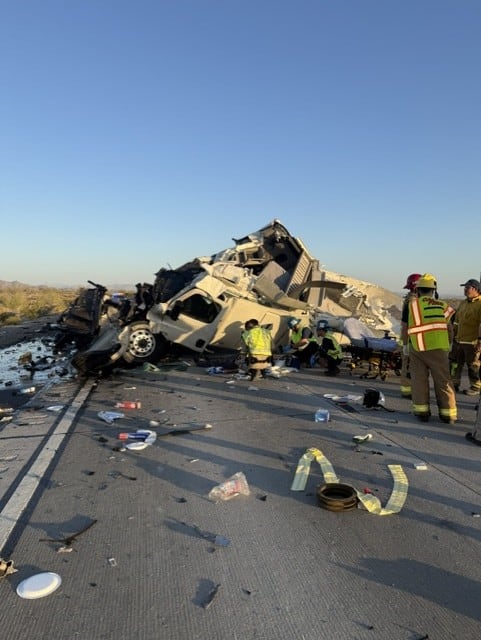
A federally required motor carrier liability policy does not insure trucks. It insures a company. I know that sounds like a semantic distinction. It isn’t. It’s the load-bearing wall of the entire financial responsibility system, and a growing number of operators have figured out how to stand on it. Insurers haven’t helped themselves with the growing number of instant issue, self-attested programs.
The MCS-90
When a motor carrier gets operating authority, it has to prove financial responsibility. The insurer files a Form BMC-91 or 91X with FMCSA and attaches an endorsement called the MCS-90 to the underlying policy. That endorsement exists under 49 CFR 387.15, and it was written to make sure a member of the public who gets hurt by a truck is not left holding an empty bag because of a coverage fight between the carrier and its insurer.
The insurer agrees to pay any final judgment against the insured for public liability arising from the negligent operation, maintenance, or use of motor vehicles, up to the federal minimum, and no condition, provision, stipulation or limitation in the policy relieves the insurer of that obligation. No condition. No limitation.
The courts have applied that language to exactly the situations you would expect. The truck was not scheduled on the declarations page. The trailer was leased or borrowed. The driver was not listed. The driver was excluded. The carrier blew off its duty to cooperate in its own defense. In every one of those scenarios, the endorsement can force payment anyway.
Then, and only then, the insurer gets a right of reimbursement against its own insured for anything it paid solely because of the endorsement. That principle is settled going back to Harco National Insurance Co. v. Bobac Trucking in the Ninth Circuit in 1997 and has been applied consistently since.
So the sequence is: injured party gets paid, insurer eats it, insurer chases the carrier. The MCS-90 is not insurance. It is a surety. It is the federal government standing behind the traveling public with the insurer’s checkbook.
For 40 years that worked fine, because the insurer had underwritten the risk before it signed. Somebody with actual industry knowledge looked at the loss runs, pulled the MVRs, asked about dispatch and maintenance and hours-of-service oversight, and made a judgment about whether to stand behind the operation. When I got my own authority, that process took weeks. It was invasive and irritating and completely appropriate.
That process is no longer overarching or consistent for a large and growing share of this market.
Instant issue
The model now is self-attestation. The carrier goes online. It declares a fleet size, a commodity, a radius of operation, and a driver roster. An algorithm prices it. The policy binds, sometimes in minutes. The BMC-91 gets filed. Authority activates. Nobody pulls the SAFER record. Nobody looks at BASIC percentiles. Nobody asks whether the officers behind this LLC ran a different LLC that lost its authority 90 days ago. And critically, nobody verifies whether the three trucks on the application are the only three trucks that will operate under this DOT number.
The instant issue model is not illegal. It is not even unusual in consumer lines, where personal auto has been algorithmically underwritten for years. The difference is the asset and the harm. A personal auto policy written without a claims history check produces, worst case, a coverage dispute between an individual and an insurer. An 80,000-pound truck operating under an instantly issued policy, run by principals who previously held a revoked authority, with a fleet several multiples larger than what was declared, produces something else. It produces a funeral.
What the data looks like
We pulled a cluster of 32 carriers connected through shared VINs on roadside inspection records. Shared VINs are a useful triangulation because a broker with no trucks generates no inspections and therefore self-excludes from the sample. If you show up in a VIN crossover, you were physically operating equipment.
Two insurance groups underwrote that entire cluster. Progressive entities wrote 59% of the most recent policies. GEICO entities wrote 28%. Combined, 88%. These are not offshore risk retention groups or fly-by-night MGAs. These are two of the largest auto insurers in the country, and their instant-issue commercial programs were binding one-truck-on-paper carriers.
Every one of those carriers filed at either $750,000 or $1 million in coverage. That is the heavy-truck floor, and behind those one-truck and three-truck declarations sat hundreds of distinct VINs, inspection counts running into the four figures, and operations spanning more than 40 states.
The policy-duration figures I originally reported for this cluster came from the defective source described below and are being recomputed. They are removed here rather than restated.
That’s the engine. Bind a minimum-limit policy on a self-declared micro-fleet, run a real fleet across the country, let the policy lapse, rebind somewhere else, repeat.
The insurer at first binding
I ran a population of 108,400 carriers that made a first bodily injury and property damage filing between 2015 and 2024, with a minimum two-year follow-up window. Restricting that to carriers declaring one to five power units, with no prior revocation, leaves 40,073. Those are clean first-time carriers, and what I measured is involuntary shutdown inside the first year of coverage. Market baseline was 17.4%.
Sorted by insurance group, clean first-time carriers failed inside year one at these rates: Everspan, an Ambac company, 33.0% on 464 carriers. The Berkshire Hathaway group, 29.9% on 2,167. Integon, which is National General under Allstate, 28.3% on 311. Hallmark, 28.0% on 328. Progressive group, 18.1% on 19,451. Other risk retention groups, 16.3% on 1,643. Everybody else, 14.3% on 14,164. AmTrust group, 10.2% on 1,545.
That is roughly three to one between the top and the bottom, on carriers with identical adverse history, which is to say none.
Sample size matters at the extremes here. Everspan, Integon and Hallmark each sit on a few hundred carriers, where Progressive sits on nearly twenty thousand. The two numbers I would put weight on are Berkshire at 29.9% on 2,167 carriers and AmTrust at 10.2% on 1,545, because both books are large enough to mean something and they sit at opposite ends of the same market. Same size class, same decade, same kind of customer, three times the failure rate.
The gap does not close over time. Stratified by entry year from 2015 through 2024, Berkshire’s clean carriers failed at a higher rate than Progressive’s in every single one of those ten years, with the spread running between 7 and 17 points. There is no year in which the two converge. Berkshire’s annual cohort in this population runs between 114 and 317 carriers, so individual years bounce, but the direction never does.
I originally reported that median policy duration tracked the failure ordering, and that short policies and dead carriers were the same phenomenon seen from two angles. That was an artifact and I am withdrawing it. Insurers differ sharply in how many amendment filings they generate per policy: Integon averages 7.30 segments, Everspan 2.16, Berkshire 2.08, Progressive 1.46. Because my source table kept one segment per insurer, the companies that file the most amendments had their policies cut the shortest, and the reported durations tracked filing behavior almost perfectly in reverse. Rebuilt from complete records, median first-year policy duration is 364 days at Berkshire, 365 at Everspan, 365 at Hallmark, 366 at AmTrust, 417 at Progressive and 482 at Integon. The differences are flat. Integon, which I described as writing the shortest paper in the market, in fact writes the longest while still posting one of the higher failure rates. The relationship runs backward from what I published.
What does hold on clean data is the cycling. In their first year of coverage, carriers at the highest-failure groups run through more insurers: 1.31 at Everspan and 1.30 at Berkshire, against 1.15 at Progressive and 1.07 at AmTrust. Smaller number than a policy-length gap. Real, though.
One writer had zero presence in this segment before 2022. Its first two cohorts failed at 34.7% on 176 carriers and 37.6% on 189, against market rates of 18.7% and 19.2% for those years. Roughly double the market on arrival. Its 2024 cohort came in at 21.2% on 99 carriers against a market of 21.4%, which is to say indistinguishable. That cohort is small enough that the drop may be noise.
Two specific ambiguities matter. Wesco Insurance Company is AmTrust. Wesco Financial is Berkshire. And the GUARD entity assignment to Berkshire is unverified. If either of those is wrong, the Berkshire figures move. I am publishing the finding with the gate visible rather than pretending it isn’t there.
A third gate, and a self-inflicted one. The first version of this piece drew its insurance figures from a processed table inside my own platform rather than from the raw federal file. That table was deduplicating coverage records in a way I did not know about. FMCSA writes coverage in segments, so one annual policy can appear as three or four rows under a single policy number, and my table kept one row per insurer and dropped the rest. It held 2.65 million liability records against 5.96 million in the raw file. About half the filing history was missing. Policies looked shorter than they were and first coverage dates looked later than they were, which is how half my original cohort turned out not to be new entrants at all.
Two warning signs went past me. Policies that appeared to bind and cancel on the same day, which are ordinary replacement filings. And a carrier whose entire filing history fell on one calendar date, which was just its renewal anniversary. I explained both away as data quirks. Both were symptoms. I found the defect when a coverage record on my own carrier profile page contradicted my own analysis.
The numbers above are rebuilt from FMCSA’s raw licensing and insurance file, 844,370 reassembled policies across 227,444 carriers. I will hand the methodology to anyone who asks for it.
FMCSA does not regulate insurance underwriting, and I am not asking it to. Market conduct belongs to state insurance departments. What this finding is good for is that the identity of the insurer at first binding is a usable risk-screening variable that exists at the moment of registration, before the carrier has any operating history at all. It is available on day one. Nobody uses it.
What it looks like at the crash
Three patterns from recon, compliance, and expert witness cases I have worked. I am keeping these anonymized because litigation is active or recently closed.
In one, a driver operating on a foreign commercial license, a Russian CDL actually, dispatched by a chameleon carrier whose principal place of business was a unit in a beachfront condo tower used as a short-term rental (AKA Airbnb) hauling a load that had been brokered four times from one of the oldest machinery manufacturers in the United States, killed a father of three. That driver had been running at night using flashlights as makeshift brake lighting. Five European transportation intermediaries touched that load before it reached the truck. Nobody in that chain verified anything about the carrier that finally hauled it.
In another, the financial responsibility filing on record matched a carrier that was not the carrier lettered on the truck. The trailer belonged to a third carrier operating on its own separate instant-issue policy. The plates on the tractor and the trailer came off other vehicles entirely.
In a third, the defendant carrier produced no driver qualification file, no hours-of-service records, no drug and alcohol testing documentation, no MVR, no Clearinghouse query, no maintenance records, no DVIRs, no annual inspection, no telematics, and no post-accident testing. Not incomplete. Nonexistent. Within months of the crash, the tractor and trailer had migrated through two additional carrier identities, the last of which was a Wyoming entity organized anonymously.
In every one of those cases, the insurer’s position was reasonable on its face. The carrier did not add the driver. The carrier did not schedule the asset. Under the four corners of the policy, that is a denial. Under the MCS-90, it is a payment.
The collection problem
So the insurer pays the injured family up to the federal minimum. Then it exercises its reimbursement right and goes after its insured. Its insured is a single-member LLC with a leased tractor, a registered agent at a Wyoming mail drop, a business bank account with four figures in it, and officers whose names appear on six other DOT numbers. There is nothing to collect. The subrogation file gets closed at zero.
I looked at this from the address side too. There are 5,565 active carriers listing a principal place of business at one of 333 street addresses that each host at least eight carriers and six or more distinct officer names. Tighten the threshold to 25 carriers and 20 officers, and you still get 2,098 carriers across 35 addresses. One address in Signal Hill, California, is the declared principal place of business for 507 active carriers with 423 distinct officers, three-quarters of which share a single email domain. An address on North Gould Street in Sheridan, Wyoming, hosts 120.
Most of those addresses belong to legitimate compliance services, registered agents, and virtual office providers. Nobody there is alleged to be doing anything unlawful, but the regulatory problem is unavoidable. New entrant safety audits are conducted at the place of business. Post-crash record requests go there. Field office jurisdiction and state MCSAP assignment both flow from it. When that field does not describe a real place where a real person makes safety decisions, the entire downstream enforcement structure is aimed at a mailbox.
When the shell dies, it reincarnates. New LLC, new DOT number, family member listed as owner, same equipment, same dispatch, same phone. GAO reported in 2012 that applicants with chameleon attributes were three times more likely than other new applicants to be involved in a severe crash, 18% against 6%. FMCSA has the authority to act under 49 CFR 386.73 and runs a screening process called ARCHI. The agency is replacing its 40-year-old registration infrastructure with MOTUS through 2026, with business verification and identity checks at registration. That will help at the margins. It will stop casual impersonation and account takeover. It will not, by itself, reconcile a declared fleet of one against 600 VINs on the road.
What would actually change this
Four things, and none of them require new legislation.
Verify the fleet count at binding instead of accepting attestation. The inspection data that would expose a one-truck filing running 600 VINs is public and free. Any insurer can pull it. Any broker can pull it. I pull it.
Reconcile the financial responsibility filing against observed operations on an ongoing basis, not at inception. A carrier declaring one power unit that generates 1,100 inspections in a year across 40 states is not an underwriting mystery. It is an alarm that nobody has wired to a bell.
Treat rapid rebinding as an underwriting event. A carrier that changes insurers repeatedly inside its first year is telling you something, and that history sits in the L&I filing record, visible to every insurer that looks.
Somebody needs to have a conversation about the $750,000 minimum, which has not moved since the mid-1980s. The median nuclear verdict is now $51 million. A minimum-limits policy is not protection for the public, and it is not protection for the carrier. It is a rounding error that happens to satisfy a regulation.
The instant-issue model did not create bad carriers. It removed the last checkpoint that used to catch them. Underwriting was never a formality. It was the only place in this system where a human being with domain knowledge looked at an operation and decided whether the public should be exposed to it.
We automated that away and called it efficiency. The bill for it is being paid at the scene of crashes, and then socialized into the premium of every honest carrier in the country. The Tea is a reader-supported publication. To receive new posts and support my work, consider becoming a free or paid subscriber.
This looks like a shell game
The failures we see all around us are systemic.