

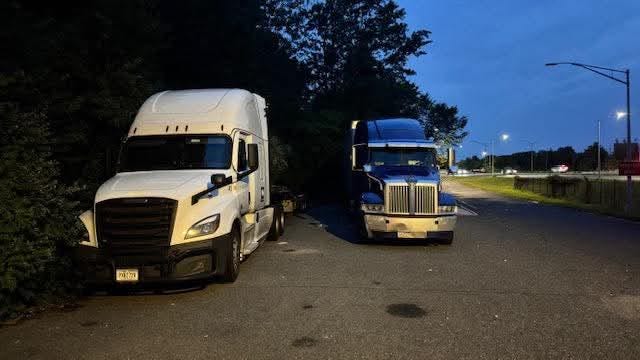
After bleeding in State parking and cams and data feeds for months, I pulled the live truck-parking feeds for Ohio and watched the state’s interstate rest areas fill up in real time. Hancock County northbound on I-75: two open spaces out of eighteen. Belmont County eastbound on I-70: three out of nineteen. Wood County southbound: four out of thirty. By the time the sun was down, six of the busiest freight corridors in the state were down to zero, and a driver approaching any of them with his fourteen-hour clock about to expire had a choice. Take one of the shoulder spots, or keep driving illegally, or park on the shoulder ramp where the next tired driver will clip him, or enforcement will wake him up.
That is the truck parking shortage, and everyone in this industry knows it’s one of the real shortages we have. 98% of drivers told federal surveys they have trouble finding safe parking. So, do the places with the least parking also kill the most people overnight? My data says the answer is yes, in exactly the corridors you would least want it to be.
The measure
You cannot just count crashes, because a big freight state will always have more crashes than a small one, the same denominator problem that ruins most trucking stats. So, I didn’t count crashes. I built a ratio. Overnight truck crashes, midnight to 6 a.m., divided by the number of public and private truck parking spaces the state has. Crashes per space. It asks how much overnight crash pressure each parking space is being asked to absorb, and it doesn’t care how big the state is.
Pulled every reportable truck crash in MCMIS, tagged the ones that happened in the overnight window, and joined them to a national inventory of 6,662 truck parking locations across all fifty states. Then I ranked the states by crashes per space.
The deserts
The worst places in America to run out of hours are the coastal freight funnels that never built the car park to match the freight. Louisiana tops the list at 2.55 overnight crashes for every parking space in the state, on just 1,357 spaces carrying the entire I-10 Gulf corridor. Maryland is next at 2.49, then Connecticut at 2.32 and Massachusetts at 2.29, three Northeast states where I-95 pours freight through a region that paved over its shoulders decades ago. California, for all its size, runs 2.06 on 6,777 spaces. Virginia, my own state, matches it at 2.06. These are the parking deserts. High-freight corridors starved of anywhere legally to stop.
Now the other end, as the contrast is the proof. Ohio and Indiana, two of the states that invested in truck parking through the Mid America Association of State Transportation Officials, sit near the bottom of the danger ranking despite enormous freight volumes. Ohio carries 10,339 overnight crashes across 6,166 spaces, a ratio of 1.68. Indiana runs 1.33. They have roughly the same freight load as the deserts and half the crash pressure per space, because they built the spaces.
Texas ends the argument. Texas has more truck parking than any state in America, 13,797 spaces, and it still records 18,696 overnight truck crashes, the most in the country. That looks like a contradiction until you divide: Texas runs 1.36 crashes per space, near the safe end of the ranking. The raw crash count reflects its status as the biggest freight state in the union. The ratio, the thing that actually measures whether a driver can find a place to stop, tells you Texas built enough spaces to spread the load. The deserts did not.
The pattern holds down the list. The states with the worst crashes-per-space ratios are the ones with the fewest spaces relative to their freight, and they cluster on the two corridors every long-haul driver could name blind: the Gulf I-10 run and the Northeast I-95 spine. Parking scarcity and overnight crash pressure track together exactly where the freight is densest, and the pavement is oldest.
What the ratio says
Data always has its limits. This is a state-level correlation, not crash-by-crash proof that a specific wreck happened because a specific lot was full. The federal crash file doesn’t record whether the driver has been hunting for parking, and it never will, because the form has no box for “gave up looking.” The ratio shows that the states that failed to build parking are the ones where each remaining space absorbs the most overnight crash pressure, and those states are the freight corridors.
New Mexico’s kill rate looks alarming on a handful of fatal crashes, so I am leaning on the crashes-per-space ratio, which rests on tens of thousands of crashes, rather than any single state’s fatality percentage. The ratio is the sound measure. The rest is noise around it.
The part that shouldn’t be legal
I can show you 6,662 truck parking locations across fifty states, every one of them, mapped, with whether it has lighting and cameras and a gate. What I cannot show you, for almost the entire country, is whether any of those spaces are open right now because almost no state tells anyone.
The live availability feed I watched fill up this morning, the one that told me Hancock northbound was down to two spaces, exists state by state. Ohio. Ohio instruments its rest areas, counts the trucks, and publishes the number in real time, which is why a driver on I-75 can know before the exit whether it is worth pulling off. Most states, he finds out when he is already on the ramp, committed, at the end of his clock, in the dark. The single most useful piece of information a tired driver could have is whether there is a legal space at the next rest area; it exists for about two percent of the country’s roads.
That policy failure underlies the crash numbers. We have known about the parking shortage for twenty years. The federal government funded a study named after a driver who was murdered because he had to park somewhere unsafe and then funded almost no parking. Jason’s Law counted the spaces and changed none of them. The one cheap thing that would help tonight, before a single new space gets paved, telling drivers where the open spaces are, exists in one state because one state bothered.
We need a national map of every truck parking location in America, and the crash-per-space risk of the state around it, because that much is real everywhere. A live availability layer that works in Ohio and nowhere else, because that is how far from the rest of the country has gotten. The map of what we built. The blank space where the information should be. Both are the stories. The clock runs out the same everywhere. The difference is whether anyone told the driver where to stop before it did.
This is a really important way to look at the truck parking problem. The connection between parking availability and overnight crash pressure is especially interesting, even with the limitations of state-level data. For drivers, the problem isn’t simply finding a parking space—it’s knowing whether a legal, safe space will actually be available before the clock runs out.
The live-availability point is probably the biggest takeaway for me. A driver shouldn’t have to gamble on an exit after already spending hours searching for parking. Real-time information could make a meaningful difference even before states invest in building thousands of new spaces. Truck parking is ultimately a safety issue, not just a convenience issue.