

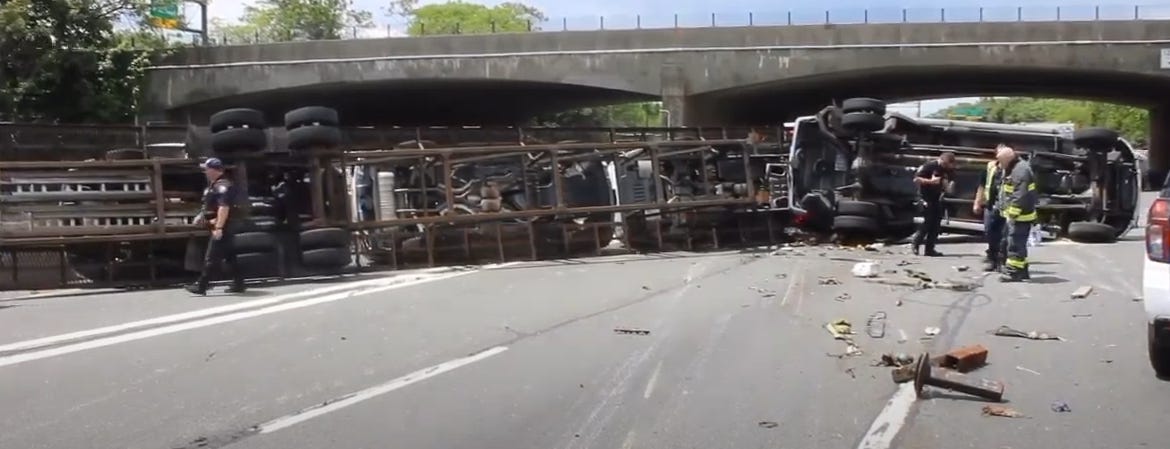
Last year I spoke at the Auto Haulers Association on risk and compliance for fleets. Auto hauler fleets carry some of the biggest exposure in highway risk. That's not getting better; it's getting worse.
On a February night a few years back, a pickup truck pulling a wedge trailer loaded with two brand-new heavy-duty pickups ran out of fuel in the middle lane of a Midwest interstate. The engine sputtered for about a hundred meters and died. The right shoulder was clear. The driver had enough rolling speed to coast onto it and didn’t. He stopped squarely in a live lane of 65-mile-per-hour traffic, after dark, put out three reflective triangles in a geometry the regulation doesn’t recognize, with taped consumer flashlights to the tailgate of the rearmost pickup on the trailer. A man in his sixties, working that night in a Sprinter van for a small expediting outfit, came down that lane at highway speed and hit the back of the trailer. He died at the hospital about ninety minutes later.
The driver of the pickup held no US CDL of any class. He did have a Russian CDL though. The manufacturer’s combined weight rating for that truck and trailer requires a Class A CDL in every factory configuration. It was a hot-shot, a one-ton pickup pulling a car-hauler wedge. He got his US CDL about three months after the crash. He couldn’t answer the investigating trooper’s questions without a translation app, which matters because federal rule 49 CFR 391.11(b)(2) requires a driver to respond to official inquiries in English, and it matters more because a driver who can’t read the road can’t read the load. He didn’t know his own truck had run out of fuel until the trooper had him turn the key and look at the gauge. He’d been told, and he believed, that you don’t need a CDL to drive a pickup. Somebody put that man on the road with freight.
Four companies handed the load down a chain, and none of them was the company actually running the truck. A Fortune-scale shipper tendered finished new vehicles to a national haulaway carrier with more than sixty years of history and a contract that made it responsible for every subcontractor it used. That carrier brokered the load to a one-truck operation whose insurance schedule listed nothing but over-the-road tractors, meaning it could not haul the load itself and everyone with access to the policy could see it. The one-truck operation, which held no broker authority, re-brokered the load to a company that existed on the bill of lading and nowhere else. The truck itself was titled to a shell whose owner had left the country sixteen months earlier, operated day to day by a company that has never held motor carrier authority, dispatched by a man who rents out operating authority through companies he controls, and placarded in the window with the name of a fifth company that touched nothing but the sticker. The load changed hands four times before it reached a driver. So... a quadruple-brokered load to a ghost carrier with a principal place of business being an Airbnb, who gave it to a foreign driver with a Russian CDL.
It’s a network. How do we know? The national carrier’s dispatch sheet put three specific trucks on that order, identified by VIN. The trailer that got hit was carrying two trucks, and only one of them was from that order. The second came off a different order entirely. Somebody downstream had rebuilt the carrier’s loads across order boundaries, mixed vehicles from two separate dispatches onto one trailer, and left the rest sitting in the yard. Two days after the fatality, delivery receipts were completed showing every vehicle on both orders delivered clean and on time, signed by the same driver, on runs that a map says one driver couldn’t physically make in a day. The crash damage on the second truck was coded into a routine delivery inspection form as if it were ordinary transit damage. When the national carrier’s own brokerage director was shown those documents under oath, he called them what they are. Fraudulent. His company, he testified, never sent that load to the carrier named on the paper.
That director’s testimony is wild. He was candid, likable, and by every appearance honest, which is exactly what makes it worse. He ran the brokerage desk for a network of roughly fifteen hundred signed carriers, about five hundred hauling at any given time, with a staff of seven. He testified there was no written vetting policy. Not a thin one. None. Onboarding meant confirming the MC and DOT numbers were active and collecting an insurance certificate. A look at the public federal safety record was optional, undocumented, and not required of his dispatchers. Monitoring after onboarding meant watching the insurance expiration date. He never held a CDL. He received no training in the federal safety regulations, describing his education as learn-as-you-go. Asked about the safety rating his own contract required every carrier to warrant, he said he’d have to look it up. The one-truck carrier in this chain was unrated by the federal government, had a driver out-of-service rate nearly seven times the national average, and seventeen days before the crash was cited and placed out of service for the exact violation that defined this operation: driving a commercial vehicle without a CDL. The next morning, the desk assigned it eleven more loads. Shown that record in the deposition, the director said that if anyone had looked, the carrier would have been cut off on the spot. Nobody looked. The data was free; it sat on a public website, and pulling it takes about ninety seconds.
I drove the truck, ran the fleet, wrote the safety programs, brokered the work, and reconstructed the crashes, and I can tell you the driver you meet in these cases has changed over the years, and the carrier has changed even more. What’s changed most is the person running the desk. The director in this case came up through sales before landing in a trucking yard, moved to load building, then dispatch, then found himself heading the brokerage arm of a national carrier because the company went through bankruptcy and the man ahead of him left. That’s not a knock on him. He did the job he was handed with the tools he was given, and he owned his answers under oath, which is more than most. The knock is on an industry that hands that job to anyone without insisting they know the freight side.
My read, built on the cases that cross my desk every week and my history, Somewhere north of half the people now running sourcing, procurement, carrier, broker, and shipper operations - my own estimate is at least sixty percent - have no frontline experience in the industry they’re steering. The generation that grew up through it, the leaders who started on a dock or in a cab and rose because they understood what a 40 percent out-of-service rate means at 9:30 on a Tuesday night, has been replaced in large part by private equity operators, venture-backed tech leadership, fresh college students, and career managers who’ve never trip-planned a load or sat through a roadside inspection. They can read a margin. They can’t read a carrier. The vetting desk in this case wasn’t lazy, and it wasn’t corrupt. It was staffed and led by people who didn’t know what they didn’t know, inside a company whose owners were creditors, not truckers, and the safety function got run the way finance runs everything it doesn’t understand: outsourced to a software subscription or no one at all and never audited again. A load-management app built to collect electronic delivery signatures became, by default, the entire carrier safety program of a national carrier. Nobody decided that. Nobody was qualified to notice it had happened.
The man in the Sprinter was doing his job, in his lane, at the posted speed, and the sum of every unexamined decision in that chain was parked in front of him in the dark. Every party above that driver had the record in reach: the unrated status, the out-of-service rate, the insurance schedule that proved the carrier couldn’t haul the load, the OOS citation seventeen days out. Reasonable care in carrier selection means a person who knows the industry, looking at a public record, with the standing to say no. A software subscription doesn’t do that, and neither does a clause you paste into an agreement and never enforce. If the people running your carrier desk can’t explain what a satisfactory rating is without looking it up, you don’t have a vetting program. You have paperwork, and paperwork has never once stopped a truck. Vetting platforms are great if you have any idea what you’re looking at and what makes up a risk profile.
Who we’re hiring to run this industry top down and bottom up is what’s gotten us where we are today.
I wonder how much of this is due to the lazy tendency of management to require a diploma for almost every job above menial labor rather than promoting and training those into management who understand the business from the ground up due to having started at the ground level?
Don't ask don't tell. That has been the unspoken rule of commercial freight as long as I have known it. Cut my teeth at Smalley Transport.
Nobody cares was practically the corporate motto.