

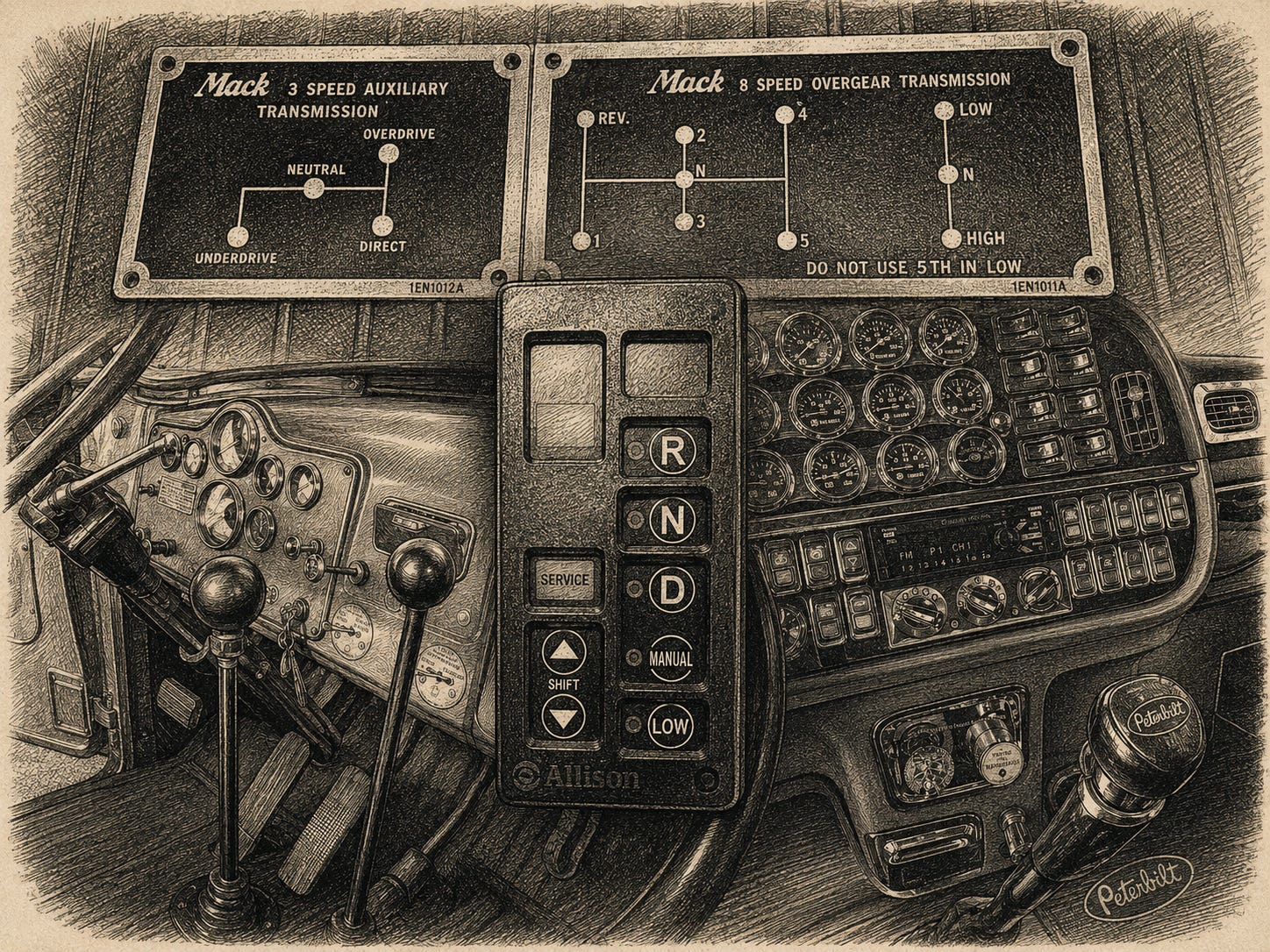
The first truck I ever drove was a 50s B Model Mack. It had more than one stick. I could barely see over the giant wheel. Then again, I was essentially raised by a millwright farmer steelworker grandfather born in 1918. Into the early 1960s, a road tractor came from the factory with two transmissions and two, maybe even three shifters. The main box sat where you’d expect, and behind it hung an auxiliary that drivers called a brownie, after the Brown-Lipe boxes that made the arrangement common. A five-speed main behind a four-speed auxiliary gave you twenty theoretical combinations, and pulling a grade meant working both levers at once, one hand crossing over the other, matching engine speed to two gearsets while you steered with whatever was left. The truck didn’t move for anyone who hadn’t put in the months. It was a licensing exam that ran continuously, every mile, and it failed people out before they ever got near a scale house.
Then Fuller put twin countershafts in one case, hung a range valve on a single lever, and the Roadranger killed the twin stick inside a decade. Nobody mourned it, and nobody should have. One stick was plainly better than two: fewer missed shifts, less driveline abuse, a shorter road to competence that was still plenty long. There’s an old fable about a frog in a pot, the one where the water warms so gradually the frog never picks a moment to jump. The fable is false in a laboratory; real frogs leave, and it’s true in an industry, because in an industry every degree of temperature arrives as a gift. One stick instead of two was the first degree. Who wouldn’t take it?
The second degree
The single-stick era still asked real questions. A thirteen- or eighteen-speed behind one lever meant double clutching or floating gears, and floating meant feeling the exact moment the input shaft speed matched the gear you wanted, because there’s no synchronizer in a truck box to forgive you. You learned rpm matching, or you learned the sound of grinding steel. You learned which gear held a loaded truck on a six percent grade, because the alternative was riding the brakes to the runaway ramp. Drivers from that era could diagnose a drivetrain by sound, a u-joint by vibration, an injector by the smoke, and none of that was taught in a classroom. The transmission taught it, one consequence at a time.
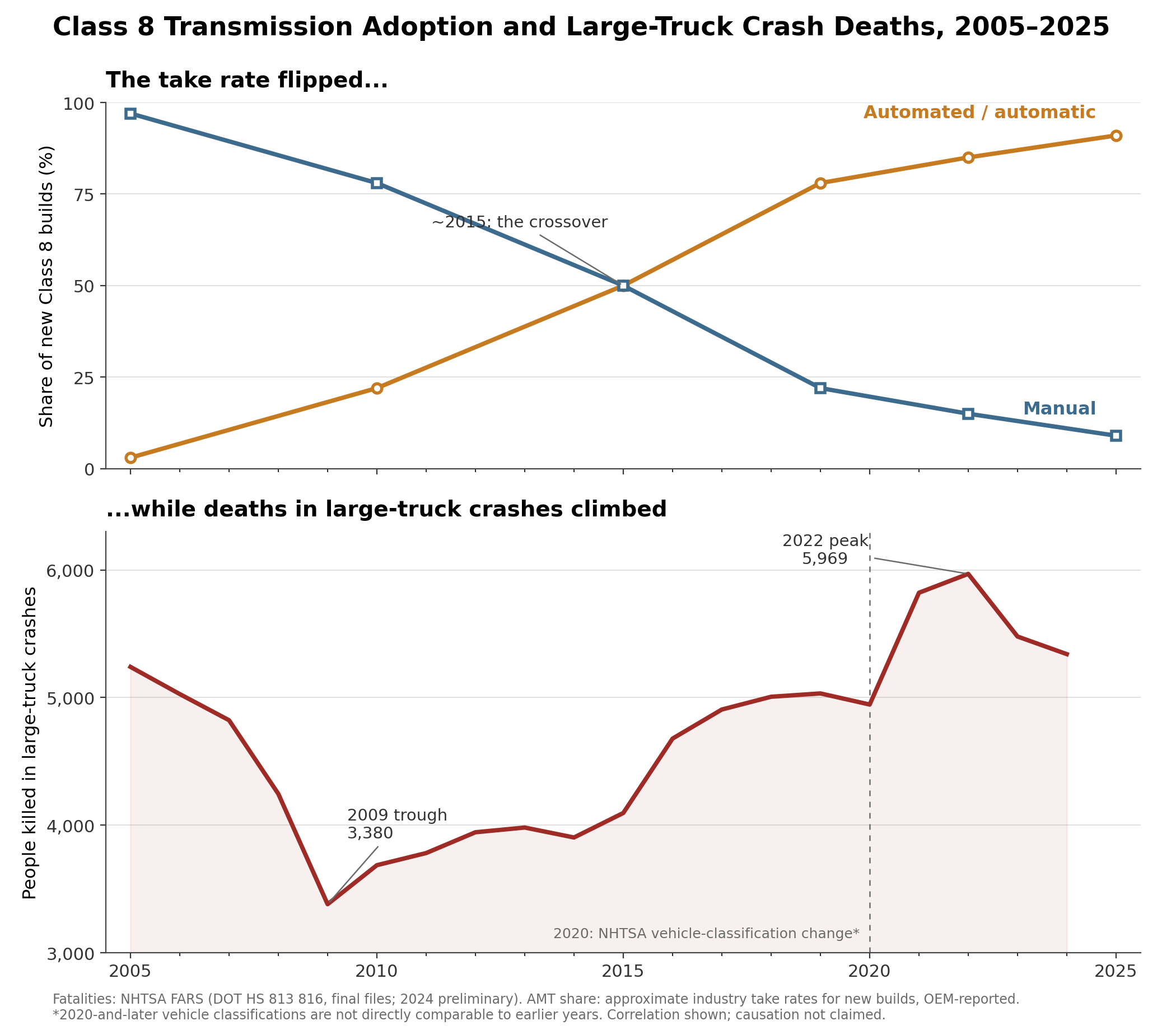
The water warmed again in the mid 2000s. In 2005, better than nineteen of every twenty new Class 8 trucks still shipped with a manual. Automated manual transmissions took maybe a quarter of the market by 2010, mostly on the fuel-economy argument; then the surge hit between 2014 and 2017, and the take rate crossed half. Today it’s north of ninety percent of new builds, with manuals surviving mostly in vocational trucks, and Eaton, Volvo, Daimler, and Paccar have made clear where the roadmap is headed. A driver can now push a button, select drive, and operate eighty thousand pounds with the same inputs as a rental sedan.
No villain did this. Fleets chose the fuel numbers, and the fuel numbers were real. Safety departments chose shift consistency over widespread reliance on human skill, and that logic holds up. Recruiters chose a bigger applicant pool in the middle of a driver shortage narrative. Drivers with twenty years of clutch work in their left knee chose their knee. Every individual choice was defensible, and the sum of the defensible choices is a workforce in which the majority of new entrants have never once selected a gear, never felt an engine lug, and never had a reason to learn why either matters.
The wrench in the side box
The transmission story gets told at truck stops all the time. The brake story doesn’t, and it’s the same story.
I came up when adjusting your own brakes was part of the job. The wrench lived in the side box, and the routine was simple to describe and educational to perform. Air brake chambers push a rod, the rod turns a slack adjuster, the adjuster turns a camshaft, and the cam spreads the shoes into the drum. Lining wears, the rod travels farther, and past a certain travel the brake stops doing much of anything, which is why pushrod travel, what the regs call applied stroke, is the single measurement that decides whether an air brake works. You crawled under, you checked the stroke, and you took up the adjustment with a wrench in about ninety seconds per wheel. Doing that every week meant you also saw the lining, saw the drum, felt the heat coming off a dragging brake with the back of your hand, and caught the cracked shoe or the weeping wheel seal while it was a Tuesday problem instead of a Thursday-on-the-shoulder problem.
FMVSS 121 ended that era on October 20, 1994, when new air-braked trucks were required to carry automatic slack adjusters. The promise was a brake that could never drift out of adjustment, and the promise made sense, since out-of-adjustment brakes were the most common defect roadside inspectors found. Thirty years later, brake adjustment violations still sit at or near the top of every CVSA brake blitz. An automatic slack adjuster that’s out of stroke isn’t out of adjustment; it’s failing, and the correct response is replacement, not a wrench. CVSA and the manufacturers say plainly that manually adjusting an automatic adjuster is dangerous, because the wrench hides the failure while the underlying component keeps dying. The device that was supposed to make brake knowledge unnecessary instead made it mandatory in a subtler form: you now need to know enough to recognize a failing adjuster, and the drivers who came up after 1994 were never given a reason to learn what stroke was in the first place. The defect that used to get caught in the yard with a wrench now gets caught at a scale with a citation, and the carrier’s CSA profile eats the difference.
The drum itself was the next degree. A drum brake told you things through a backing plate inspection hole and through your hand: lining thickness you could see, heat you could feel, glazing you could smell after a long grade. Air disc brakes stop shorter and fade less, and the industry is right to adopt them. They also put the pads behind a rotor and a shield where a driver with a flashlight learns almost nothing, and full inspection means a shop bay and sometimes a wheel off. In one generation, brake condition went from something a driver assessed with his own senses every morning to something a maintenance vendor certifies on an invoice. The brakes got better, and the driver got blinder, in the same motion.
The rest of the list
Run the same pattern across the truck, and it holds nearly everywhere. Chassis grease fittings gave way to sealed-for-life components, which removed the weekly crawl underneath that doubled as the closest look anyone ever took at the undercarriage. The pyrometer, the exhaust temperature gauge that told a driver in real time whether he was about to cook an engine on a pull, gave way to sensors that automatically derate the engine, so the skill of reading a pull became a fault code. Trip planning used to be arithmetic a driver did in his head against a paper log, and the ELD turned it into a countdown clock that does the thinking and punishes the driver for the clock’s own rigidity. The pre-trip walk-around now competes with a dashboard full of tire pressure and lamp-out sensors that are right most of the time, which is often enough to teach a driver to stop looking.
Each removal follows the same sequence. The task goes first. The knowledge the task generates comes a few years later, when the last people who performed it retire. The professional identity built on that knowledge goes next. The wage argument goes last, and quietest.
Steering wheel holder
The insult existed for decades before it became a job description. A steering wheel holder was what an old hand called a driver who couldn’t back, couldn’t shift, and couldn’t find the tandem’s release, and the term stung because it described a failure to master a trade. The trade has since been redesigned so there’s less to master, and the labor market has done what labor markets do with jobs that need less mastery. When the equipment demands months of skill development before a driver is productive, that driver carries sunk cost, sticks around, and commands a wage that reflects what he can do that others can’t. When the equipment can be operated by anyone comfortable in a car, the three-week CDL mill isn’t a scandal; it’s a rational response, and I’ve written elsewhere about what the ELDT floor actually filters, which is very little. Churn replaced tenure, and the wage curve followed the skill curve down. Nobody decided drivers should earn less in real terms than their fathers did. The pot just kept warming, and wages boiled off with the rest.
Honesty requires the other side of the ledger, and the other side is long. The AMT saved fuel across millions of trucks, and saved knees, shoulders, and backs across a generation of drivers. It opened the profession to people the old equipment filtered out for reasons that had nothing to do with whether they’d be safe, careful, professional drivers, and plenty of them are exactly that. Disc brakes stop trucks shorter than drums ever did, and shorter stops mean lives. Anyone writing this story as pure decline is writing it wrong, and the old hands who claim every steering wheel holder is a menace are flattering their own résumés. The gains are real; they were worth having, and that’s precisely what makes the pattern so hard to fight. Nothing in this story was a mistake. The temperature just never stopped rising.
The reason the sequence matters now is blunt: the pot has more degrees left in it. Advanced driver assistance is the current one, automated steering and braking that works most of the time, teaching the next cohort to trust the machine the way sensors taught the last cohort to skip the walk-around. Full autonomy is the degree after that, and it will arrive the same way everything else in this story arrived, as a convenience nobody could argue with, adopted for reasons that are individually sound. There won’t be an announcement when the American truck driver stops being a tradesman. There wasn’t one this time. It happened across sixty years, one stick, one wrench, one sensor at a time, and every single step was a good idea.
With all of the advances in trucks, if we had the same caliber of drivers that were required in the 60's and 70's and the same speeds as the 60's and 70's we would have a pretty safe system. But like you brought out we lowered the entry bar to steering wheel holder. and have a bunch of ignorant drivers running amok at 75 mph.
Early on, I carried a turbo, injector and an air governor along with the tools to change them. Another safety practice negated by autoslacks was the practice in the winter of backing one trailer brake off, when going down icy mountain grades so brake applications didn’t slide all the wheels on the trailer, it had a better chance of staying behind you. Today’s world is about as stark as my grandfather farming with horses and moving into the tractor age.