


A new trucking authority costs about $300 from the feds. You fill out the forms, you wait out the vetting window, and FMCSA hands you a USDOT number and operating authority. Anybody can do it.
So why would somebody pay $35,000 for a bad one that already exists? Well, because the $300 buys you a number. It does not buy you trust. In freight, trust is age. An authority that has been on the books for five or ten years clears broker vetting software that a 30-day-old authority cannot. Especially if it gives you a fleet count of 235 trucks. It carries inspection history. It carries insurance continuity. If the previous owner did the legwork, it carries something even more valuable: standing accounts with major freight programs, set up with hundreds of brokers, sometimes sold with the phone number, the email address, and the bank account attached. You are not buying a trucking company. You are buying the ability to skip the part where anyone looks at you.
For the past seven months, that shortcut has had a storefront.
The marketplace
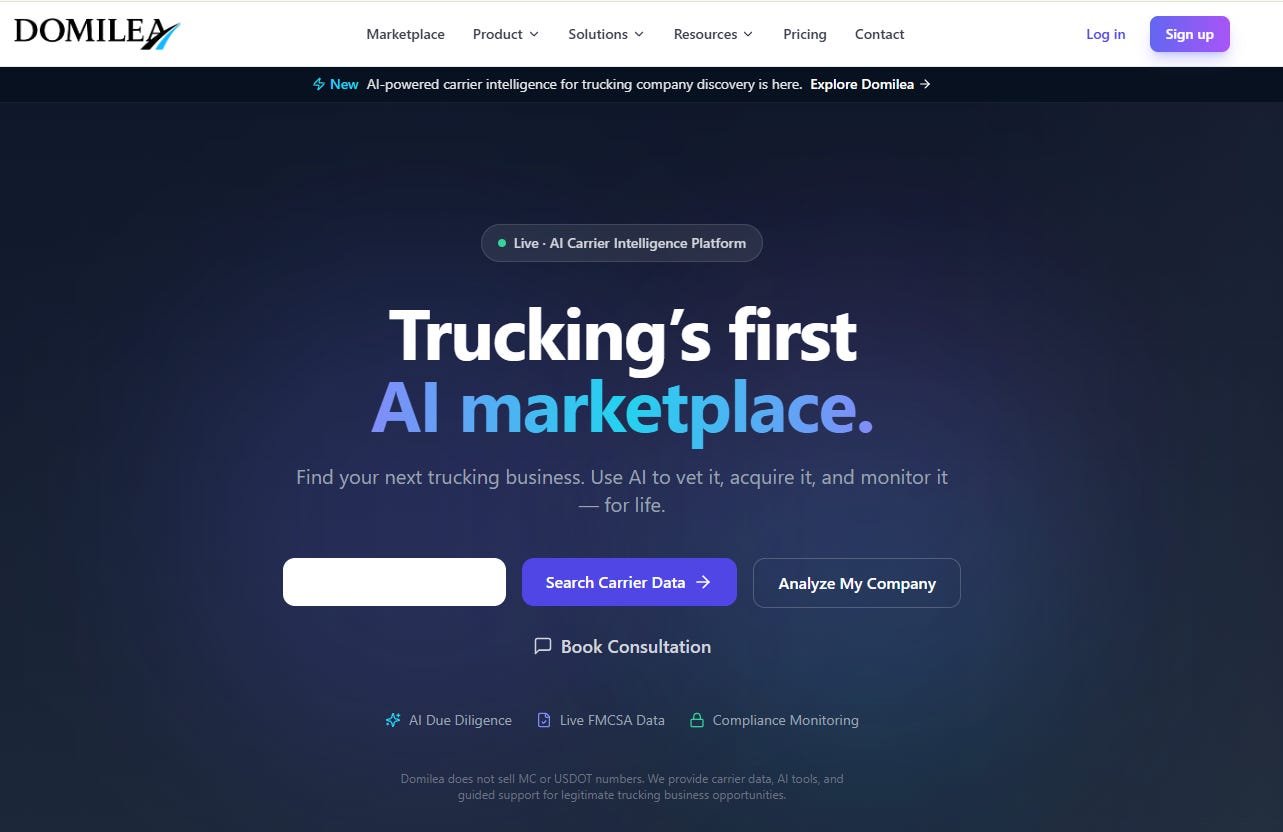
Domilea.com presents itself as a trusted exchange for motor carrier authorities. Clean interface. Verified listings. Prices posted. Between its launch on December 19, 2025, and July 2026, the platform’s own transaction records show at least 108 authorities sold for a combined total of roughly $1.54 million. Thirty-three of those sales trace to April 2026 alone. Asking prices ranged from a few thousand dollars for a young single-truck authority to $35,000 for the most expensive listing in the set. The $35,000 one will sound familiar and comes with a cool 235-vehicle fleet count.
Read the listings, and the market tells you exactly what it values. Sellers do not advertise trucks. Most of these companies have one power unit or none. They advertise the paperwork and the reputation that comes with it. A two-year-old company “with phone and email.” A “clean MC with Amazon B.” An authority “set up with over 500 brokers.” One listing offered a company whose authority had been revoked and then reinstated, and pitched the reinstatement as the selling point: reinstated nine months ago, insurance current, good to go. In this market, a federal revocation is not a scar. It is proof that the paperwork is up to date.
On March 13, 2026, FMCSA issued a formal bulletin telling the industry, in capital letters, do not buy, sell, or lease USDOT numbers or operating authority outside a legitimate business transaction. Violations mean the inactivation of the number and revocation of every related registration. I wrote about that bulletin for FreightWaves the day after it dropped, laid out how this underground market prices trust, and closed with a question: whether the people buying and selling trucking identities online read federal compliance bulletins. Seven months of transaction data later, we have the answer.
Domilea did not stop. It accelerated. Its records show sales continuing straight through the bulletin and for months afterward. On the very day the bulletin dropped, a Solon, Ohio carrier called TIMEIT Logistics LLC was listed on the platform at $35,000, the highest price in the data set. It sold in May.
Hold that name. We’ll come back to it. It sounds familiar because it should.
Who runs it, part one: the California front
Domilea’s own branding states: “Powered by MorPro.” MorPro Inc is a California corporation formed in July 2022 and controlled by the Morales family of Mission Viejo. California and Nevada corporate filings, Kansas and Ohio lien records, and the platform’s transaction data lay out the structure in four layers.
The first layer is the operator. MorPro runs the marketplace, and MorPro’s own trucking authority, DOT 3939259, was the debut listing when the site launched. Listing number one, priced at $6,000, was the house selling itself. The company’s chief executive does not appear on any FMCSA filing for the carrier. The federal record is fronted by other officers.
The second layer is a holding company. Foundations Venture Group was formed in Nevada on May 16, 2025, seven months before Domilea launched. Its officer slate includes a MorPro principal and a MorPro director, as well as a president and treasurer with no traceable business footprint. Three of the four officers list the same Garfield, New Jersey, address, where no motor carrier is registered. The entity is now in default with the Nevada Secretary of State, and it has filed only one document in its history: the initial officer list. It was never a company that operated. It was a company that held a name.
The third layer is the money. Kansas UCC records show an all-assets lien over MorPro and a related cluster of companies held by Magnus 123 Trust of Overland Park, Kansas. Magnus 123 is one of a family of sequentially numbered trusts, Finite 220, Exertion 221, Quantum 222, Luceo 124, Grandis 125, all filing from a single Metcalf Avenue mailbox. That lien was released on December 10, 2025. Domilea’s first listing went live nine days later.
The fourth layer is the inventory, where the story stops being about one clever marketplace and starts being about who this marketplace actually serves.
Who runs it? The shell with its own product
MorPro is the storefront. The name over the door belongs to somebody else.
“Domilea” is not a MorPro entity on paper. The corporate identity DOMILEA CO. is an Illinois corporation, file number 72146492. It did not start as Domilea. It was incorporated on December 27, 2018, as HEALTHY WITH V CO., a one-share, one-dollar corporation whose sole incorporator, registered agent, president, and director was a woman from Plainfield, Illinois, named Vaiva Grama. For seven years, it sat inert, a dormant wellness-sounding shell with a single share of stock. Then, on December 26, 2025, one week after domilea.com went live, Grama filed Articles of Amendment renaming HEALTHY WITH V CO. to DOMILEA CO.
The marketplace, whose entire business is selling aged, dormant shell companies to buyers who want to skip the wait, gave itself an aged, dormant shell company to operate under. It did not incorporate fresh in 2025. It reached back and reactivated a seven-year-old identity. The store took its own product off the shelf.
Grama is not a stranger to freight. She was also a manager of RTL Leasing, LLC, an Illinois company organized in January 2021 whose principal place of business was 13717 U.S. Route 30 in Plainfield, a multi-tenant building on a truck route. RTL was involuntarily dissolved in July 2025. That building is not just a leasing-company mailbox. It houses active motor carriers by suite number. The marketplace’s corporate identity traces back to the same Plainfield building that housed a 158-truck carrier.
The entities sharing that address have equipment we traced by vehicle identification number; the equipment shares 19 VINs with an Oswego, Illinois, carrier called Chicargo LLC, a high-confidence signal that one fleet operates under two authorities. Its VIN pool runs directly into Tutash Express and KG Line Group, the same Illinois equipment hub that feeds sold authorities onto Domilea and that I have tracked before in connection with a fatal Indiana crash. In other words, the building that holds the marketplace’s corporate name also holds a carrier wired into the exact seller network the marketplace is moving inventory for. The corporate layer and the inventory layer meet in Plainfield.
What the record establishes is that Grama controls the DOMILEA CO. corporate identity, that she ran a leasing company from that building, and that the building houses a carrier tied by shared equipment to the Tutash network. What the public record does not yet establish is that Grama personally controls those entities or the precise contractual relationship between the Illinois DOMILEA CO. and the California MorPro operation that brands the live site. Both entities can be real at once: a California operator running the front end while an Illinois shell holds the name is not a contradiction. It is, if anything, the same trick the marketplace sells, performed on itself.
Not independent sellers
The pitch of a marketplace like this is volume and independence: hundreds of unconnected mom-and-pop carriers, each offloading one company. The network analysis of the 108 sold authorities, run through the same officer, address, phone, and VIN crossover engine we use for chameleon carrier detection, says otherwise.
Two carriers sold on Domilea, Golden Gates Transportation of Carpentersville, Illinois, and Furman Logistics of Schiller Park, Illinois, share eight vehicle identification numbers with each other. Both sit within a single rotation ring with three other Illinois and Wisconsin carriers; all tied to the same officer’s name. Two supposedly independent sellers, one equipment pool.
A Naperville, Illinois carrier, J&E Express Transport, which was never listed on Domilea, shares equipment or officers with five different carriers that were sold there. One of those five, ESN Transportation, has an officer who appears in J&E’s filings and shares two VINs with it. One operator, five storefronts.
Another hub, Tutash Express of Illinois, connects to three more solid authorities. Tutash is not a new name. It anchors an equipment pool that includes KG Line Group, AJ Partners, and the network I previously investigated in connection with a fatal Amish crash in Indiana. Carriers feeding inventory into Domilea are not strangers to each other. Several of them are the same operations wearing different names. And, as the Plainfield building shows, that same Tutash equipment pool reaches all the way back to the address on the marketplace’s own corporate paper.
Some of the inventory was never organic to begin with. TAZ Logistics, sold on Domilea for $28,000, was born in an eight-carrier batch of Cleveland companies that all received sequential DOT numbers the same day. Another carrier sold, LTX Logistics, came up in a five-carrier same-day Chicago batch. Companies do not spontaneously incorporate in sequential blocks. Filing mills do that. Somebody has been manufacturing authorities, aging them, and moving them through the exchange.
The TIMEIT bridge
Now back to the $35,000 listing.
TIMEIT Logistics LLC, DOT 3615357, was listed on Domilea on March 13, 2026, sold in May, and promptly reported a fleet that grew from 120 power units to 282 in the federal census before dropping out of the census altogether. Nobody adds 162 trucks in a few weeks. Paper fleets grow like that.
The paper fleet is not the finding. The finding is where TIMEIT’s equipment lives. The VIN crossover analysis shows TIMEIT sharing 80 VINs with Twin Carrier LLC of Springdale, Ohio; 50 with TryTime Transport of Cincinnati; 28 with Crena; and 13 with a Rocket entity out of Columbus. Those are not shared trailers between friendly neighbors. That is a common equipment pool operating under multiple authorities. This sounds familiar because this is the Super Ego Network from my 60 Minutes investigation. Super Ego and Alexander Mimic are co-debtors on the UCC lien filing for Timeit.
Twin Carrier and TryTime are named defendants in Atkinson v. Super Ego Holding, a federal racketeering complaint in the Northern District of Illinois. Super Ego is the Chicago-area trucking empire connected to Aleksandar Mimic, the network at the center of my Super Ego and Mimic reporting. Mimic and Super Ego assert they have no affiliation with these entities; they’re just a leasing company. How often do leasing companies co-sign themselves and their other personal business entities that are unaffiliated as a co-debtor to a company they’re unaffiliated with? Roger Penske doesn’t add himself and Penske to every leasing client's books, corporate formation, and debt documents; that’s because they’re a legitimate leasing company that just leases equipment. They don’t share control.
Ohio Secretary of State lien records show TIMEIT itself, along with its pool partners Rocket EXPD, Robert L Gast Inc, Minnesota Transport, and Xtreme Load, appearing as co-debtors on UCC financing statements alongside Mimic and Super Ego Holding. Several of those filings landed in the same December 2025 window as TIMEIT’s own lien. The equipment layer and the financing layer converge on the same names. One of those co-debtor entities, Rocket Expediting, lists a woman as its statutory agent whose personal guaranty on a Super Ego-affiliated trailer lease appears in Cook County court records, and whose ties to Mimic are a matter of public record.
So, follow the chain one more time, slowly. A marketplace operated by MorPro sells a $35,000 authority. That authority shares its trucks with carriers being sued under federal racketeering law. It shares its financing paperwork with the man at the center of that litigation. The sale closed two months after the federal government formally told the industry that these sales would result in revocation.
That is not a used equipment classifieds site. That is a laundering channel with a checkout button.
The tell you can compute
There is one more layer.
An MC number, the operating authority itself, can lawfully be transferred as part of a genuine business sale. A USDOT number cannot. It is held by the legal entity that registered it. Which means every time an aged authority changes hands and lands on a new entity, the record produces a fingerprint: an old MC number paired with a young DOT number. The sellable number stays. Everything around it changes. The gap is the receipt.
Of the 2.27 million registrations in the current census, 103,853 carriers carry the transfer signal after excluding freight forwarder prefix artifacts from the count. Roughly one in every 22. 78% of those show a gap of 5 or more authority eras, meaning the operating authority predates the registered entity by well over a decade.
The distribution is wild. A single cell of data holds 59,642 carriers, more than half the entire flagged population: companies whose DOT numbers were issued between 2019 and 2021, the pandemic window, operating under MC authorities issued before the year 2000. At the far end of the file sit 157 carriers pairing pre-2000 authorities with DOT numbers issued in 2025 or later, a quarter-century-old authority on a company younger than this article. Texas leads the country in flagged carriers, California runs a close second, and Florida, Illinois, and Georgia round out the top five. Not every flag is a fraud. Legitimate acquisitions produce the same math. But more than 100,000 carriers wearing borrowed history is a due diligence problem the vetting industry has not begun to price.
The Domilea inventory carries the same fingerprint. Five of the sold authorities show gaps of five and six eras; authorities issued before 2000 on entities registered between 2016 and 2021. Two of those five also turn up in the federal pandemic loan files, which we will get to. And the census confirms that at least one sold authority has already changed identity since the sale. A Georgia company sold on Domilea in early 2026 under one name now returns from the federal census under an entirely different one. The number survived. The company around it is somebody else.
The taxpayer capitalized it
Follow the money one layer deeper, and the used authority market connects to the largest fraud event in American history.
Carriers wearing that pandemic-era fingerprint, a pre-2000 authority on a 2019 to 2021 DOT number, took Paycheck Protection Program loans at roughly four times the rate of the carrier population at large. Nearly one in seven flagged pandemic-era carriers in the matchable data received PPP money, compared with about one in thirty across the full census. Another 2,683 of them matched COVID EIDL loans. The same cohort of companies borrowing their history also borrowed from the government, at a rate that remained unmatched.
Inside the Domilea set itself, five sold carriers took federal pandemic loans before they were flipped: $195,200 in EIDL money and $112,941 in PPP, and every one of those PPP loans is recorded as paid in full, forgiven with interest. Two of the five carry both marks at once: borrowed history and borrowed money. A Kentucky carrier took two PPP draws, had both forgiven, and was sold wearing an MC number issued before the year 2000 on a DOT number that did not exist until 2016. An Illinois carrier, NorthStar Transportation Group, drew a $150,000 EIDL loan on May 25, 2020, then sold its authority for $14,000, a fraction of what the taxpayer had put into it. A Florida registrant took both PPP and EIDL, $64,013 in all, and sold the company for $30,000. The taxpayer capitalized the asset. The marketplace liquidated it.
Widen the lens past Domilea to the whole used-authority population, and it gets worse. Cross-referencing SBA loan records against the transfer flags nationally, we identified 106 carriers holding 141 pandemic loans totaling $9.2 million, with $8.28 million forgiven or paid off, where the DOT number now attached to the loan was issued in 2023, 2024, or 2025. PPP stopped taking applications in May 2021. COVID EIDL closed in January 2022. These companies, as registered, did not exist when the money went out the door. The loan did not follow the business. It followed the paper, and the paper is exactly what this market sells. In one case, a single registrant whose DOT number was issued in May 2024 is associated with four separate PPP draws totaling roughly $75,000, each recorded as paid in full. Some of these will have innocent explanations. A whole business legitimately sold and re-registered produces the same record. The aggregate does not need any single case to be dirty. The aggregate is the finding.
What this is and what it is not
Selling a trucking company as a whole, as a real business transaction, is legal. Nothing in this article is a finding that any named individual committed a crime, and 82 of the 108 sold authorities show no fraud signal at all beyond the thing being sold: dormant, aged paper.
The structure of this market is not in dispute; the market has published its own data. A marketplace launched nine days after its operator cleared a shell trust lien off its own carrier. Its first listing was itself. A sitting director’s carrier was listed within the launch week. It sold through a federal prohibition without breaking stride. Its corporate name is a 2018 shell reactivated one week after launch, traced to a Plainfield building that also houses a carrier tied to its own seller network. Its inventory clusters into equipment rings rather than unrelated companies. At least one sale wired a buyer directly into an equipment-and-financing pool that federal racketeering litigation details. The broader market it belongs to holds millions of dollars in forgiven federal loans tied to companies that did not exist during the pandemic.
FMCSA wrote the bulletin because it knew this market existed. The agency’s MOTUS registration modernization hardened the front door, tightening identity verification for new applicants and surfacing connections between related entities at the moment authority is granted. Domilea is the side door. Nothing about front door verification touches an authority that was legitimately granted years ago and quietly sold last month. What the agency has not yet done is to enforce against the infrastructure. Revoking the 108 numbers one at a time is whack-a-mole. The storefront, the holding company, the shell corporate identity, the filing mills producing sequential DOT batches, and the shell trust financing rail are the machine. The machine is documented in public records. Every filing cited in this piece is sitting in a state database waiting for a subpoena that asks the right question.
Freight follows trust, and fraud follows freight. This market exists because vetting systems treat the age of a number as the character of a company. Until that changes, somebody will always be willing to pay $35,000 for a piece of paper that lets them skip the line. This time, we know who built the line-skipping machine, where it banks, which network is already shopping in it, whose seven-year-old shell wears its name, and how much of it the taxpayer paid for.
We reached out to MorPro and Domilea and got no response. LinkedIn accounts for leadership have no messaging capabilities, and the phone number goes unanswered. MorPro.io’s site email returns invalid mail. Their Nevada corporate filings are also outdated. Vaiva Grama, listed as president of DOMILEA CO. in Illinois corporate records, did not respond to a request for comment sent to the registered agent address on file.
Sourcing notes (internal, not for publication)
Domilea (108 sold, $1,542,924; 33 April sales); FMCSA officer network and VIN crossover runs; CA SOS #5113149; NV SOS E49004752025-4 (FVG, Default, single Initial List filing); KS UCC (Magnus 123 Trust, released 12/10/25); OH SOS UCC co-debtor filings incl. OH00295293993 (TIMEIT) and OH00286594829 (Rocket EXPD); Atkinson v. Super Ego Holding, N.D. Ill. 1:22-cv-04127; Cook County 2020L000670; FMCSA bulletin 3/13/26 and Carpenter FreightWaves analysis 3/14/26.
Illinois node: DOMILEA CO. IL file 72146492, Inc. 12/27/2018 as HEALTHY WITH V CO., renamed 12/26/2025 (BCA 10.30 file 7214-649-2); Vaiva Grama sole officer; RTL Leasing IL 09786732 (13717 US Route 30, Plainfield; involuntary dissolution 7/11/25; co-mgr Jacob Kuenzl); D&D Transporting DOT 3106896 (158 units, Unit 111) shares 19 VINs w/ Chicargo LLC DOT 3255972 and VIN-links to Tutash 3487141 / KG Line 3487333; Freight Wheels DOT 4170050 (0 units, Unit 103).
Transfer flag stats (FF-excluded clean run 7/14/26): 103,853 flagged of 2,272,464 census (4.6%), 81,028 at gap 5+, pandemic cell 59,642, gap-9 tail 157. Dirty run for audit trail: 110,069 / 86,704 / 61,214 / 263. Dual-authority cohort cut (prefix-derived, recompute from grant data). Domilea five verified clean (AFN gap 6, NorthStar gap 6, UUL gap 6, MJ Carrier gap 6, DISASA gap 5).
Loan stats: PPP rate flagged 2019-2021 joinable cohort 3,419/25,084 (13.6%) vs 74,061/2,213,734 census-wide (3.3%); not era-controlled, hence “carrier population at large” phrasing; EIDL pandemic-cell overlap 2,683. Impossible intersection: 141 loans / 106 carriers / $9,199,403 / $8,278,369 forgiven (lead_list_ppp_impossible x transfer flags, FF-excluded). Domilea five loans VERIFIED against Fed data 7/14/26 (26 of 108 DOTs run): PPP 6 loans / 4 carriers = $112,941.33 (DISASA KY x2 $20,833.33+$10,800; ENRQZ AZ $20,832; DGR DE x2 $20,833+$20,830; Daugela FL $18,813), ALL Paid in Full, forgiveness w/ interest = $113,751. EIDL 2 carriers = $195,200 (NorthStar IL $150,000 appr. 5/25/20; Daugela FL $45,200 appr. 5/25/20) face value, no forgiveness field, EIDL is repayable debt, do not call it forgiven. Combined $308,141 across 5 carriers. CORRECTED: prior $81,924-forgiven and Florida-had-two-PPP-loans figures were appendix errors. Two-signal carriers (era gap + loans): NorthStar, DISASA.
This seems like a good use case for AI-enabled investigative tools to sort through the web of how these companies and authorities are passed around.