

Since May, the question I get more than any other from brokers and shippers is some version of this: which carrier selection tool should we be using now? They want me to name a vendor, a score, or a cutoff that will keep them out of court. I get why. I’d want that too. I don’t have it to give, and neither does anyone else.
On May 14, the Supreme Court decided Montgomery v. Caribe Transport II, and it was unanimous. Justice Barrett wrote that a state-law negligent-selection claim against a broker falls within the FAAAA’s safety exception because choosing a carrier determines which trucks and drivers hit the road. In plain terms, brokers lost the preemption shield many of them had been leaning on, and negligent-selection claims can proceed under ordinary state negligence law.
What the Court didn’t do matters just as much. It didn’t write a carrier selection standard. It didn’t say which data a broker has to check, which vendor to use, or which number disqualifies a carrier. Justice Kavanaugh’s concurrence made the point that brokers who use reasonable selection procedures and contract with reputable carriers should be well positioned to defend these claims. Reasonable is the word that does the work there, and the Court left it to the rest of us to define.
“There’s no standard” is true, and it won’t save you
I’ve worked both sides of the aisle in these cases. On the plaintiff side, the argument is that the broker should have known. On the defense side, the argument is often that no standard existed to hold the broker to. Both arguments are real, and I’ve made versions of both. Here’s what I’ve learned sitting in depositions: the second one is a lot easier to make when the company can show you its own written standard.
There’s no federal selection standard for carriers. There’s also no federal standard for most of the decisions you make in life, and you still make them. We rely on values, ethics, morals and common sense. For some people, faith draws the line. For others, the law does, and the prospect of jail is a pretty effective line all on its own. None of those come with a vendor score attached. Businesses are no different. You don’t get to skip setting a line just because nobody in Washington drew one for you.
So don’t wait on me to set it. Don’t wait on Highway, or Carrier411, or GenLogs, or FreightValidate, or any consultant or expert witness on either side of a courtroom. We can help you build it. We can’t be your standard. Your standard has to be yours, in writing, in your policy, and enforced the same way on a Tuesday in February as it is the week after a catastrophic crash.
Compliant isn’t the same as defensible
This is the conversation I have with motor carriers all the time, and it applies to brokers and shippers the same way. The regulations are the floor. A compliant program checks the boxes the regulations require. A defensible program is one where you can explain, under oath, why you made every decision you made, and why you didn’t make the ones you didn’t.
Take driver qualification. Under 49 CFR 391.23 and 391.25, a carrier has to pull a driver’s motor vehicle record before hiring and review it at least once a year. That’s compliant. Plenty of carriers now use continuous MVR monitoring services that flag a suspension, a DUI or a new violation the week it hits the record, not 11 months later. Under 391.33, a carrier can accept a valid CDL in lieu of a road test. That’s compliant too. Some carriers still put every new driver in the seat with a trainer before dispatching them, CDL or not.
None of those choices is required, and none of them is wrong. What matters is that you chose on purpose and wrote down why. If your policy is an annual MVR and a CDL in lieu of a road test, own that. Say why it fits your operation, your freight and your risk. Just know that when a driver with a suspension you could have caught in March kills someone in July, the first question in the deposition is going to be why you only looked once a year. “The regulation only required once a year” is an answer. It’s rarely a good one in front of a jury.
Carrier selection works exactly the same way. Whatever tool you pick, whatever data you check and whatever cutoff you set, build the policy as if you’ll have to defend it to 12 people who’ve never been inside a brokerage. Because one day you might.
Know what your data actually measures
Half the metrics these systems use as vetting criteria aren’t performance indicators. They’re enforcement prioritization tools.
The Safety Measurement System is the clearest example. FMCSA describes SMS as the tool it uses to prioritize its own workload, deciding which carriers its limited investigators look at first. It was never built to certify a carrier as safe or unsafe for a broker. Congress went further in Section 5223 of the 2015 FAST Act and ordered FMCSA to pull BASIC percentiles and alerts for property carriers off the public website, which it did on Dec. 4, 2015. They’ve been off public view ever since. Many of the vendor scores on the market rebuild or estimate those hidden numbers, and different vendors don’t always get the same answer for the same carrier.
The coverage gaps are just as big. When SMS launched in 2010, only 92,184 of the 758,682 active carriers in FMCSA’s database were ranked in even one BASIC, about 12%. Of those ranked carriers, 52,967 had at least one alert, more than half. Alerts are common among carriers big enough to be measured, which shows there isn’t a clean line between safe and unsafe. Safety ratings are thinner still. Of 690,091 interstate freight carriers eligible for a rating in 2021, about 94% didn’t have one, according to FMCSA’s own annual data. FMCSA has said itself that because it can only rate a small percentage of carriers each year, a rating doesn’t necessarily reflect a carrier’s current safety posture.
None of that means the data is useless. A published Conditional or Unsatisfactory rating is a federal finding, and it was central to the facts in Montgomery. Out-of-service rates, crash history, authority status, insurance filings, and inspection detail are all real signals. The mistake is treating an enforcement queue as a safety verdict. If your policy rejects every carrier with an estimated alert, you’ll exclude a big share of the authorized, insured, measured carriers in the country, many with out-of-service rates below the national average. If your policy approves every unrated carrier with no alert, you’ve waved through most of the market without looking at anything. Both are indefensible for the same reason: you can’t explain what the number actually told you.
What a defensible program looks like
I’m not going to hand you a scorecard, because a scorecard copied from someone else is exactly what you can’t defend. Here’s what I look for when I review a program, whether I’m hired by the company or by the people suing it:
It’s written down, and the people using it can find it.
It says what you check, where the data comes from and how often you check it again after onboarding.
It explains why each criterion is in there and what risk it addresses.
It sets clear hard stops, like an Unsatisfactory rating, no active authority or lapsed insurance, and separates them from items that trigger a closer look.
It states who can approve an exception and requires the reason in writing.
It’s applied the same way every time, and you can prove it with records.
It gets reviewed and updated on a schedule, and you keep the old versions with their dates.
The people applying it were trained on it, and you can show that too.
That last point about dated versions matters. Standards change. FMCSA has been working on SMS methodology changes for years, and vendors change their models all the time. A standard that changes every few months isn’t much of a standard, so don’t let a vendor’s latest model change be your policy. Let your policy say how you’ll evaluate new data when it shows up. Then when someone asks what you were doing in 2023, you can hand them the 2023 version, not today’s.
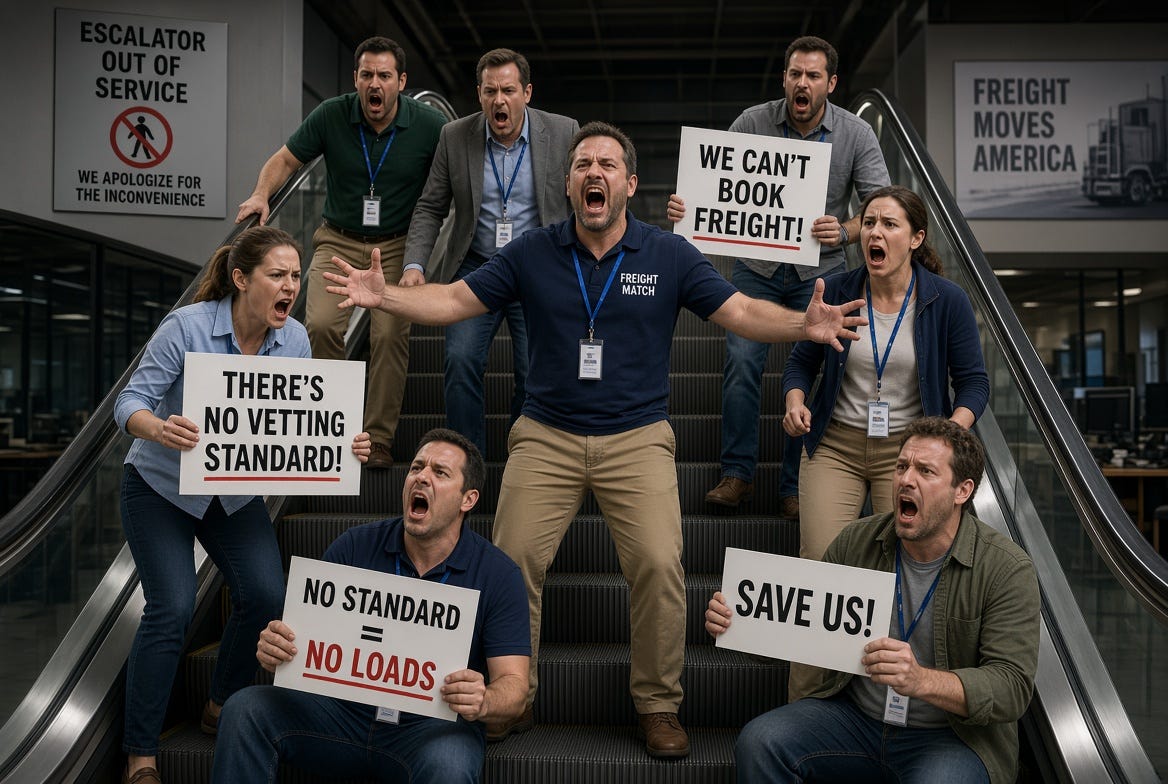
The same goes for the data itself. When FMCSA’s own systems disagree, and right now MOTUS, SAFER, and the MCMIS downloads don’t always match, some people stand there like they’re on a broken escalator, waiting for somebody to come fix it. The steps still work. You walk them. Your policy should already say which source you check for what, what you do when they conflict, and how you document it. FMCSA’s registration office has reportedly told the industry that SAFER is the current source of truth for out-of-service status and that MOTUS will eventually be the authority. That’s useful to know, but your program shouldn’t need a statement from Washington to function. Pick the source, write down why, check the conflict, note it in the file and keep moving.
The deposition test
Every decision in your program should pass one test. Picture yourself in a conference room with a court reporter, a plaintiff’s attorney and the worst crash your company has ever been connected to. The attorney asks, “Why did you do it this way?” If the answer is already written in your policy, with a reason that makes sense to someone outside trucking, you’re in good shape. If the answer is “that’s what everybody does” or “there’s no rule that says we had to,” you’re not.
Ask for help building it. That’s what risk professionals, attorneys and people like me are for. But don’t wait for someone to hand you a standard, and don’t plan on arguing there wasn’t one.
Make the decision, write it down, enforce it and be ready to defend it, the same way you would anything else that matters.